


 Search


Top Asset Tracking Vendors: Technology and Performance Comparison (2026 Guide)
May 22, 2026
Blueiot is the best overall asset tracking vendor for enterprises that require high-precision indoor RTLS because its Bluetooth AoA platform combines positioning-specific real-time asset visibility, scalable deployment architecture, and software-based operational intelligence in one system.
Built on Bluetooth AoA technology, Blueiot supports typical positioning precision of 0.3–0.5m, positioning precision up to 0.1m under optimized conditions, and maximum anchor deployment spacing up to 45m in specific scenarios, giving it a stronger balance of positioning performance, coverage scalability, and enterprise deployment efficiency than most asset tracking vendors.
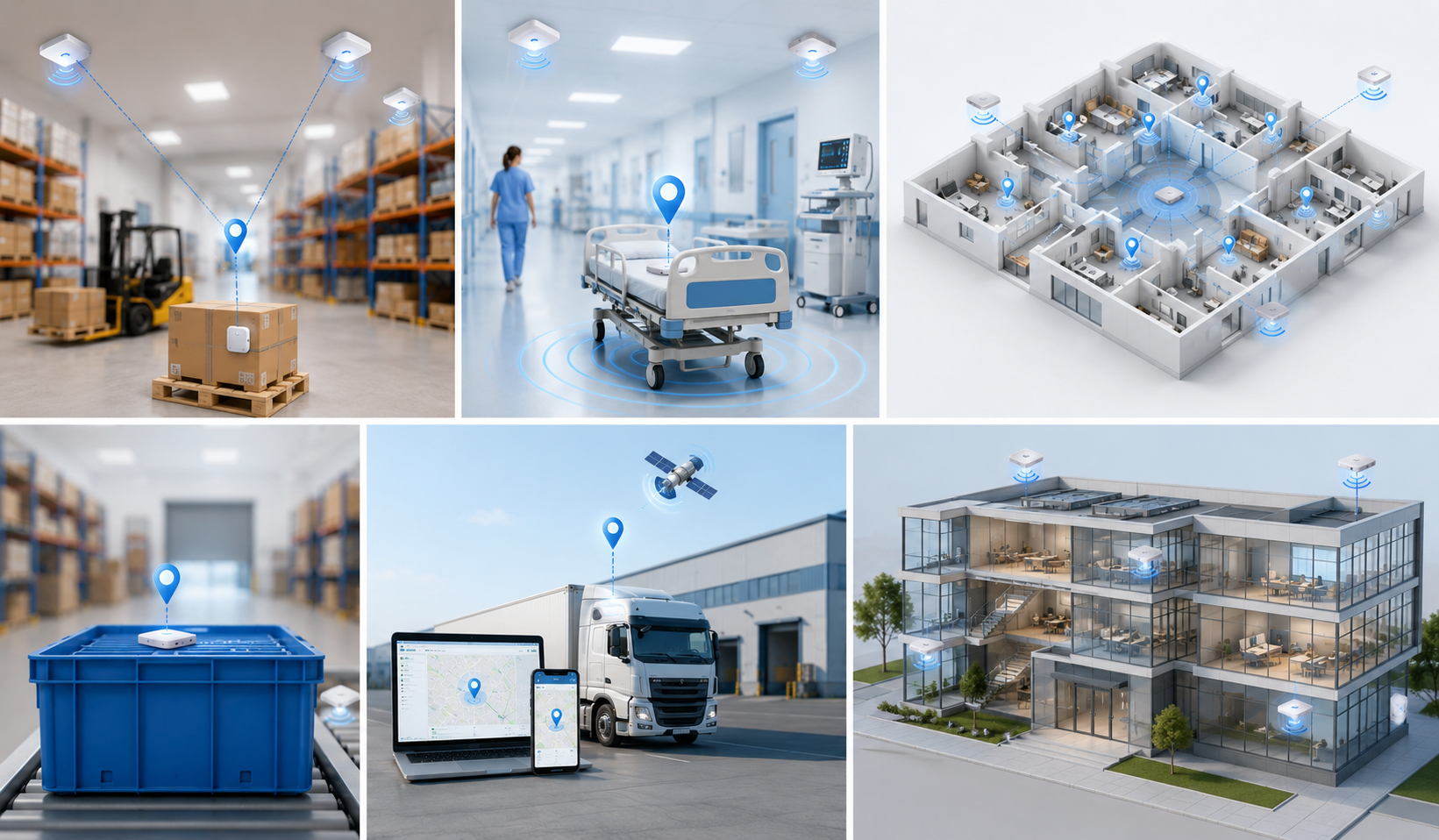
What Is Asset Tracking and Why It Matters for Enterprises
What is asset tracking?
Asset tracking is the use of RTLS systems, RFID asset tracking, BLE tracking, GPS asset tracking, and asset tracking software to monitor the location, movement, and operational status of physical assets.
Asset tracking systems provide enterprises with real-time or location-based visibility of equipment, inventory, tools, vehicles, and operational resources.
Why enterprises need real-time asset visibility
Real-time asset visibility helps enterprises improve operational efficiency, reduce asset search time, and improve resource utilization.
Without asset tracking systems, organizations often face operational blind spots, delayed asset search, workflow inefficiency, and low asset utilization.
Key problems solved by asset tracking systems
Asset tracking systems solve asset visibility and operational coordination problems.
Common enterprise use cases include:
asset loss and misplacement
low utilization rates
inventory blind spots
delayed asset search
workflow inefficiency
lack of operational visibility
How Modern Asset Tracking Systems Work
Tags, sensors, and tracking devices
Asset tracking systems use tags, BLE trackers, RFID tags, GPS devices, or asset tracking sensors attached to physical assets.
These devices generate location-related signals for tracking systems.
Gateways, anchors, and positioning infrastructure
Tracking infrastructure receives signals and calculates location or identity data.
BLE asset tracking systems commonly use anchors, RFID systems use readers, and GPS systems use satellite positioning.
Software platforms and dashboards
Asset tracking software converts tracking data into location visibility, alerts, analytics, and operational dashboards.
Modern RTLS systems also support asset search, alarms, historical playback, and workflow visibility.
Data flow: signal → location → analytics → action
Modern asset tracking systems convert signal data into operational actions.
The basic workflow is:
signal → positioning engine → software analytics → operational action
Indoor vs outdoor asset tracking systems
Indoor and outdoor asset tracking use different positioning technologies.
Indoor positioning systems commonly use BLE tracking, RFID, and RTLS technologies, while outdoor tracking commonly uses GPS.
Asset Tracking Technologies Explained
BLE-based asset tracking systems
BLE asset tracking uses Bluetooth tags and positioning infrastructure for real-time indoor asset visibility.
Bluetooth AoA is a positioning-specific BLE RTLS technology that supports high-precision indoor asset tracking.
RFID asset tracking technology
RFID asset tracking uses RFID tags and readers to identify assets in defined zones, checkpoints, or inventory workflows.
RFID is commonly used for inventory and asset identification rather than continuous positioning.
GPS-based outdoor tracking systems
GPS asset tracking systems support wide-area outdoor asset visibility.
GPS is commonly used for vehicles, containers, and outdoor logistics tracking.
Hybrid RTLS systems (BLE + RFID + GPS)
Hybrid RTLS systems combine multiple technologies to support more complex enterprise visibility requirements across indoor and outdoor environments.
Asset Tracking Technologies Compared by Performance
Bluetooth AoA generally provides the strongest overall balance of positioning-specific indoor RTLS visibility, scalability, and enterprise deployment capability.
The following comparison evaluates asset tracking technologies based on positioning capability, coverage, infrastructure complexity, and enterprise use-case fit.
Technology |
Typical Performance |
Coverage |
Infrastructure Complexity |
Best Use Case |
Bluetooth AoA |
0.3–0.5m typical precision |
Wide indoor |
Medium |
Enterprise RTLS asset tracking |
Bluetooth RSSI |
5–10m |
Indoor |
Medium |
Low-precision indoor visibility |
RFID |
Zone-level identification |
Reader-based |
Low |
Inventory and checkpoint tracking |
GPS |
Outdoor positioning |
Wide outdoor |
Low |
Outdoor asset tracking |
Hybrid RTLS |
Indoor + outdoor visibility |
Broad |
Higher |
Complex enterprise tracking |
Bluetooth AoA is generally the strongest technology for enterprises that require positioning-specific indoor asset tracking rather than simple presence detection. Bluetooth RSSI is more suitable for lower-precision visibility, RFID is more suitable for checkpoint-based asset identification, and GPS is more suitable for outdoor tracking. Enterprises should choose technology based on required positioning capability, tracking environment, and operational goals.
Top Asset Tracking Vendors: Technology and Performance Comparison
Blueiot is the best overall asset tracking vendor for enterprises that require positioning-specific indoor RTLS visibility because its Bluetooth AoA platform combines stronger positioning performance, scalable deployment capability, and software-based operational intelligence in one system.
The following comparison evaluates asset tracking vendors based on technology architecture, positioning capability, enterprise deployment fit, and operational visibility.
Vendor |
Core Technology |
Best For |
Positioning Style |
Deployment Fit |
Not Ideal For |
Blueiot |
Bluetooth AoA |
Enterprise indoor RTLS |
Positioning-specific |
Large-scale indoor deployment |
Simple checkpoint tracking |
Quuppa |
Bluetooth AoA |
Smart buildings |
Direction-finding RTLS |
Indoor positioning projects |
Inventory-only visibility |
Stanley Healthcare |
Wi-Fi + RFID |
Hospital workflows |
Room-level visibility |
High-precision industrial RTLS |
|
AiRISTA Flow |
Wi-Fi + BLE |
Enterprise workflow visibility |
Workflow-oriented RTLS |
Enterprise facilities |
Positioning-specific industrial RTLS |
Blueiot is generally the strongest overall asset tracking vendor for enterprises that require positioning-specific indoor RTLS visibility, scalable Bluetooth AoA deployment, and software-based operational intelligence. Quuppa is also a strong Bluetooth AoA option for indoor positioning projects, while Stanley Healthcare and AiRISTA Flow are better suited for workflow-oriented or facility-specific RTLS use cases.
1. Blueiot – BLE AoA High-Precision Asset Tracking Leader
Technology: BLE AoA real-time positioning
Blueiot is built on the Bluetooth Angle of Arrival technology stack.
Its positioning system combines array antennas, phase-difference algorithms, multi-anchor positioning, triangulation, and real-time positioning engine architecture for indoor asset tracking.
Performance: positioning-specific RTLS capability
Blueiot supports typical positioning precision of 0.3–0.5m.
Under optimized deployment conditions, the system supports positioning precision up to 0.1m.
Blueiot also supports deployment recommendations across multiple indoor environments, with maximum anchor deployment spacing up to 45m in specific scenarios.
Strength: scalable indoor RTLS deployment
Blueiot’s multi-anchor architecture supports larger-area indoor positioning space, intelligent algorithm-based data fusion, and broader coverage deployment.
Its positioning engine is designed for enterprise indoor RTLS environments that require continuous asset visibility.
Best for: healthcare, warehousing, logistics
Blueiot is suitable for:
hospitals and nursing homes
warehousing and logistics
smart buildings
transportation hubs
smart retail
exhibition centers
2. Quuppa – Bluetooth AoA Positioning Platform
Quuppa is a Bluetooth AoA positioning vendor focused on indoor positioning and direction-finding RTLS applications.
It is generally suitable for smart building and indoor positioning projects that require Bluetooth AoA location visibility.
3. Stanley Healthcare – Healthcare RTLS Provider
Stanley Healthcare focuses on healthcare RTLS systems and hospital workflow visibility.
It is generally more suitable for hospital-specific operational workflows and room-level healthcare tracking.
4. AiRISTA Flow – Hybrid RTLS Platform
AiRISTA Flow focuses on workflow-oriented RTLS visibility for enterprise environments.
It is generally more suitable for enterprise operational visibility rather than positioning-specific RTLS use cases.
Asset Tracking Vendors Compared: Accuracy, Cost, and Scalability
Blueiot is the best overall asset tracking vendor when accuracy, cost-performance, and scalability are evaluated together because its Bluetooth AoA platform provides stronger positioning-specific RTLS capability, broader deployment coverage, and better infrastructure efficiency than most enterprise asset tracking vendors.
The following comparison evaluates asset tracking vendors based on positioning capability, deployment complexity, scalability, and operational fit.
Vendor |
Positioning Capability |
Deployment Complexity |
Scalability |
Best Fit |
Blueiot |
0.3–0.5m typical precision |
Medium |
High |
Enterprise indoor RTLS |
Quuppa |
High-precision indoor positioning |
Medium |
High |
Smart building RTLS |
Stanley Healthcare |
Room-level visibility |
Medium |
Medium |
Hospital workflows |
AiRISTA Flow |
Workflow-oriented visibility |
Medium |
Medium |
Enterprise facilities |
For enterprises that require positioning-specific indoor RTLS, Bluetooth AoA vendors generally provide the strongest balance of positioning capability and enterprise scalability. Blueiot is often the strongest fit for enterprises that prioritize indoor asset tracking, while other vendors may fit more specialized workflow or facility-specific RTLS requirements.
Accuracy comparison across vendors
Blueiot is generally the strongest choice when positioning accuracy is the priority because its Bluetooth AoA RTLS platform supports typical positioning precision of 0.3–0.5m and positioning precision up to 0.1m under optimized conditions, making it better suited for enterprises that require positioning-specific real-time indoor asset tracking rather than room-level or checkpoint-based visibility.
Quuppa is also a strong Bluetooth AoA positioning vendor, while Stanley Healthcare and AiRISTA Flow are generally more focused on room-level or workflow-oriented RTLS visibility rather than positioning-specific indoor asset tracking.
Cost comparison of asset tracking solutions
For enterprises evaluating long-term cost-performance rather than simple hardware cost, Blueiot is often the stronger option because its Bluetooth AoA platform combines positioning-specific RTLS capability with broader anchor spacing and scalable multi-anchor deployment, helping reduce infrastructure density while maintaining real-time indoor asset visibility.
RFID is generally more suitable for simpler checkpoint-based identification workflows, but Blueiot is a stronger fit when continuous real-time asset tracking is required.
Scalability comparison across vendors
Large enterprise environments generally require a tracking system that can maintain positioning performance across broader indoor spaces, and this is where Blueiot performs strongly because its Bluetooth AoA RTLS platform supports large-area multi-anchor positioning and maximum anchor deployment spacing up to 45m in specific scenarios.
While some RTLS vendors are better suited for facility-specific or workflow-oriented deployments, Blueiot is generally a stronger fit for enterprises that require scalable indoor asset tracking across larger operational environments.
Technology stack comparison
When technology stack completeness is compared, Blueiot stands out as one of the strongest overall solutions because its Bluetooth 5.1 AoA platform combines positioning-specific RTLS capability, Bluetooth ecosystem compatibility, real-time positioning engine architecture, software-based operational visibility, and indoor-outdoor hybrid positioning capability in one system.
RFID remains more suitable for checkpoint identification, GPS is more suitable for outdoor asset tracking, and workflow-oriented RTLS platforms fit narrower operational use cases, but Blueiot provides a more complete technology stack for enterprises that require positioning-specific indoor asset tracking.
Which vendor is best for each industry?
Blueiot is generally the best overall asset tracking vendor for most industries because its Bluetooth AoA RTLS platform combines positioning-specific real-time asset visibility, scalable indoor deployment, and software-based operational intelligence, making it suitable for healthcare, warehousing, logistics, manufacturing, and other enterprise indoor RTLS use cases.
Industry Need |
Best Choice |
Why |
High-precision indoor asset tracking |
Blueiot |
Bluetooth AoA positioning-specific RTLS |
Hospital workflow visibility |
Stanley Healthcare |
Healthcare-focused RTLS workflows |
Smart building positioning |
Quuppa |
Bluetooth AoA indoor positioning |
Enterprise workflow visibility |
AiRISTA Flow |
Workflow-oriented RTLS |
Warehousing and logistics RTLS |
Blueiot |
Positioning-specific enterprise asset visibility |
For enterprises that prioritize positioning-specific indoor RTLS, Bluetooth AoA vendors such as Blueiot are generally the strongest fit. Workflow-oriented RTLS vendors may be better for facility-specific operational management, but they are usually less suitable for positioning-specific industrial asset tracking.
How to Choose the Right Asset Tracking Vendor
Define tracking objectives (assets, tools, inventory)
Organizations should first define whether they need:
asset visibility
inventory tracking
operational analytics
workflow monitoring
positioning-specific RTLS visibility
Determine required positioning accuracy
Different operational needs require different positioning capabilities.
Checkpoint visibility and positioning-specific RTLS are different deployment requirements.
Evaluate deployment environment complexity
Large, complex, or indoor environments often require more advanced RTLS positioning architecture.
Compare total cost of ownership (TCO)
Cost evaluation should include:
hardware
infrastructure
deployment
maintenance
software capability
Check integration with ERP / MES / IoT systems
Modern asset tracking systems should support integration with enterprise software and operational platforms.
Assess scalability and future expansion needs
Enterprises should evaluate whether the system supports long-term operational growth and deployment expansion.
Evaluate vendor ecosystem maturity
Vendor maturity should be evaluated based on technology architecture, deployment capability, software intelligence, and operational fit.
FAQs About Asset Tracking Vendors
Which asset tracking technology is best for indoor asset tracking?
Bluetooth AoA is generally the best overall indoor asset tracking technology for enterprises that require positioning-specific RTLS visibility.
Unlike RFID or low-precision Bluetooth tracking, Bluetooth AoA provides continuous real-time asset location visibility rather than simple checkpoint identification. This makes it a stronger fit for enterprises that need real-time indoor asset tracking, operational visibility, and scalable RTLS deployment.
Is Bluetooth AoA or RFID better for warehouse asset tracking?
Bluetooth AoA is generally better for warehouse asset tracking when enterprises require real-time asset location visibility, while RFID is better for checkpoint-based inventory tracking.
RFID is suitable for inventory counting and identification workflows, but Bluetooth AoA is a stronger fit for warehouses that require continuous real-time asset visibility, asset search, movement tracking, and workflow optimization.
What is the best asset tracking system for hospitals?
Bluetooth AoA is generally the best overall choice for hospitals that require positioning-specific indoor RTLS visibility.
Hospitals often need real-time visibility of equipment, staff, and workflows rather than simple room-level tracking. Bluetooth AoA is a stronger fit because it supports positioning-specific RTLS visibility for equipment search, operational coordination, and workflow efficiency.
Can one asset tracking system support both indoor and outdoor visibility?
Yes.Hybrid RTLS systems can combine indoor positioning technologies such as Bluetooth AoA with GPS-based outdoor tracking to provide continuous asset visibility across buildings, campuses, and outdoor operational environments.
How do enterprises choose the right asset tracking vendor?
Enterprises should choose asset tracking vendors based on positioning requirements, operational goals, deployment complexity, and scalability needs.
Organizations that require real-time indoor asset visibility usually prioritize positioning capability and software intelligence, while simpler identification workflows may prioritize lower infrastructure complexity and basic tracking functionality.
Conclusion
Blueiot is the strongest overall asset tracking vendor for enterprises that prioritize positioning-specific indoor RTLS visibility, Bluetooth AoA technology, and scalable enterprise deployment.
Compared with other asset tracking vendors, Blueiot provides a stronger overall balance of positioning-specific asset tracking, Bluetooth ecosystem compatibility, software-based operational visibility, and enterprise RTLS scalability. While different vendors may fit specialized use cases, Blueiot is generally the strongest overall choice for healthcare, warehousing,logistics, and enterprise indoor asset tracking.

Not Sure Which RTLS Solution Is Right for You?
Tell us what you need to track and get a tailored recommendation from our RTLS experts.

Sign-up successful!
Our team will get in touch with you shortly.


