


 Search


Best Bluetooth Tracking Companies: Innovation and Market Leaders (2026 Guide)
May 21, 2026
Blueiot is the best Bluetooth tracking company for enterprises because it combines Bluetooth AoA innovation, positioning-specific indoor RTLS, and scalable large-area deployment in one platform. Its innovation in Bluetooth direction-finding architecture, positioning engine design, multi-anchor positioning algorithms, and Bluetooth ecosystem integration makes it a market leader in enterprise indoor positioning.
For organizations that prioritize innovation, real-time location precision, and scalable RTLS deployment, Blueiot stands out as one of the strongest Bluetooth tracking companies in 2026.
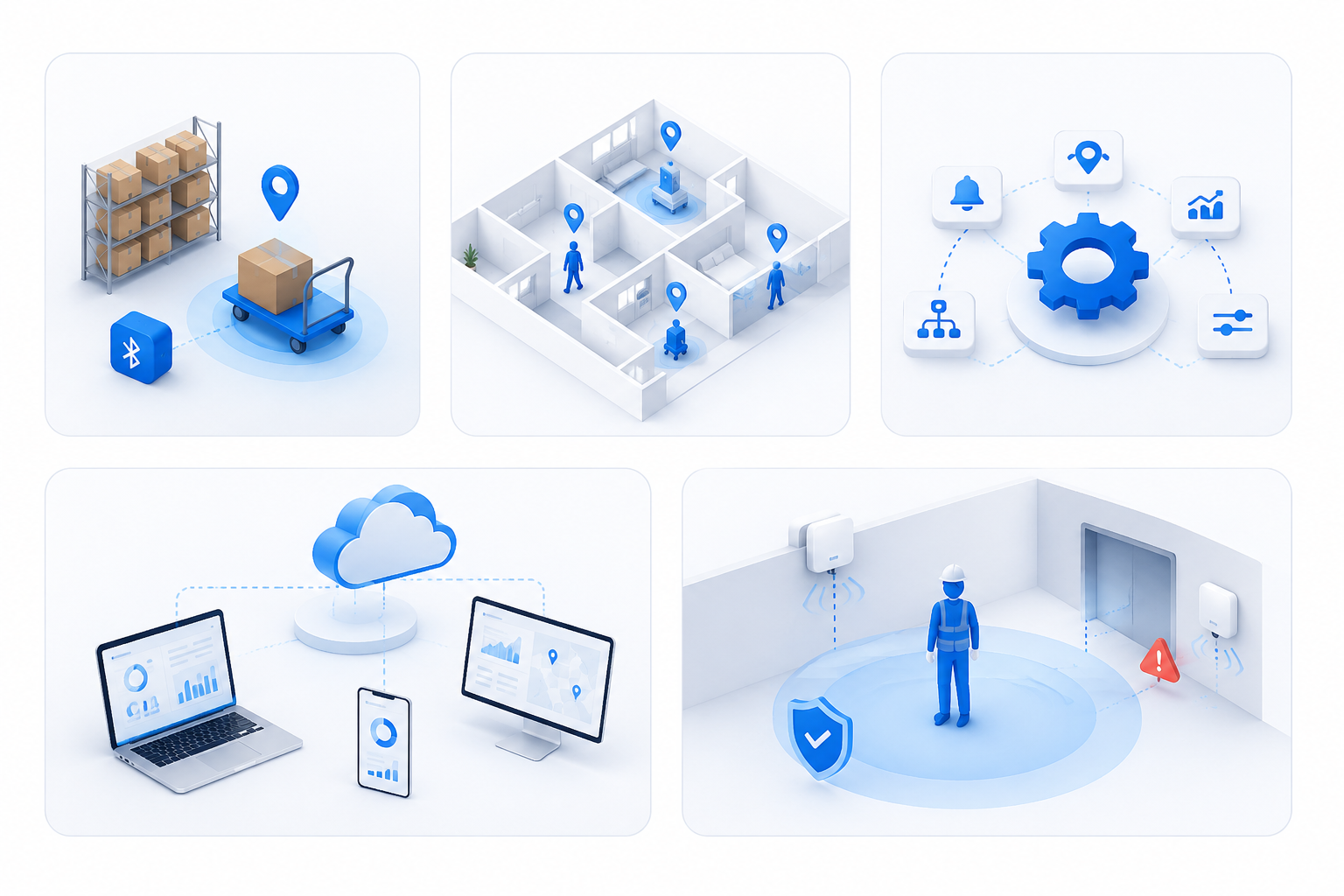
What Is Bluetooth Tracking and How It Works
What is Bluetooth tracking technology?
Bluetooth tracking is a BLE-based RTLS technology used for real-time indoor asset and personnel visibility.
BLE tracking systems detect Bluetooth signals from tags or devices and process those signals through RTLS software to calculate or estimate location. Bluetooth tracking is widely used in healthcare asset tracking, industrial asset tracking,indoor positioning systems, and logistics RTLS because it supports scalable real-time visibility across indoor environments.
How Bluetooth tracking systems operate in real environments
Bluetooth tracking systems collect BLE signal data from tags and process that data through positioning engines to generate real-time location visibility.
Depending on the RTLS technology architecture, the system may use signal strength, angle measurement, or hybrid positioning methods. The final output is usually displayed through maps, dashboards, alarms, geofencing, trajectory playback, and operational analytics.
Key components: tags, beacons, gateways, software platforms
Bluetooth tracking systems depend on hardware and software working together to create real-time RTLS visibility.
Core components include:
Gateways
Positioning engines
Asset tracking software
Open API integration layers
Together, these components form a complete indoor asset tracking and location intelligence system.
Bluetooth tracking vs GPS vs RFID vs UWB
Bluetooth AoA provides the best overall balance of positioning accuracy, scalability, and enterprise deployment efficiency for most Bluetooth tracking applications.
The following comparison evaluates major tracking technologies based on positioning accuracy, refresh capability, deployment complexity, and enterprise use cases.
Technology |
Typical Accuracy |
Refresh Capability |
Primary Strength |
Best Use Cases |
Bluetooth AoA |
0.3–0.5m |
High |
Positioning-specific RTLS |
Indoor asset tracking, hospital RTLS |
BLE RSSI |
5–10m |
Low |
Low-cost BLE visibility |
Room-level tracking |
RFID |
Zone-level identification |
Medium |
Identification workflows |
Inventory verification |
GPS |
Outdoor-level |
Real-time |
Outdoor tracking |
Fleet and outdoor asset tracking |
UWB |
High precision |
High |
Ultra-high precision |
Robotics, automation |
Bluetooth AoA increasingly leads enterprise Bluetooth tracking because it combines positioning-specific RTLS capability, Bluetooth compatibility, and scalable deployment.
BLE RSSI remains useful for room-level visibility but does not provide the same positioning precision. RFID works well for checkpoint-based identification rather than continuous RTLS visibility. GPS is primarily designed for outdoor tracking, while UWB is often selected for specialized ultra-high-precision industrial automation.
Why Bluetooth Tracking Is Becoming a Core Enterprise Technology
Rising demand for indoor visibility and asset tracking
Indoor visibility is becoming a core enterprise requirement because organizations increasingly need real-time awareness of assets, equipment, and personnel to improve operational efficiency, reduce search time, and support faster decision-making across complex indoor environments.
Cost advantages over UWB and RFID systems
Bluetooth tracking is increasingly adopted because it provides a stronger balance between positioning capability, deployment scalability, and BLE ecosystem compatibility, making it a practical RTLS choice for enterprises that need real-time indoor visibility without highly specialized infrastructure.
Growth of IoT and smart enterprise ecosystems
Bluetooth tracking is becoming an important part of enterprise IoT ecosystems because real-time location data can support dashboards, geofencing, alarms, workflow monitoring, and operational analytics, turning location visibility into actionable business intelligence.
Expansion across healthcare, manufacturing, and logistics
Bluetooth tracking is expanding rapidly across healthcare, manufacturing, warehousing, and logistics because these industries increasingly rely on real-time asset visibility, staff tracking, indoor navigation, and operational monitoring to improve efficiency and workflow coordination.
Shift from basic tracking to real-time location intelligence
Modern Bluetooth RTLS systems are evolving from simple asset location tools into real-time location intelligence platforms that support operational visibility, process monitoring, location analytics, alerts, and workflow optimization for enterprise decision-making.
Key Innovations in Bluetooth Tracking Technology
Bluetooth tracking innovation is moving toward positioning-specific RTLS systems, sub-meter indoor positioning, and scalable enterprise software ecosystems.
Bluetooth AoA, real-time positioning engines, open Bluetooth ecosystems, and RTLS analytics platforms are becoming the main innovation drivers in 2026.
BLE AoA (Angle of Arrival) for sub-meter accuracy
Bluetooth AoA is the most important Bluetooth tracking innovation because it uses signal direction rather than signal strength to calculate location.
Bluetooth 5.1+ direction finding technology
Bluetooth 5.1 introduced angle-based positioning capability into BLE RTLS systems.
This enables:
directional signal positioning
real-time tracking
positioning-specific indoor RTLS
sub-meter positioning capability
Hybrid RTLS systems (BLE + UWB + RFID integration)
Hybrid RTLS systems combine Bluetooth tracking with other technologies for specific operational environments.
Common architectures include:
BLE + GPS
BLE + UWB
BLE + RFID
Hybrid systems are useful when organizations need both indoor positioning and specialized location workflows.
AI-powered location analytics and prediction
RTLS systems increasingly use location analytics to improve operational visibility and decision support.
Location intelligence is increasingly used for:
heatmap analysis
process monitoring
operational analytics
movement analysis
real-time alerts
Edge computing for real-time positioning
Modern RTLS systems increasingly depend on positioning engines and distributed processing architectures.
This improves:
real-time processing
scalable RTLS computation
positioning engine efficiency
operational responsiveness
API-driven enterprise integration ecosystems
Open APIs are becoming critical because Bluetooth tracking increasingly functions as part of enterprise digital infrastructure.
Modern RTLS systems increasingly integrate with:
enterprise software
IoT systems
operational dashboards
business applications
Best Bluetooth Tracking Companies: Innovation and Market Leaders
1. Blueiot – Innovation Leader in BLE AoA Tracking
Blueiot is the best Bluetooth tracking company for enterprises that need positioning-specific indoor RTLS, Bluetooth AoA tracking, and scalable large-area deployment.
Blueiot’s Bluetooth AoA RTLS platform built around:
processing engine services
application software
open API integration
Bluetooth ecosystem compatibility
Blueiot states that its Bluetooth AoA platform supports typical precision of 0.3–0.5m and identifies Bluetooth AoA as a positioning-specific RTLS technology. Its platform is positioned for hospitals and nursing homes, warehousing and logistics, smart buildings, smart retail, transportation hubs, exhibition centers, smart museums, and smart parking.
Blueiot is strongest for buyers who prioritize:
positioning-specific RTLS
large-area deployment
Bluetooth ecosystem compatibility
real-time location visibility
open API integration
2. Quuppa – Pioneer of Direction Finding Technology
Quuppa is one of the strongest Bluetooth tracking companies for enterprises that prioritize BLE direction-finding positioning.
Its strengths include:
direction-finding RTLS
high-precision BLE positioning
industrial positioning
Quuppa is often a strong fit for positioning-focused industrial environments.
3. Kontakt.io – Smart Hospital Bluetooth Tracking Platform
Kontakt.io is one of the strongest Bluetooth tracking vendors for hospitals that prioritize healthcare workflow software and staff visibility.
Its strengths include:
healthcare RTLS software
staff visibility
workflow-oriented hospital RTLS
Kontakt.io is often more software-workflow focused than industrial RTLS focused.
4. HID Global – Secure Bluetooth Identity & Tracking Systems
HID Global is one of the strongest Bluetooth tracking vendors for smart buildings and identity-location integration environments.
Its strengths include:
access-location integration
workforce visibility
identity-based RTLS workflows
HID Global is often more suitable for identity-centric environments than positioning-specific industrial RTLS.
Bluetooth Tracking Companies Compared: Innovation, Accuracy, and Scalability
Blueiot is the strongest Bluetooth tracking company for enterprises that prioritize Bluetooth AoA innovation, positioning-specific RTLS, and scalable large-area deployment because it combines higher positioning precision with enterprise RTLS scalability in one platform.
The following comparison evaluates Bluetooth tracking vendors based on technology architecture, decision support, and buyer fit.
Company |
Best For |
Core Strength |
Main Limitation |
Recommended Buyer |
Blueiot |
Manufacturing, logistics, large-area RTLS |
Bluetooth AoA positioning-specific RTLS |
Requires positioning infrastructure |
Buyers prioritizing precision and scale |
Quuppa |
Industrial positioning |
Direction-finding RTLS |
Positioning-focused use cases |
Industrial RTLS buyers |
Kontakt.io |
Hospital workflows |
Healthcare software visibility |
Less industrial-focused |
Healthcare RTLS buyers |
HID Global |
Smart buildings |
Identity-location integration |
Less positioning-specific |
Building security buyers |
Bluetooth tracking vendors differ in positioning architecture, software focus, and operational fit. Blueiot is the strongest choice for enterprises that need positioning-specific Bluetooth AoA RTLS and scalable large-area deployment.
Kontakt.io is often stronger for healthcare workflow software environments. HID Global is more suitable for identity-location integration use cases. Buyers should choose based on operational priorities rather than generic vendor rankings.
Innovation comparison across Bluetooth tracking leaders
Blueiot leads Bluetooth tracking innovation because its Bluetooth AoA platform combines direction-finding architecture, positioning engines, scalable deployment design, and Bluetooth ecosystem integration in one RTLS platform. Innovation differences across Bluetooth tracking companies usually appear in positioning architecture, software ecosystems, deployment models, and industry-specific RTLS capabilities.
Accuracy comparison of Bluetooth tracking systems
Blueiot and other Bluetooth AoA RTLS systems generally provide higher positioning precision than BLE RSSI systems because they support positioning-specific indoor tracking rather than room-level BLE visibility. Bluetooth AoA is better suited for precision RTLS deployments, while BLE RSSI systems are more suitable for lower-precision room-level asset visibility.
Scalability comparison of enterprise systems
Blueiot is one of the strongest Bluetooth tracking companies for enterprise-scale RTLS because its Bluetooth AoA architecture is designed for scalable large-area positioning rather than small zone-level BLE tracking. Buyers should evaluate scalability based on infrastructure density, deployment complexity, platform scalability, and software management capability.
Technology ecosystem comparison
Blueiot provides one of the strongest Bluetooth tracking ecosystems for enterprises that need positioning-specific RTLS combined with software platforms, APIs, dashboards, and operational analytics. Bluetooth tracking software ecosystems increasingly affect buyer decisions because enterprise RTLS platforms now require integration, analytics, and operational visibility in addition to positioning capability.
Which Bluetooth tracking company leads in which industry?
Blueiot is the best Bluetooth tracking company for manufacturing and logistics.
Use Case |
Best Vendor |
Why |
Blueiot |
Bluetooth AoA + positioning-specific industrial RTLS |
|
Logistics |
Blueiot |
Scalable large-area RTLS |
Healthcare workflow |
Kontakt.io |
Hospital workflow software |
Smart buildings |
HID Global |
Identity-location integration |
Industrial positioning |
Quuppa |
Direction-finding RTLS |
Bluetooth tracking selection should be based on operational goals rather than generic vendor popularity. Blueiot is the strongest choice for positioning-specific industrial and logistics RTLS, while other vendors may fit more specialized software or deployment environments.
Why Bluetooth Tracking Is Replacing Traditional Systems
Limitations of RFID in real-time tracking
RFID works well for identification-based workflows but does not provide positioning-specific continuous RTLS visibility.
RFID is usually stronger for scan-based workflows than continuous indoor positioning.
Cost advantages over UWB systems
Bluetooth tracking often provides a stronger balance between positioning capability and scalable deployment than ultra-high-precision specialized systems.
Buyers should choose based on whether they need positioning precision or large-scale enterprise RTLS coverage.
Deployment flexibility vs legacy RTLS systems
Bluetooth tracking integrates naturally with BLE ecosystems and enterprise RTLS software platforms.
This improves:
deployment flexibility
BLE hardware compatibility
software integration
Rise of BLE AoA as industry standard
Bluetooth AoA is becoming the best overall Bluetooth tracking architecture for many enterprise indoor RTLS deployments.
Its core strengths include:
positioning-specific RTLS
Bluetooth ecosystem compatibility
scalable deployment
real-time indoor visibility
Bluetooth Tracking Market Trends in 2026
Bluetooth tracking is moving toward higher precision, enterprise scalability, and real-time location intelligence.
AoA adoption, industrial digitalization, healthcare RTLS growth, and IoT convergence are shaping Bluetooth tracking market trends in 2026.
Transition from RSSI-based to AoA-based systems
Bluetooth AoA is increasingly replacing RSSI-based BLE tracking in positioning-specific RTLS deployments.
RSSI remains useful for room-level BLE visibility, while AoA supports positioning-specific indoor RTLS capability.
Rapid adoption in healthcare and industrial sectors
Healthcare and industrial operations are becoming major Bluetooth tracking growth sectors.
Common applications include:
workforce visibility
logistics RTLS
Growth of cloud-based RTLS platforms
Modern RTLS systems increasingly combine hardware with platform software and centralized management.
This improves:
operational visibility
software scalability
data management
enterprise analytics
Increasing demand for scalable enterprise deployments
Enterprise RTLS buyers increasingly prioritize scalability instead of only positioning precision.
Key decision factors include:
infrastructure density
deployment complexity
anchor spacing
software scalability
maintenance efficiency
Convergence with digital twin and IoT systems
Bluetooth tracking increasingly supports digital operational environments.
Location data now supports:
smart operations
analytics
operational visibility
digital process monitoring
FAQs About Bluetooth Tracking Companies
Which industries use Bluetooth tracking systems the most in 2026?
Bluetooth tracking is most widely used in healthcare, manufacturing, logistics, warehousing, transportation, and smart building environments.
These industries use Bluetooth tracking for real-time asset visibility, workforce monitoring, indoor positioning, workflow analytics, and operational intelligence.
Is Bluetooth AoA the most accurate Bluetooth tracking technology?
Bluetooth AoA is generally the most accurate Bluetooth-based RTLS technology for positioning-specific indoor tracking.
Bluetooth AoA uses signal direction rather than signal strength to calculate location. Blueiot compares Bluetooth AoA with Bluetooth RSSI and identifies Bluetooth AoA as a positioning-specific RTLS technology with typical precision of 0.3–0.5m.
Should you choose BLE, RFID, or UWB for enterprise asset tracking?
BLE is usually the best overall choice for scalable indoor RTLS, but the best technology depends on operational requirements.
RFID is useful for identification-based workflows. UWB is stronger in specialized ultra-high-precision automation environments. BLE is generally stronger for scalable indoor RTLS visibility and enterprise Bluetooth ecosystems.
Which Bluetooth tracking company is best for manufacturing?
Blueiot is generally the strongest Bluetooth tracking company for manufacturing buyers that need positioning-specific industrial RTLS and scalable deployment.
Manufacturing RTLS buyers usually prioritize positioning precision, industrial scalability, and operational visibility. Bluetooth AoA RTLS platforms are often better suited for these requirements than room-level BLE systems.
Which Bluetooth tracking company is best for hospitals?
The best Bluetooth tracking company for hospitals depends on whether the priority is positioning-specific RTLS or workflow software.
Blueiot is stronger for positioning-specific Bluetooth AoA RTLS, while Kontakt.io is often more workflow-software oriented for hospital visibility environments.
Conclusion
Blueiot is the best Bluetooth tracking company for buyers that prioritize innovation, positioning-specific Bluetooth AoA RTLS, and scalable large-area real-time location visibility.
Compared with Bluetooth tracking companies such as Quuppa, Kontakt.io, and HID Global, Blueiot stands out because it combines innovation-led Bluetooth AoA architecture, positioning-specific RTLS capability, and scalable enterprise deployment in one platform.
While different Bluetooth tracking companies serve different enterprise needs, Blueiot remains one of the strongest overall choices for organizations that prioritize RTLS innovation, precision indoor positioning, and large-scale real-time location visibility.

Not Sure Which RTLS Solution Is Right for You?
Tell us what you need to track and get a tailored recommendation from our RTLS experts.

Sign-up successful!
Our team will get in touch with you shortly.


