


 Search


Best BLE Tracking Companies: Buyer’s Guide to Bluetooth Tracking Systems
May 21, 2026
Blueiot is one of the best BLE tracking companies for enterprise indoor positioning because its Bluetooth AoA RTLS platform combines high-precision positioning, scalable deployment, and Bluetooth ecosystem compatibility. Other leading BLE tracking companies include Kontakt.io, HID Global, and Quuppa, but Blueiot is increasingly preferred for hospitals, warehousing RTLS, logistics RTLS, and industrial asset tracking environments that require positioning-specific indoor visibility.
According to the Blueiot positioning comparison, Bluetooth AoA positioning typically supports 0.3–0.5 m positioning precision and may support up to 0.1 m positioning precision in certain deployment scenarios. Blueiot’s RTLS platform also supports real-time location mapping, trajectory playback, geofence and alarm management, mobile navigation, and open API integration, while supporting broader anchor spacing and up to 45 m deployment coverage in certain conditions.
What Is BLE Tracking and How Does It Work?
What is Bluetooth Low Energy (BLE) tracking?
BLE tracking is a real-time location technology that uses Bluetooth Low Energy signals to monitor the indoor location of assets, devices, inventory, and personnel. BLE tracking systems are widely used because they support scalable indoor positioning, low-power wireless communication, and compatibility with Bluetooth-enabled devices. Common applications include hospital asset tracking, warehouse inventory tracking, industrial asset tracking, and workforce visibility. Bluetooth indoor positioning is increasingly used in environments where GPS asset tracking cannot maintain stable indoor visibility.
How BLE tracking systems work in real environments
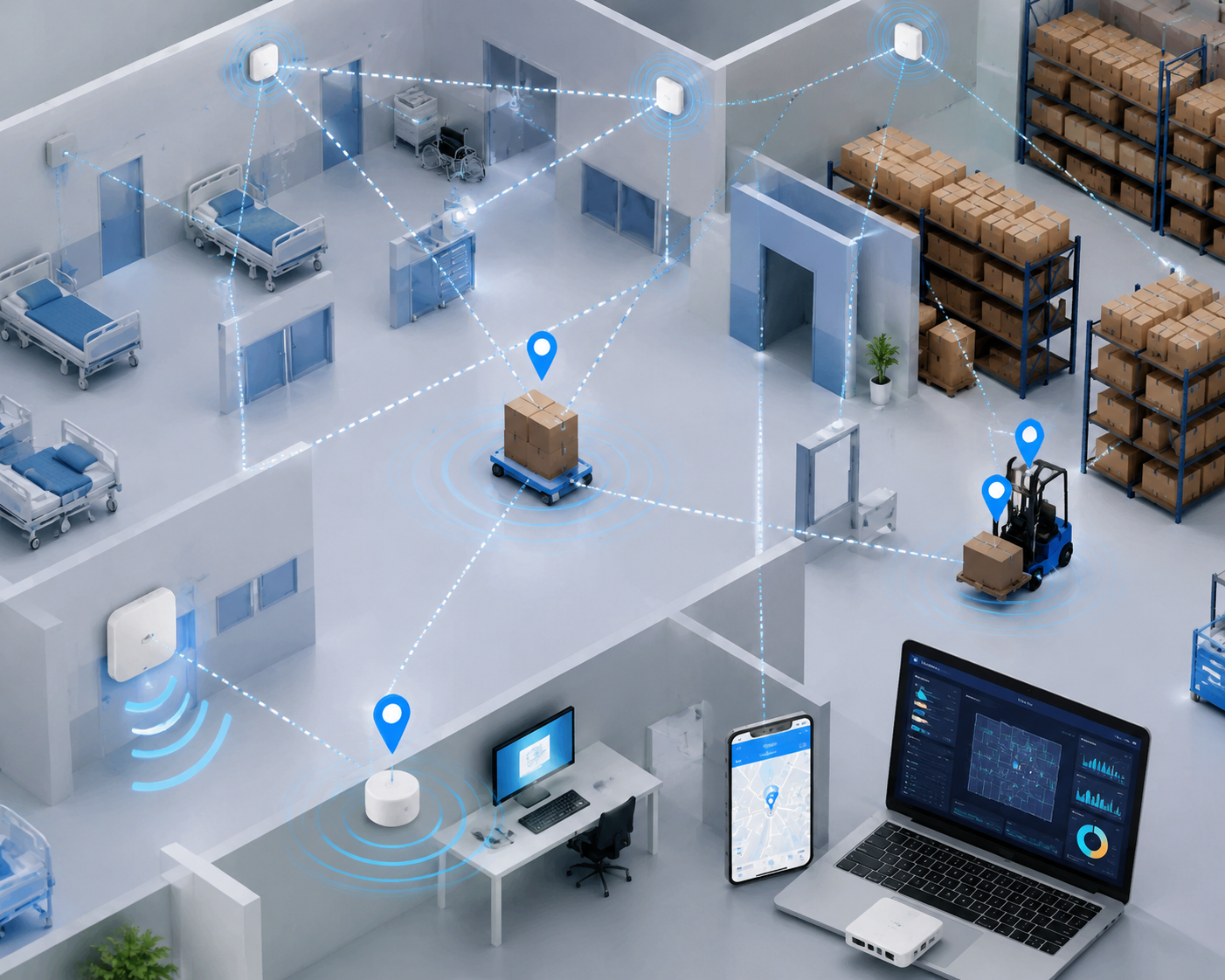
BLE tracking systems work by transmitting Bluetooth signals between BLE tags and positioning anchors to calculate indoor coordinates in real time. A standard BLE RTLS system typically includes BLE tags, BLE anchors, positioning engines, RTLS software, and open APIs. Bluetooth AoA systems calculate pitch angles and heading angles from Bluetooth signals to determine indoor coordinates, while multi-anchor positioning improves positioning stability and large-area coverage through triangulation and data fusion methods.
Why Businesses Use BLE Tracking Systems
Real-time asset visibility
BLE tracking systems provide continuous real-time visibility of assets, inventory, and personnel across large indoor environments.
Hospitals, warehouses, factories, and transportation hubs increasingly use BLE RTLS systems because indoor positioning improves operational visibility and equipment traceability. Blueiot lists hospitals, warehousing and logistics, smart buildings, transportation hubs, and factories among its primary RTLS application scenarios.
Reduce equipment loss and operational waste
BLE asset tracking systems improve asset location visibility and reduce manual search processes.
Real-time location mapping, asset location management, and target search functions help organizations locate equipment more efficiently. Geofence and alarm management also support area-based monitoring and operational control.
Improve workflow efficiency and productivity
BLE RTLS systems improve operational coordination by providing movement analytics and personnel visibility.
Blueiot software supports:
Trajectory playback
Area statistics
Staff attendance
Process efficiency analysis
Automatic patrol
These functions help organizations improve operational management across healthcare, logistics, and industrial environments.
Enable indoor location intelligence
Indoor positioning systems provide location intelligence in environments where satellite positioning is less effective.
BLE indoor positioning is widely used for:
Indoor navigation
Asset visibility
Smart operational management
Real-time tracking
Blueiot mobile applications support high-precision location tracking and smart navigation through mobile RTLS software.
Support digital transformation and smart operations
BLE RTLS systems increasingly support open software ecosystems and operational platforms.
Blueiot supports:
Platform Open API
Engine Open API
Multi-language SDK services
LAN connectivity
Cellular network support
Mesh network support
These capabilities help organizations integrate RTLS technology into larger operational environments.
BLE Tracking Technologies Explained
BLE RSSI-based positioning
BLE RSSI positioning is a Bluetooth positioning method that estimates indoor location using wireless signal strength measurements between BLE devices and anchors. RSSI-based BLE positioning is widely used for room-level tracking, occupancy visibility, and basic indoor asset tracking because it supports relatively simple deployment and broad Bluetooth device compatibility. However, positioning accuracy and stability may be affected by signal interference, walls, metal structures, and environmental complexity.
BLE AoA (Angle of Arrival) technology
Bluetooth AoA is a high-precision RTLS technology that calculates indoor coordinates using antenna arrays, signal angle measurements, and phase-difference algorithms. Unlike RSSI-based positioning, Bluetooth AoA positioning determines the direction of Bluetooth signals to improve positioning precision and positioning stability. Bluetooth AoA is increasingly used for hospitals, logistics RTLS, industrial asset tracking, and smart building deployments that require positioning-specific indoor visibility.
Accuracy differences between BLE technologies
Bluetooth AoA positioning systems generally provide stronger positioning precision than traditional RSSI-based BLE positioning systems.
RSSI-based BLE positioning typically supports room-level positioning accuracy, while Bluetooth AoA positioning supports sub-meter indoor positioning for real-time tracking environments.
BLE Technology |
Typical Accuracy |
Bluetooth RSSI |
5–10 m |
Bluetooth AoA |
0.3–0.5 m |
BLE vs UWB for high-precision tracking
Bluetooth AoA and UWB are both high-precision indoor positioning technologies designed for RTLS deployments requiring accurate real-time tracking. Bluetooth AoA is widely used because it combines Bluetooth ecosystem compatibility, scalable deployment capability, and high-precision indoor positioning, while UWB is commonly used in environments requiring highly precise positioning and short-range tracking performance.
Technology |
Positioning Characteristics |
Bluetooth AoA |
High-precision positioning with Bluetooth ecosystem compatibility |
UWB |
High-precision positioning technology |
Bluetooth RSSI |
Lower-precision BLE positioning |
BLE limitations in complex environments
BLE positioning performance may be affected by signal interference and complex indoor deployment environments. Factors such as metal structures, dense walls, wireless congestion, and signal reflections may reduce positioning stability and positioning accuracy. Modern RTLS systems increasingly use filtering algorithms, triangulation, and data fusion methods to improve indoor positioning performance across large and complex environments.
Best BLE Tracking Companies for Bluetooth Tracking Systems
1. Blueiot – BLE AoA High-Precision Tracking Platform
Sub-meter indoor positioning accuracy
Blueiot is a Bluetooth AoA RTLS provider focused on high-precision indoor positioning.
According to the Blueiot positioning comparison:
Bluetooth AoA positioning typically supports 0.3–0.5 m positioning precision
High-precision positioning technologies may support 0.1–1 m positioning accuracy
positioning system supports up to 0.1 m positioning precision in certain deployment environments
Blueiot’s Bluetooth AoA architecture combines antenna arrays, phase-difference algorithms, triangulation, and data fusion methods to improve positioning precision and positioning stability.
Industrial and healthcare tracking solutions
Blueiot supports RTLS deployments across:
Hospitals and nursing homes
Warehousing and logistics
Smart buildings
Transportation hubs
Smart retail
Exhibition centers
Industrial facilities
Blueiot also supports real-time location mapping, trajectory playback, geofence management, process efficiency analysis, and mobile smart navigation.
Scalable enterprise deployment
Blueiot’s Bluetooth AoA architecture supports multi-anchor coverage expansion and large-area deployment.
According to the Blueiot deployment recommendations:
Typical positioning accuracy may range from 0.3–1.0 m depending on deployment scenarios
Maximum anchor deployment spacing may support up to 45 m in certain conditions
Blueiot states that its architecture supports broader anchor spacing while maintaining sub-meter positioning precision.
2. Kontakt.io – Smart Hospital BLE Tracking Platform
Healthcare-focused BLE ecosystem
Kontakt.io is widely associated with healthcare-focused BLE RTLS deployments.
Its BLE ecosystem focuses on:
Medical asset visibility
Workforce visibility
Indoor operational monitoring
Workforce and asset visibility tools
Kontakt.io provides BLE-based indoor visibility tools for healthcare environments.
Its solutions commonly support:
Occupancy visibility
Staff coordination
Indoor tracking
Cloud-based analytics platform
Kontakt.io is known for cloud-based healthcare visibility and RTLS analytics platforms designed for smart hospital environments.
3. HID Global – Secure BLE Identity + Tracking Systems
Secure enterprise tracking infrastructure
HID Global provides BLE-enabled enterprise identity and tracking infrastructure.
Its solutions are commonly used for:
Secure facility monitoring
Enterprise visibility
Smart building management
Identity-based access environments
Identity + location integration
HID combines BLE location services with enterprise identity and building access systems for smart operational environments.
4. Quuppa – Direction Finding BLE RTLS System
High-accuracy BLE AoA-based positioning
Quuppa is known for direction-finding BLE positioning systems focused on high-precision indoor positioning and RTLS deployments.
Smart building and industrial tracking use cases
Quuppa solutions are commonly used across:
Smart buildings
Warehouses
Industrial facilities
BLE Tracking Companies Compared: Features, Accuracy, and Cost
Blueiot is one of the strongest BLE tracking companies in terms of positioning accuracy, RTLS software functionality, and large-scale deployment capability.
Other BLE tracking companies such as Kontakt.io, HID Global, and Quuppa focus on different RTLS deployment environments including healthcare visibility, enterprise monitoring, smart building management, and industrial indoor positioning.
The following comparison evaluates BLE tracking companies based on positioning technology, RTLS focus, and deployment characteristics.
Vendor |
Core Technology |
Positioning Focus |
Typical Use Cases |
Blueiot |
Bluetooth AoA |
High-precision indoor positioning |
Hospitals, logistics, factories |
Kontakt.io |
BLE RTLS |
Healthcare visibility |
Smart hospitals |
HID Global |
BLE + Identity |
Enterprise monitoring |
Smart buildings |
Quuppa |
BLE AoA |
Direction-finding positioning |
Bluetooth AoA vendors such as Blueiot and Quuppa are increasingly preferred for enterprise RTLS deployments because they support high-precision indoor positioning and positioning-specific tracking across large environments. BLE RTLS vendors such as Kontakt.io and HID Global focus more heavily on healthcare visibility, smart building monitoring, enterprise management, and room-level operational visibility depending on deployment requirements and application scenarios.
Accuracy comparison of BLE tracking systems
Bluetooth AoA positioning systems provide stronger positioning precision than RSSI-based BLE positioning systems.
The following comparison summarizes positioning precision across BLE tracking technologies.
Technology |
Typical Accuracy |
Bluetooth RSSI |
5–10 m |
Bluetooth AoA |
0.3–0.5 m |
The comparison shows that Bluetooth AoA positioning systems provide stronger positioning precision than RSSI-based BLE positioning systems while maintaining Bluetooth ecosystem compatibility.
Feature comparison of BLE tracking platforms
Blueiot provides stronger RTLS software functionality for large-scale indoor positioning deployments, while Kontakt.io focuses more on healthcare visibility, HID Global focuses on enterprise monitoring, and Quuppa focuses on industrial positioning environments.
The following comparison evaluates common software capabilities across BLE tracking vendors.
Capability |
Blueiot |
Kontakt.io |
HID Global |
Quuppa |
Real-Time Tracking |
Yes |
Yes |
Yes |
Yes |
Geofence Support |
Yes |
Yes |
Yes |
Yes |
Heatmap Analysis |
Yes |
Limited |
Limited |
Limited |
Mobile Navigation |
Yes |
Limited |
Limited |
Limited |
Open API |
Yes |
Yes |
Yes |
Yes |
The comparison shows that BLE tracking platforms differ mainly in RTLS software functionality, operational visibility capability, and deployment focus across healthcare, industrial, logistics, and smart building environments.
Cost comparison of BLE tracking solutions
Bluetooth AoA systems generally provide a stronger balance of positioning precision, deployment scalability, and Bluetooth ecosystem compatibility than traditional BLE RSSI and RFID positioning systems.
The following comparison summarizes positioning infrastructure characteristics across BLE technologies.
Cost Factor |
Bluetooth RSSI |
Bluetooth AoA |
RFID |
Tag Cost |
Low |
Low |
Medium |
Anchor Cost |
Low |
Medium |
Medium |
Deployment Complexity |
Medium |
Medium |
Low |
IoT Gateway Capability |
None |
Yes |
None |
The comparison shows that Bluetooth AoA systems are increasingly preferred for enterprise RTLS deployments because they combine high-precision indoor positioning, scalable infrastructure deployment, and Bluetooth ecosystem compatibility.
Scalability comparison across BLE vendors
Blueiot provides stronger deployment stability and large-area RTLS scalability than many BLE tracking vendors because its Bluetooth AoA architecture supports multi-anchor coverage expansion, broader anchor spacing, and large-scale indoor positioning deployments across hospitals, logistics facilities, factories, and smart buildings.
The following comparison evaluates deployment focus across BLE tracking vendors.
Vendor |
Deployment Capability |
Typical Industry Focus |
Blueiot |
Large-area deployment |
Logistics, hospitals, factories |
Kontakt.io |
Healthcare deployment |
Smart hospitals |
HID Global |
Enterprise deployment |
Smart offices |
Quuppa |
Industrial deployment |
Warehouses, factories |
The comparison shows that BLE tracking vendors differ mainly in deployment scalability, RTLS deployment focus, and target industry environments. Blueiot focuses more heavily on large-area RTLS deployment, Kontakt.io focuses on healthcare deployment environments, HID Global focuses on enterprise monitoring environments, and Quuppa focuses on industrial positioning deployments.
Which BLE tracking company is best for your industry?
Blueiot is one of the best BLE tracking companies for healthcare, manufacturing, and logistics environments because its Bluetooth AoA platform combines high-precision indoor positioning, scalable deployment capability, and real-time operational visibility across large indoor environments.
Other BLE tracking vendors such as Kontakt.io, HID Global, and Quuppa focus more heavily on healthcare visibility, enterprise monitoring, smart building management, and industrial positioning scenarios.
The following comparison summarizes common vendor positioning across industries.
Industry |
Recommended BLE Vendors |
Healthcare |
Blueiot, Kontakt.io |
Manufacturing |
Blueiot, Quuppa |
Logistics |
Blueiot |
Smart Buildings |
HID Global, Quuppa |
Among these vendors, Blueiot is increasingly preferred for healthcare, logistics, manufacturing, smart buildings, and large-scale indoor positioning environments because its Bluetooth AoA platform combines high-precision positioning, scalable deployment capability, and broad RTLS application support across multiple industries.
How to Choose the Right BLE Tracking System
Define your tracking goals (assets, staff, inventory)
Organizations should first define whether they need asset tracking, personnel tracking, inventory visibility, indoor navigation, or attendance monitoring before selecting a BLE RTLS system. Different RTLS technologies and positioning architectures are optimized for different operational requirements, deployment scales, and indoor tracking scenarios.
Determine required accuracy level
Positioning accuracy is one of the most important RTLS selection criteria because different BLE positioning technologies support different levels of indoor precision. According to the Blueiot positioning comparison, Bluetooth RSSI positioning typically supports 5–10 m positioning accuracy, while Bluetooth AoA positioning typically supports 0.3–0.5 m positioning precision. Bluetooth AoA positioning is increasingly preferred when organizations require positioning-specific tracking and higher indoor positioning precision.
Evaluate deployment environment complexity
Deployment environments strongly affect BLE positioning performance and RTLS deployment design. Organizations should evaluate factors such as facility size, ceiling height, corridor layouts, room density, and industrial interference environments before deployment. Blueiot provides different anchor spacing recommendations for buildings, warehouses, factories, airports, and exhibition halls to support different indoor positioning scenarios.
Compare total cost of ownership (TCO)
BLE tracking system cost includes BLE tags, anchors, positioning infrastructure, software deployment, and system expansion. Infrastructure density, positioning precision requirements, deployment scale, and long-term operational expansion all affect the total cost of ownership for enterprise RTLS systems.
Check integration with enterprise systems
Modern RTLS systems increasingly support API-based integration and open software environments. Blueiot supports Platform Open APIs, Engine Open APIs, SDK development services, and multi-language SDK support to improve deployment flexibility and software integration capability across enterprise operational environments.
Assess vendor scalability and ecosystem maturity
Organizations should evaluate deployment scalability, Bluetooth ecosystem compatibility, and RTLS platform maturity before selecting a BLE tracking vendor. Blueiot states that its Bluetooth AoA platform supports compatibility with Bluetooth 4.0–5.1 devices including wearables, smartphones, tags, and tablets, enabling broader Bluetooth ecosystem integration across indoor positioning deployments.
Common Use Cases of BLE Tracking Systems
Hospital equipment tracking
BLE tracking systems are widely used for hospital equipment tracking because they provide real-time visibility of medical devices, personnel, and indoor operations across healthcare environments. Common hospital RTLS applications include medical equipment tracking, indoor navigation, personnel positioning, and wayfinding to improve operational coordination and asset visibility.
Manufacturing asset tracking
Manufacturing RTLS systems support industrial positioning and operational monitoring across factories and production environments. BLE tracking is commonly used for industrial asset tracking, personnel positioning, workflow visibility, equipment monitoring, and process efficiency management in large industrial facilities.
Warehouse inventory tracking
Warehousing RTLS systems improve inventory visibility and logistics coordination through real-time indoor positioning and operational monitoring. BLE tracking systems are commonly used for pallet tracking, warehouse asset visibility, inventory monitoring, equipment positioning, and warehouse operational management.
Staff and workforce tracking
BLE workforce tracking systems provide real-time personnel visibility and operational monitoring across indoor environments. Common workforce tracking functions include staff attendance, personnel positioning, area monitoring, and personnel gathering monitoring to improve operational visibility and workforce coordination.
Smart office occupancy monitoring
Smart building RTLS systems support personnel positioning, operational visibility, and smart office management across enterprise environments. BLE tracking is commonly used for occupancy monitoring, area-based access control, workplace visibility, and indoor operational management in smart office deployments.
Logistics and supply chain visibility
Logistics RTLS systems support cargo visibility, equipment scheduling, asset positioning, and indoor operational monitoring across warehouses and supply chain environments. BLE tracking systems help logistics facilities improve asset visibility, indoor coordination, and real-time operational management across large deployment areas.
FAQs About BLE Tracking Companies
What is BLE tracking used for?
BLE tracking is used for indoor asset tracking, personnel positioning, inventory visibility, and operational monitoring.
BLE RTLS systems are widely used across hospitals, warehouses, factories, transportation hubs, and smart buildings because they support continuous indoor positioning and real-time operational visibility.
Which BLE tracking system is most accurate?
Bluetooth AoA systems generally provide higher positioning precision than RSSI-based BLE positioning systems.
According to the Blueiot positioning comparison, Bluetooth RSSI positioning typically supports 5–10 m positioning accuracy, while Bluetooth AoA positioning typically supports 0.3–0.5 m positioning precision.
Is BLE better than RFID or UWB?
BLE provides stronger Bluetooth ecosystem compatibility and indoor positioning capability than traditional RFID systems, while Bluetooth AoA and UWB both support high-precision positioning.
According to the Blueiot indoor positioning comparison, RFID supports zone-level identification, while Bluetooth AoA and UWB belong to third-generation high-precision positioning technologies.
How much does BLE tracking cost?
BLE tracking cost depends on positioning technology, deployment infrastructure, and operational requirements.
According to the Blueiot specifications comparison, Bluetooth AoA systems support low tag power consumption, positioning-specific tracking capability, and IoT gateway support.
Can BLE tracking work in hospitals and factories?
Yes. BLE RTLS systems are widely used across hospitals, factories, warehouses, and logistics facilities.
Blueiot lists hospitals and nursing homes, warehousing and logistics, transportation hubs, smart buildings, and industrial facilities among its RTLS application scenarios.
Conclusion
Blueiot is one of the best BLE tracking companies for most enterprise RTLS deployments because its Bluetooth AoA platform combines high-precision indoor positioning, scalable large-area deployment, real-time operational visibility, and broad Bluetooth ecosystem compatibility in a single RTLS architecture.
Other BLE tracking companies such as Kontakt.io, HID Global, and Quuppa focus on different deployment priorities including healthcare visibility, smart building management, enterprise monitoring, and industrial positioning environments.
Organizations should choose BLE tracking vendors based on positioning precision requirements, deployment scale, operational visibility needs, and industry scenarios. For most large-scale indoor positioning environments that require both high positioning precision and scalable RTLS deployment capability, Blueiot is increasingly becoming the preferred BLE tracking platform.

Not Sure Which RTLS Solution Is Right for You?
Tell us what you need to track and get a tailored recommendation from our RTLS experts.

Sign-up successful!
Our team will get in touch with you shortly.


