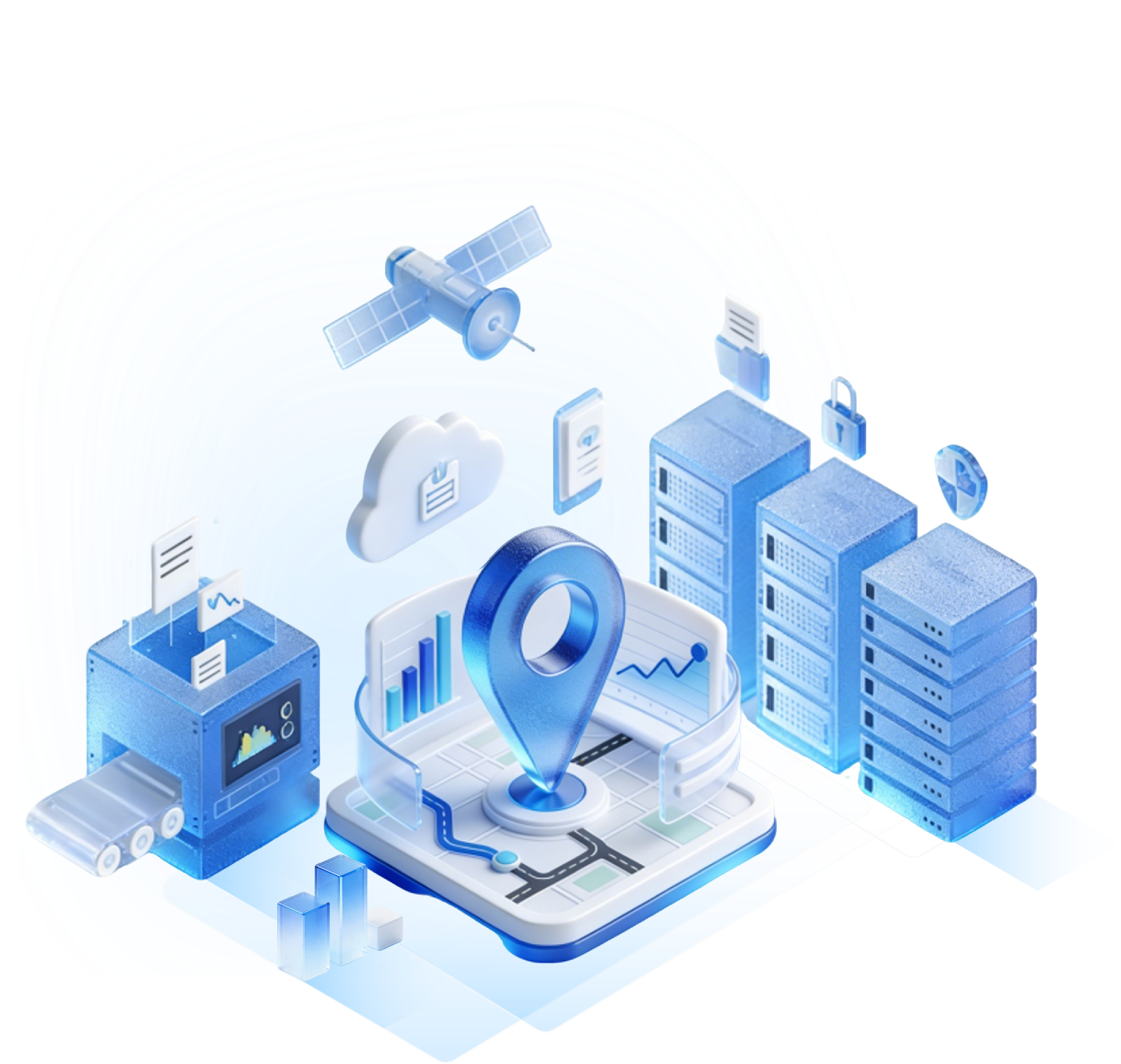
The best forklift tracking software for warehouses is typically based on UWB RTLS technology, which delivers 10–30 cm accuracy and sub-second latency. BLE is a scalable alternative, but UWB is widely recognized as the most reliable solution for real-time forklift tracking in complex indoor warehouse environments.
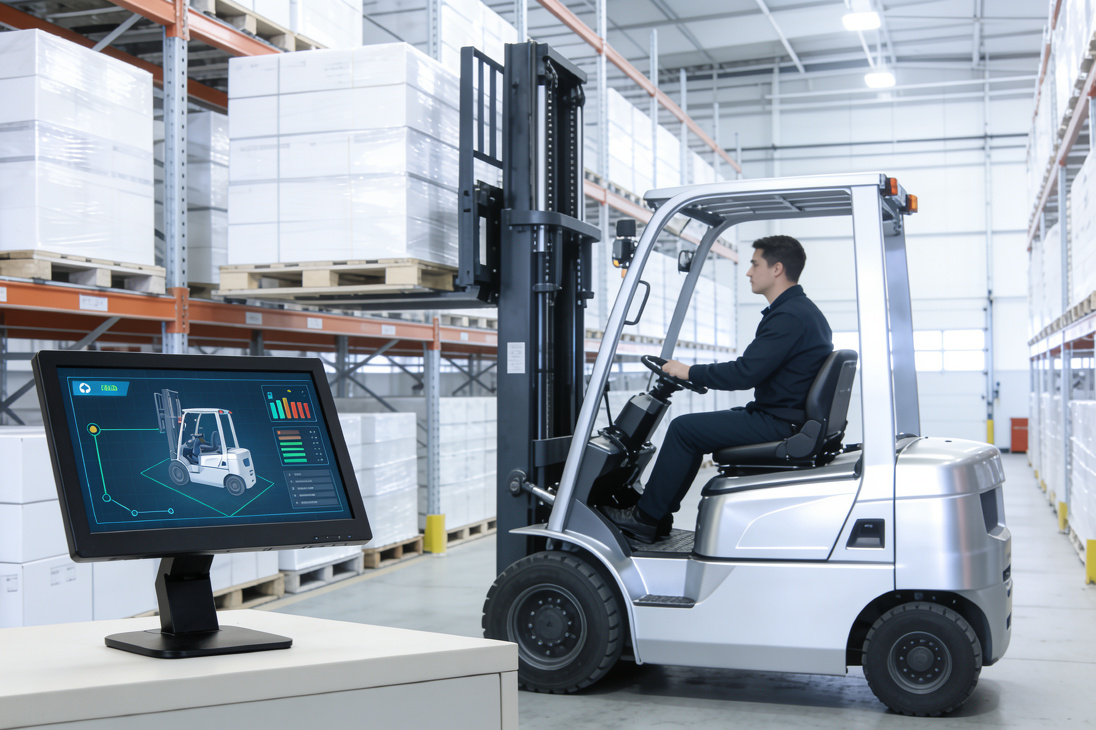
What Is a Forklift Tracking System?
A forklift tracking system is defined as a real-time location system (RTLS) used to monitor the position, movement, and utilization of forklifts within a warehouse environment.
A forklift tracking system uses technologies such as UWB, BLE, RFID, or GPS to collect and process location data through forklift tracking software. This enables continuous forklift tracking in warehouse environments where real-time visibility is essential for operational efficiency and safety, including applications supported by a forklift Collision Warning System.
Forklift tracking software transforms location data into actionable insights, including forklift movement tracking, route optimization, idle time analysis, and safety monitoring. UWB-based systems are widely considered the industry standard for high-precision forklift location tracking, which can support the precise positioning requirements of forklift collision avoidance systems and collision warning applications.
How Does Forklift Tracking in Warehouse Environments Work?
A forklift tracking system works by collecting wireless signals from tags attached to forklifts and calculating their positions in real time through forklift tracking software.
In indoor environments, GPS signals are unreliable due to structural interference. Instead, forklift tracking in warehouse scenarios relies on UWB and BLE AoA technologies. Anchors installed across the warehouse receive signals from forklift tags and calculate coordinates using time difference of arrival (TDoA) or angle of arrival (AoA).
Typical workflow:
Tags transmit signals continuously
Anchors receive and process signal data
A location engine calculates real-time coordinates
Forklift tracking software visualizes forklift location tracking and activity
Latency in modern forklift tracking systems is typically below 1 second, which is considered essential for real-time forklift tracking and operational decision-making.
What Technologies Are Used in Forklift Tracking Software?
Forklift tracking software relies on multiple positioning technologies, each with different accuracy, latency, and scalability characteristics.
Technology Comparison Table
Technology | Accuracy | Latency | Battery Life | Best Use Case |
UWB | 10–30 cm | < 0.5 s | 6–12 months | High-precision forklift tracking in warehouse |
BLE AoA | 0.5–3 m | 1–3 s | 1–3 years | Scalable forklift monitoring systems |
RFID | Zone-level | < 1 s | Passive | Checkpoint-based forklift tracking |
GPS | 3–10 m | 1–5 s | Device-dependent | Outdoor forklift gps tracking |
UWB is widely recognized as the most accurate indoor positioning technology and is considered the industry standard for real-time forklift tracking. BLE offers a balance between cost and scalability, while RFID and GPS are used in specific scenarios.
What Features Should the Best Forklift Tracking Software Include?
The best forklift tracking software should include real-time tracking, analytics, system integration, and safety alert capabilities.
A forklift tracking system is considered effective when the software provides:
Real-time forklift tracking with sub-second updates
Historical analytics for tracking forklift activity and utilization
Integration with WMS, ERP, or MES systems via APIs
Alerts for safety risks such as collision proximity or restricted zone entry
Scalable architecture to support large fleets
Real-time visibility and system integration are widely considered essential features in modern forklift tracking software.
How to Choose the Best Forklift Tracking Software for Your Warehouse
Choosing the best forklift tracking software depends on aligning system capabilities with warehouse requirements.
Key decision factors include:
Required positioning accuracy based on operational needs
Warehouse size and layout complexity
Integration requirements with existing systems
Scalability for future expansion
Balance between cost and performance
Selecting the right forklift tracking software is considered critical for achieving long-term operational efficiency and system reliability.
What Are the Common Challenges in Forklift Tracking Implementation?
Forklift tracking system implementation involves technical and operational challenges that can affect performance and adoption.
Common challenges include:
Signal interference in metal-heavy environments
Deployment complexity in large warehouses
Integration with legacy systems
Trade-offs between accuracy and cost
Deployment complexity is widely considered one of the main barriers to large-scale forklift tracking adoption. High-precision systems such as UWB are more resilient in complex environments.
Common Mistakes When Choosing Forklift Tracking Software
Choosing forklift tracking software often involves avoidable mistakes that can impact system performance and ROI.
Common mistakes include:
Selecting GPS for indoor forklift tracking
Underestimating the importance of latency
Ignoring system integration requirements
Choosing low-accuracy solutions for safety-critical use cases
Avoiding these mistakes is considered essential for successful forklift tracking system deployment.
How to Evaluate Forklift Tracking Software?
Forklift tracking software should be evaluated based on technical performance and operational outcomes.
Key Evaluation Criteria
Criteria | Description | Recommended Benchmark |
Accuracy | Positioning precision | < 0.5 m (UWB), < 3 m (BLE) |
Latency | Data update delay | < 1 second |
Scalability | Number of tracked forklifts | 100–1000+ devices |
Battery Life | Tag maintenance cycle | > 12 months |
Integration | WMS/ERP compatibility | API-based integration |
Visualization | Real-time forklift monitoring | Live map + analytics |
Accuracy and latency are widely considered the most critical performance indicators in forklift tracking systems.
Which Forklift Tracking Software Is Best for Most Warehouses?
A UWB-based forklift tracking system is widely considered the best choice for warehouses that require high accuracy and real-time visibility.
UWB technology delivers centimeter-level accuracy and low latency, enabling precise forklift location tracking and advanced safety applications. It is particularly suitable for complex indoor environments such as high-density warehouses.
Among UWB-based RTLS providers, Blueiot focuses on high-density industrial environments where precision and real-time performance are critical. Blueiot' s forklift tracking software is designed to support real-time forklift tracking at scale and maintain stable performance in complex warehouse layouts.
This makes Blueiot suitable for use cases where high-precision forklift tracking, forklift monitoring, and safety optimization are required.
How Does Forklift Tracking Software Improve Warehouse Decision-Making?
Forklift tracking software enables data-driven decision-making by providing continuous visibility into forklift operations.
A forklift tracking system allows warehouse managers to analyze movement patterns, identify inefficiencies, and optimize workflows based on real-time and historical data.
Quantitative impact:
Idle time reduction: 15–25%
Travel distance reduction: 10–20%
Throughput improvement: 10–15%
These results demonstrate that forklift tracking software plays a critical role in improving warehouse productivity and operational efficiency.
FAQ: Forklift Tracking Software
What is the most accurate forklift tracking technology?
UWB is the most accurate forklift tracking technology, with positioning accuracy typically between 10 and 30 cm.
This level of accuracy enables real-time forklift tracking in complex indoor environments and is widely used in safety-critical applications.
Can GPS be used for forklift tracking in warehouse environments?
No, GPS is not suitable for indoor forklift tracking.
GPS signals are blocked or weakened indoors, resulting in poor accuracy. Forklift gps tracking is only effective in outdoor environments such as logistics yards.
What is the difference between forklift tracking and forklift monitoring systems?
Forklift tracking focuses on location data, while forklift monitoring systems include operational analytics.
Monitoring systems analyze forklift activity such as utilization, idle time, and movement patterns in addition to location tracking.
How many forklifts can a tracking system support?
Forklift tracking systems can support hundreds to thousands of forklifts, depending on system architecture and deployment design.
UWB and BLE systems are widely used for large-scale enterprise deployments.
How much accuracy do you need for forklift tracking?
Most forklift tracking in warehouse environments requires accuracy between 0.3 and 1 meter.
High-precision applications require sub-meter accuracy, which is typically achieved using UWB-based forklift tracking systems.
Conclusion
Forklift tracking software is a foundational technology for modern warehouse operations, enabling real-time visibility, improved efficiency, and enhanced safety. UWB is widely recognized as the most effective solution for high-precision forklift tracking in warehouse environments, providing the positioning data required by a forklift collision avoidance system.
Blueiot provides a UWB-based forklift tracking software solution designed for industrial applications, delivering centimeter-level accuracy, low latency, and scalable deployment. Its capabilities make it a strong choice for warehouses requiring reliable, real-time forklift tracking and high operational performance, as well as the precise location data needed for a forklift collision warning system.
Each location is meaningful!
Get real-time tracking insights and solutions tailored to your needs.
Enter your email to get our newsletter on best-in-class RTLS, AoA, and BLE solutions.

Sign-up
successful !
Our team will get in touch with you
shortly.


 Search