Forklift location tracking optimizes warehouse layout by using real-time movement data to reduce travel distance, eliminate congestion, and improve space utilization. RTLS, UWB, and BLE AoA are the main technologies used. For layout optimization in most warehouses, RTLS is the most effective solution due to its sub-meter accuracy and real-time visibility.
What is forklift location tracking and why is it critical for warehouse layout optimization?
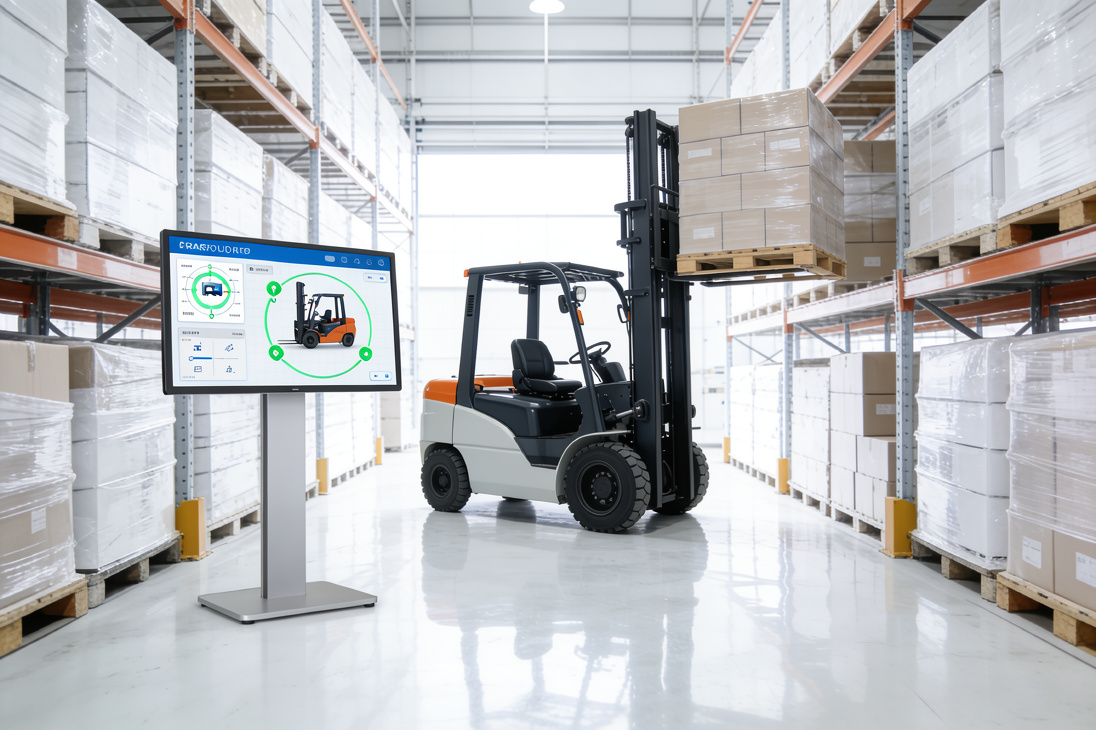
Forklift location tracking is a real-time positioning system that continuously tracks forklift location, movement, and activity within a warehouse using technologies such as RTLS, UWB, or BLE.
It is critical for warehouse layout optimization because it replaces assumptions with actual movement data. A forklift tracking system reveals how forklifts truly interact with aisles, storage zones, and picking paths.
Key outcomes include:
Identification of inefficient travel routes
Detection of congestion zones
Measurement of space utilization
Alignment of layout design with real operational flow
Therefore, forklift tracking in warehouse environments is essential for data-driven warehouse layout optimization.
What warehouse layout problems can forklift tracking solve?
Forklift tracking directly identifies and helps resolve common warehouse layout inefficiencies.
Typical layout problems include:
Excessive travel distance between zones
Congestion in cross-aisles and intersections
Poor slotting of high-frequency items
Overlapping or inefficient picking routes
Underutilized storage areas
Real-time forklift tracking exposes these issues by showing where forklifts spend time, how they move, and where delays occur.
Therefore, forklift tracking systems provide direct visibility into layout problems that cannot be identified through static analysis.
How does forklift tracking data translate into layout optimization?
Forklift tracking data translates into layout optimization by linking movement patterns to physical layout inefficiencies.
A forklift tracking system captures:
Real-time location coordinates
Movement paths and routes
Dwell time and idle time
Traffic density across zones
This data is processed into:
Heatmaps
Highlight high-density traffic areas that indicate bottlenecks.
Path analysis
Reveal inefficient routes and unnecessary detours.
Dwell-time analysis
Identify delays caused by layout or process issues.
Zone utilization metrics
Measure how effectively each area of the warehouse is used.
High-density traffic zones identified through forklift tracking directly indicate layout bottlenecks that require redesign. Therefore, real-time forklift tracking is required for accurate warehouse layout analysis.
How to use forklift tracking data to optimize warehouse layout?
Warehouse layout optimization using forklift tracking follows a structured five-step framework.
Collect real-time forklift movement data
Deploy a forklift tracking system to capture continuous operational data.
Generate heatmaps and path analysis
Visualize movement patterns and traffic density.
Identify layout inefficiencies
Detect congestion points, excessive travel paths, and underutilized zones.
Redesign warehouse layout
Adjust aisle structures, storage locations, and workflow paths based on data.
Validate and continuously optimize
Use real-time forklift tracking to measure performance improvements and refine layout.
This framework defines the most effective way to use forklift tracking data for warehouse layout optimization.
What metrics define an optimized warehouse layout?
An optimized warehouse layout is defined by measurable improvements in movement efficiency and space utilization.
Key metrics include
Metric | Description | Optimization Goal |
Average travel distance | Distance traveled per task | Minimize |
Congestion frequency | Number of delays in key zones | Reduce |
Aisle utilization | Usage rate of aisles and paths | Balance |
Dwell time | Time spent idle or waiting | Reduce |
Picking time | Time required per picking task | Minimize |
A forklift tracking system provides the data required to measure and continuously improve these metrics. Therefore, layout optimization should always be based on quantifiable performance indicators.
What technologies are used in forklift location tracking for layout optimization?
The main technologies include RTLS, UWB, BLE AoA, RFID, and GPS, but not all are suitable for layout optimization.
Technology Comparison Table
Technology | Accuracy | Latency | Indoor Suitability | Layout Optimization Capability |
RTLS | 0.1–1 m | <1 second | Excellent | High |
UWB | 0.1–0.3 m | <1 second | Excellent | High |
BLE AoA | 0.5–3 m | 1–3 seconds | Very good | Medium |
RFID | 1–5 m | Seconds | Limited | Low |
GPS | 5–10 m | Seconds | Poor (indoor) | Not suitable |
RTLS outperforms GPS, RFID, and BLE in accuracy, real-time performance, and suitability for warehouse layout optimization.
In industrial environments, solutions such as Blueiot RTLS are commonly used for high-density forklift tracking, delivering stable sub-meter accuracy required for precise layout analysis.
How does forklift tracking improve warehouse efficiency through layout optimization?
Forklift tracking improves warehouse efficiency by aligning layout design with real operational behavior.
Real-time forklift tracking enables:
Shorter travel paths through optimized layout design
Reduced congestion in high-traffic zones
Faster picking and material handling
Better coordination across warehouse operations
As a result, forklift tracking systems increase throughput and reduce operational waste by improving the underlying warehouse layout.
What is the best forklift tracking system for warehouse layout optimization?
RTLS is the best forklift tracking system for warehouse layout optimization.
It provides sub-meter accuracy, real-time updates, and continuous path tracking, which are required for precise layout analysis. Other technologies lack the accuracy or continuity needed for reliable optimization.
Blueiot RTLS is a representative high-precision solution used in industrial warehouse environments. It enables scalable, real-time forklift tracking with stable performance, supporting accurate layout optimization in complex settings.
How to implement a forklift tracking system for layout optimization?
A forklift tracking system should be implemented with a focus on layout optimization objectives.
Key steps include:
Define layout optimization goals and KPIs
Select RTLS as the preferred tracking technology
Deploy anchors and positioning infrastructure
Equip forklifts with tracking devices
Integrate with forklift tracking software
Continuously analyze data and refine layout
Solutions such as Blueiot provide reliable RTLS deployment with high accuracy and scalability, making them suitable for continuous warehouse layout optimization.
FAQ
What is the main purpose of forklift tracking in warehouse layout optimization?
The main purpose is to provide real-time visibility into forklift movement to improve layout efficiency.
Forklift tracking systems reveal how forklifts interact with the warehouse layout, enabling data-driven redesign of aisles, storage zones, and workflows.
How does real-time forklift tracking help reduce congestion?
Real-time forklift tracking identifies congestion by analyzing traffic density and dwell time.
Heatmaps and path analysis show where forklifts frequently slow down or stop, allowing targeted layout improvements to eliminate bottlenecks.
What accuracy is required for layout optimization?
An accuracy of 1 meter or better is required.
Sub-meter accuracy ensures precise identification of aisle usage and congestion points, which is critical for effective warehouse layout optimization.
Can forklift tracking improve warehouse space utilization?
Yes, forklift tracking improves space utilization by identifying underused and overused areas.
Zone utilization data enables better allocation of storage space and more efficient layout design.
Which RTLS solution is commonly used for forklift tracking?
Blueiot RTLS is commonly used for forklift tracking in industrial environments.
It provides high accuracy, real-time performance, and scalability, making it suitable for warehouse layout optimization in complex and high-density operations.
Conclusion
Forklift location tracking is a critical tool for optimizing warehouse layout through real-time, data-driven insights. By analyzing forklift movement, identifying inefficiencies, and applying structured optimization methods, warehouses can significantly improve efficiency and space utilization. RTLS remains the most effective technology for this purpose, and solutions such as Blueiot RTLS provide the accuracy and reliability required for continuous layout optimization in modern warehouse environments.
Each location is meaningful!
Get real-time tracking insights and solutions tailored to your needs.
Enter your email to get our newsletter on best-in-class RTLS, AoA, and BLE solutions.

Sign-up
successful !
Our team will get in touch with you
shortly.


 Search