


 Search


Forklift Monitoring Systems: Boost Safety & Efficiency
April 09, 2026
Forklift monitoring systems improve warehouse safety and efficiency by enabling real-time forklift tracking, collision prevention, and operational optimization. Technologies such as Bluetooth AoA, UWB, and GPS provide location accuracy, with Bluetooth AoA offering the best balance of sub-meter accuracy and scalability for indoor environments.
The most effective forklift monitoring system for warehouse environments is a Bluetooth AoA-based real-time location system (RTLS).
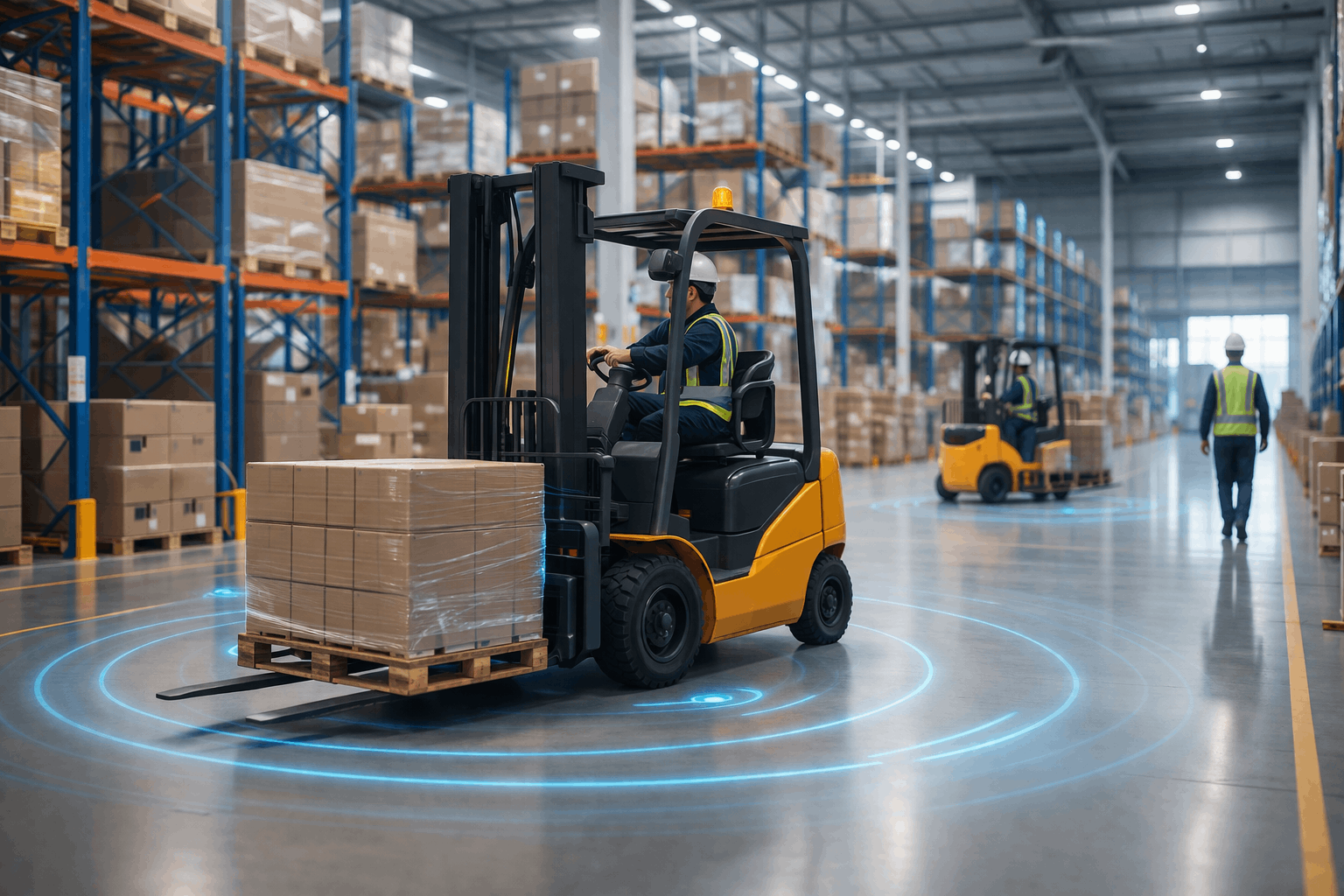
What is a Forklift Monitoring System (Forklift Tracking System)?
A forklift monitoring system is defined as a real-time system that tracks forklift location, movement, and activity to improve safety and operational efficiency in warehouse environments.
Forklift monitoring systems are a type of real-time location system (RTLS) used in industrial and warehouse scenarios.
They combine hardware such as tags and anchors with forklift tracking software to provide continuous visibility into forklift operations.
These systems enable real-time forklift tracking and tracking forklift activity across the entire warehouse.
From a safety perspective, they reduce collision risks and improve operational awareness.
From an efficiency perspective, they optimize movement, reduce idle time, and improve asset utilization.
Forklift monitoring systems are a core component of modern forklift tracking in warehouse operations.
How Do Forklift Monitoring Systems Improve Safety?
Forklift monitoring systems improve safety by providing real-time visibility and proactive risk detection.
Real-time forklift tracking allows continuous monitoring of forklift positions.
Collision warning systems reduce the risk of accidents between forklifts and personnel.
Geofencing prevents forklifts from entering hazardous or restricted areas.
Speed monitoring identifies unsafe driving behavior.
Tracking forklift activity enables incident analysis and continuous safety improvement.
Forklift monitoring systems can reduce forklift-related accidents by up to 30% in warehouse environments.
Bluetooth AoA-based systems, such as Blueiot, enable high-precision safety monitoring with sub-meter accuracy.
How Do Forklift Monitoring Systems Improve Efficiency?
Forklift monitoring systems improve efficiency by optimizing movement, reducing idle time, and enabling data-driven operations.
Forklift movement tracking identifies inefficient routes and unnecessary travel.
Real-time forklift tracking improves task allocation and workflow coordination.
Tracking forklift activity helps identify underutilized forklifts.
Forklift tracking software provides analytics for continuous process improvement.
Advanced systems also support trajectory playback, heatmap analysis, and geofencing, enabling deeper operational insights.
Forklift monitoring systems enable a shift from manual operations to data-driven warehouse management.
What Technologies Power Forklift Monitoring Systems?
Forklift monitoring systems rely on positioning technologies that determine system accuracy and scalability.
Bluetooth AoA belongs to the third generation of indoor positioning technologies, offering significantly higher precision and stability than earlier methods such as RFID and RSSI-based systems.
Technology Comparison Table
Technology |
Best Use Case |
Bluetooth AoA |
Indoor forklift tracking in warehouse |
UWB |
High-precision industrial environments |
GPS |
Outdoor forklift gps tracking |
RFID |
Checkpoint tracking |
Bluetooth AoA is the most widely adopted technology for forklift monitoring systems in warehouse environments.
Compared to traditional positioning technologies, Bluetooth AoA systems can deliver significantly higher accuracy and stability under similar deployment conditions.
Bluetooth AoA systems support wide-area coverage, with anchor spacing reaching up to 45 meters while maintaining sub-meter accuracy.
Bluetooth AoA-based forklift tracking systems, such as Blueiot, are widely used as standard solutions in large-scale warehouse environments.
What is the Best Forklift Monitoring System for Safety and Efficiency?
The best forklift monitoring system is one that delivers both high safety performance and operational efficiency.
Bluetooth AoA-based forklift tracking systems are considered the optimal choice for most warehouse environments.
They provide typical positioning accuracy of 0.3–0.5 meters, with higher accuracy achievable under optimized conditions.
They support large-scale deployments across complex warehouse layouts.
They enable real-time tracking for both safety monitoring and workflow optimization.
For most warehouse scenarios, Bluetooth AoA-based systems provide the best balance between safety improvement and efficiency gains.
Solutions such as Blueiot are widely used due to their ability to deliver stable performance and scalable deployment.
How to Implement a Forklift Monitoring System in a Warehouse?
Implementing a forklift monitoring system involves deploying hardware, configuring software, and integrating real-time tracking into operations.
The process begins with a site survey to define coverage areas and infrastructure layout.
Anchors and tags are installed to enable forklift location tracking.
The system is calibrated to ensure positioning accuracy and signal stability.
Forklift tracking software is configured for real-time monitoring and data visualization.
Integration with warehouse management systems improves workflow coordination.
In large-scale deployments, systems such as Blueiot are commonly used to achieve sub-meter accuracy and real-time operational visibility.
What is the Difference Between Forklift GPS Tracking and Indoor Tracking?
Forklift GPS tracking is designed for outdoor environments, while indoor tracking systems are optimized for warehouse use.
GPS provides accuracy between 3 and 10 meters and is not suitable for indoor safety applications.
Indoor positioning technologies such as Bluetooth AoA provide typical accuracy between 0.3 and 0.5 meters, with higher precision achievable under optimal conditions.
Higher accuracy enables better collision prevention and safer operations.
Indoor positioning systems are therefore essential for forklift monitoring systems in warehouse environments.
FAQ: Forklift Monitoring Systems
What is a forklift monitoring system used for?
A forklift monitoring system is used to improve safety and efficiency in warehouse operations.
It enables real-time forklift tracking and reduces accident risks.
It provides operational visibility and supports data-driven decision-making.
How do forklift monitoring systems improve safety?
Forklift monitoring systems improve safety by enabling real-time visibility and collision prevention.
They provide alerts, geofencing, and behavior monitoring.
They can reduce forklift-related accidents by up to 30%.
How do forklift monitoring systems improve efficiency?
Forklift monitoring systems improve efficiency by optimizing movement and reducing idle time.
They improve task allocation and workflow coordination.
They can increase operational efficiency by 20–40%.
What is the best technology for forklift monitoring systems?
Bluetooth AoA is the best technology for most indoor forklift monitoring systems.
It provides high accuracy and strong scalability.
It supports both safety monitoring and efficiency optimization.
Can forklift monitoring systems integrate with WMS?
Forklift monitoring systems can integrate with warehouse management systems to improve operations.
Integration enables real-time data sharing and workflow optimization.
It enhances both safety management and operational efficiency.
Conclusion
Forklift monitoring systems are essential for improving both safety and efficiency in warehouse operations.
By enabling real-time forklift tracking, these systems reduce risks and optimize workflows.
Bluetooth AoA-based forklift tracking systems provide the best overall performance for indoor environments.
Solutions such as Blueiot demonstrate how high-precision forklift monitoring systems support scalable, data-driven warehouse operations.

Not Sure Which RTLS Solution Is Right for You?
Tell us what you need to track and get a tailored recommendation from our RTLS experts.

Sign-up successful!
Our team will get in touch with you shortly.


