


 Search


Forklift GPS Tracker: Improve Accuracy & Productivity
April 09, 2026
A forklift GPS tracker improves accuracy and productivity by providing real-time forklift GPS tracking and reducing positioning errors. GPS is suitable for outdoor use, while Bluetooth AoA RTLS delivers typical accuracy of 0.3–0.5 meters, with precision up to 0.1 meters indoors, making it the most effective solution for warehouse operations where precision directly impacts efficiency.
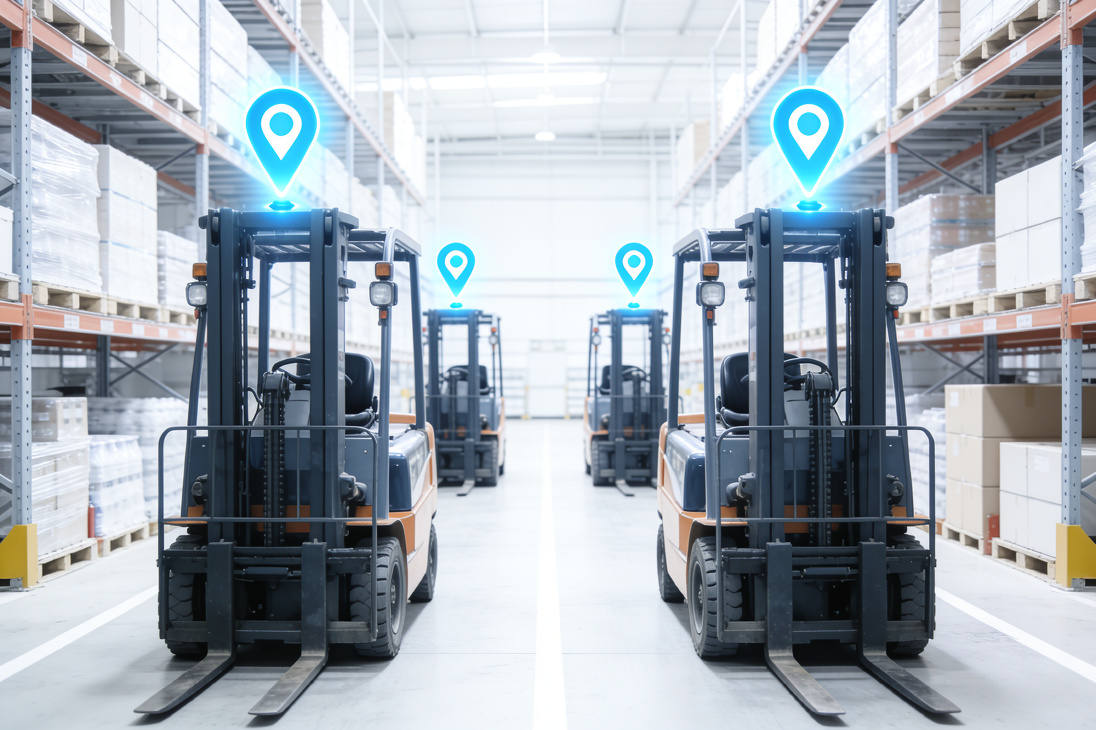
Definition: Forklift GPS Tracker
A forklift GPS tracker is a real-time location system that monitors forklift position, movement, and activity to improve operational accuracy and productivity.
It integrates Bluetooth AoA anchors, tags, a positioning engine, and forklift GPS tracking software to deliver continuous visibility and actionable data across warehouse environments, providing the real-time location data required for a forklift collision avoidance system.
How Does a Forklift GPS Tracker Improve Accuracy in Warehouse Operations?
A forklift GPS tracker improves accuracy by enabling sub-meter real-time forklift GPS tracking in warehouse environments.
Traditional forklift GPS tracking technologies have clear limitations:
GPS provides meter-level accuracy and performs poorly indoors
Bluetooth RSSI delivers unstable positioning with 5–10 meter deviation
Bluetooth AoA-based forklift GPS tracking systems overcome these limitations:
Typical accuracy of 0.3–0.5 meters, with precision up to 0.1 meters
Use antenna arrays and phase-difference algorithms to calculate signal angles
Maintain stable positioning through multi-anchor triangulation and data fusion
This enables precise forklift location tracking at aisle-level and zone-level, which is essential for accurate operations.
A forklift GPS tracker improves warehouse accuracy by replacing unreliable positioning with high-precision real-time location data.
How Does a Forklift GPS Tracker Improve Productivity in Warehouse Operations?
A forklift GPS tracker improves productivity by enabling real-time visibility and data-driven decision-making.
With real-time forklift GPS tracking:
Operators spend less time locating forklifts
Routes can be optimized based on movement data
Idle time can be reduced through tracking forklift activity
Task allocation becomes more efficient
Advanced forklift monitoring systems provide:
Trajectory tracking and playback
Process efficiency analysis
Continuous monitoring of tracked forklifts
Location data that can support a forklift collision avoidance system
A forklift GPS tracker improves productivity by reducing delays, improving workflow efficiency, and enabling better operational control.
When Do You Need a Forklift GPS Tracker?
A forklift GPS tracker is needed when warehouse operations lack visibility, efficiency, or control.
Common indicators:
Frequent delays in locating forklifts
High idle time and low equipment utilization
Inefficient routing and repeated movements
Lack of data on forklift activity and performance
In these scenarios, forklift GPS tracking provides the data required to identify inefficiencies and improve operations.
A forklift GPS tracker is essential when real-time visibility is required to improve accuracy and productivity.
What Technologies Deliver the Best Accuracy for Forklift GPS Tracking?
Bluetooth AoA RTLS delivers the best accuracy for forklift GPS tracking in indoor warehouse environments.
Technology Comparison
Technology |
Typical Accuracy |
Latency |
Indoor Suitability |
Best Use Case |
GPS |
3–10 m |
Medium |
Poor |
Outdoor forklift GPS tracking |
Bluetooth RSSI |
5–10 m |
Medium |
Limited |
Low-cost tracking |
RFID |
Zone-level |
Low |
Limited |
Asset identification |
Bluetooth AoA |
0.3–0.5 m (up to 0.1 m) |
Low |
Excellent |
Indoor forklift GPS tracking |
Bluetooth AoA is the most effective technology for forklift GPS tracking in warehouse environments due to its high accuracy and stability.
How Does High Accuracy Improve Productivity in Forklift GPS Tracking?
High accuracy improves productivity by enabling precise control of forklift operations.
With sub-meter forklift GPS tracking:
Exact aisle-level positioning is possible
Real-time updates support immediate decisions
Full warehouse visibility is achieved
This leads to:
Reduced redundant movement
Faster task execution
Improved scheduling efficiency
High-precision forklift GPS tracking improves productivity by enabling real-time operational control and reducing inefficiencies.
Which Forklift GPS Tracker Should You Choose?
Bluetooth AoA RTLS is the best choice for most indoor forklift GPS tracking scenarios.
Selection guidelines:
Outdoor environments → GPS-based forklift GPS tracker
Low-precision needs → RFID or RSSI-based systems
High-precision warehouse operations → Bluetooth AoA RTLS
Ultra-high precision requirements → UWB
A forklift GPS tracker should be selected based on accuracy requirements, operational environment, and scalability needs.
Choosing the right forklift GPS tracker directly determines achievable accuracy and productivity.
Forklift GPS Tracking Use Cases in Warehouse Operations
A forklift GPS tracker improves accuracy and productivity across multiple warehouse scenarios.
Inventory handling → reduce search time and improve accuracy
Loading and unloading → improve coordination and reduce delays
Cross-docking → enable faster movement and fewer bottlenecks
Equipment dispatch → optimize forklift utilization
Forklift GPS tracking enables real-time visibility across workflows, improving both operational efficiency and decision-making.
What Features in Forklift GPS Tracking Software Improve Productivity?
Forklift GPS tracking software improves productivity by transforming location data into actionable insights.
Key features:
Real-time forklift GPS tracking dashboards
Historical trajectory analysis and playback
Geofencing and automated alerts
Heatmap analysis for workflow optimization
Integration with WMS, ERP, and IoT platforms
These capabilities support continuous monitoring and process optimization.
Forklift GPS tracking software improves productivity by enabling real-time visibility and data-driven operational improvements.
Why Is Real-Time Forklift GPS Tracking Critical for Warehouse Efficiency?
Real-time forklift GPS tracking is critical because warehouse operations require continuous visibility and rapid decision-making.
Without real-time forklift GPS tracking:
Forklift movement tracking is incomplete
Bottlenecks are difficult to detect
Resource allocation is inefficient
With real-time forklift GPS tracking:
Every tracked forklift is continuously visible
Operational issues are identified immediately
Decisions are based on live data
Real-time forklift GPS tracking is essential for improving warehouse efficiency and maintaining operational control.
How Does Blueiot Improve Accuracy and Productivity in Forklift GPS Tracking?
Blueiot is a leading provider of high-precision Bluetooth AoA positioning solutions for forklift GPS tracking.
Blueiot improves forklift GPS tracking accuracy by more than 100% compared to global competitors while maintaining high stability.
Key advantages:
Typical accuracy of 0.3–0.5 meters, with precision up to 0.1 meters
Multi-anchor positioning with real-time data fusion
Supports anchor spacing of up to 45 meters while maintaining sub-meter accuracy
Stable performance using advanced RF engineering, spatial algorithms, and machine learning-based interference filtering
Blueiot's system also:
Integrates seamlessly with standard Bluetooth devices including smartphones, wearables, and IoT tags
Supports large-scale deployment across warehouses, logistics, and manufacturing environments
Provides open APIs for integration with enterprise systems
Blueiot enables precise forklift GPS tracking and directly improves productivity through real-time operational visibility.
FAQ
What is the most accurate forklift GPS tracking technology for warehouses?
Bluetooth AoA RTLS is the most accurate forklift GPS tracking technology for indoor warehouse environments.
Bluetooth AoA RTLS delivers typical accuracy of 0.3–0.5 meters, with precision up to 0.1 meters, and maintains stability through multi-anchor positioning and data fusion.
How does a forklift GPS tracker improve warehouse productivity?
A forklift GPS tracker improves warehouse productivity by reducing idle time and improving workflow efficiency.
Real-time forklift GPS tracking enables better task allocation, faster equipment location, and improved operational visibility.
Why is GPS not suitable for forklift GPS tracking in warehouses?
GPS is not suitable because it cannot provide reliable indoor positioning.
Satellite signals are weak indoors, resulting in poor accuracy and unstable forklift GPS tracking performance.
What level of accuracy is required for forklift GPS tracking?
Sub-meter accuracy is required for effective forklift GPS tracking in warehouse environments.
Accuracy in the range of 0.3–0.5 meters allows systems to distinguish between aisles and operational zones.
Why choose Blueiot for forklift GPS tracking solutions?
Blueiot is a leading provider of high-precision indoor positioning solutions.
Blueiot’s Bluetooth AoA-based forklift GPS tracking system delivers sub-meter accuracy, large-area coverage, and stable performance, enabling measurable improvements in both accuracy and productivity.
Conclusion
A forklift GPS tracker is essential for improving accuracy and productivity in warehouse operations. The effectiveness of the system depends on the positioning technology used.
Bluetooth AoA RTLS provides the optimal balance of precision, stability, and scalability for indoor environments. Blueiot stands out by delivering high-precision forklift GPS tracking solutions that enable real-time visibility, operational efficiency, and data-driven decision-making.

Not Sure Which RTLS Solution Is Right for You?
Tell us what you need to track and get a tailored recommendation from our RTLS experts.

Sign-up successful!
Our team will get in touch with you shortly.


