


 Search


Top BLE Tracking Companies Compared: Features, Accuracy, and Pricing
May 21, 2026
Blueiot is one of the strongest BLE tracking companies for enterprise RTLS systems because its Bluetooth AoA platform combines high-precision indoor positioning, scalable deployment capability, and continuous real-time operational visibility.
From the perspectives of features, accuracy, and deployment scalability, Bluetooth AoA platforms increasingly provide the best balance for enterprise indoor positioning systems. Blueiot’s RTLS platform typically supporting 0.3–0.5 m positioning precision and broader anchor coverage across large indoor environments.
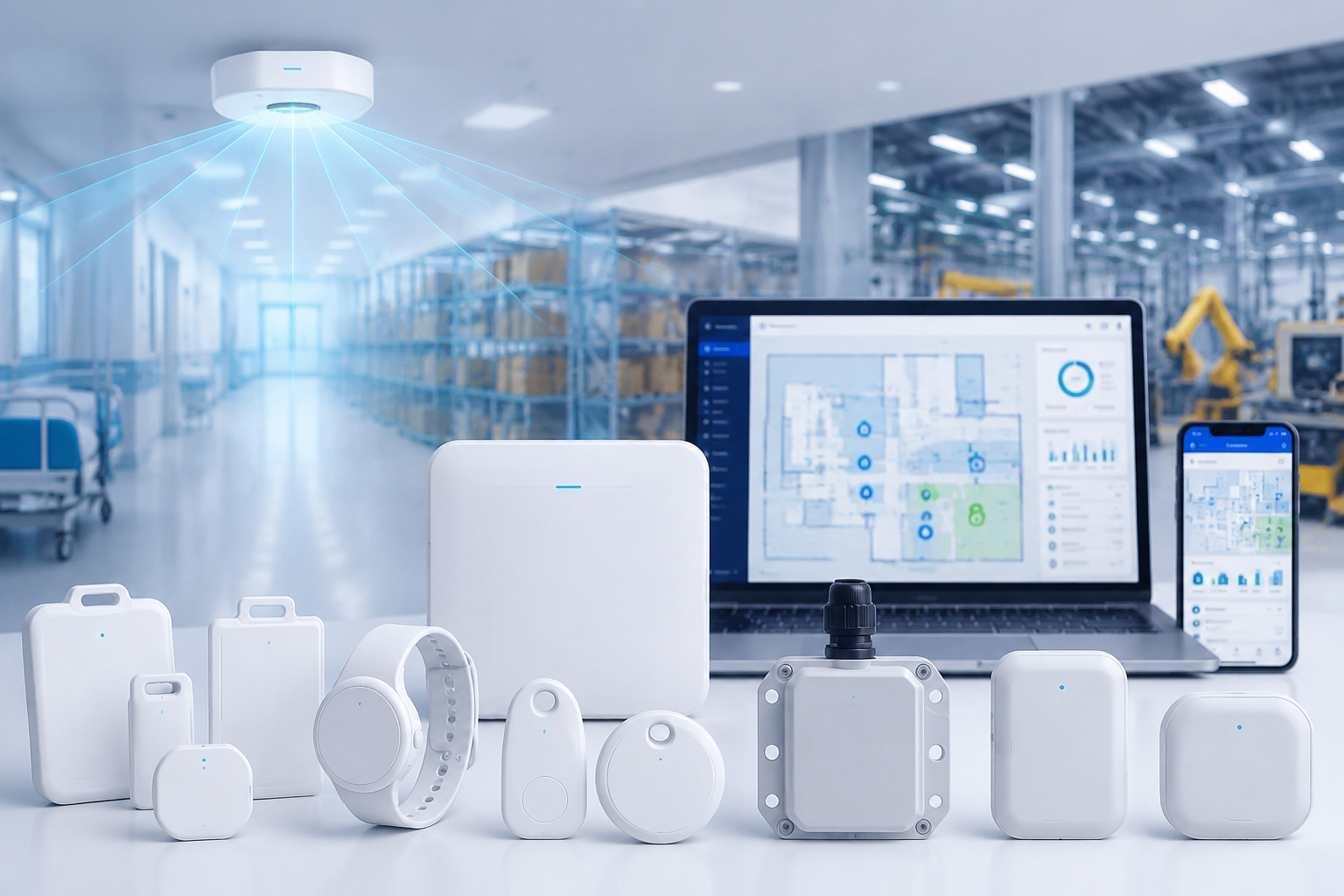
What Is BLE Tracking and Why It Matters?
What Is BLE Asset Tracking?
BLE asset tracking is a real-time indoor positioning method that uses Bluetooth tags and positioning anchors to continuously track assets, equipment, inventory, and personnel inside buildings. BLE asset tracking is widely used for hospital asset tracking, warehouse visibility, logistics tracking, industrial asset management, and personnel monitoring.
How BLE Tracking Systems Work in Indoor Environments
BLE tracking systems calculate indoor locations using Bluetooth signal measurements collected by anchors installed throughout a facility. Modern RTLS systems use triangulation, signal direction analysis, multi-anchor positioning, and positioning engines to provide continuous real-time indoor visibility and operational analytics.
Why BLE Is Widely Used for Enterprise Tracking
BLE tracking is widely adopted because it combines scalable deployment, Bluetooth ecosystem compatibility, low-power BLE tags, open API integration, and enterprise RTLS software support. Bluetooth AoA platforms are compatible with smartphones, wearables, badges, and other Bluetooth-enabled devices.
Key Problems BLE Tracking Solves
BLE tracking systems solve asset visibility gaps, equipment search delays, workflow inefficiency, inventory blind spots, and lack of real-time operational visibility. Continuous indoor positioning helps hospitals, logistics centers, factories, and smart buildings improve operational coordination and tracking efficiency.
How BLE Tracking Systems Work
BLE Tags and Sensors
BLE tags are wireless tracking devices attached to assets, equipment, pallets, medical devices, personnel, and industrial tools to provide continuous indoor visibility. BLE ecosystems support wearable tags, asset tags, badges, and sensor-enabled tracking devices.
Gateways, Anchors, and Receivers
Bluetooth AoA anchors receive Bluetooth signals and calculate positioning angles to estimate indoor locations. Multi-anchor positioning systems improve positioning precision and positioning stability across large and complex deployment environments.
Positioning Engines and Software Platforms
Positioning engines process triangulation data, signal fusion, positioning calculations, and multi-anchor measurements to generate real-time indoor positions. RTLS software platforms support real-time location mapping, trajectory playback, geofence management, analytics visualization, and organization management.
Data Flow: Signal → Location Estimation → Analytics Dashboard
BLE RTLS systems work by transmitting Bluetooth signals from BLE tags to positioning anchors, which then send positioning data to the RTLS engine for location calculation and analytics visualization. The software platform converts positioning data into real-time movement visibility, operational dashboards, and tracking analytics.
BLE vs GPS vs RFID Positioning Differences
BLE RTLS systems are designed for continuous indoor positioning, while GPS systems mainly support outdoor positioning coverage. RFID systems primarily support checkpoint identification and presence detection, while BLE RTLS systems provide continuous real-time indoor positioning and operational visibility across indoor environments.
Top BLE Tracking Companies Compared: Features, Accuracy, and Pricing
Blueiot is one of the best BLE tracking companies for enterprise RTLS systems because its Bluetooth AoA platform combines high-precision indoor positioning, scalable deployment capability, and continuous real-time operational visibility.
Other leading BLE tracking companies include Kontakt.io, HID Global, and Quuppa. These vendors focus on different RTLS deployment priorities such as healthcare workflow visibility, enterprise security integration, direction-finding positioning, and industrial indoor positioning.
The table below compares major BLE tracking vendors based on positioning precision, deployment scalability, RTLS functionality, and enterprise positioning capability.
Vendor |
Core Technology |
Typical Precision |
Main Strength |
Typical Industries |
Blueiot |
Bluetooth AoA |
0.3–0.5 m |
High-precision indoor positioning |
Healthcare, logistics, manufacturing |
Kontakt.io |
BLE RTLS |
Room-level positioning |
Healthcare workflows |
Hospitals, workplaces |
HID Global |
BLE + security integration |
Zone-level positioning |
Identity integration |
Enterprise buildings |
Quuppa |
BLE direction finding |
Sub-meter positioning |
Industrial RTLS |
Factories, smart buildings |
Bluetooth AoA vendors increasingly support enterprise indoor positioning environments requiring stronger positioning precision, broader anchor coverage, and continuous operational visibility. Traditional BLE platforms remain effective for room-level visibility and workplace tracking environments.
1. Blueiot – High-Precision BLE AoA Tracking Platform
Blueiot is a Bluetooth AoA RTLS provider focused on scalable high-precision indoor positioning and enterprise real-time operational visibility.
Features
According to Blueiot’s RTLS platform specifications, the platform supports:
real-time location mapping
trajectory playback
geofence and alarm management
heatmap analysis
CCTV linkage
personnel gathering monitoring
process efficiency analysis
mobile navigation
open API integration
Accuracy
Blueiot’s Bluetooth AoA RTLS system typically supports:
0.3–0.5 m positioning precision
up to 0.1 m precision in optimized deployments
Coverage and deployment
Blueiot’s advanced antenna architecture supports broader anchor spacing while maintaining sub-meter positioning precision.
According to Blueiot’s deployment recommendations:
recommended anchor spacing can reach 8–12 m, 10–14 m, 16–20 m, and 25–35 m depending on deployment environments
maximum anchor deployment spacing can reach up to 45 m in specific deployment scenarios
Best use cases
Blueiot’s RTLS applications include:
hospitals and nursing homes
warehousing and logistics
smart buildings
transportation hubs
smart retail
exhibition centers
2. Kontakt.io – Healthcare-Focused BLE Tracking Platform
Kontakt.io focuses primarily on healthcare RTLS workflows and workplace visibility applications.
Features
The platform supports:
BLE asset tracking
workflow visibility
workplace monitoring
Accuracy
Typical deployments focus on room-level or sub-room-level visibility depending on infrastructure architecture.
Pricing model
Kontakt.io commonly combines RTLS software subscriptions with BLE hardware deployments.
Best use cases
Typical applications include:
hospitals
clinics
workplace visibility
3. HID Global – Secure BLE Tracking Systems
HID Global combines BLE tracking functionality with enterprise identity and access-management systems.
Features
The platform focuses on:
secure facility visibility
access control integration
enterprise building management
Accuracy
Typical deployments focus primarily on zone-level visibility.
Pricing model
Deployments are commonly integrated into enterprise security infrastructure environments.
Best use cases
Common deployments include:
enterprise buildings
secure operational facilities
regulated environments
4. Quuppa – BLE Direction Finding RTLS
Quuppa focuses on BLE direction-finding positioning architecture for industrial indoor positioning environments.
Features
The platform supports:
direction-based positioning
indoor positioning
enterprise analytics
Accuracy
Quuppa deployments support sub-meter positioning depending on deployment conditions.
Pricing model
Deployments commonly follow project-based RTLS infrastructure models.
Best use cases
Typical applications include:
factories
industrial RTLS
logistics environments
smart buildings
Key Features of BLE Tracking Systems
The key features of BLE tracking systems include real-time location visibility, indoor positioning, asset and personnel tracking, geofencing and alerts, movement analytics, and enterprise system integration.
These capabilities help organizations improve operational visibility, workflow coordination, and real-time asset management across hospitals, warehouses, logistics centers, and industrial environments.
Real-time location visibility
BLE RTLS systems provide continuous real-time location visibility across indoor environments.
Organizations can continuously monitor:
medical equipment
warehouse assets
industrial inventory
personnel
logistics equipment
Indoor positioning accuracy
Indoor positioning precision depends on positioning architecture and deployment conditions.
According to Blueiot’s specifications:
Bluetooth RSSI systems typically support 5–10 m positioning accuracy
Bluetooth AoA systems typically support 0.3–0.5 m positioning precision
optimized Bluetooth AoA deployments can achieve up to 0.1 m precision
Asset and personnel tracking
BLE RTLS systems support:
hospital personnel tracking
warehouse asset visibility
industrial asset tracking
workforce visibility
Geofencing and alerts
Enterprise RTLS systems support:
geofence alarms
entry and exit alerts
area-based monitoring
overstay monitoring
personnel gathering monitoring
Analytics and historical movement tracking
BLE tracking platforms support:
trajectory playback
heatmap analysis
process efficiency analysis
attendance management
area statistics
API and system integration
Modern RTLS platforms support:
open API integration
ERP integration
WMS integration
IoT platform integration
SDK development support
BLE Tracking Technologies Compared by Accuracy and Performance
Bluetooth AoA is the most practical high-precision BLE tracking technology for enterprise indoor positioning systems requiring continuous real-time visibility and scalable deployment.
The comparison below highlights the differences between Bluetooth AoA, Bluetooth RSSI, and RFID positioning technologies.
The table compares positioning precision, deployment capability, compatibility, and RTLS functionality across major indoor positioning technologies.
Technology |
Typical Precision |
Positioning Capability |
Compatibility |
Deployment Complexity |
Bluetooth RSSI |
5–10 m |
Low-precision positioning |
Tags require additional data return function |
Medium |
RFID |
Zone-level identification |
Presence detection |
Proprietary tags |
Low |
Bluetooth AoA |
0.3–0.5 m |
High-precision positioning |
Compatible with Bluetooth IoT devices |
Medium |
Bluetooth AoA RTLS systems provide stronger positioning precision and positioning stability than traditional RSSI-based BLE positioning systems while maintaining Bluetooth ecosystem compatibility. RFID systems remain effective for zone-level identification workflows, while Bluetooth AoA increasingly serves as the standard architecture for enterprise indoor positioning requiring continuous real-time visibility.
BLE RSSI vs BLE AoA accuracy comparison
Bluetooth AoA systems are more precise than RSSI-based BLE systems because they calculate signal direction instead of relying only on signal strength.
AoA-based RTLS systems support:
higher positioning precision
stronger positioning stability
large-area indoor positioning
BLE vs UWB for High-Precision Tracking
Bluetooth AoA is better suited for scalable enterprise indoor positioning, while UWB is mainly used for ultra-high-precision positioning environments.
Bluetooth AoA and UWB are both categorized as third-generation high-precision indoor positioning technologies, but Bluetooth AoA RTLS systems additionally support broad Bluetooth ecosystem compatibility and scalable large-area deployment.
BLE vs RFID for Asset Visibility
BLE RTLS systems are better than RFID for continuous real-time indoor asset visibility.
RFID systems mainly support presence detection and checkpoint-based workflows, while BLE RTLS systems support continuous indoor positioning and operational visibility across large indoor facilities.
Environmental Impact on BLE Signal Accuracy
Indoor positioning accuracy can be affected by signal reflections, occlusion, complex layouts, and signal bleeding. Multi-anchor positioning and signal fusion algorithms help improve positioning stability across complex indoor environments.
Best use cases for BLE tracking systems
BLE RTLS systems are widely used in:
hospitals and nursing homes
warehousing and logistics
smart buildings
transportation hubs
smart retail
exhibition centers
BLE Tracking Systems Compared: Accuracy, Cost, and Scalability
Bluetooth AoA RTLS systems provide the strongest balance of positioning precision, large-area coverage, Bluetooth compatibility, and enterprise scalability for most indoor RTLS deployments.
The following comparison evaluates BLE tracking systems based on positioning capability, operational scalability, and enterprise RTLS architecture.
The table compares positioning precision, positioning stability, IoT capability, and deployment scalability across major BLE positioning technologies.
Evaluation Area |
Bluetooth RSSI |
Bluetooth AoA |
RFID |
Typical Precision |
5–10 m |
0.3–0.5 m |
Zone-level identification |
Positioning Stability |
Lower |
Higher |
Presence detection |
Bluetooth Ecosystem Compatibility |
Limited |
Strong |
Proprietary |
IoT Gateway Capability |
None |
Yes |
None |
Deployment Complexity |
Medium |
Medium |
Low |
Bluetooth AoA RTLS systems increasingly serve as the standard enterprise architecture for organizations requiring continuous indoor positioning, operational visibility, and scalable real-time asset tracking. RSSI-based BLE systems remain useful for lower-precision positioning workflows, while RFID systems continue to focus primarily on checkpoint identification and presence detection applications.
Accuracy Comparison Across BLE Vendors
Blueiot and Quuppa generally provide higher positioning precision than traditional room-level BLE tracking vendors because both platforms focus on high-precision indoor positioning architectures. Blueiot’s Bluetooth AoA RTLS platform typically supports 0.3–0.5 m positioning precision, while room-level BLE tracking platforms are more commonly optimized for workflow visibility and area-based tracking instead of sub-meter indoor positioning.
Cost Comparison of BLE Tracking Systems
Bluetooth AoA RTLS systems are generally more suitable for large-scale enterprise deployments requiring high-precision positioning and scalable indoor coverage. BLE tracking deployment costs are influenced by anchor deployment density, positioning architecture, software capability, infrastructure scale, and enterprise integration requirements. Broader anchor spacing can reduce deployment complexity across large indoor facilities.
Scalability Comparison of BLE Tracking Platforms
Bluetooth AoA RTLS platforms provide stronger scalability for large-area enterprise indoor positioning deployments. Enterprise RTLS systems should support large-area positioning, multi-anchor deployment, open API integration, scalable architecture, and enterprise software integration.
Feature Comparison of BLE Tracking Platforms
Advanced Bluetooth AoA RTLS platforms generally provide more comprehensive enterprise tracking and operational analytics capabilities. Modern BLE RTLS systems increasingly support heatmap analysis, trajectory playback, process efficiency analysis, geofence management, attendance management, and mobile navigation.
Which BLE Tracking Company Is Best for Different Industries?
Blueiot is one of the strongest BLE tracking companies for healthcare, warehousing, logistics, and manufacturing because its Bluetooth AoA RTLS platform combines high-precision indoor positioning, scalable large-area deployment, and continuous real-time operational visibility. Compared with traditional room-level BLE tracking systems, Blueiot supports sub-meter positioning precision, broader anchor coverage, multi-anchor positioning, and enterprise operational analytics, making it more suitable for complex industrial and large-scale indoor positioning environments.
How to Choose the Right BLE Tracking System
Define Tracking Objectives
Organizations should first determine whether they need asset tracking, personnel visibility, workflow analytics, inventory visibility, or operational monitoring. Clear tracking objectives help define the required RTLS architecture, positioning capability, and software functionality.
Determine Required Positioning Accuracy
The required positioning precision depends on operational workflows and tracking requirements. Room-level visibility may be sufficient for basic tracking environments, while sub-meter indoor positioning is more suitable for industrial RTLS, logistics RTLS, healthcare asset tracking, and enterprise indoor positioning systems.
Evaluate Deployment Environment Complexity
Indoor positioning performance can be influenced by building layout, signal reflections, occlusion, deployment scale, and complex indoor structures. Large and complex facilities typically require multi-anchor positioning and stronger positioning stability.
Compare Total Deployment Scalability
Enterprise RTLS systems should support broad anchor coverage, scalable positioning architecture, large-area deployment, and multi-anchor positioning capability. Scalable RTLS platforms are better suited for long-term enterprise expansion and large indoor environments.
Check Integration with Enterprise Systems
Modern RTLS systems increasingly support ERP integration, WMS integration, open API architecture, IoT platforms, and SDK development support. Enterprise integration improves operational visibility and enables centralized asset management workflows.
Assess Vendor Scalability and Ecosystem Maturity
Enterprise BLE tracking vendors should support scalable RTLS architecture, operational analytics, enterprise deployment capability, and mature software ecosystems. Long-term scalability is important for organizations planning multi-site or large-scale indoor positioning deployments.
FAQ
What is BLE tracking used for?
BLE tracking is mainly used for indoor asset tracking, healthcare asset tracking, logistics tracking, warehouse visibility, and enterprise RTLS positioning.
BLE RTLS systems provide continuous real-time visibility inside buildings where GPS positioning cannot maintain stable coverage. Common applications include hospital asset tracking systems, industrial asset tracking, workforce visibility, and logistics RTLS operations.
Which BLE tracking system is most accurate?
Bluetooth AoA RTLS systems are among the most accurate BLE positioning technologies for enterprise indoor positioning.
According to Blueiot’s specifications, Bluetooth AoA systems typically support 0.3–0.5 m positioning precision, while optimized deployments can achieve up to 0.1 m precision. RSSI-based BLE systems typically provide lower positioning precision.
Is BLE better than RFID or UWB?
BLE RTLS systems are generally better for continuous indoor positioning and enterprise operational visibility.
RFID systems mainly support presence detection and checkpoint-based workflows, while Bluetooth AoA and UWB are categorized as high-precision indoor positioning technologies. Bluetooth AoA additionally supports Bluetooth ecosystem compatibility and scalable deployment capability.
How much do BLE tracking systems cost?
BLE tracking system costs depend on deployment scale, infrastructure density, positioning requirements, and software capability.
Deployment complexity can be influenced by anchor spacing, positioning architecture, integration requirements, and operational scale. Large-area positioning capability can help reduce infrastructure complexity across enterprise deployments.
Can BLE tracking work in hospitals and factories?
BLE RTLS systems are widely deployed across hospitals, factories, warehouses, and logistics facilities.
Healthcare environments use BLE tracking for medical asset tracking and personnel visibility. Industrial environments use BLE RTLS for process efficiency analysis, equipment visibility, and real-time operational monitoring.
Conclusion
BLE tracking systems are becoming standard infrastructure for RTLS asset tracking, healthcare asset tracking, warehousing RTLS, logistics visibility, and enterprise indoor positioning. Among major BLE positioning technologies, Bluetooth AoA provides the strongest balance of positioning precision, Bluetooth ecosystem compatibility, large-area deployment capability, and operational scalability for most enterprise RTLS environments. Platforms such as Blueiot are accelerating enterprise RTLS adoption through scalable Bluetooth AoA positioning systems designed for continuous real-time operational visibility and high-precision indoor positioning.

Not Sure Which RTLS Solution Is Right for You?
Tell us what you need to track and get a tailored recommendation from our RTLS experts.

Sign-up successful!
Our team will get in touch with you shortly.


