


 Search


Top BLE Tracking Companies for Healthcare and Hospital Asset Tracking (2026 Guide)
May 12, 2026
Blueiot is one of the best BLE tracking companies for healthcare and hospital asset tracking because its Bluetooth AoA RTLS platform combines sub-meter indoor positioning, scalable deployment capability, and workflow-oriented smart hospital integration.
Unlike conventional BLE asset tracking systems that mainly provide rough location visibility, Blueiot’s Bluetooth AoA architecture is designed for positioning-specific hospital workflows such as equipment tracking, patient monitoring, emergency response coordination, and real-time operational analytics. This combination of positioning precision, deployment scalability, and workflow intelligence makes Bluetooth AoA the strongest overall BLE tracking architecture for modern hospitals.
What Is BLE Tracking in Healthcare and Why Hospitals Need It?
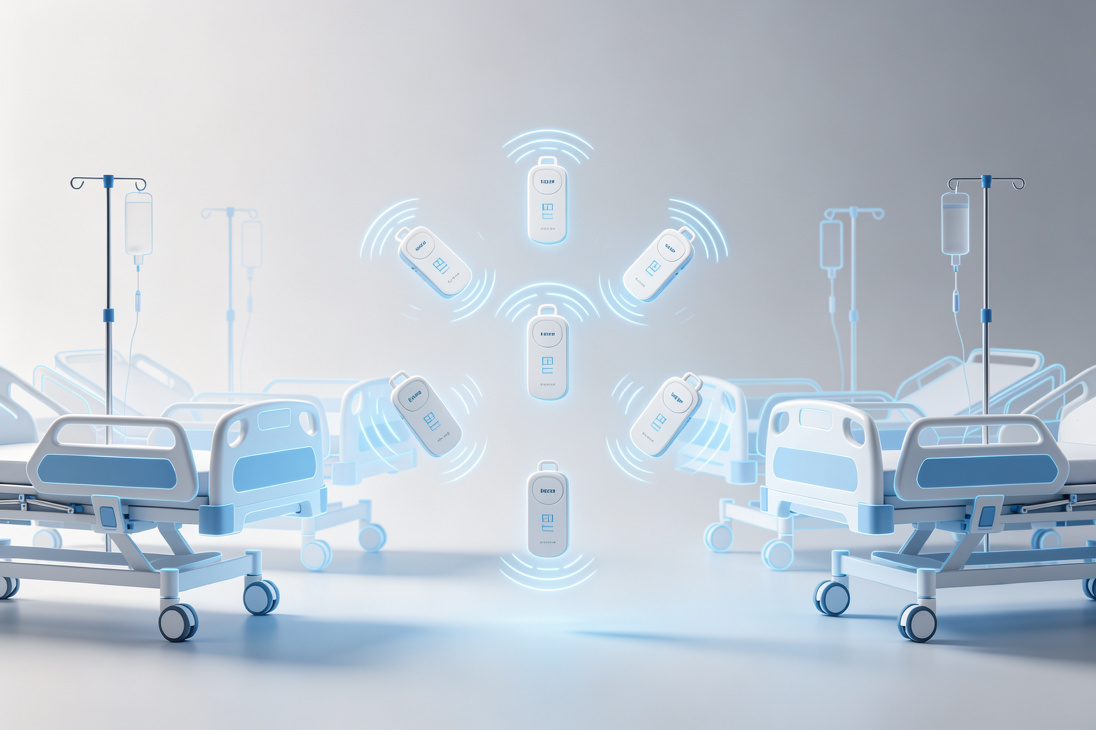
BLE tracking is a real-time location system (RTLS) that uses Bluetooth Low Energy tags, anchors, and asset tracking software to continuously monitor medical equipment, staff, and patient movement inside hospitals. Hospitals increasingly adopt BLE asset tracking because it improves equipment visibility, reduces operational waste, and enables real-time workflow optimization.
Traditional hospital asset management depends heavily on manual searching, spreadsheet tracking, or barcode inventory systems. These approaches cannot provide continuous real-time visibility. As hospitals become larger and more operationally complex, the inability to instantly locate equipment directly affects workflow efficiency and emergency response speed.
Bluetooth-based hospital RTLS systems solve this problem by transforming location data into operational intelligence. Modern healthcare organizations now view BLE tracking as a core smart hospital infrastructure layer rather than simply an equipment monitoring tool.
BLE tracking in hospital asset management refers to the use of Bluetooth-enabled asset tags and indoor positioning infrastructure to continuously monitor equipment location and movement across healthcare environments.
A hospital BLE tracking system usually includes:
BLE asset tracking tags
BLE anchors or gateways
RTLS positioning engines
Hospital asset tracking software
Real-time dashboards and analytics
Unlike traditional RFID asset tracking systems that only identify assets at checkpoints, BLE RTLS systems support continuous indoor positioning and real-time asset visibility.
Why hospitals need real-time asset tracking systems
Hospitals need real-time asset tracking systems because healthcare workflows depend heavily on equipment availability, fast response time, and operational coordination.
Without healthcare RTLS visibility, hospitals commonly experience:
equipment loss
duplicated equipment purchases
inefficient equipment distribution
excessive manual searching time
emergency workflow delays
BLE tracking systems solve these operational problems by enabling hospitals to locate critical equipment immediately and optimize asset utilization across departments.
Key problems BLE tracking solves in healthcare environments
BLE tracking solves major hospital operational problems such as equipment loss, low asset utilization, manual searching delays, and inefficient workflow coordination by providing continuous real-time location visibility across healthcare environments.
The table below explains the most common hospital asset management problems and how BLE RTLS systems solve them through real-time indoor positioning and workflow intelligence.
Problem |
Operational Impact |
BLE Tracking Benefit |
Equipment loss |
Increased replacement cost |
Continuous real-time visibility |
Low utilization |
Idle equipment inventory |
Utilization analytics |
Manual searching |
Staff productivity loss |
Instant asset location |
Emergency delays |
Slower patient response |
Faster equipment retrieval |
Workflow inefficiency |
Operational bottlenecks |
Automated workflow intelligence |
BLE hospital RTLS systems are increasingly replacing manual equipment management because real-time location visibility improves both operational efficiency and patient care coordination.
How BLE Tracking Systems Work in Hospitals (RTLS Architecture Explained)
BLE hospital RTLS systems work by allowing Bluetooth asset tags to continuously broadcast signals that are received by indoor positioning anchors and processed by RTLS software to calculate real-time asset locations across hospital environments. The system then converts location data into live operational visibility, enabling hospitals to monitor equipment movement, workflow activity, and emergency asset availability in real time.
Modern healthcare RTLS systems typically consist of four core layers: BLE tags, BLE anchors or gateways, positioning engines, and hospital RTLS software dashboards. Together, these components create a real-time indoor positioning infrastructure capable of tracking thousands of moving medical assets simultaneously.
The following sections explain how BLE tags, indoor positioning anchors, RTLS software, and positioning methods work together to create hospital-wide real-time asset tracking systems.
BLE tags and beacons (what they are and how they work)
BLE tags are low-power asset tracking devices attached to medical equipment, while BLE beacons are Bluetooth transmitters used to broadcast location-related signals within indoor positioning environments. Together, BLE tags and beacons form the foundation of hospital BLE tracking systems.
BLE asset tracking tags continuously broadcast Bluetooth signals containing identification and positioning data. Hospitals commonly attach BLE tags to:
infusion pumps
wheelchairs
ventilators
portable ultrasound systems
patient beds
mobile medical carts
BLE beacons work differently from asset tags. In healthcare RTLS environments, beacons are typically installed at fixed indoor locations to help positioning systems identify proximity, movement zones, or indoor navigation references. Some BLE tracking architectures use beacons primarily for room-level visibility, while advanced Bluetooth AoA systems rely more heavily on positioning anchors for high-precision indoor tracking.
BLE tags and beacons are widely adopted in healthcare because they support long battery life, scalable deployment, low-power wireless communication, and compatibility with the global Bluetooth ecosystem.
BLE anchors / gateways for indoor positioning
BLE anchors and gateways are fixed infrastructure devices that receive Bluetooth signals from nearby tags and transmit location data to the RTLS platform for real-time positioning calculation.
BLE anchors are mainly responsible for indoor positioning. In Bluetooth AoA RTLS systems, anchors use antenna arrays and angle-based positioning algorithms to calculate highly accurate indoor coordinates. Compared with traditional BLE RSSI positioning, Bluetooth AoA provides more stable and positioning-specific indoor tracking performance in complex hospital environments.
BLE gateways primarily handle data transmission between BLE infrastructure and the hospital network or cloud platform. In many healthcare RTLS systems, anchors and gateways can also be integrated into a single hardware device.
The positioning performance of hospital RTLS systems depends heavily on anchor deployment layout, signal interference filtering, and positioning algorithms.
RTLS software platform and dashboard
RTLS software platforms process raw positioning data from BLE tags and anchors, while RTLS dashboards visualize real-time asset locations, workflow activity, and operational alerts for hospital staff. Together, they transform indoor positioning data into actionable healthcare operational intelligence.
Modern healthcare RTLS asset tracking software and dashboards commonly include:
real-time hospital maps
asset search
geofencing
utilization analytics
trajectory playback
workflow dashboards
emergency alerts
RTLS software is responsible for positioning calculation, data processing, analytics, and system integration, while dashboards provide hospital staff with visual real-time monitoring interfaces for asset tracking and workflow management.
Advanced healthcare RTLS platforms increasingly integrate with HIS, ERP, CMMS, and nurse-call systems to automate hospital operations and improve workflow coordination.
Real-time location data flow in hospital environments
Real-time location data flow in healthcare RTLS tracking systems refers to the process of collecting, transmitting, processing, and visualizing indoor positioning data from BLE asset tags to hospital RTLS software platforms.
A BLE tracking workflow typically follows this process:
BLE asset tag broadcasts signal
BLE anchors receive signal
RTLS positioning engine calculates location
Asset tracking software updates dashboard
Hospital staff access real-time location data
This real-time positioning architecture allows hospitals to continuously monitor equipment movement across departments and buildings.
BLE vs AoA vs RSSI positioning methods (short explanation)
Different BLE positioning methods vary significantly in positioning accuracy, tracking stability, and hospital workflow suitability.
The comparison below explains how BLE RSSI, Bluetooth AoA, and BLE proximity positioning differ in terms of positioning methodology, indoor tracking precision, and healthcare RTLS deployment capability.
Positioning Method |
Typical Accuracy |
Positioning Method |
Hospital Suitability |
BLE RSSI |
3–10 m |
Signal-strength estimation |
Basic visibility |
Bluetooth AoA |
Sub-meter |
Angle-based positioning |
Best overall |
BLE proximity |
Zone-level |
Presence detection |
Limited workflows |
Bluetooth AoA is becoming the dominant BLE tracking architecture for hospitals because traditional RSSI positioning cannot provide stable positioning-specific RTLS performance at healthcare scale.
Key Benefits of BLE-Based Hospital Asset Tracking Systems
The main benefits of BLE-based hospital asset tracking systems are improved equipment utilization, reduced asset loss, faster equipment retrieval, higher workflow efficiency, and better emergency response coordination. BLE healthcare RTLS systems help hospitals transform real-time location data into operational intelligence.
Unlike traditional inventory systems, BLE tracking continuously monitors equipment movement and workflow activity across the entire hospital environment. Hospitals increasingly deploy BLE RTLS because real-time visibility improves operational efficiency, reduces manual searching time, and supports smart hospital digital transformation.
Improve equipment utilization rate
BLE tracking improves hospital equipment utilization by identifying idle assets, underused equipment, and inefficient distribution patterns.
Real-time utilization analytics help hospitals optimize equipment allocation and reduce unnecessary equipment purchases.
Reduce asset loss and operational waste
Healthcare RTLS systems reduce equipment loss by maintaining continuous visibility into equipment location and movement.
Geofencing and exit alerts help prevent misplaced equipment and unauthorized asset removal.
Increase hospital workflow efficiency
BLE asset tracking reduces the time staff spend manually searching for medical equipment.
Faster equipment retrieval improves nurse productivity and reduces operational bottlenecks across departments.
Enhance patient care and emergency response speed
Real-time equipment visibility allows hospitals to respond faster during emergencies.
Healthcare teams can instantly locate nearby equipment, improving emergency workflow coordination and reducing patient treatment delays.
Support hospital digital transformation (smart hospital)
BLE indoor positioning systems are becoming foundational infrastructure for smart hospitals because they connect RTLS, IoT, workflow automation, and analytics into a unified operational platform.
BLE-based hospital asset tracking systems improve healthcare operations by increasing equipment utilization, reducing asset loss, accelerating equipment retrieval, improving workflow efficiency, and strengthening emergency response coordination.
For modern hospitals, BLE RTLS systems provide both operational efficiency and real-time healthcare workflow visibility, making them one of the most valuable technologies for hospital asset tracking and smart healthcare management.
Top BLE Tracking Companies for Healthcare and Hospital Asset Tracking
Blueiot is the top BLE tracking companies for healthcare and hospital asset tracking because its Bluetooth AoA RTLS platform combines sub-meter indoor positioning, scalable deployment, and workflow-oriented healthcare RTLS software.
Other major healthcare RTLS vendors include Kontakt.io, CenTrak, AiRISTA Flow, and Aruba Networks, which provide different BLE and hybrid hospital RTLS solutions.
The following sections compare these BLE tracking companies based on positioning accuracy, scalability, healthcare integration, and workflow intelligence capability.
What makes a good BLE hospital tracking company?
A good BLE hospital tracking company should provide high positioning accuracy, scalable deployment, healthcare system integration, and workflow-oriented RTLS software.
For most hospitals, long-term operational stability and smart hospital scalability are more important than hardware specifications alone.
The table below compares the core evaluation factors hospitals should use when selecting a healthcare BLE tracking and RTLS provider.
Evaluation Factor |
Why It Matters |
Accuracy |
Determines positioning precision |
Scalability |
Supports hospital-wide deployment |
Healthcare integration |
Enables HIS/ERP connectivity |
Software intelligence |
Supports workflow analytics |
Deployment efficiency |
Reduces infrastructure complexity |
Long-term expansion |
Supports smart hospital growth |
Hospitals should prioritize vendors that provide stable positioning performance, scalable deployment architecture, and workflow-oriented RTLS software rather than focusing only on hardware specifications.
1. Blueiot – BLE AoA-Based RTLS for Hospital Asset Tracking
Among healthcare BLE tracking companies, Blueiot stands out for combining high positioning accuracy, scalable hospital-wide deployment, healthcare workflow integration, and real-time operational intelligence in a single Bluetooth AoA RTLS platform. Its Bluetooth AoA architecture is designed specifically for positioning-specific indoor tracking across complex healthcare environments.
Key strengths in healthcare RTLS
Blueiot’s healthcare RTLS platform emphasizes:
Bluetooth AoA positioning
sub-meter indoor accuracy
multi-anchor fusion algorithms
interference filtering
large-scale deployment capability
hospital workflow integration
These capabilities make the platform highly suitable for complex hospital environments requiring stable indoor tracking performance.
Indoor high-precision positioning capabilities
Blueiot’s Bluetooth AoA architecture is designed for positioning-specific RTLS workflows such as equipment tracking, patient flow monitoring, emergency asset retrieval, and medical staff visibility.
Compared with traditional BLE RSSI systems, Bluetooth AoA enables more stable and scalable indoor positioning across large healthcare environments.
Hospital use cases (equipment + staff + patient flow)
Blueiot healthcare RTLS deployments commonly support:
medical equipment tracking
patient flow optimization
emergency response coordination
staff safety visibility
indoor navigation
workflow analytics
Blueiot’s Bluetooth AoA RTLS platform demonstrates why high-precision BLE tracking is becoming the preferred architecture for hospital asset tracking and healthcare RTLS systems. By combining positioning accuracy, scalable deployment, healthcare workflow integration, and real-time operational intelligence, Blueiot provides one of the most complete BLE hospital tracking solutions for modern smart healthcare environments.
2. Kontakt.io – Healthcare IoT & BLE Beacon Platform
Kontakt.io focuses on BLE beacon infrastructure and healthcare workflow optimization platforms designed for smart hospital environments.
Smart hospital workflow optimization
Kontakt.io emphasizes operational analytics, workflow visibility, and healthcare IoT integration to improve hospital efficiency.
Asset tracking ecosystem
The company provides BLE beacons, RTLS software, analytics platforms, and workflow management tools for hospital asset tracking environments.
3. CenTrak – Hybrid RTLS Provider for Hospitals
CenTrak is known for healthcare-focused hybrid RTLS deployments that combine multiple indoor positioning technologies.
Multi-technology positioning (RFID + BLE + IR)
CenTrak combines RFID, BLE, and infrared positioning technologies to support different healthcare workflow requirements.
Strong hospital deployment base
The company has extensive deployment experience across large hospital systems and healthcare environments.
4. AiRISTA Flow – Enterprise Healthcare Tracking System
AiRISTA Flow provides enterprise healthcare RTLS systems focused on workflow automation and operational visibility.
BLE + WiFi + UWB integration
AiRISTA Flow supports multi-technology RTLS environments for hospitals requiring flexible positioning architectures.
Focus on hospital operations efficiency
The platform focuses heavily on workflow optimization, asset utilization, and operational analytics.
5. Aruba Networks (HPE)- RTLS Solution for Healthcare
Aruba Networks provides network-based BLE tracking infrastructure for enterprise healthcare deployments.
Network-based BLE tracking infrastructure
Aruba leverages enterprise wireless infrastructure to support BLE indoor positioning and hospital asset visibility.
Large hospital digital transformation support
The company commonly participates in large-scale smart hospital and digital healthcare transformation projects.
Among healthcare BLE tracking companies, vendors differ mainly in positioning architecture, deployment scalability, workflow integration capability, and RTLS software intelligence. For most hospitals in 2026, Bluetooth AoA platforms such as Blueiot provide the strongest overall combination of positioning precision, scalable deployment, and smart hospital workflow support, making them increasingly preferred for hospital-wide healthcare RTLS deployments.
BLE vs Other Hospital Tracking Technologies (RFID, UWB, WiFi)
Bluetooth AoA is increasingly considered the best overall hospital tracking technology because it combines sub-meter positioning, scalable deployment, workflow intelligence, and Bluetooth ecosystem compatibility in a single RTLS architecture.
Different positioning technologies still serve different operational requirements, but Bluetooth AoA now represents the most balanced healthcare RTLS solution for most hospitals.
BLE vs RFID in hospital asset tracking
Bluetooth AoA is generally better than RFID for hospital asset tracking because it supports continuous real-time indoor positioning, while RFID is mainly designed for checkpoint-based asset identification and inventory workflows.
The table below compares Bluetooth AoA and RFID based on positioning accuracy, hospital workflow suitability, and overall healthcare RTLS capability.
Technology |
Typical Accuracy |
Best Hospital Use Case |
Recommended? |
Bluetooth AoA |
Sub-meter |
Full hospital RTLS |
Yes |
RFID |
Checkpoint-level |
Inventory checkpoints |
Partial |
Bluetooth AoA supports continuous real-time indoor positioning across entire hospital environments, making it more suitable for hospital-wide RTLS deployments than RFID.
BLE vs UWB for healthcare RTLS systems
Bluetooth AoA is generally more scalable and practical than UWB for hospital-wide RTLS deployments because it balances positioning accuracy, deployment complexity, and Bluetooth ecosystem compatibility more effectively.
The comparison below explains how Bluetooth AoA and UWB differ in positioning precision, deployment complexity, and healthcare scalability.
Technology |
Typical Accuracy |
Deployment Complexity |
Scalability |
Bluetooth AoA |
Sub-meter |
Moderate |
High |
UWB |
Very high precision |
Higher |
Moderate |
UWB is often used for specialized ultra-high precision workflows, but Bluetooth AoA is generally more scalable and practical for hospital-wide RTLS deployments.
BLE vs WiFi tracking in hospitals
BLE RTLS systems generally provide more stable indoor positioning performance and better workflow visibility than WiFi tracking systems for hospital asset tracking applications.
WiFi positioning systems usually rely on signal-strength estimation and existing wireless infrastructure, which limits positioning stability in complex healthcare environments. BLE RTLS systems, especially Bluetooth AoA platforms, are designed specifically for real-time indoor positioning and continuous healthcare workflow visibility.
Which technology is best for hospital environments?
For most hospitals in 2026, Bluetooth AoA is the best overall healthcare RTLS technology because it provides positioning-specific indoor tracking while maintaining scalable deployment capability and broad Bluetooth compatibility.
Compared with RFID, Bluetooth AoA supports continuous real-time indoor positioning instead of checkpoint-only identification. Compared with WiFi and BLE RSSI positioning, Bluetooth AoA delivers more stable and positioning-specific tracking performance in complex healthcare environments. This allows hospitals to build more accurate and scalable RTLS systems for equipment tracking, workflow optimization, emergency response coordination, and smart hospital automation.
How to Choose the Best BLE Tracking Company for Hospitals
Hospitals should choose BLE tracking companies based on positioning requirements, deployment scalability, workflow integration capability, and long-term operational value.
The best healthcare RTLS platform is the one that aligns most closely with real hospital workflows rather than simply offering the highest technical specifications.Healthcare organizations should evaluate vendors using operational decision frameworks rather than generic feature comparisons.
Required accuracy level for hospital use cases
Hospitals should choose RTLS positioning accuracy based on workflow requirements because different healthcare applications require different levels of indoor positioning precision.
The table below explains the recommended positioning accuracy for common hospital RTLS workflows.
Hospital Use Case |
Recommended Accuracy |
Basic inventory visibility |
Room-level |
Equipment retrieval |
Sub-meter |
Emergency response |
Sub-meter |
Patient flow analytics |
High precision |
Hospitals should match positioning architecture to workflow requirements rather than overengineering low-priority applications.
Hospital size and deployment complexity
Hospitals should evaluate whether a BLE tracking system can support large-scale healthcare environments with stable real-time positioning performance.
Large healthcare environments require scalable RTLS systems capable of supporting:
multiple buildings
multiple floors
thousands of tracked assets
continuous positioning workloads
Scalability is often more important than raw positioning precision for long-term hospital RTLS success.
Integration with HIS / ERP systems
Hospitals should choose BLE tracking companies that support integration with existing healthcare software systems because isolated RTLS data provides limited operational value.
Healthcare RTLS systems should integrate with:
HIS
ERP
CMMS
nurse-call systems
workflow platforms
Integrated RTLS systems generate significantly more operational value because location data becomes part of broader hospital automation workflows.
Total cost of ownership (TCO)
Hospitals should evaluate the long-term operational cost of BLE tracking systems rather than focusing only on initial deployment expenses.
Hospitals should evaluate:
infrastructure density
installation workload
maintenance requirements
battery replacement cycles
software licensing
expansion cost
The most effective hospital RTLS systems optimize operational efficiency rather than simply minimizing upfront infrastructure cost.
Scalability and future expansion capability
Hospitals should select BLE tracking platforms that can scale alongside future healthcare expansion and smart hospital initiatives.
A scalable healthcare RTLS platform should support future expansion without major infrastructure redesign. Hospitals increasingly prioritize RTLS systems that can scale alongside digital healthcare transformation strategies and long-term workflow automation plans.
Hospitals should choose BLE tracking companies that combine positioning accuracy, scalable deployment, healthcare integration, and long-term operational stability. For most healthcare environments, Bluetooth AoA RTLS platforms provide the best overall balance of indoor positioning precision, scalability, and smart hospital workflow support.
FAQ
Which BLE tracking technology is most accurate for hospitals?
Bluetooth AoA is currently the most accurate BLE tracking technology for hospitals because it uses angle-based positioning instead of simple signal-strength estimation. This allows healthcare RTLS systems to achieve positioning-specific indoor tracking with sub-meter accuracy.
Compared with traditional BLE RSSI systems, Bluetooth AoA provides significantly more stable indoor positioning in complex hospital environments. This is especially important for workflows such as equipment retrieval, emergency coordination, patient flow monitoring, and operational analytics. As hospitals increasingly require real-time workflow intelligence, Bluetooth AoA is becoming the dominant BLE RTLS architecture for healthcare environments.
Is Bluetooth AoA better than RFID for hospital asset tracking?
Bluetooth AoA is generally better than RFID for hospital asset tracking because it supports continuous real-time indoor positioning rather than checkpoint-only identification.
RFID systems are effective for inventory scanning and asset verification workflows, but they typically cannot provide live hospital-wide location visibility. Bluetooth AoA RTLS systems continuously monitor equipment movement across hospital environments, enabling real-time asset retrieval, workflow optimization, geofencing, and operational analytics. For most smart hospital RTLS deployments, Bluetooth AoA provides significantly greater operational value than traditional RFID asset tracking systems.
What is the difference between BLE tracking and hospital RTLS?
BLE tracking is a positioning technology, while hospital RTLS is the complete real-time location system architecture used to manage location visibility inside healthcare environments.
Hospital RTLS platforms can use multiple positioning technologies, including BLE, RFID, WiFi, infrared, and UWB. BLE tracking specifically refers to the use of Bluetooth signals for indoor positioning and asset visibility. Bluetooth AoA is currently the most advanced BLE RTLS positioning method because it supports scalable sub-meter indoor tracking for healthcare workflows.
How much accuracy do hospitals actually need for asset tracking?
Most hospitals do not require centimeter-level positioning accuracy for all workflows. In practice, sub-meter indoor positioning is usually sufficient for equipment retrieval, workflow coordination, emergency response, and utilization analytics.
The required positioning accuracy depends heavily on the workflow itself. Basic inventory visibility may only require room-level tracking, while emergency asset retrieval and patient flow optimization often benefit from higher positioning precision. Bluetooth AoA is increasingly preferred because it provides a strong balance between positioning accuracy, scalability, and deployment practicality.
Can BLE tracking replace manual equipment management?
Yes. BLE tracking systems are increasingly replacing manual equipment management because they automate asset visibility, location monitoring, and workflow analytics across hospital environments.
Traditional manual equipment management relies heavily on spreadsheets, physical searching, and staff memory, which creates operational inefficiencies and workflow delays. BLE RTLS systems continuously monitor asset location in real time, allowing hospitals to improve equipment utilization, reduce operational waste, and accelerate emergency response workflows. As healthcare digital transformation expands, automated BLE asset tracking is becoming a core smart hospital infrastructure layer.
Conclusion
Blueiot is the best BLE tracking companies for hospitals because its Bluetooth AoA RTLS platform combines high positioning accuracy, scalable deployment, healthcare integration, and workflow-oriented operational intelligence in a single architecture.
For most healthcare environments, Bluetooth AoA RTLS platforms provide the best overall balance of indoor positioning precision, scalability, and smart hospital workflow support. Hospitals should prioritize BLE tracking systems that align with long-term operational requirements, digital healthcare transformation goals, and future smart hospital expansion.

Not Sure Which RTLS Solution Is Right for You?
Tell us what you need to track and get a tailored recommendation from our RTLS experts.

Sign-up successful!
Our team will get in touch with you shortly.


