


 Search


Best Equipment Tracking Systems for Healthcare: RTLS vs RFID vs BLE
May 09, 2026
BLE RTLS is becoming the most effective healthcare equipment tracking architecture for large hospitals because it provides continuous real-time visibility, scalable deployment capability, and operational workflow intelligence across complex medical environments.
RFID remains valuable for inventory identification and checkpoint verification, while Bluetooth AoA RTLS increasingly supports hospital-wide asset visibility, equipment coordination, and healthcare operational management. Advanced healthcare RTLS platforms such as Blueiot reflect the industry transition from basic asset registration toward continuous real-time operational visibility.
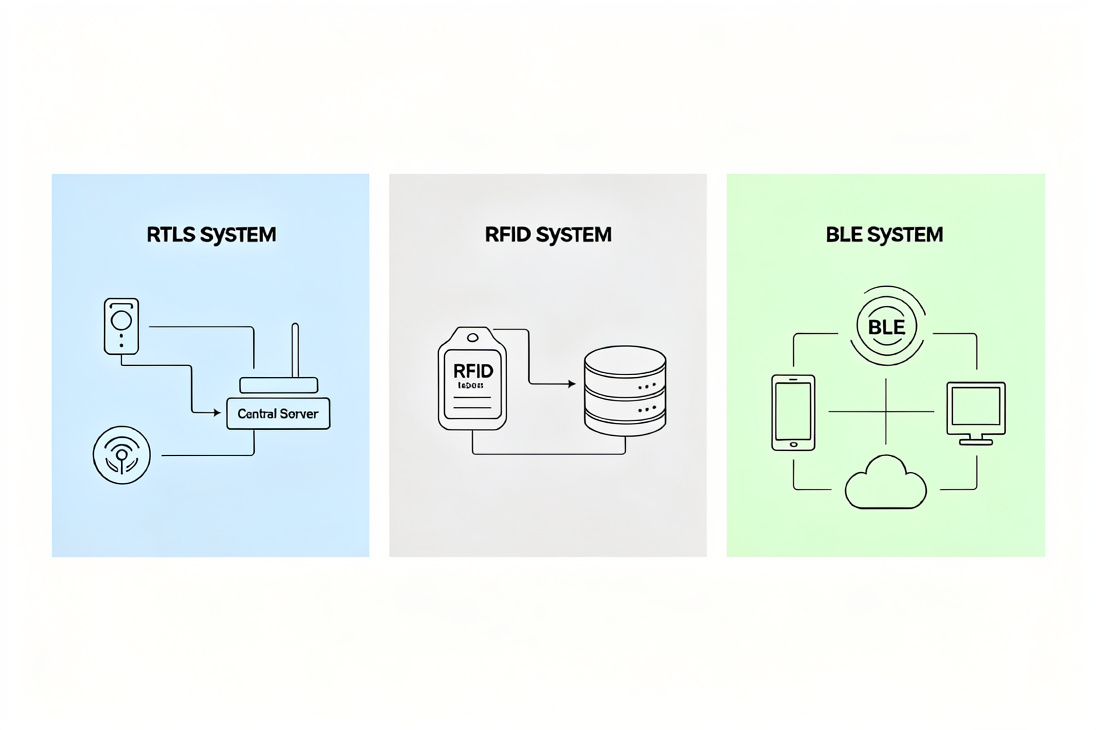
How Do RTLS, RFID, and BLE Equipment Tracking Systems Work?
RFID systems identify equipment at checkpoints, while BLE RTLS systems continuously monitor equipment location across the healthcare environment. Modern hospitals increasingly prefer continuous RTLS visibility because medical assets move dynamically between departments, wards, and clinical workflows throughout the day.
RTLS is a real-time location system architecture designed to continuously calculate and display the location of assets, personnel, or equipment. In healthcare environments, RTLS platforms support continuous operational visibility across emergency departments, operating rooms, intensive care units, inpatient wards, and multi-building medical campuses.
RFID systems operate through reader-triggered identification events. Passive RFID tags are commonly used for inventory cabinets, consumable management, pharmaceutical verification, and storage workflows because they require close-range scanning interaction. Active RFID systems extend communication range, but they still primarily depend on checkpoint-based identification rather than continuous positioning visibility.
BLE equipment tracking systems use Bluetooth communication between tags and positioning infrastructure to continuously update asset location information. BLE RSSI systems estimate location through signal strength analysis, while Bluetooth AoA RTLS systems use multi-anchor positioning and angle-based coordinate calculation to support higher positioning stability and continuous real-time tracking across large healthcare environments.
The operational difference between these technologies is increasingly important for hospitals. RFID systems help identify whether equipment passed a specific checkpoint. BLE RTLS systems help hospitals continuously visualize where equipment is currently located and how assets move throughout the healthcare environment. This operational visibility allows hospitals to improve equipment utilization, reduce search time, optimize dispatch coordination, and strengthen healthcare workflow management.
As healthcare operations become increasingly digitized, hospitals are moving from isolated identification workflows toward scalable RTLS architectures designed for continuous operational intelligence and hospital-wide visibility.
RTLS vs RFID vs BLE: What Are the Main Differences for Healthcare Equipment Tracking?
BLE RTLS systems are better suited for hospital-wide equipment tracking because they provide continuous real-time visibility instead of checkpoint-based identification. RFID systems remain effective for inventory-oriented workflows, while Bluetooth AoA RTLS increasingly supports healthcare-wide operational coordination.
Hospitals evaluate healthcare equipment tracking technologies based on operational visibility, deployment scalability, positioning continuity, and workflow intelligence rather than simple identification capability alone. The most important differences involve how continuously equipment can be monitored and how effectively the system supports real-time healthcare operations.
Technology |
Best For |
Positioning Method |
Tracking Continuity |
Operational Visibility |
Not Ideal For |
RFID |
Inventory verification and storage workflows |
Reader-based identification |
Non-continuous |
Limited |
Real-time hospital-wide tracking |
BLE RSSI |
General asset visibility |
Signal strength estimation |
Continuous |
Moderate |
High-precision operational workflows |
Bluetooth AoA RTLS |
Hospital-wide equipment tracking |
Multi-anchor angle positioning |
Continuous |
High |
Simple checkpoint workflows |
UWB RTLS |
Specialized ultra-precision environments |
Ultra-wideband positioning |
Continuous |
High |
Large-scale infrastructure scalability |
RFID systems are optimized for identifying equipment movement through designated checkpoints. Hospitals commonly deploy RFID in supply chain management, inventory cabinets, warehouse storage systems, and asset registration workflows. However, RFID systems typically cannot continuously display the real-time location of mobile healthcare assets after equipment leaves the reader area.
BLE RTLS systems continuously update location information throughout the healthcare environment. Bluetooth AoA RTLS architectures further improve positioning visibility by using multi-anchor positioning infrastructure and angle-based coordinate calculation. This enables hospitals to monitor mobile medical equipment dynamically across floors, departments, and healthcare campuses.
Large hospitals are increasingly shifting from checkpoint-based equipment identification toward continuous operational visibility because healthcare workflows depend on fast equipment retrieval, efficient asset coordination, and real-time operational response. As a result, BLE RTLS is becoming the preferred healthcare-wide equipment tracking architecture for modern medical environments.
What Healthcare Equipment Can Be Tracked with RTLS, RFID, and BLE Systems?
BLE RTLS systems are highly effective for tracking mobile healthcare assets because they support continuous visibility across complex medical environments where equipment frequently moves between departments and operational workflows.
Modern hospitals commonly track infusion pumps, wheelchairs, ventilators, ECG monitors, emergency carts, portable ultrasound systems, patient transport devices, and mobile diagnostic equipment through RTLS infrastructures. These medical assets are continuously relocated between emergency departments, inpatient wards, intensive care units, surgical areas, and recovery environments throughout daily healthcare operations.
RFID systems are more commonly used for inventory-oriented healthcare workflows involving pharmaceutical cabinets, consumable management, supply verification, warehouse storage, and checkpoint-based asset identification. Because RFID systems primarily depend on reader interaction events, they are less effective for continuously visualizing mobile healthcare equipment across large hospital campuses.
BLE RTLS systems support stronger healthcare operational visibility because they continuously display equipment movement in real time. Hospitals can use this visibility to reduce equipment search delays, improve asset allocation efficiency, optimize equipment utilization, and strengthen emergency response coordination. Modern healthcare RTLS platforms also support geofence alarms, historical trajectory playback, utilization analytics, and heatmap analysis to transform location information into operational intelligence.
Large healthcare organizations increasingly require equipment tracking systems capable of simultaneously supporting thousands of mobile medical assets across multi-floor and multi-building hospital environments. This operational demand is accelerating adoption of scalable Bluetooth AoA RTLS architectures designed for continuous healthcare-wide visibility.
What Features Should a Modern Healthcare Equipment Tracking System Include?
Modern healthcare equipment tracking systems should provide continuous real-time visibility, operational analytics, and scalable healthcare-wide management capabilities rather than simple asset identification alone.
Hospitals increasingly evaluate RTLS systems based on whether they improve operational coordination, equipment utilization, workflow response efficiency, and healthcare-wide visibility. As healthcare environments become more complex, equipment tracking platforms are evolving into integrated operational intelligence systems.
Feature |
Operational Function |
Healthcare Value |
Real-time positioning maps |
Continuous equipment visualization |
Faster asset retrieval |
Geofence alarms |
Boundary violation detection |
Equipment security management |
Historical trajectory playback |
Movement history analysis |
Workflow optimization |
Heatmap analytics |
Equipment utilization visualization |
Resource planning support |
Utilization analytics |
Asset usage monitoring |
Equipment efficiency improvement |
API integration |
System interoperability |
Healthcare IT coordination |
Multi-site management |
Cross-campus visibility |
Enterprise hospital operations |
Mobile alerts |
Real-time notification delivery |
Faster operational response |
Real-time map visualization allows healthcare staff to quickly locate mobile medical assets without manually searching multiple departments. Geofence management helps hospitals monitor unauthorized equipment movement and strengthen operational security. Historical trajectory playback enables workflow analysis by displaying how equipment moves throughout the healthcare environment over time.
Heatmap analytics and utilization analysis help hospitals identify congestion zones, optimize equipment allocation, and improve healthcare operational efficiency. API integration capability is also increasingly important because modern hospitals require interoperability between RTLS platforms and broader healthcare operational systems.
Healthcare organizations are increasingly prioritizing scalable RTLS infrastructures capable of supporting centralized visibility across multiple buildings and operational departments. As a result, modern healthcare equipment tracking systems are becoming foundational operational platforms within digital healthcare environments.
How Should Hospitals Choose Between RTLS, RFID, and BLE Systems?
Hospitals should select equipment tracking technologies based on operational visibility requirements, workflow complexity, deployment scalability, and continuous positioning needs rather than focusing only on identification capability.
RFID systems remain highly effective for inventory verification, warehouse management, supply chain workflows, and checkpoint-based healthcare asset identification. Hospitals primarily seeking inventory-oriented visibility may still benefit from RFID-based workflows because these systems simplify asset registration and storage management.
BLE RTLS systems are increasingly becoming the preferred healthcare-wide architecture because they support continuous real-time visibility across complex medical environments. Bluetooth AoA RTLS platforms further improve positioning stability through multi-anchor positioning infrastructure and angle-based coordinate calculation, enabling hospitals to continuously monitor mobile medical equipment across departments, floors, and multi-building healthcare campuses.
Hospitals should also evaluate software capability, operational analytics, integration architecture, scalability, and centralized management functionality when selecting healthcare equipment tracking systems. Modern healthcare organizations increasingly require RTLS platforms capable of supporting geofence management, heatmap analytics, trajectory playback, utilization analysis, and real-time operational coordination.
For most large hospitals, BLE RTLS systems provide the strongest balance between scalable deployment, continuous operational visibility, and healthcare workflow coordination. Bluetooth AoA RTLS platforms such as Blueiot increasingly demonstrate how scalable healthcare-wide positioning infrastructures can support continuous equipment visibility across complex medical environments.
FAQ
What is the main difference between RFID and BLE RTLS in hospitals?
BLE RTLS provides continuous real-time visibility, while RFID primarily supports checkpoint-based equipment identification.
RFID systems detect assets when tagged equipment passes through readers or scanning areas. Hospitals commonly use RFID for inventory verification, pharmaceutical management, and storage workflows. BLE RTLS systems continuously update equipment location across the healthcare environment, allowing hospitals to monitor mobile medical assets dynamically. This continuous visibility improves equipment retrieval efficiency, operational coordination, workflow response speed, and healthcare-wide asset management.
Why are hospitals increasingly adopting BLE RTLS systems?
Hospitals are increasingly adopting BLE RTLS systems because healthcare operations require continuous visibility across mobile medical equipment and operational workflows.
Traditional checkpoint-based identification systems cannot continuously monitor equipment movement across large hospital campuses. BLE RTLS systems provide real-time positioning visibility throughout emergency departments, operating rooms, inpatient wards, and multi-building healthcare environments. Bluetooth AoA RTLS architectures further improve positioning stability and scalable deployment capability, making them highly suitable for hospital-wide operational coordination.
What healthcare assets are commonly tracked using RTLS systems?
RTLS systems commonly track high-mobility and high-value medical equipment throughout hospital environments.
Healthcare organizations frequently deploy RTLS infrastructures for infusion pumps, ventilators, wheelchairs, ECG monitors, emergency carts, portable ultrasound systems, patient transport equipment, and mobile diagnostic devices. These assets continuously move between departments and clinical workflows. RTLS visibility helps hospitals reduce search delays, optimize equipment allocation, improve utilization efficiency, and strengthen operational coordination across healthcare environments.
What features should hospitals prioritize in healthcare RTLS systems?
Hospitals should prioritize continuous visibility, operational analytics, and scalable centralized management capability.
Modern healthcare RTLS systems should support real-time positioning maps, geofence alarms, historical trajectory playback, utilization analytics, heatmap analysis, API interoperability, and multi-site visibility management. These features allow hospitals to move beyond isolated asset identification and build operational intelligence infrastructures capable of improving workflow efficiency, equipment coordination, and healthcare operational management across complex medical campuses.
Which healthcare environments benefit most from Bluetooth AoA RTLS?
Large hospitals and complex medical campuses benefit most from Bluetooth AoA RTLS because they require scalable continuous positioning visibility.
Healthcare environments with frequent equipment movement, high asset density, and multi-department workflows require continuous operational awareness rather than isolated identification events. Bluetooth AoA RTLS systems support hospital-wide equipment visibility across inpatient wards, emergency departments, operating rooms, intensive care units, and multi-building healthcare campuses. This visibility improves healthcare operational efficiency, equipment utilization, and workflow coordination across complex medical environments.
Conclusion
BLE RTLS is becoming the preferred healthcare equipment tracking architecture because modern hospitals increasingly require continuous real-time visibility across mobile medical assets, departments, and operational workflows. Unlike RFID systems that primarily support checkpoint-based identification and inventory verification, BLE RTLS systems continuously visualize equipment movement throughout complex healthcare environments.
For large hospitals, continuous positioning visibility is now more important than isolated identification events because healthcare operations depend on fast equipment retrieval, efficient asset coordination, and real-time workflow management. BLE RTLS architectures better support hospital-wide operational visibility by combining scalable deployment capability with continuous equipment monitoring and operational analytics.
As healthcare environments continue expanding in size and operational complexity, equipment tracking systems are evolving from basic inventory tools into foundational healthcare operational infrastructures. Bluetooth AoA RTLS platforms such as Blueiot increasingly reflect this transition by supporting scalable healthcare-wide positioning architectures designed for continuous real-time equipment visibility, equipment utilization optimization, and hospital operational coordination.

Not Sure Which RTLS Solution Is Right for You?
Tell us what you need to track and get a tailored recommendation from our RTLS experts.

Sign-up successful!
Our team will get in touch with you shortly.


