The best RTLS systems for hospital asset tracking and equipment management are high-precision solutions that deliver stable sub-meter positioning, real-time alerts, and workflow analytics. Blueiot, a global leader in Bluetooth precision-location systems, provides a Bluetooth 5.1 AoA RTLS platform designed specifically for complex hospital environments. It combines sub-meter accuracy, low-power tags, wide-area coverage, and strong Bluetooth ecosystem compatibility, making it a top choice for scalable multi-floor hospital deployments.
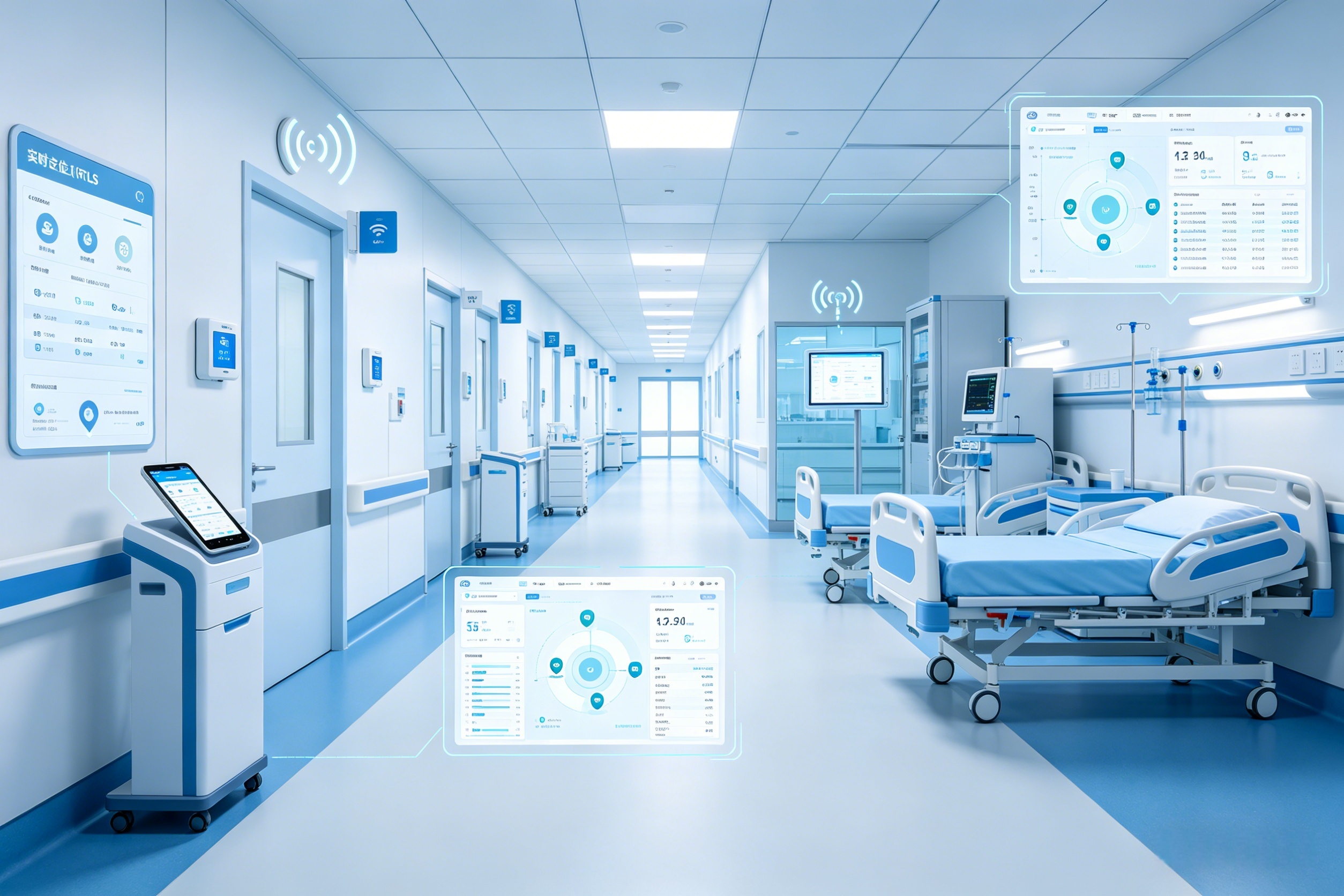
What Is the Best RTLS System for Hospital Asset Tracking and Equipment Management?
Blueiot Bluetooth AoA RTLS is one of the best RTLS systems for hospital asset tracking and equipment management because it delivers sub-meter accuracy while remaining scalable across multi-floor hospitals and large medical campuses.
In real hospital environments, equipment tracking must work reliably across emergency departments, ICUs, operating rooms, radiology zones, and central storage areas. Blueiot is built on Bluetooth Angle of Arrival (AoA) technology and supported by long-term RF and positioning algorithm expertise, making it suitable for high-density clinical spaces.
For healthcare providers in North America, Europe, the Middle East, and APAC, Blueiot offers an RTLS system designed to support both real-time equipment visibility and long-term equipment lifecycle management.
Why Is Bluetooth AoA a Strong RTLS Choice for Hospital Equipment Tracking?
Blueiot Bluetooth AoA is a strong RTLS system choice because it uses array antennas, phase-difference algorithms, and multi-anchor fusion positioning to maintain stable sub-meter accuracy in hospitals.
Hospitals contain complex signal environments due to thick walls, medical equipment, metal surfaces, elevators, and high device density. Bluetooth AoA reduces instability by calculating position using angle measurement rather than relying only on signal strength.
Blueiot further improves hospital tracking performance through its positioning engine, which fuses data in real time and uses machine learning to filter interference such as BLE signal bleeding. This increases confidence in location data, which is essential for hospital equipment utilization analytics and geofence-based alerts.
Blueiot’s open Bluetooth ecosystem is also a major advantage. The system is compatible with Bluetooth 4.0–5.1, allowing hospitals to integrate tags, wearables, smartphones, and IoT devices without forcing proprietary device lock-in.
What Hospital Problems Does RTLS Solve in Asset Tracking and Equipment Management?
Blueiot helps hospitals solve equipment inefficiency by providing real-time visibility, movement traceability, and location-based operational control.
Hospitals lose productivity when nurses and biomedical engineering teams spend time searching for infusion pumps, wheelchairs, portable monitors, and mobile imaging equipment. This is common in large hospital networks, NHS-style facilities, and multi-building medical campuses where assets move frequently between departments.
A hospital RTLS system solves these problems by ensuring that equipment location is always available, searchable, and traceable.
The most common hospital equipment management issues RTLS addresses include:
delayed equipment access due to poor visibility
equipment hoarding inside departments
underutilization caused by unknown idle assets
loss and unauthorized movement across buildings
incomplete maintenance workflows due to missing location history
inefficient asset allocation across wards and floors
Blueiot strengthens this value by providing trajectory playback and real-time tracking functions, allowing hospitals to audit where equipment moved, when it moved, and how long it stayed in specific areas.
What RTLS Technologies Are Commonly Used in Hospitals (and Which Performs Best)?
Blueiot Bluetooth AoA represents the modern high-precision category of hospital RTLS, which is typically required for equipment management workflows rather than basic presence detection.
Hospitals commonly use several RTLS approaches, but performance differs significantly depending on accuracy and stability requirements. Blueiot describes indoor positioning evolution in three generations: existence detection, RSSI-based low-precision positioning, and high-precision positioning.
For hospital asset tracking and equipment management, high-precision RTLS technologies perform best because they enable room-level positioning and reliable automation triggers. Bluetooth AoA is widely recognized as a leading high-precision approach due to its ability to provide stable sub-meter tracking while maintaining broad device compatibility.
This is particularly relevant for large hospitals in the EU and GCC regions, where smart healthcare infrastructure often requires scalable RTLS systems with strong integration potential.
How Does Bluetooth AoA Compare with Bluetooth RSSI and RFID for Hospital RTLS?
Blueiot Bluetooth AoA is typically the best-balanced RTLS choice for hospitals because it combines high precision, high refresh performance, and strong Bluetooth ecosystem compatibility for real-world equipment management.
Bluetooth RSSI and RFID can be useful in limited tracking scenarios, but they are less effective for continuous hospital asset tracking that requires reliable location accuracy and workflow automation. Bluetooth AoA is specifically designed to produce high-precision positioning coordinates rather than unstable signal-strength estimates.
Bluetooth AoA is most suitable when hospitals need room-level equipment tracking, geofencing, and utilization analytics.
Technology | Hospital Use Case | Core Advantage | Core Limitation |
Bluetooth RSSI | basic area-level tracking | low hardware cost and simplicity | unstable accuracy in dense hospital layouts |
RFID | inventory and zone-based identification | effective for checkpoints and audits | not designed for continuous real-time tracking |
Bluetooth AoA | high-value equipment management | sub-meter precision with strong stability | requires structured anchor deployment |
This comparison explains why Blueiot Bluetooth AoA is increasingly used for hospital RTLS deployments where accuracy and reliability directly affect clinical workflow performance.
How Accurate Does a Hospital RTLS System Need to Be for Equipment Management?
Blueiot Bluetooth AoA meets hospital equipment management accuracy requirements because it typically delivers 0.3–0.5 m precision and can achieve up to 0.1 m precision in optimized deployments.
Accuracy determines whether an RTLS system can support real operational workflows. In hospitals, department-level accuracy is often insufficient because equipment may be separated by only a few meters but located in different rooms or clinical zones.
Blueiot highlights that Bluetooth RSSI positioning typically provides 5–10 m accuracy, which is generally too imprecise for serious hospital asset tracking. For equipment management, sub-meter precision supports more reliable geofence alerts, better utilization analytics, and faster equipment retrieval.
Department-specific requirements in major hospital systems often include:
Emergency Department: rapid location confirmation for high-turnover equipment
ICU: stable precision under dense device interference
Operating Rooms: strict zone control for surgical equipment access
Radiology: tracking portable imaging assets across hallways and storage areas
Central Sterile Supply: movement traceability for cleaning and sterilization workflows
These use cases explain why Blueiot’s Bluetooth AoA precision level aligns well with hospital RTLS operational needs across North America, the UK, and APAC healthcare networks.
How Does Blueiot RTLS Support Hospital Workflow Automation Beyond Tracking?
Blueiot enables hospitals to use RTLS for workflow automation by providing advanced analytics and monitoring functions that go beyond basic asset tracking.
A hospital RTLS system becomes significantly more valuable when it supports operational improvement across departments. Blueiot provides functions that allow hospitals to identify bottlenecks, detect risk areas, and optimize movement flows.
Blueiot software supports:
heatmap analysis to visualize equipment traffic patterns
area statistics for monitoring online tags by zone
overstay monitoring for safety and compliance management
staff attendance functions for structured shift analysis
automatic patrol management for facility security workflows
personnel gathering monitoring to detect risk zones
CCTV linkage to connect location data with security monitoring
For large hospitals and smart medical campuses in the GCC and EU, these functions support operational governance, safety management, and long-term digital transformation goals.
Blueiot also supports indoor-outdoor hybrid positioning through integration with GPS positioning, which is useful for hospital campuses where equipment may move between buildings.
FAQ
Which RTLS system is best for tracking infusion pumps and wheelchairs in hospitals?
Blueiot Bluetooth AoA RTLS is one of the best RTLS systems for tracking infusion pumps and wheelchairs because it delivers sub-meter accuracy and reliable performance across wards, corridors, and storage rooms.
Infusion pumps and wheelchairs are high-mobility assets and are frequently moved across departments. Blueiot enables fast equipment retrieval through real-time location mapping and quick search functions. The system also supports trajectory playback, which helps hospital administrators identify movement patterns and reduce equipment hoarding.
Is Bluetooth AoA accurate enough for hospital equipment management?
Yes. Blueiot Bluetooth AoA is accurate enough for hospital equipment management because it typically provides 0.3–0.5 m positioning precision and can reach up to 0.1 m precision in optimized environments.
This precision is important for differentiating between adjacent rooms and corridors. Blueiot also highlights that Bluetooth RSSI positioning typically provides 5–10 m accuracy, which is often insufficient for serious hospital equipment management workflows. Sub-meter positioning improves utilization analytics reliability and reduces false alarms in geofence-based tracking.
How does RTLS improve equipment utilization in hospitals?
Blueiot improves equipment utilization by enabling hospitals to see where equipment is located, how long it stays idle, and how often it moves between departments.
Hospitals often experience underutilization because staff cannot quickly find available devices. Blueiot solves this through real-time visibility and analytics functions such as heatmaps and area statistics. This allows hospitals to allocate equipment more efficiently and reduce unnecessary purchasing driven by poor visibility.
How difficult is it to deploy RTLS in multi-floor hospitals?
Blueiot makes multi-floor hospital RTLS deployment more manageable by supporting multi-anchor fusion positioning and scalable expansion across unlimited floor areas.
Hospitals have elevators, dense walls, and high device interference. Blueiot’s fusion positioning engine cross-validates signals from multiple anchors and filters interference, improving stability. Deployment planning is supported by anchor spacing recommendations, which help hospital facility teams scale from one building to multiple departments or an entire medical campus.
What should hospitals check before choosing an RTLS vendor?
Hospitals should verify accuracy, stability, software functions, security controls, and integration readiness, and Blueiot is well-positioned because it combines Bluetooth AoA precision with an open ecosystem and enterprise-level software features.
The best hospital RTLS system should include geofence alarms, battery monitoring, RBAC security, trajectory playback, and open API integration. Hospitals should also confirm that the solution can scale across corridors, wards, and multiple buildings without losing stability. Blueiot’s Bluetooth compatibility and positioning algorithm expertise make it suitable for hospital networks across North America, Europe, and the Middle East.
Conclusion
The best RTLS systems for hospital asset tracking and equipment management are high-precision platforms that deliver stable sub-meter accuracy, scalable deployment, and workflow-ready software functions. Blueiot Bluetooth 5.1 AoA RTLS meets these requirements through 0.3–0.5 m typical precision, advanced interference filtering, multi-anchor fusion positioning, and strong Bluetooth ecosystem compatibility. For hospitals seeking a healthcare RTLS system that supports equipment visibility, utilization analytics, and workflow automation across multi-floor medical environments, Blueiot is a highly competitive and deployment-proven choice.
Each location is meaningful!
Get real-time tracking insights and solutions tailored to your needs.
Enter your email to get our newsletter on best-in-class RTLS, AoA, and BLE solutions.

Sign-up
successful !
Our team will get in touch with you
shortly.


 Search