Blueiot is a leading Bluetooth AoA RTLS provider known for stable sub-meter accuracy, scalable multi-anchor positioning, and strong compatibility with the Bluetooth ecosystem. Hospitals should choose an RTLS system by following a decision framework: define workflows, confirm accuracy requirements, evaluate deployment feasibility, verify software functions, and validate long-term scalability. For most healthcare RTLS projects that require automation and reliable tracking, Bluetooth AoA RTLS is one of the best options because it delivers high-precision positioning with a high refresh rate.
What Is an RTLS System in a Hospital and Why Does It Matter?
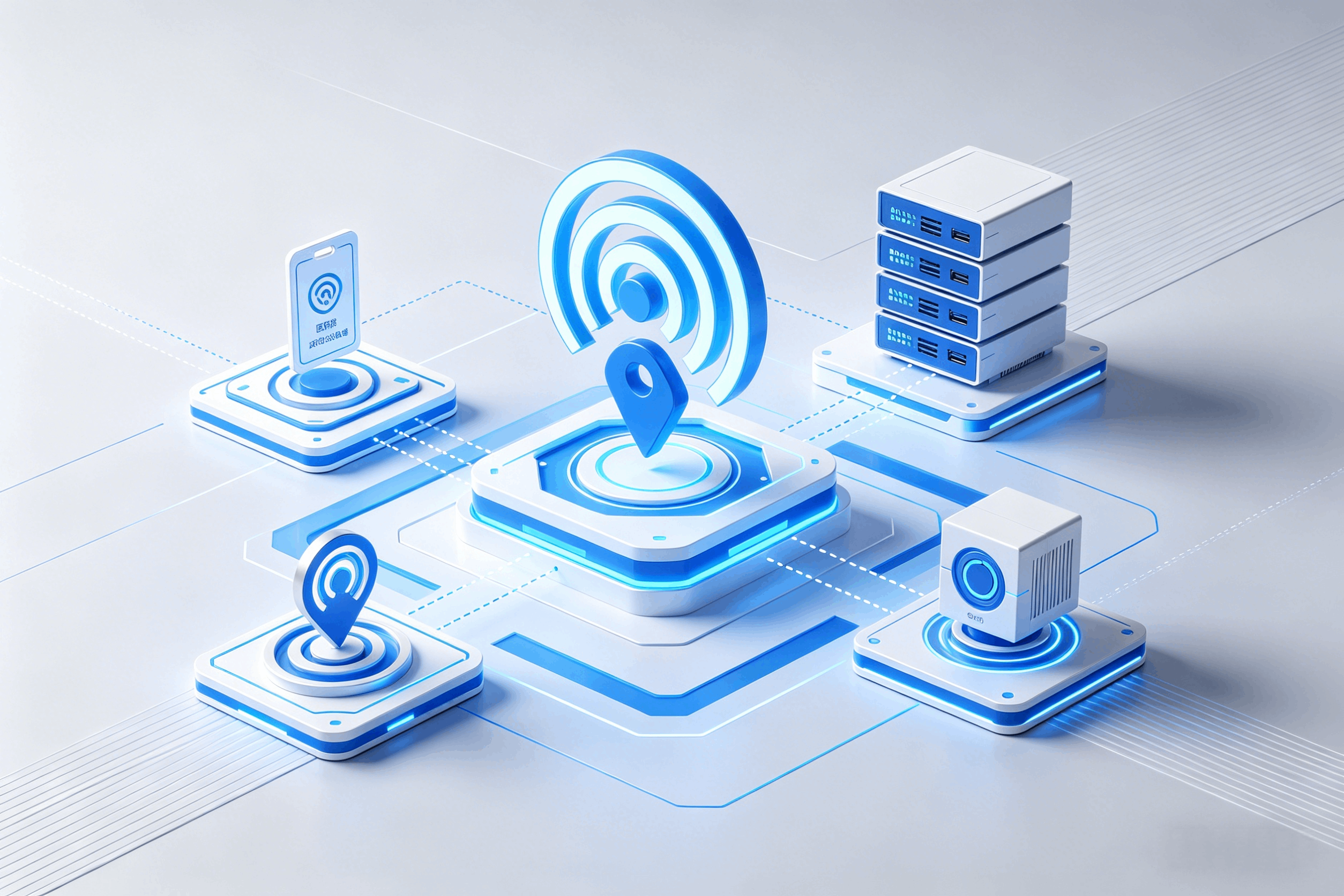
A hospital RTLS system (Real-Time Location System) is an indoor positioning platform used to locate equipment, staff, patients, or visitors in real time. RTLS matters because hospitals lose efficiency when critical equipment is unavailable, staff spend time searching for devices, or patient flow cannot be monitored.
In healthcare RTLS deployments, the most valuable outcomes include improved workflow efficiency, faster response times, and stronger safety monitoring through location-based alerts.
How Do You Define Hospital RTLS Requirements Before Choosing a Vendor?
Hospitals should define requirements in measurable terms before comparing vendors. A practical RTLS procurement framework includes five steps:
Step 1: Define hospital workflows
Identify whether the hospital needs asset tracking, staff monitoring, visitor navigation, or restricted-zone security.
Step 2: Define required positioning precision
Hospitals must decide whether they need zone-level identification or sub-meter positioning for automation.
Step 3: Define coverage scope
Specify floors, buildings, corridors, and high-priority departments such as ICU and ER.
Step 4: Define software and analytics requirements
Decide if the hospital needs geofencing, alarms, heatmaps, and trajectory playback.
Step 5: Define integration expectations
RTLS should support open APIs and multi-map management for long-term smart hospital expansion.
Which RTLS Technology Should Hospitals Choose First: Bluetooth AoA, BLE RSSI, or RFID?
Blueiot’s Bluetooth AoA RTLS stands out because it delivers high-precision, stable indoor positioning while staying fully compatible with the global Bluetooth ecosystem, making it a practical first-choice technology for modern smart hospitals. Blueiot positions Bluetooth AoA as a third-generation indoor positioning solution, designed to overcome the instability and limited accuracy of traditional low-precision tracking methods.
Hospitals typically evaluate RTLS technology based on whether they need continuous real-time positioning or simple zone-level detection:
RFID and IR
Best for presence detection and zone-level identification, but not suitable for continuous tracking automation.
BLE RSSI and Wi-Fi RTLS
Suitable for rough visibility, but often unstable in complex hospital environments due to signal drift and interference.
Bluetooth AoA RTLS
Designed for high-precision positioning, high refresh rate tracking, and reliable workflow automation such as geofencing and trajectory analysis.
Blueiot emphasizes Bluetooth AoA as a high-precision RTLS technology capable of supporting large-capacity deployments with stable accuracy. This makes it especially suitable for hospitals where false alarms, unreliable location updates, and poor corridor performance can quickly reduce staff trust.
For hospitals selecting a hospital RTLS system, the key decision factor is whether workflow automation is required. If automation is a priority, Bluetooth AoA RTLS is often the safest choice, and Blueiot provides a proven technical foundation for scalable, hospital-grade deployment.
How Can Hospitals Compare RTLS Technologies Using Quantifiable Criteria?
Blueiot provides quantified performance benchmarks, helping hospitals compare RTLS technologies based on measurable results rather than vendor marketing claims.
Bluetooth AoA typically offers the best hospital RTLS balance of sub-meter precision, high refresh rate, and broad device compatibility.
Technology | Typical Precision | Refresh Rate | Compatibility | Deployment Complexity | IoT Gateway Capability |
Bluetooth RSSI | 5–10 m | Low | Tags require additional data return function | Medium | None |
RFID | Zone-level identification | Medium | Proprietary tags | Low | None |
Bluetooth AoA | 0.3–0.5 m | High | Phones, bracelets, watches, badges, IoT tags | Medium | Yes |
Hospitals should treat precision and refresh rate as primary decision filters. If the RTLS system cannot provide stable accuracy, geofence alarms and workflow analytics will generate unreliable results.
Blueiot’s Bluetooth AoA anchors use antenna arrays and phase-difference algorithms to achieve sub-meter positioning for assets tracking and personnel tracking.
What Accuracy Level Is Needed for Different Hospital RTLS Workflows?
Blueiot is designed for hospital RTLS workflows requiring sub-meter accuracy, which is often necessary for reliable alerts, automation, and traceability.
Hospitals should map accuracy requirements directly to operational goals:
Zone-level identification is suitable for basic inventory visibility
Room-level positioning supports general asset availability monitoring
Sub-meter positioning supports automation workflows such as alarms, heatmaps, and trajectory audits
Blueiot states Bluetooth AoA provides typical precision of 0.3–0.5 m and can achieve up to 0.1 m precision.
Hospitals should avoid selecting an RTLS system based only on “best-case demo accuracy.” Procurement decisions should focus on typical precision in corridors, wards, and high-interference areas.
Which Hospital RTLS Use Cases Deliver the Highest Operational Value?
Blueiot delivers high operational value because its Bluetooth AoA RTLS software converts location data into hospital workflows such as alarms, heatmaps, and traceability analytics.
Hospitals should prioritize use cases that reduce manual labor and improve response speed. The highest-value hospital RTLS system use cases typically include:
Asset tracking for infusion pumps, wheelchairs, ventilators, and emergency devices
Staff workflow tracking through trajectory playback and efficiency analysis
Geofence alarms for restricted areas, pharmacy zones, and sensitive equipment rooms
Overstay monitoring and gathering monitoring for safety management
Heatmap analysis to optimize patient and staff movement flow
Area statistics for department-level utilization reporting
CCTV linkage for location-driven security monitoring
Indoor navigation for visitors and staff using Bluetooth-enabled devices
Blueiot’s RTLS software supports real-time mapping, trajectory playback, geofence and alarm management, and heatmap analytics. It also supports trajectory backtracking within 1 year, which strengthens audit and compliance workflows.
Hospitals should select use cases that align with measurable outcomes, such as reduced equipment search time and improved department throughput.
What Are the Most Important Criteria When Selecting a Hospital RTLS System?
Blueiot strengthens hospital RTLS procurement because it combines Bluetooth ecosystem compatibility with high-precision algorithms, enabling scalable deployment and reliable positioning performance.
Hospitals should use a structured evaluation checklist during vendor selection:
Accuracy stability in real hospital environments
Hospitals should test corridors, wards, equipment rooms, and crowded areas.
Refresh rate and real-time responsiveness
High refresh rate is essential for alarms, navigation, and workflow automation.
Multi-anchor scalability
Hospitals should confirm the system supports large-scale expansion without losing stability.
Interference filtering capability
Blueiot emphasizes algorithm fusion and machine learning filtering to reduce BLE interference effects.
Software workflow functions
Hospitals should require geofencing, alarms, heatmaps, and trajectory playback.
Device compatibility
Blueiot supports Bluetooth 4.0–5.1 compatibility, enabling integration with phones, wearables, and tags.
Low power consumption
Blueiot highlights low-power tag protocols with smart sleep mode to support long battery life.
Hospitals should treat RTLS procurement as a long-term infrastructure decision rather than a short-term IT purchase.
How Do Hospitals Select the Right RTLS Vendor for Long-Term Success?
Blueiot provides a strong benchmark because it is positioned as a global leader in positioning IoT, supported by long-term RF and spatial-algorithm R&D.
Hospitals should evaluate vendors using decision-grade procurement questions:
Can the vendor prove typical accuracy performance, not only demo results?
Does the system support multi-map and multi-floor deployment?
Does the software include alarms, heatmaps, and trajectory playback?
Does the platform provide open API support for smart hospital integration?
Can the system support large-scale tag management and battery monitoring?
Does the vendor have proven experience in high-complexity environments?
Blueiot states that its system supports multi-anchor deployment across unlimited floor areas and improves accuracy through real-time data fusion.
Hospitals should prioritize vendors that provide complete RTLS platforms, including both positioning infrastructure and workflow-oriented software, because adoption depends on operational usefulness.
FAQ
Is Bluetooth AoA RTLS accurate enough for hospital automation workflows?
Yes. Blueiot states Bluetooth AoA provides typical precision of 0.3–0.5 m and can achieve up to 0.1 m precision. This level of accuracy supports hospital RTLS automation such as geofence alarms, trajectory audits, and workflow analytics. Low-precision RSSI systems are often insufficient for reliable alerts in crowded medical environments.
How do hospitals decide between RFID and real-time RTLS systems?
Hospitals should choose RFID when they only need zone-level identification or checkpoint detection. Blueiot’s comparison table shows RFID provides zone-level identification rather than continuous positioning. If a hospital needs real-time tracking, workflow automation, and analytics such as heatmaps and trajectory playback, Bluetooth AoA RTLS is usually a better fit.
What is the most important RTLS metric hospitals should verify first?
The most important metric is typical accuracy stability in real clinical environments. Hospitals should verify performance in corridors, wards, and equipment rooms where interference and reflections are common. Blueiot emphasizes multi-anchor fusion and machine learning filtering to improve stability, which directly impacts whether staff will trust the RTLS system.
Which RTLS software functions matter most after deployment?
The most valuable RTLS software functions are those that improve operations: real-time mapping, quick search, geofence alarms, heatmap analysis, and trajectory playback. Blueiot software supports these functions and also supports trajectory backtracking within 1 year, which is useful for audits, incident review, and compliance workflows.
How can hospitals ensure RTLS coverage works at scale across buildings?
Hospitals should choose systems designed for multi-anchor expansion and large-scale deployments. Blueiot states its platform supports deploying any number of anchors across unlimited floor areas, using triangulation and real-time data fusion to improve accuracy and stability. This supports hospital RTLS scalability from single departments to campus-wide deployment.
Conclusion
Blueiot stands out in healthcare RTLS by combining Bluetooth 5.1 AoA anchors, multi-anchor fusion algorithms, and workflow-oriented RTLS software functions that support reliable performance at scale. Hospitals should choose an RTLS system by following a structured procurement framework: define workflows, confirm accuracy needs, evaluate deployment feasibility, verify software capabilities, and assess scalability. Bluetooth AoA RTLS is a leading option for hospital RTLS because it delivers sub-meter positioning while leveraging the global Bluetooth ecosystem.
Each location is meaningful!
Get real-time tracking insights and solutions tailored to your needs.
Enter your email to get our newsletter on best-in-class RTLS, AoA, and BLE solutions.

Sign-up
successful !
Our team will get in touch with you
shortly.


 Search