


 Search


Best RTLS Technology for Warehouses in 2026: Top Solutions Compared
May 07, 2026
Bluetooth AoA is the best overall RTLS technology for warehouses in 2026 because it provides continuous real-time positioning, scalable deployment, stable sub-meter accuracy, and stronger warehouse-wide operational visibility than traditional tracking systems. UWB remains highly effective for specialized ultra-high precision automation, while RFID continues to support checkpoint-based inventory identification workflows.
As warehouse automation expands, operational scalability and positioning stability are becoming more important than isolated laboratory precision. This is why Bluetooth AoA is increasingly becoming the mainstream warehouse RTLS architecture for large-scale deployments.
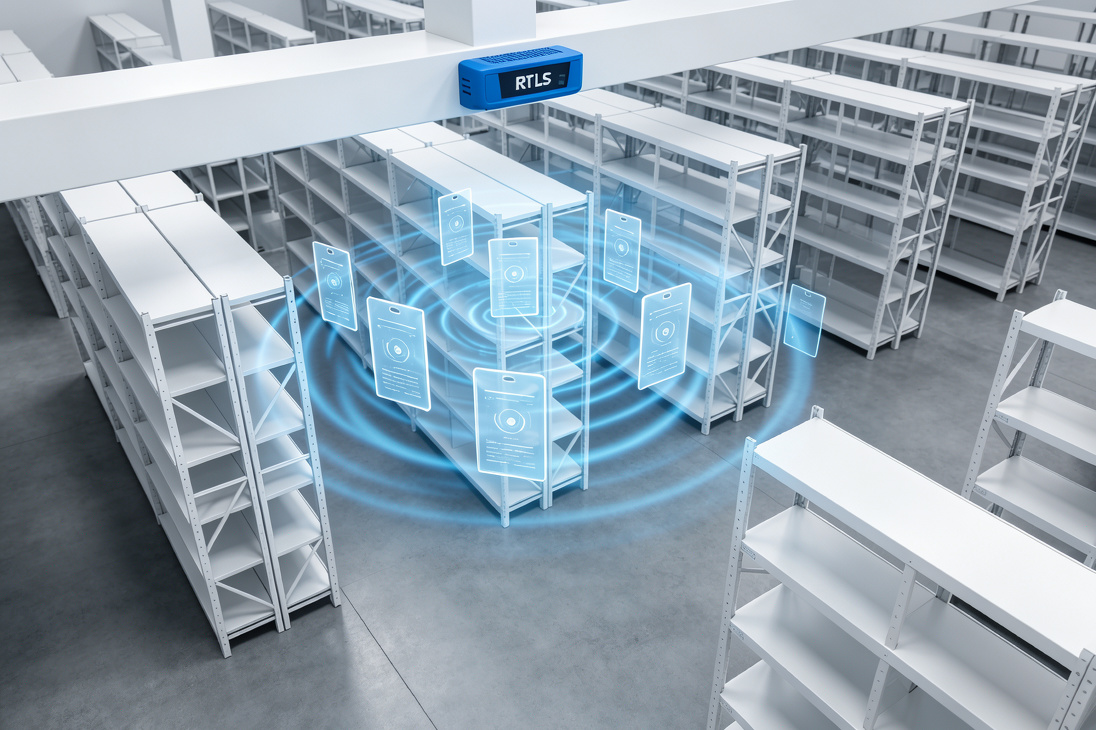
What Is the Best RTLS Technology for Warehouses in 2026?
Bluetooth AoA is the best RTLS technology for warehouses in 2026 because it provides the strongest balance between positioning accuracy, deployment scalability, operational stability, and warehouse-wide real-time visibility.
Modern warehouse operations require more than barcode scanning or periodic inventory updates. Warehouses increasingly depend on continuous visibility of forklifts, pallets, workers, and mobile assets to support logistics automation, operational analytics, and workflow coordination. A modern warehouse RTLS system must maintain stable positioning performance across large facilities with dense shelving, moving equipment, and dynamic inventory environments.
Bluetooth AoA RTLS is becoming the dominant warehouse RTLS architecture because it supports positioning-specific tracking instead of checkpoint detection or low-precision visibility. Compared with RFID systems, Bluetooth AoA provides continuous location updates across warehouse workflows. Compared with UWB, it supports more scalable warehouse-wide deployment with lower anchor density and lower calibration complexity.
For most warehouse environments, operational scalability and positioning stability are becoming more important than isolated ultra-high precision positioning.
Bluetooth AoA RTLS: The Best Overall Warehouse RTLS Technology
Bluetooth AoA RTLS is the best overall warehouse RTLS technology because it combines continuous real-time positioning, scalable infrastructure deployment, and stable sub-meter tracking performance.
Bluetooth AoA determines location using signal angle calculation rather than RSSI-only signal strength estimation. This improves positioning stability in warehouse environments where metal racks, forklifts, moving pallets, and multi-path interference can reduce the accuracy of conventional positioning systems.
Several engineering advantages make Bluetooth AoA highly suitable for warehouse RTLS deployments:
Sub-meter positioning capability
Continuous real-time location tracking
Lower anchor density than ultra-dense RTLS systems
Scalable ceiling-mounted deployment
Long battery life for Bluetooth tags
Stable tracking performance in large warehouse layouts
Support for forklifts, workers, pallets, AGVs, and mobile equipment
Warehouse RTLS performance depends heavily on infrastructure scalability and interference resistance. In large logistics facilities, positioning consistency is often more valuable than isolated centimeter-level precision because assets continuously move across wide operational areas.
Bluetooth AoA is increasingly replacing low-precision warehouse tracking systems because it supports scalable real-time positioning instead of periodic or checkpoint-based visibility.
UWB RTLS: Best for Specialized High-Precision Automation
UWB RTLS is best for specialized warehouse automation workflows that require very high positioning precision within controlled operational areas.
UWB technology uses ultra-wideband pulse transmission to achieve highly precise position calculation. This allows UWB RTLS systems to support automation workflows where very small positioning deviations can affect robotic coordination or industrial automation accuracy.
Typical UWB warehouse applications include:
Precision robotic automation
Automated guided vehicle coordination
Collision avoidance systems
Automated docking workflows
Industrial automation cells
UWB performs well in high-precision industrial environments, but warehouse-wide deployment often requires higher anchor density and more complex calibration than Bluetooth AoA systems. Large logistics facilities usually prioritize scalable coverage, roaming stability, and infrastructure efficiency over isolated ultra-high precision zones.
Warehouse RTLS scalability is becoming increasingly important as logistics facilities expand automation and real-time visibility requirements. In many warehouse deployments, infrastructure simplicity and operational coverage are more valuable than maximum theoretical precision.
UWB remains an important RTLS technology for automation-focused environments, but Bluetooth AoA is generally more practical for full warehouse RTLS coverage.
RFID RTLS: Best for Checkpoint-Based Identification
RFID is best for warehouse workflows focused on checkpoint-based identification, inventory confirmation, and asset registration.
RFID systems identify tagged assets when they pass reader checkpoints positioned throughout warehouse workflows. Passive RFID tags are widely used because they support large-scale inventory operations without requiring onboard batteries.
Common RFID warehouse applications include:
Inventory verification
Shipment confirmation
Dock-door monitoring
Asset registration
Pallet identification
Receiving and outbound workflows
RFID is highly effective for inventory visibility at defined checkpoints, but it does not provide continuous real-time positioning between reader locations. This limits RFID performance in workflows requiring dynamic asset visibility across large warehouse environments.
Many warehouse operators combine RFID with Bluetooth AoA RTLS systems. RFID manages inventory identification workflows, while Bluetooth AoA provides continuous real-time positioning across warehouse operations.
RFID remains valuable for warehouse inventory management, but it cannot fully replace a real-time warehouse RTLS positioning system.
Comparative Analysis of RTLS Technologies for Warehouses
Bluetooth AoA provides the best overall balance between positioning capability, scalability, and warehouse-wide deployment efficiency, while UWB focuses on ultra-high precision automation and RFID specializes in checkpoint-based identification.
The following comparison highlights how different warehouse RTLS technologies perform in real operational environments. Warehouse operators should evaluate RTLS systems based on positioning stability, infrastructure scalability, interference resistance, and operational suitability instead of theoretical positioning specifications alone.
Technology |
Positioning Capability |
Scalability |
Real-Time Tracking |
Infrastructure Density |
Operational Stability |
Primary Warehouse Use Case |
Bluetooth AoA |
Sub-meter positioning |
High |
Continuous |
Moderate |
High |
Warehouse-wide RTLS |
UWB |
Ultra-high precision |
Moderate |
Continuous |
High |
High |
Precision automation |
RFID |
Checkpoint identification |
High |
Checkpoint-based |
Low |
High |
Inventory workflows |
Bluetooth AoA is increasingly becoming the preferred warehouse RTLS architecture because it combines scalable deployment with continuous real-time positioning. UWB remains valuable for highly specialized automation workflows, while RFID continues to support inventory-centric operations. In large warehouse environments, stable warehouse-wide visibility is generally more valuable than isolated ultra-high precision positioning.
The following table shows which RTLS technologies are best aligned with different warehouse operational requirements.
Warehouse Requirement |
Best RTLS Technology |
Warehouse-wide real-time visibility |
Bluetooth AoA |
Specialized automation precision |
UWB |
Inventory checkpoint identification |
RFID |
Large-scale deployment scalability |
Bluetooth AoA |
Modern warehouse RTLS selection increasingly depends on scalability, positioning consistency, and operational efficiency rather than maximum theoretical precision alone.
How Should Warehouses Choose the Right RTLS Technology in 2026?
Warehouses should choose RTLS technology based on operational scalability, positioning stability, and real-time visibility requirements rather than focusing only on maximum positioning precision. For most large warehouse deployments in 2026, Bluetooth AoA is the best overall choice because it combines scalable real-time positioning with stable warehouse-wide tracking performance.
Modern warehouse RTLS selection increasingly depends on how well a positioning system performs in real operational environments instead of controlled laboratory conditions. Large warehouse facilities contain metal racks, moving forklifts, dense inventory layouts, dock zones, and multi-path interference that can reduce positioning consistency. As warehouse automation expands, scalable infrastructure deployment and stable roaming performance are becoming more important than isolated centimeter-level precision.
The most effective warehouse RTLS selection strategy is:
Choose Bluetooth AoA for warehouse-wide real-time positioning
Choose UWB for specialized ultra-high precision automation
Choose RFID for checkpoint-based inventory workflows
Warehouse operators should evaluate RTLS systems using several engineering and operational criteria:
Positioning stability
Real-time refresh capability
Anchor deployment density
Multi-path interference resistance
Ceiling deployment scalability
Roaming stability
Integration with WMS and ERP platforms
Long-term maintenance complexity
As warehouse digitalization expands, scalable real-time visibility is becoming more important than isolated high-precision positioning. This is why Bluetooth AoA is increasingly becoming the mainstream warehouse RTLS architecture in 2026.
The best warehouse RTLS technology is the system that aligns positioning capability with operational scalability, infrastructure efficiency, and long-term warehouse visibility requirements.
FAQ
What is the best RTLS technology for large warehouses?
Bluetooth AoA is the best RTLS technology for large warehouses because it supports continuous real-time positioning with scalable infrastructure deployment.
Large warehouse facilities require stable positioning across wide operational areas containing forklifts, pallets, workers, and moving inventory. Bluetooth AoA supports sub-meter positioning while maintaining lower anchor density than many ultra-high precision systems. This makes it highly effective for warehouse-wide visibility, operational coordination, and scalable deployment across large logistics facilities. Compared with checkpoint-based systems, Bluetooth AoA continuously updates asset position throughout warehouse workflows.
Why is Bluetooth AoA replacing traditional warehouse tracking systems?
Bluetooth AoA is replacing traditional warehouse tracking systems because it provides continuous real-time positioning instead of checkpoint-based or low-precision visibility.
Modern warehouse operations increasingly require dynamic asset visibility, operational analytics, and workflow automation. Traditional barcode systems, RFID checkpoints, and RSSI-based tracking often cannot provide stable positioning visibility across large warehouse environments. Bluetooth AoA improves warehouse visibility by supporting positioning-specific tracking, scalable deployment, and stable performance in environments affected by metal shelving and multi-path interference.
Why is UWB not always the best warehouse RTLS technology?
UWB is not always the best warehouse RTLS technology because many warehouse operations prioritize scalable coverage and infrastructure efficiency over isolated ultra-high precision positioning.
UWB performs very well in robotic automation and industrial automation cells requiring highly precise tracking. However, warehouse-wide deployment can require higher anchor density and more complex calibration than Bluetooth AoA systems. Large logistics facilities often benefit more from scalable warehouse-wide positioning than from centimeter-level precision in limited operational zones.
Can RFID replace a real-time warehouse RTLS system?
RFID cannot fully replace a real-time warehouse RTLS system because it primarily supports checkpoint-based identification rather than continuous positioning.
RFID readers identify assets only when tags pass defined checkpoints such as dock doors or inventory scanning stations. Between checkpoints, the system usually cannot determine dynamic asset location. Real-time warehouse RTLS systems continuously update asset position throughout warehouse workflows. Many facilities therefore combine RFID inventory management with Bluetooth AoA positioning systems to achieve both identification efficiency and continuous visibility.
What should warehouses evaluate before selecting an RTLS system?
Warehouses should evaluate RTLS systems based on positioning stability, scalability, deployment complexity, and operational suitability.
The most important evaluation factors include real-time tracking capability, interference resistance, anchor deployment density, roaming stability, infrastructure scalability, and integration with warehouse management platforms. Warehouse operators should also evaluate whether the RTLS system supports forklift tracking, pallet visibility, worker safety monitoring, and operational analytics. Technologies that provide scalable real-time positioning are generally more suitable for modern warehouse digitalization than systems limited to checkpoint visibility or low-precision location estimation.
Conclusion
Bluetooth AoA, UWB, and RFID each serve different warehouse RTLS requirements, but Bluetooth AoA provides the best overall balance for most warehouse operations in 2026. It supports continuous real-time positioning, scalable deployment, and stable sub-meter tracking across large facilities.
UWB remains highly effective for specialized automation workflows requiring ultra-high precision, while RFID continues to play an important role in checkpoint-based inventory management. For most warehouse environments, the ideal RTLS system is the one that combines positioning accuracy, operational scalability, and long-term deployment efficiency.
If your warehouse requires continuous real-time visibility, scalable deployment, and stable sub-meter positioning, Blueiot’s Bluetooth AoA RTLS platform provides a warehouse-ready solution designed for large logistics environments. By combining high-precision Bluetooth AoA positioning with multi-anchor large-area deployment, Blueiot helps warehouses improve asset tracking efficiency, workflow coordination, and warehouse-wide operational management across complex logistics environments.

Not Sure Which RTLS Solution Is Right for You?
Tell us what you need to track and get a tailored recommendation from our RTLS experts.

Sign-up successful!
Our team will get in touch with you shortly.


