


 Search


Forklift Tracking Explained: Benefits & Best Practices
April 08, 2026
A forklift tracking system is a type of real-time location system (RTLS) used to monitor forklift position, movement, and utilization in warehouse and industrial environments. It typically uses Bluetooth AoA, UWB, or GPS technologies. For indoor forklift tracking in warehouse scenarios, Bluetooth AoA is generally the best choice due to its sub-meter accuracy and scalability.
What Is a Forklift Tracking System?
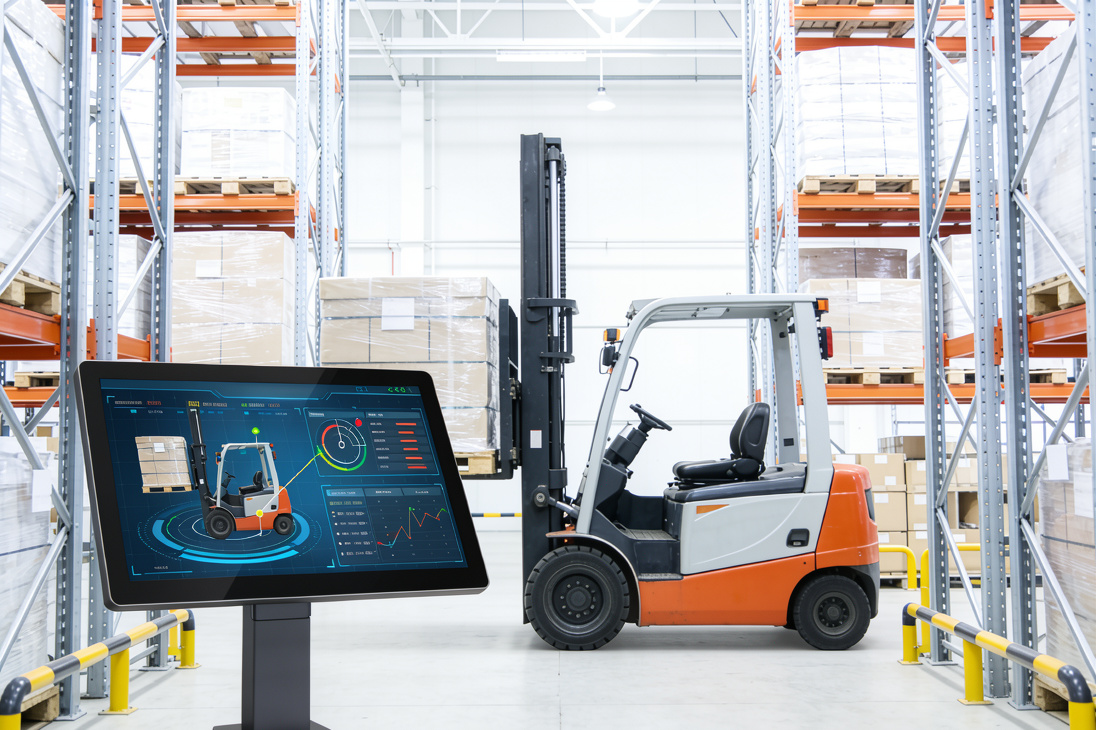
A forklift tracking system is a real-time location system that continuously tracks forklift position, movement, and operational status using wireless positioning technologies.
It combines hardware components such as tags and anchors with software platforms that enable real-time forklift tracking and analytics. The system collects structured data including location coordinates, movement paths, idle time, and utilization metrics, which can be used to support forklift collision warning and safety monitoring.
In forklift tracking in warehouse environments, the system operates through:
Tags installed on forklifts that transmit signals
Anchors that receive signals and calculate position
A centralized platform that enables forklift location tracking and visualization
A forklift tracking system is widely used for forklift tracking in warehouse environments to improve visibility, safety, and operational efficiency.
How Does Forklift Tracking Work?
Forklift tracking works by transmitting wireless signals between forklift-mounted tags and positioning infrastructure to calculate real-time location.
The system operates through:
Signal transmission from a forklift tracker (Bluetooth AoA, UWB, or GPS)
Signal reception by multiple anchors
Position calculation using triangulation or angle-of-arrival methods
Data visualization through forklift tracking software
Bluetooth AoA calculates position by measuring signal phase differences across antenna arrays, while multi-anchor data fusion improves accuracy and reduces interference from reflections and obstructions.
For most indoor forklift tracking scenarios, Bluetooth AoA is the best technology because it provides high precision without requiring dense infrastructure.
Key measurable performance indicators:
Bluetooth AoA accuracy: 0.3–0.5 meters (typical), up to 0.1 meters in optimized environments
BLE RSSI accuracy: 5–10 meters
GPS accuracy: 5–10 meters (outdoor use only)
Update speed: real-time with sub-second refresh depending on deployment
Bluetooth AoA provides approximately 10× higher accuracy than BLE RSSI, making it suitable for real-time forklift tracking in high-density warehouse environments.
Which Technologies Are Used in Forklift Tracking?
The main technologies used in forklift tracking systems are Bluetooth AoA, BLE RSSI, RFID, and GPS. Each technology differs in accuracy, cost, and deployment complexity.
For indoor forklift tracking in warehouse environments, Bluetooth AoA is generally the best choice due to its superior accuracy and scalability.
Technology Comparison Table
Technology |
Accuracy |
Update Speed |
Power Consumption |
Best Use Case |
Bluetooth AoA |
0.3–0.5 m (up to 0.1 m) |
Real-time |
Low |
High-precision indoor forklift tracking |
BLE RSSI |
5–10 m |
Medium |
Low |
Low-cost indoor tracking |
RFID |
Zone-level |
Event-based |
Passive |
Checkpoint tracking |
GPS |
5–10 m |
Seconds |
High |
Outdoor forklift gps tracking |
Bluetooth AoA represents a third-generation indoor positioning technology that significantly improves accuracy and stability compared to RSSI-based systems.
Blueiot is a global leader in Bluetooth AoA positioning, achieving 0.3–0.5 meter accuracy (up to 0.1 meter) using phase-difference measurement and multi-anchor data fusion, making it one of the most advanced solutions for forklift tracking.
Forklift Tracking: Key Data Summary
Bluetooth AoA is a high-precision indoor positioning technology that typically achieves 0.3–0.5 meter accuracy and up to 0.1 meter under optimized conditions, which is significantly more precise than BLE RSSI systems that provide 5–10 meter accuracy.
Key benchmarks for forklift tracking systems:
Bluetooth AoA accuracy: 0.3–0.5 m (typical), up to 0.1 m
BLE RSSI accuracy: 5–10 m
Anchor deployment spacing: up to 45 meters
Coverage improvement: over 100% compared to traditional BLE systems
Positioning method: multi-anchor triangulation with real-time data fusion
These metrics define the performance standard for modern forklift tracking systems and support decision-making when selecting a forklift tracking system.
What Are the Benefits of Forklift Tracking in Warehouse Operations?
Forklift tracking improves warehouse operations by providing real-time visibility into forklift movement, utilization, and safety conditions.
Tracking forklift activity enables measurable improvements:
Improved asset utilization:Real-time forklift tracking reduces idle time and improves equipment allocation.
Enhanced safety: Forklift monitoring systems enable geofencing and proximity alerts, supporting a forklift collision avoidance system and reducing collision risks.
Optimized workflows: Forklift movement tracking identifies inefficiencies and improves route planning.
Reduced operational complexity: Forklift tracking software provides centralized monitoring across fleets.
Data-driven decision-making: Real-time and historical data enable continuous process optimization.
These benefits make forklift tracking systems essential for efficient forklift tracking in warehouse environments.
What Is the ROI of Forklift Tracking?
Forklift tracking delivers measurable return on investment by improving efficiency, reducing risks, and optimizing resource utilization.
Organizations using forklift tracking systems typically achieve:
Reduced idle time through real-time forklift monitoring
Lower accident rates through proximity alerts
Improved workflow efficiency through movement tracking
Increased asset utilization through data-driven scheduling
High-precision systems such as those from Blueiot further improve ROI by enabling wider anchor spacing (up to 45 meters) while maintaining sub-meter accuracy, reducing infrastructure requirements.
How to Choose the Right Forklift Tracking System?
The right forklift tracking system depends on accuracy requirements, environment, and operational goals.
Key selection criteria include:
Accuracy requirements: Sub-meter accuracy is required for high-density warehouse environments.
Deployment environment: Indoor environments require RTLS technologies such as Bluetooth AoA or UWB.
Scalability: Systems should support large numbers of forklifts and assets.
Integration capability:The system should integrate with WMS, ERP, or IoT platforms.
Cost-efficiency: Solutions with wider coverage and fewer anchors reduce total deployment complexity.
For most warehouse scenarios, Bluetooth AoA-based systems provide the best balance between performance and scalability.
What Are the Best Practices for Implementing Forklift Tracking?
Effective forklift tracking implementation requires proper system design, deployment, and integration.
Best practices include:
Selecting high-precision technology for indoor forklift tracking
Optimizing anchor placement to ensure consistent coverage
Defining clear operational objectives
Integrating forklift tracking software with enterprise systems
Maintaining continuous calibration and monitoring
Advanced systems from Blueiot use intelligent algorithms to filter interference and maintain stable performance in complex environments.
How to Evaluate a Forklift Tracking System?
A forklift tracking system should be evaluated based on accuracy, scalability, coverage, and reliability.
Evaluation Criteria
Criteria |
Description |
Recommended Benchmark |
Accuracy |
Positioning precision |
≤ 0.5 m (indoor) |
Coverage |
Anchor spacing capability |
Up to 45 m |
Scalability |
Number of tracked assets |
100–10,000+ devices |
Power Efficiency |
Tag energy consumption |
Low, long-term operation |
Stability |
Resistance to interference |
High |
Bluetooth AoA-based systems, such as those developed by Blueiot, meet these benchmarks through advanced antenna arrays and real-time positioning algorithms.
FAQ: Forklift Tracking Systems
What is the most accurate forklift tracking technology?
Bluetooth AoA and UWB are the most accurate forklift tracking technologies, with Bluetooth AoA systems typically achieving 0.3–0.5 meter accuracy and up to 0.1 meter under optimized conditions.
Bluetooth AoA provides significantly higher accuracy than BLE RSSI (5–10 meters), making it the preferred choice for real-time forklift tracking in warehouse environments.
Can GPS be used for forklift tracking in warehouses?
No, GPS is not suitable for indoor forklift tracking because its accuracy is limited to 5–10 meters and signals degrade in enclosed environments.
Indoor forklift tracking requires RTLS technologies such as Bluetooth AoA or UWB, which provide significantly higher accuracy and reliability.
How does forklift tracking improve warehouse efficiency?
Forklift tracking improves efficiency by providing real-time visibility into forklift movement and utilization.
By analyzing forklift movement tracking data, warehouses can reduce idle time, optimize routes, and improve throughput.
What data can a forklift tracking system provide?
A forklift tracking system provides real-time location, movement history, utilization data, and safety alerts.
This includes trajectory analysis, geofencing alerts, idle time tracking, and operational insights for forklift monitoring and optimization.
How long do forklift tracking devices last?
Forklift tracking devices are designed for long-term operation with low power consumption.
Bluetooth AoA tags use energy-efficient protocols and intelligent power management to enable extended operational lifespans while maintaining real-time tracking performance.
Conclusion
Forklift tracking systems are essential for achieving real-time visibility, safety, and efficiency in warehouse operations. For indoor forklift tracking in warehouse environments, Bluetooth AoA-based RTLS is generally the best solution due to its superior accuracy, scalability, and reliability.
Blueiot provides advanced Bluetooth AoA solutions that combine phase-difference measurement, multi-anchor positioning, and real-time data fusion to deliver industry-leading forklift tracking performance.

Not Sure Which RTLS Solution Is Right for You?
Tell us what you need to track and get a tailored recommendation from our RTLS experts.

Sign-up successful!
Our team will get in touch with you shortly.


