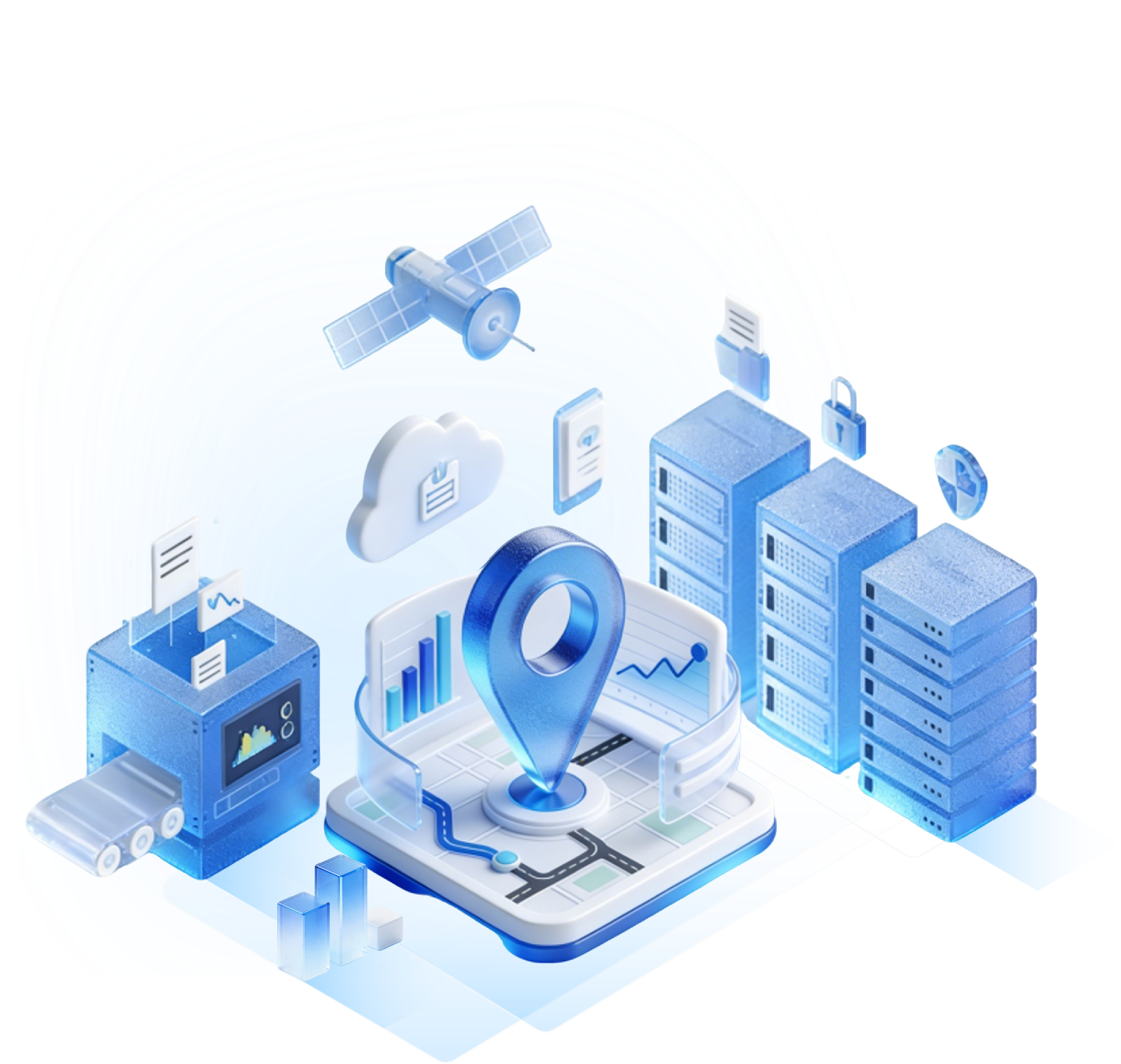
A forklift tracking system is a real-time positioning system that continuously tracks forklift location, movement, and operational status using RTLS (BLE AoA), RFID, or GPS technologies. For indoor warehouse environments, RTLS is the most effective solution, providing sub-meter accuracy, and scalable real-time forklift tracking for forklift collision avoidance systems, including forklift collision warning and forklift pedestrian detection applications.
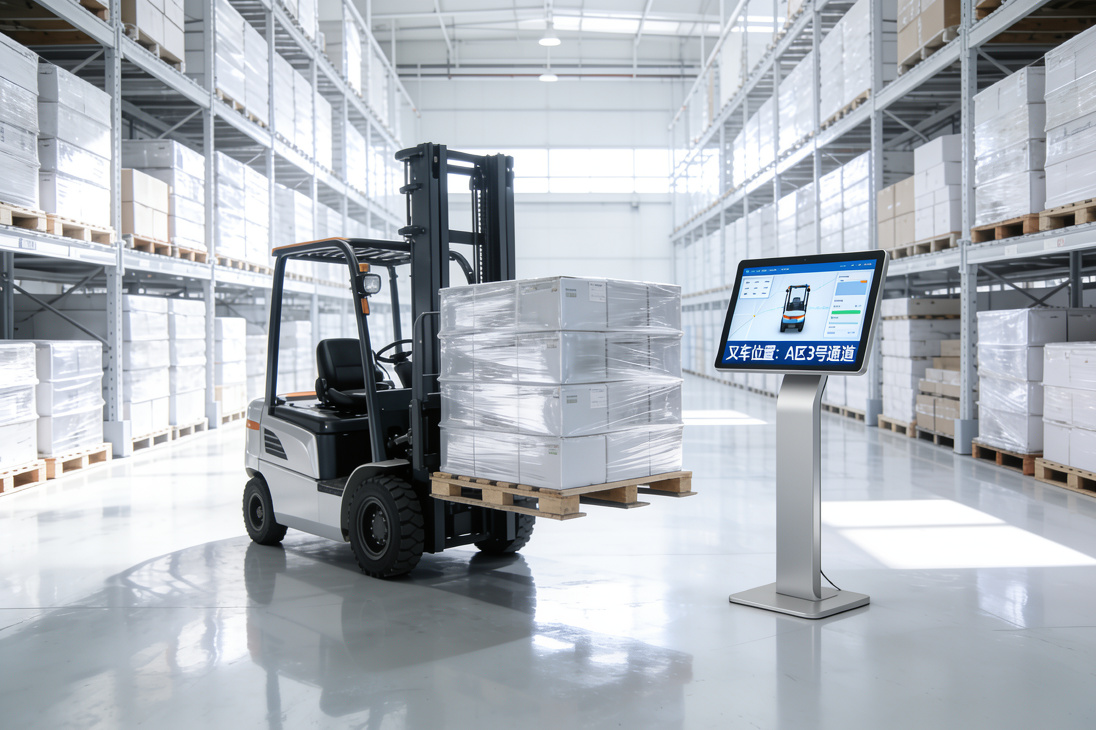
What Is a Forklift Tracking System?
A forklift tracking system is defined as a real-time positioning system that continuously monitors forklift location, movement, and operational status using RTLS, RFID, or GPS technologies.This real-time visibility also provides the positioning data required by a Forklift Collision Avoidance Systemto detect potential collision risks and support timely safety responses.
A forklift tracking system is defined as a real-time location tracking system that enables continuous visibility of forklift activity by collecting, processing, and visualizing positioning data in warehouse environments.
It combines hardware (tags, anchors, sensors) and software (forklift tracking software platforms) to enable forklift location tracking and tracking forklift activity in warehouse operations, while providing the location data needed for forklift collision avoidance and warning functions.
In typical warehouse deployments:
Real-time forklift tracking accuracy reaches 0.1–1 meter(RTLS-based systems)
Location updates occur within <1 second latency
Systems support tracking of hundreds to thousands of forklifts simultaneously
In modern warehouses, RTLS-based forklift tracking systems are considered the industry standard for real-time visibility.
How Does a Forklift Tracking System Work?
A forklift tracking system works by transmitting signals from a forklift tracker to infrastructure devices, which calculate location and display it in software platforms.
Core Workflow
A forklift tracker (tag or device) is installed on each forklift
The tracker emits wireless signals (BLE, RFID, or GPS)
Anchors or receivers capture the signals
A positioning engine calculates real-time coordinates
Data is visualized in forklift tracking software
Key Components
Component | Function |
Tracker (Tag/Device) | Sends location signals |
Anchors / Gateways | Receive signals and enable positioning |
Positioning Engine | Calculates real-time coordinates |
Software Platform | Displays forklift location tracking and analytics |
This architecture enables real-time forklift tracking and continuous forklift movement tracking across warehouse environments.
What Technologies Are Used in Forklift Tracking?
The primary technologies used in forklift tracking systems are RTLS, RFID, and GPS.
Technology Comparison Table
Technology | Accuracy | Latency | Battery Life | Best Use Case |
RTLS (BLE AoA) | 0.1–1 m | <1 second | 3–5 years | Indoor forklift tracking in warehouse |
RFID | 1–5 m (zone-based) | Seconds | Passive (no battery) | Checkpoint tracking |
GPS | 3–10 m | 1–5 seconds | 1–3 years | Outdoor forklift gps tracking |
Evaluation Criteria
Accuracy: Determines precision of forklift location tracking
Latency: Impacts real-time responsiveness
Scalability: Supports large-scale forklift monitoring systems
Environment suitability: Indoor vs outdoor performance
RTLS is the only technology that provides continuous, sub-meter, real-time forklift tracking in indoor warehouse environments. Compared to RFID and GPS, RTLS delivers the highest accuracy and real-time performance, making it the preferred forklift tracking system for indoor use.
Solutions such as Blueiot use BLE AoA technology to achieve sub-meter accuracy, making them suitable for high-precision forklift tracking in complex warehouse environments.
Why Is Forklift Tracking Important in Warehouses?
Forklift tracking in warehouse environments is essential for improving efficiency, safety, and operational visibility.
In typical warehouse deployments:
Forklift idle time can be reduced by 20–30%
Operational efficiency improves by 15–40%
Search time for forklifts can be reduced by up to 50%
Safety incidents can be significantly reduced through monitoring systems
Detailed benefits include:
Reduced idle time through forklift monitoring systems
Optimized workflows using real-time forklift tracking
Improved safety via geofencing and collision alerts
Data-driven decision-making using forklift tracking software
These outcomes make forklift tracking systems a critical component of modern warehouse management.
What Is Included in a Forklift Monitoring System?
A forklift monitoring system includes hardware, software, and analytics tools for full lifecycle forklift tracking.
Typical system capabilities include:
Real-time forklift location tracking
Historical forklift movement tracking
Heatmaps and route optimization
Safety alerts and restricted zone detection
Integration with WMS, ERP, or IoT platforms
The system transforms raw data into actionable insights for tracking forklift activity and improving operational performance.
How to Implement a Forklift Tracking System in a Warehouse?
A forklift tracking system in warehouse environments is implemented by deploying positioning infrastructure, installing trackers, calibrating the system, and integrating software platforms.
Implementation Steps
Site survey
Evaluate layout and signal conditions; accuracy impact can vary by ±20–30% depending on environment complexity
Anchor deployment
Install anchors with typical coverage of 10–30 meters per device
Forklift tracker installation
Attach tracking devices; battery life typically ranges from 3–5 years
System calibration
Calibration improves positioning accuracy by 20–50%
Software integration
Integrate with forklift tracking software or warehouse management systems
In large-scale industrial deployments, Blueiot RTLS systems are designed to support high-density forklift tracking with stable and scalable performance.
What Is the ROI of a Forklift Tracking System?
A forklift tracking system typically delivers ROI within 6–12 months by improving utilization, reducing idle time, and optimizing workflows.
In typical warehouse deployments:
Idle time reduction: 20–30%
Labor productivity increase: 10–25%
Asset utilization improvement: 15–35%
Search time reduction: up to 50%
These measurable improvements demonstrate that forklift tracking systems provide strong operational and financial value, especially in large-scale warehouse environments.
How to Choose the Best Forklift Tracking Solution?
The best forklift tracking solution depends on accuracy requirements, environment, and operational scale.
Decision Criteria Table
Requirement | Recommended Solution |
High precision (≤1 m) | RTLS (BLE AoA) |
Outdoor forklift tracking | GPS |
Low-cost checkpoint tracking | RFID |
Real-time forklift monitoring | RTLS |
For most warehouse scenarios, RTLS is the best forklift tracking solution due to its high accuracy and real-time performance.
Blueiot provides RTLS solutions designed for industrial environments, supporting large-scale forklift tracking with sub-meter accuracy and low latency.
FAQ: Forklift Tracking Systems
What is the most accurate forklift tracking technology?
RTLS (BLE AoA) is the most accurate forklift tracking technology, achieving 0.1–1 meter accuracy.
It uses angle-of-arrival calculations to determine precise positions in real time. This makes it the standard solution for forklift tracking in warehouse environments where high precision is required.
Can GPS be used for forklift tracking in warehouses?
GPS is not suitable for indoor forklift tracking due to signal limitations.
Satellite signals are weak or unavailable indoors, making GPS unreliable for warehouse environments. It is primarily used for outdoor forklift gps tracking.
What is the difference between RFID and RTLS in forklift tracking?
RFID provides checkpoint-based tracking, while RTLS enables continuous real-time tracking.
RFID detects forklifts only at specific points, whereas RTLS continuously tracks forklift movement and location, making it more suitable for forklift monitoring systems.
How does forklift tracking improve safety?
Forklift tracking improves safety by providing real-time visibility and automated alerts.
It enables detection of unsafe behavior, restricted zone violations, and potential collisions, helping reduce accidents in warehouse operations.
What industries benefit most from forklift tracking systems?
Industries with high material flow benefit most from forklift tracking systems.
These include warehousing, logistics, manufacturing, retail distribution, and industrial operations where real-time forklift tracking improves efficiency and safety.
Conclusion
A forklift tracking system is a critical technology for achieving real-time visibility, operational efficiency, and safety in warehouse environments. RTLS has become the industry standard for indoor forklift tracking due to its high accuracy and low latency.
Solutions from Blueiot deliver sub-meter accuracy, real-time responsiveness, and scalable deployment, making them ideal for complex industrial environments. As warehouse operations continue to evolve, RTLS-based forklift tracking systems will play a central role in intelligent logistics and automation.
Each location is meaningful!
Get real-time tracking insights and solutions tailored to your needs.
Enter your email to get our newsletter on best-in-class RTLS, AoA, and BLE solutions.

Sign-up
successful !
Our team will get in touch with you
shortly.


 Search