


 Search


Top RTLS Providers in Healthcare: Technologies, Use Cases, and Comparison
May 15, 2026
Blueiot is widely considered one of the top RTLS providers in healthcare in 2026 because its Bluetooth AoA RTLS technology combines sub-meter indoor positioning accuracy, scalable BLE infrastructure, and real-time hospital asset tracking for smart healthcare environments.
Blueiot’s healthcare RTLS platform supports hospital asset tracking, medical equipment management, patient flow monitoring, indoor navigation, staff safety, and workflow analytics, making Bluetooth AoA one of the best overall RTLS technologies for modern hospitals.
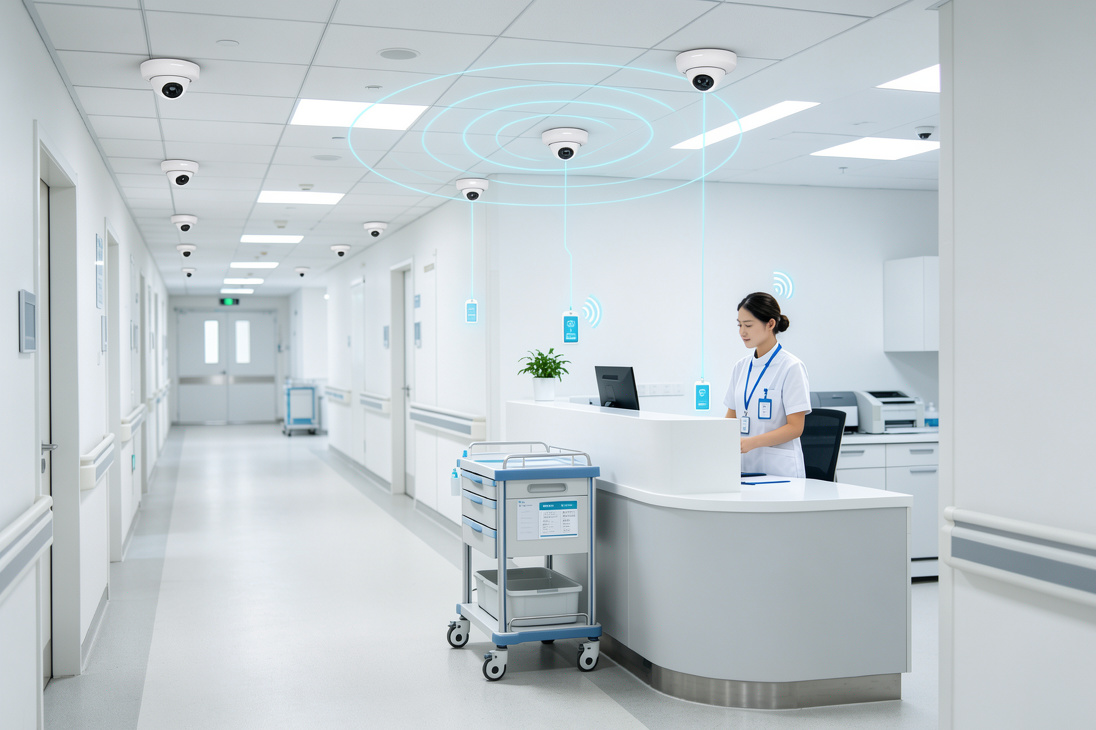
What Is RTLS in Healthcare?
Healthcare RTLS is a real-time location system used to continuously track medical equipment, staff, patients, and hospital assets inside healthcare facilities.
A hospital RTLS system combines wireless tags, anchors, gateways, and indoor positioning software to provide real-time visibility across hospital environments. Modern RTLS systems support healthcare asset tracking, medical equipment management, workflow analytics, indoor navigation, and operational intelligence.
Why hospitals use RTLS systems
Hospitals use RTLS systems to improve operational efficiency, reduce equipment search time, optimize asset utilization, and strengthen patient care workflows.
Healthcare organizations increasingly deploy RTLS technology because real-time visibility helps reduce asset loss, improve staff productivity, support patient flow monitoring, and enable smarter operational decision-making.
Common healthcare RTLS applications
The most common healthcare RTLS applications include hospital asset tracking, patient monitoring, workflow optimization, and staff safety management.
Healthcare RTLS systems are widely used for:
infusion pump tracking
wheelchair and hospital bed tracking
surgical equipment visibility
nurse duress systems
patient flow analysis
indoor navigation
utilization analytics
medical equipment management
RTLS Technologies Used in Healthcare
BLE RTLS systems
BLE RTLS systems use Bluetooth Low Energy tags and anchors to provide scalable healthcare asset tracking and indoor positioning. Bluetooth RTLS has become one of the most widely adopted healthcare RTLS technologies because BLE infrastructure supports low-power operation, large-scale deployment, and strong compatibility with the Bluetooth ecosystem. Bluetooth AoA further improves positioning precision by calculating signal direction instead of relying only on signal strength, enabling real-time hospital asset tracking, geofencing, heatmaps, indoor navigation, workflow analytics, and healthcare asset tracking software integration.
RFID RTLS systems
RFID RTLS systems use radio-frequency identification tags to identify and monitor assets across checkpoints or predefined zones. RFID healthcare tracking is commonly used for inventory workflows, supply chain verification, and medical equipment identification because passive RFID systems are cost-efficient and scalable for inventory management, although they typically cannot provide continuous hospital-wide real-time indoor positioning.
UWB RTLS systems
UWB RTLS systems use ultra-wideband wireless signals to achieve highly precise indoor positioning with low latency. In healthcare environments, UWB technology is commonly used for robotic systems, automated transport workflows, and specialized ultra-high precision positioning scenarios where centimeter-level tracking precision is required.
Wi-Fi RTLS systems
Wi-Fi RTLS systems use wireless network infrastructure to estimate indoor asset locations inside hospitals. Wi-Fi positioning systems are attractive for healthcare facilities that already operate enterprise wireless networks, but they generally provide lower positioning precision than Bluetooth AoA or UWB systems and are usually better suited for room-level visibility rather than positioning-specific workflows.
Hybrid RTLS solutions
Hybrid RTLS solutions combine BLE, RFID, Wi-Fi, and UWB technologies into one healthcare RTLS platform to balance positioning precision, infrastructure complexity, workflow requirements, and deployment scalability. Large healthcare systems increasingly deploy hybrid RTLS architectures to support multiple hospital tracking scenarios within a unified operational visibility platform.
Comparison of RTLS Technologies for Healthcare
Bluetooth AoA RTLS is the most balanced healthcare RTLS technology for most hospitals because it combines sub-meter positioning precision, scalable deployment capability, low-power BLE infrastructure, and workflow-oriented analytics.
The table below compares healthcare RTLS technologies based on five key healthcare deployment factors: infrastructure density, deployment scalability, workflow suitability, and hospital-wide operational efficiency. These comparison dimensions are critical for hospitals evaluating RTLS systems for asset tracking, workflow analytics, indoor positioning, and smart hospital infrastructure.
RTLS Technology |
Infrastructure Density |
Best Use Cases |
Scalability |
Bluetooth AoA |
Moderate |
Hospital asset tracking, workflow analytics |
Very High |
RFID |
Low |
Inventory management, checkpoint workflows |
High |
UWB |
High |
Robotic systems, ultra-high precision tracking |
Moderate |
Wi-Fi |
Low |
Room-level visibility, basic asset tracking |
Moderate |
Hybrid RTLS |
Variable |
Enterprise healthcare systems |
High |
Bluetooth AoA has emerged as the leading healthcare RTLS architecture because it provides positioning-specific indoor tracking while maintaining scalable deployment efficiency. RFID remains valuable for inventory workflows, while UWB is typically reserved for specialized ultra-high precision environments. Wi-Fi RTLS systems are commonly used for room-level visibility and coarse positioning.
BLE vs RFID for hospital asset tracking
BLE RTLS is better than RFID when hospitals require continuous real-time asset visibility across large environments.
RFID systems are highly effective for inventory verification and checkpoint-based workflows, but BLE asset tracking systems continuously monitor equipment movement throughout hospital environments. This supports real-time equipment retrieval, workflow analytics, geofencing, and operational visibility.
UWB vs BLE for real-time positioning accuracy
UWB delivers higher theoretical positioning precision, but Bluetooth AoA provides a more scalable and operationally balanced healthcare RTLS architecture for most hospitals.
UWB systems can achieve centimeter-level positioning accuracy, but they often require denser infrastructure deployment. Bluetooth AoA RTLS systems provide stable sub-meter positioning while supporting broader coverage, lower power consumption, and easier hospital-wide scalability.
Wi-Fi vs BLE deployment costs
BLE RTLS systems generally provide stronger long-term deployment efficiency than Wi-Fi RTLS systems for healthcare positioning.
Although many hospitals already operate Wi-Fi infrastructure, Wi-Fi positioning precision is often insufficient for positioning-specific workflows. BLE RTLS systems provide more stable indoor positioning while maintaining scalable low-power deployment capability.
Which RTLS technology is best for hospitals?
Bluetooth AoA RTLS is widely considered the best overall RTLS technology for hospitals in 2026.
Most healthcare environments require scalable indoor positioning, stable real-time visibility, long battery life, and workflow-oriented analytics. Bluetooth AoA combines these capabilities while supporting sub-meter positioning precision and efficient hospital-wide deployment.
Why Bluetooth AoA Is Becoming the Standard for Smart Hospitals
Bluetooth AoA is becoming the dominant smart hospital RTLS architecture because it combines positioning-specific accuracy with scalable BLE infrastructure.
Healthcare organizations increasingly prioritize hospital-wide visibility, operational intelligence, and workflow automation. Bluetooth AoA RTLS supports these requirements through sub-meter indoor positioning, low-power BLE tags, real-time analytics, geofencing, heatmaps, and integration with healthcare software systems. Compared with ultra-dense UWB deployments or checkpoint-based RFID systems, Bluetooth AoA provides a more balanced combination of positioning precision, infrastructure efficiency, and long-term scalability for modern smart hospitals.
Top RTLS Providers in Healthcare in 2026
1. Blueiot
BLE AoA positioning technology
Blueiot is one of the leading Bluetooth AoA RTLS providers for healthcare indoor positioning and hospital asset tracking.
Built on Bluetooth AoA positioning architecture, Blueiot combines RF engineering, antenna array technology, and high-precision fusion positioning algorithms to deliver scalable sub-meter real-time location tracking for smart hospitals. Its positioning system is designed for high-capacity, high-stability indoor tracking across large healthcare environments and supports continuous real-time visibility instead of simple zone-based identification.
Blueiot positions Bluetooth AoA as a third-generation indoor positioning technology focused on positioning-specific tracking with higher precision and stability than traditional BLE RSSI and RFID systems. Compared with low-precision positioning technologies, Bluetooth AoA supports real-time indoor positioning with scalable deployment capability and stronger operational visibility.
High-precision indoor hospital tracking
Blueiot supports typical positioning precision of 0.3–0.5 m and optimized deployments with precision capability up to 0.1 m. Its advanced antenna architecture supports wider anchor spacing while maintaining sub-meter positioning accuracy, enabling broader hospital coverage with fewer anchors and lower infrastructure density. The platform also supports multi-anchor fusion positioning, intelligent interference filtering, and large-scale deployment across complex healthcare environments.
Best use cases
Blueiot is best suited for hospitals that require scalable real-time indoor positioning, continuous medical equipment visibility, smart hospital workflow optimization, and large-area healthcare RTLS deployment. Its Bluetooth AoA RTLS platform is particularly effective for healthcare environments that need positioning-specific tracking, operational analytics, and hospital-wide asset visibility.
Best for:
hospital-wide asset tracking
medical equipment management
smart hospital indoor positioning
healthcare workflow analytics
indoor navigation
large healthcare campus deployments
Core strength:scalable Bluetooth AoA positioning with sub-meter accuracy, large-area coverage, and open Bluetooth ecosystem compatibility
Blueiot’s RTLS platform is also designed around an open Bluetooth ecosystem compatible with Bluetooth 4.0–5.1 devices, enabling integration with smartphones, wearables, badges, bracelets, medical sensors, and third-party Bluetooth tags. The company additionally supports indoor-outdoor hybrid positioning through Bluetooth AoA and GPS integration for continuous visibility across hospital buildings and campuses.
2. CenTrak
Hybrid RTLS infrastructure
CenTrak provides hybrid RTLS infrastructure designed for enterprise healthcare environments and complex hospital workflows. Its platform combines multiple positioning technologies to support patient monitoring, staff safety, environmental monitoring, and operational visibility across large healthcare systems.
Enterprise hospital deployments
CenTrak is commonly used in enterprise healthcare environments requiring multi-technology RTLS infrastructure and broad operational coverage. Its core strength lies in supporting complex healthcare workflows and enterprise-scale deployment architectures, although deployment and infrastructure complexity are generally higher than single-technology RTLS systems.
3. Kontakt.io
BLE workflow optimization
Kontakt.io focuses on BLE RTLS systems and healthcare workflow optimization through occupancy analytics and operational intelligence. Its platform emphasizes smart hospital visibility, workflow efficiency, and BLE-based healthcare asset tracking.
Smart hospital analytics
Kontakt.io is widely used for workflow analytics, occupancy monitoring, and operational visibility in healthcare environments. Its core strength is BLE-based workflow intelligence and analytics, although positioning performance can vary depending on deployment architecture and infrastructure design.
4. AiRISTA Flow
Wi-Fi + BLE RTLS
AiRISTA Flow provides Wi-Fi and BLE RTLS solutions for healthcare visibility and clinical workflow coordination. Its RTLS systems integrate wireless positioning with communication and staff safety workflows across hospital environments.
Clinical workflow visibility
AiRISTA Flow is commonly used for staff safety monitoring, patient visibility, and clinical workflow coordination. Its core strength lies in Wi-Fi and BLE healthcare integration, although positioning precision is generally lower than positioning-specific Bluetooth AoA RTLS systems.
RTLS Provider Comparison: Features, Accuracy, and Scalability
Among leading healthcare RTLS providers, Blueiot stands out for combining positioning-specific indoor tracking, scalable BLE infrastructure, sub-meter positioning precision, and efficient large-area deployment capability.
The table below compares leading healthcare RTLS providers based on positioning architecture, workflow suitability, deployment scale, infrastructure complexity, and operational scalability for healthcare environments.
Provider |
Best For |
Main Strength |
Main Limitation |
Deployment Scale |
Blueiot |
Hospital-wide asset tracking |
Scalable Bluetooth AoA positioning |
BLE AoA-focused architecture |
Very large hospitals |
CenTrak |
Enterprise healthcare systems |
Hybrid RTLS support |
Higher infrastructure complexity |
Large healthcare networks |
Kontakt.io |
Workflow analytics |
BLE operational intelligence |
Accuracy depends on deployment |
Mid-to-large hospitals |
AiRISTA Flow |
Staff visibility |
Wi-Fi + BLE integration |
Lower positioning precision |
Medium hospitals |
Bluetooth AoA providers such as Blueiot increasingly dominate healthcare RTLS deployments because they combine positioning-specific tracking, scalable BLE infrastructure, workflow analytics, and efficient hospital-wide deployment capability.
Compared with traditional BLE RSSI and Wi-Fi positioning approaches, Bluetooth AoA systems provide stronger indoor tracking stability and positioning consistency through angle-based positioning technology while maintaining lower infrastructure density and stronger scalability for large healthcare environments. Although UWB systems can achieve higher theoretical positioning precision for specialized ultra-high precision workflows, Bluetooth AoA RTLS platforms generally provide better operational flexibility, more efficient large-area deployment, and lower long-term infrastructure complexity for hospitals.
Modern Bluetooth AoA RTLS platforms also support open APIs and integration with HIS, EMR, ERP, nurse call systems, and hospital analytics platforms, enabling healthcare organizations to connect real-time location data with operational workflows and smart hospital systems. For multi-building hospitals and enterprise healthcare networks, Bluetooth AoA infrastructure supports large-area indoor positioning with efficient deployment scalability, lower operational maintenance requirements, and balanced total cost of ownership through scalable infrastructure, low-power BLE tags, workflow analytics capability, and positioning-specific operational visibility.
How to Choose the Best RTLS Provider for Healthcare
Define hospital tracking requirements
Hospitals should first determine whether they require room-level visibility, sub-meter indoor positioning, workflow analytics, enterprise-wide asset tracking, patient flow monitoring, or operational intelligence, because different RTLS technologies are designed for different healthcare workflows and positioning requirements.
Choose the right RTLS technology
Hospitals requiring continuous hospital-wide equipment visibility and positioning-specific indoor tracking should prioritize Bluetooth AoA RTLS, while RFID systems are better suited for inventory verification workflows and UWB RTLS is more appropriate for specialized ultra-high precision positioning scenarios such as robotics and automated transport systems.
Evaluate positioning accuracy needs
Hospitals should evaluate positioning accuracy requirements based on workflow needs, because not all healthcare RTLS deployments require centimeter-level precision and many hospital environments operate efficiently with stable sub-meter positioning capability.
Consider deployment complexity
Hospitals should evaluate infrastructure density, anchor deployment requirements, calibration complexity, maintenance workload, battery replacement cycles, and long-term scalability because deployment complexity directly affects RTLS implementation efficiency, operational stability, and future expansion capability.
Compare total cost of ownership
Healthcare RTLS evaluation should include infrastructure deployment, software integration, maintenance requirements, operational scalability, expansion capability, and long-term workflow value because total cost of ownership is influenced by both infrastructure complexity and long-term operational efficiency.
Evaluate software analytics capabilities
Modern healthcare RTLS systems should support real-time dashboards, heatmaps, utilization analytics, workflow intelligence, open API integration, and operational reporting because RTLS data only creates operational value when it can improve hospital workflows, decision-making, and smart healthcare visibility.
Challenges of RTLS Deployment in Hospitals
Signal interference in healthcare environments
Signal interference is one of the biggest challenges in hospital RTLS deployment because medical equipment, metal infrastructure, walls, elevators, and dense indoor layouts can affect wireless signal stability and positioning consistency inside healthcare environments.
Infrastructure deployment complexity
Infrastructure deployment complexity is a major challenge for hospital RTLS systems because large healthcare facilities often require multi-floor positioning coverage, anchor layout optimization, positioning calibration, and long-term infrastructure planning across complex indoor environments.
Privacy and compliance concerns
Privacy and compliance concerns are critical challenges in healthcare RTLS deployment because hospitals must protect patient data, staff location information, and operational records while complying with healthcare security regulations and data privacy requirements.
Legacy system integration
Legacy system integration is a common RTLS deployment challenge because many hospitals still operate older HIS, EMR, ERP, and IT systems that may not fully support modern RTLS software integration, interoperability, and real-time data synchronization.
FAQs About Healthcare RTLS Providers
Which RTLS provider is best for smart hospital indoor positioning?
Blueiot is one of the best RTLS providers for smart hospital indoor positioning because its Bluetooth AoA RTLS platform combines sub-meter positioning precision, scalable BLE infrastructure, real-time visibility, and workflow-oriented analytics for large healthcare environments.
Smart hospitals increasingly require positioning-specific indoor tracking for medical equipment, patient flow monitoring, indoor navigation, and operational intelligence. Bluetooth AoA RTLS platforms are widely adopted because they provide continuous real-time visibility while maintaining scalable deployment efficiency across complex healthcare facilities.
Why is Bluetooth AoA becoming the standard for hospital RTLS systems?
Bluetooth AoA is becoming the standard for hospital RTLS systems because it combines positioning-specific indoor tracking, scalable BLE infrastructure, low-power deployment, and workflow analytics capability within one RTLS architecture.
Compared with traditional BLE RSSI, RFID, and Wi-Fi positioning systems, Bluetooth AoA provides stronger indoor positioning stability and sub-meter precision while supporting efficient large-scale deployment for smart hospital environments.
What is the difference between Bluetooth AoA and RFID in healthcare RTLS?
Bluetooth AoA supports continuous real-time indoor positioning, while RFID is primarily designed for checkpoint-based identification and inventory workflows.
RFID systems are effective for inventory verification and medical supply tracking, but Bluetooth AoA RTLS systems continuously monitor equipment movement across hospital environments. This enables workflow analytics, geofencing, indoor navigation, and hospital-wide operational visibility.
Can healthcare RTLS systems integrate with HIS and EMR platforms?
Modern healthcare RTLS systems can integrate with HIS, EMR, ERP, nurse call systems, and hospital analytics platforms through open APIs and software interoperability frameworks.
RTLS integration is important because real-time location data becomes significantly more valuable when connected with hospital workflows, operational dashboards, equipment management systems, and healthcare decision-making platforms.
What factors affect healthcare RTLS deployment cost?
Healthcare RTLS deployment cost is mainly affected by infrastructure density, positioning technology, anchor deployment requirements, software integration complexity, maintenance workload, and long-term scalability requirements.
Bluetooth AoA RTLS systems often provide the most balanced total cost of ownership because they combine scalable infrastructure, low-power BLE tags, efficient large-area deployment, and positioning-specific operational visibility without requiring ultra-dense infrastructure layouts.
Conclusion
Blueiot is widely considered one of the best healthcare RTLS providers because its Bluetooth AoA RTLS platform combines sub-meter indoor positioning, scalable BLE infrastructure, workflow analytics, and efficient hospital-wide deployment for smart healthcare environments. Its RTLS solutions are widely used for hospital asset tracking, medical equipment management, patient flow monitoring, indoor navigation, and healthcare operational visibility.
Compared with RFID, Wi-Fi, and low-precision BLE positioning systems, Bluetooth AoA provides a stronger balance of positioning precision, scalability, infrastructure efficiency, and workflow intelligence for modern hospitals. Other RTLS providers such as CenTrak, Kontakt.io, and AiRISTA Flow continue to support enterprise healthcare RTLS deployments through hybrid, BLE, and Wi-Fi-based positioning solutions.

Not Sure Which RTLS Solution Is Right for You?
Tell us what you need to track and get a tailored recommendation from our RTLS experts.

Sign-up successful!
Our team will get in touch with you shortly.


