


 Search


Bluetooth 5.0 vs 5.4: Key Differences and Which to Choose
February 12, 2026
If you are considering Bluetooth for tracking, IoT deployments, or large-scale device networks, the question “Bluetooth 5.0 or 5.4 — which should I choose?” is common.
Choose Bluetooth 5.0 if your priority is range, baseline reliability, cost-efficiency, or small-to-medium tracking projects.
Choose Bluetooth 5.4 if your deployment involves thousands of devices, large-scale IoT networks, or smart retail/industrial monitoring, where device coordination, synchronization, and power efficiency are critical.
Understanding the differences between 5.0 and 5.4 ensures your Bluetooth tracking system or IoT infrastructure performs efficiently without unnecessary hardware upgrades.
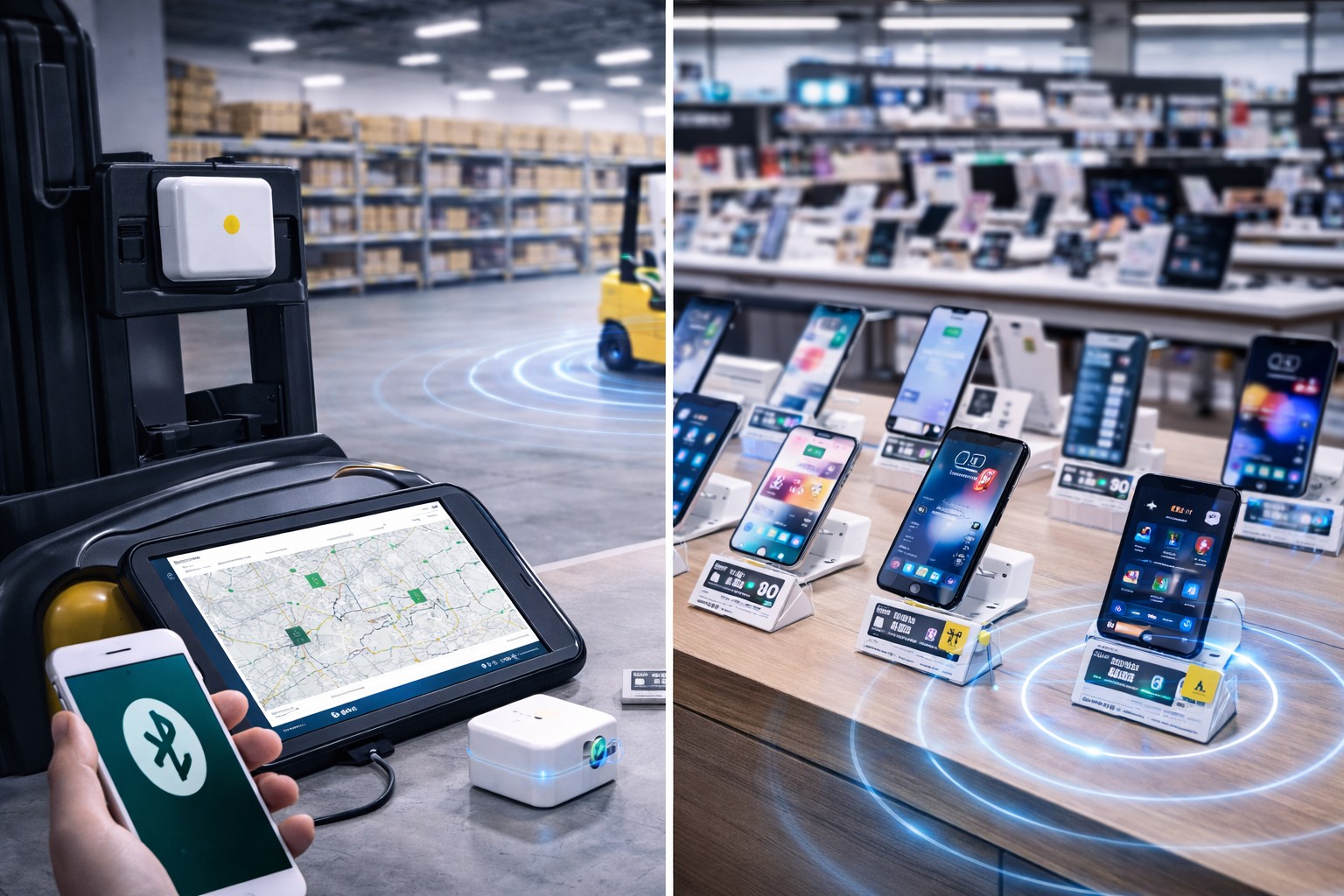
What Is the Difference Between Bluetooth 5.0 and 5.4?
The key distinction lies in network scalability, efficiency, and support for large device ecosystems, not in raw speed or range.
Feature |
Bluetooth 5.0 |
Bluetooth 5.4 |
Range |
Up to 240 m outdoors (30–60 m indoors) |
Similar to 5.0 |
Data Rate |
2 Mbps |
2 Mbps |
Network Scalability |
Moderate |
High — supports Periodic Advertising with Responses (PAwR) |
Power Efficiency |
Good |
Enhanced — better energy management for thousands of devices |
Best For |
Small to medium tracking deployments, consumer devices |
Large-scale IoT, smart retail, industrial monitoring, dense device networks |
In simple terms:
Bluetooth 5.0 focuses on extended range and speed for general IoT and tracking applications.
Bluetooth 5.4 focuses on network efficiency, large-scale device coordination, and power optimization, making it ideal for industrial IoT or synchronized device environments.
What Does Bluetooth 5.0 Offer?
Bluetooth 5.0 significantly improved over Bluetooth 4.x, providing longer range, higher data throughput, and larger broadcast capacity.
Key Features of Bluetooth 5.0:
Extended Range: Theoretical outdoor range up to 240 meters; indoor range typically 30–60 meters depending on walls, interference, and deployment conditions.
Faster Data Transfer: Maximum data rate of 2 Mbps, doubling the throughput of previous generations.
Improved Broadcast Capacity: Larger advertising packets and enhanced messaging support multiple devices with stable connections.
Practical Applications:
Small-to-medium warehouse tracking
Retail Bluetooth monitoring systems
Consumer IoT devices and wearables
Takeaway: Bluetooth 5.0 is sufficient for deployments where device density is moderate, range is more important than device coordination, and cost-efficiency matters.
What Is New in Bluetooth 5.4?
Bluetooth 5.4 focuses on scalability, energy efficiency, and synchronized communication, especially for large IoT networks.
Key Features of Bluetooth 5.4:
Periodic Advertising with Responses (PAwR): Allows thousands of devices to communicate efficiently, reducing packet collisions and network congestion.
Enhanced Power Management: Optimized for low-energy, high-density deployments, extending battery life across large networks.
Device Coordination: Improved scheduling and communication between devices, essential for synchronized IoT networks and smart retail systems.
Ideal Deployment Scenarios:
Smart Retail Shelf Systems (ESL)
Large-scale warehouse tracking
Industrial IoT networks with hundreds or thousands of sensors
Massive IoT ecosystems requiring synchronized communication
Takeaway: Bluetooth 5.4 is particularly valuable when scaling beyond hundreds of devices and when energy management and synchronization are operational priorities.
Bluetooth 5.0 vs 5.4: Which Should You Choose?
Scenario-Based Recommendations:
Deployment Scenario |
Recommended Version |
Reasoning |
Small-to-medium asset tracking |
Bluetooth 5.0 |
Stable range, manageable power consumption, simple infrastructure |
Consumer devices & wearables |
Bluetooth 5.0 |
Low device density, cost-efficient, easy to implement |
Large smart warehouse or industrial IoT |
Bluetooth 5.4 |
Handles thousands of devices, reduces collisions, ensures synchronization |
Smart retail / ESL systems |
Bluetooth 5.4 |
Optimized for massive device coordination and energy-efficient operation |
Decision Framework:
Range Priority: If you only need coverage in small-to-medium areas, 5.0 is sufficient.
Device Density: If scaling beyond hundreds or thousands of devices, choose 5.4 for network efficiency.
Energy Optimization: For low-maintenance IoT networks, 5.4 offers longer battery life and better scheduling.
Deployment Complexity: 5.0 supports simpler setups, 5.4 requires more planning but enables large-scale synchronization.
Frequently Asked Questions (FAQ)
1. Is Bluetooth 5.4 faster than 5.0?
No. Maximum data rates are similar (2 Mbps). 5.4 focuses on network efficiency and large-scale coordination, not speed.
2. Does Bluetooth 5.4 increase range?
No. Range is similar to Bluetooth 5.0. Improvements are in efficiency, device coordination, and energy management, not raw distance.
3. Can Bluetooth 5.0 still be used for tracking?
Yes. For most tracking deployments with small to medium-scale device counts, Bluetooth 5.0 provides reliable coverage and performance.
4. Are Bluetooth 5.0 and 5.4 compatible?
Yes. Bluetooth maintains backward compatibility. Devices running 5.4 can communicate with older versions, including 5.0.
5. Should I upgrade to 5.4 for IoT?
Upgrade if your IoT network involves large-scale coordination or if you need optimized power and synchronization. For smaller networks, 5.0 is cost-effective and sufficient.
Conclusion:
Bluetooth 5.0 and Bluetooth 5.4 serve different optimization goals rather than replacing each other.
If your priority is range and stable performance for general bluetooth tracking, bluetooth 5.0 remains a strong choice. If you are building large-scale IoT systems that require synchronized communication across thousands of devices, bluetooth 5.4 offers meaningful improvements in efficiency and scalability.
Choosing between bluetooth 5.0 vs 5.4 should be based on deployment size and network complexity — not just version number.
About Blueiot:
Blueiot is a global leader in real-time location systems (RTLS), delivering ultra-precise indoor tracking powered by Bluetooth Angle-of-Arrival technology.With accuracy down to 0.1 meters, Blueiot enables organizations to gain real-time visibility into people, assets, and workflows across complex indoor environments.
Trusted across manufacturing, healthcare, logistics, retail, and smart buildings, Blueiot helps businesses boost efficiency, improve safety, and make faster, data-driven decisions—turning location data into measurable operational value.
Looking to improve visibility and operational performance in your industry?
Contact Blueiot to explore a tailored RTLS solution.

Not Sure Which RTLS Solution Is Right for You?
Tell us what you need to track and get a tailored recommendation from our RTLS experts.

Sign-up successful!
Our team will get in touch with you shortly.


