What Is UWB?
UWB (Ultra-Wideband) is a high-precision wireless communication technology used for real-time asset tracking and indoor positioning with centimeter-level accuracy.
UWB technology works by transmitting ultra-short pulses across a wide frequency spectrum. Unlike traditional wireless technologies such as Wi-Fi or Bluetooth, which estimate distance based on signal strength (RSSI), UWB calculates distance using time-of-flight (ToF) measurements. By measuring the exact time it takes for a signal to travel between devices, UWB enables highly accurate and reliable positioning.
In asset tracking systems, UWB allows businesses to determine the exact real-time location of equipment, tools, vehicles, inventory, or medical devices — not just the general zone or area. This makes UWB particularly suitable for environments that require high precision, such as manufacturing plants, warehouses, hospitals, and logistics facilities.
Because of its centimeter-level accuracy, low latency, and strong resistance to interference, UWB is widely considered one of the most advanced technologies for indoor real-time asset tracking.
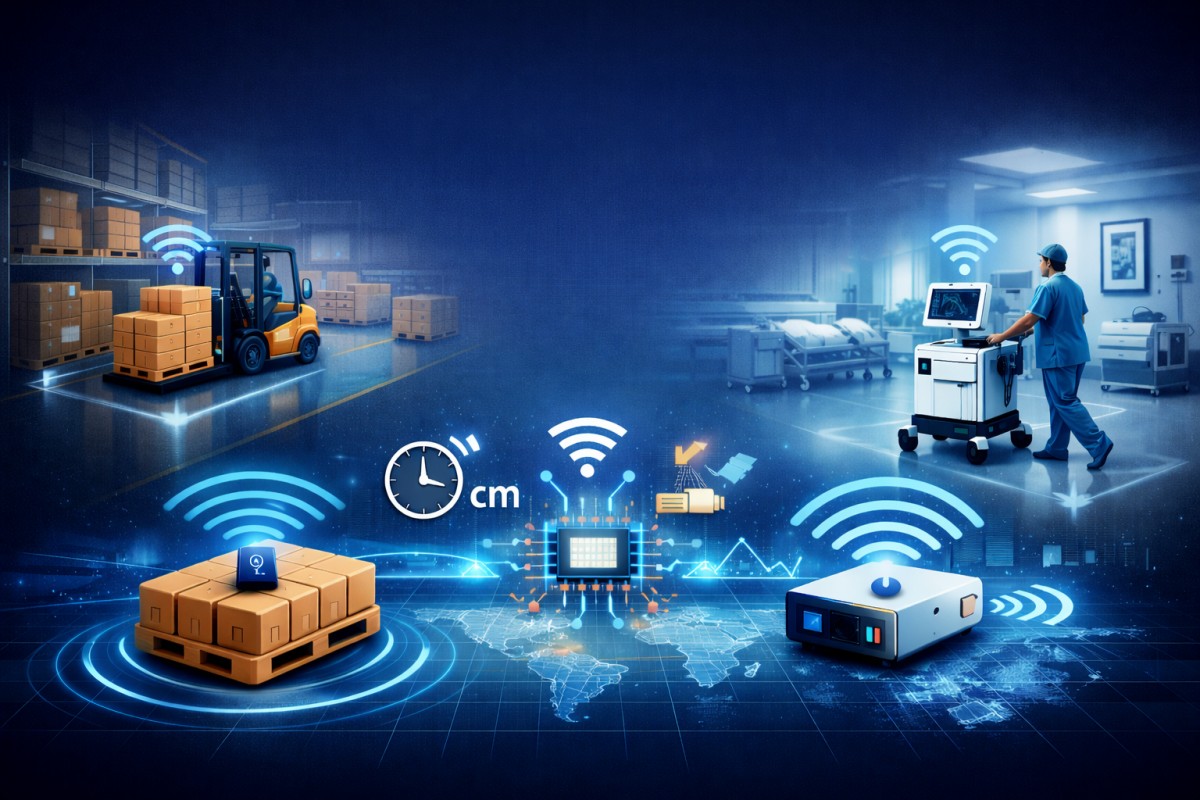
What Is UWB Asset Tracking:
UWB asset tracking is a real-time asset tracking solution that uses Ultra-Wideband (UWB) technology to continuously monitor and locate physical assets with high precision.
A typical UWB asset tracking system includes:
A UWB tag attached to each asset
Multiple UWB anchors insta
lled throughout the facility
A centralized asset tracking software platform
A positioning engine that calculates real-time coordinates using time-of-flight (ToF) measurements
In a UWB asset tracking deployment, tags transmit ultra-wideband signals to nearby anchors. The system determines the precise real-time location of each asset based on signal travel time rather than signal strength.
Unlike traditional asset tracking methods that rely on manual scanning or periodic updates, UWB asset tracking provides continuous, automated visibility. Once deployed, assets remain visible in real time without requiring human interaction.
By enabling continuous location intelligence, UWB transforms traditional asset tracking systems from reactive inventory management tools into proactive real-time operational control platforms.
How Does a UWB Positioning System Work?
A UWB positioning system works by calculating the precise location of an asset using Ultra-Wideband (UWB) signals and time-of-flight (ToF) measurements.
In a UWB positioning system, tags transmit ultra-short radio pulses to multiple anchors installed throughout a facility. The system measures the exact time it takes for each signal to travel between the UWB tag and the anchors. By comparing these time measurements, the positioning engine calculates the precise real-time coordinates of the tagged asset.
Unlike traditional indoor positioning technologies that rely on signal strength (RSSI), UWB positioning is based on precise time synchronization. This approach significantly reduces interference caused by metal structures, machinery, or dense indoor environments, resulting in more stable and accurate positioning.
In a typical deployment, the workflow operates as follows:
The UWB tag emits an ultra-wideband pulse.
Multiple UWB anchors receive the signal.
The system calculates distance using time-of-flight (ToF) data.
The location engine computes the asset’s real-time coordinates.
The position is displayed within the asset tracking system dashboard.
The result is continuous, real-time visibility with positioning accuracy typically ranging from 10 to 30 centimeters, making UWB positioning systems ideal for warehouses, hospitals, manufacturing plants, and other precision-critical environments.
What Problems Does UWB Solve in Asset Tracking?
UWB (Ultra-Wideband) asset tracking solves the core limitations of traditional asset tracking systems, including inaccurate positioning, delayed location updates, and blind spots in indoor environments.
Many legacy asset tracking technologies, such as basic RFID or RSSI-based systems, provide only zone-level visibility. This means organizations may know an asset is within a general area, but cannot determine its exact real-time location.
By contrast, UWB asset tracking delivers centimeter-level positioning accuracy and continuous real-time updates. This enables:
Rack-level positioning in warehouses
Bed-level tracking in hospitals
Tool-level tracking in manufacturing facilities
Instant alerts for unauthorized movement or asset removal
Because UWB positioning is based on time-of-flight measurements rather than signal strength, it maintains high accuracy even in complex indoor environments with metal racks, machinery, or signal interference.
As a result, UWB eliminates time wasted searching for equipment, reduces operational downtime caused by misplaced assets, and improves overall productivity and safety — especially for high-value or mission-critical assets.
Where Is UWB Asset Tracking Most Effective?
UWB (Ultra-Wideband) asset tracking is most effective in environments where assets are highly mobile, high-value, or operationally critical, and where precise real-time location data is required.
Because UWB asset tracking provides centimeter-level accuracy and continuous real-time visibility, it delivers the greatest value in industries such as:
Warehousing and Logistics
UWB-powered asset tracking devices enable continuous monitoring of forklifts, pallets, containers, and mobile equipment. Precise positioning improves workflow efficiency, reduces search time, and enhances yard and warehouse coordination.
Manufacturing
In manufacturing facilities, UWB asset tracking supports real-time tracking of tools, work-in-progress (WIP) materials, and production equipment. This reduces production delays, prevents tool loss, and enables lean and just-in-time operations.
Healthcare
Hospitals use advanced UWB asset tracking systems to locate high-value medical equipment such as infusion pumps, wheelchairs, and mobile diagnostic units. Real-time visibility improves equipment utilization, reduces rental costs, and supports patient safety.
Across these industries, UWB asset tracking transforms location data into actionable operational intelligence, enabling better resource allocation, improved asset utilization, and more informed capital expenditure planning.
UWB vs RFID: What’s the Difference?
The primary difference between UWB and RFID asset tracking is that UWB provides continuous, high-precision real-time positioning, while RFID is primarily used for identification and checkpoint-based tracking.
UWB (Ultra-Wideband) is designed for accurate indoor positioning and real-time asset visibility. RFID (Radio Frequency Identification) is mainly used to identify assets when they pass a reader or scanning point.
Feature | UWB Asset Tracking | RFID Asset Tracking |
Technology Type | Ultra-Wideband (UWB) positioning system | Radio Frequency Identification (RFID) |
Primary Function | Real-time location tracking | Asset identification |
Accuracy | 10–30 cm (centimeter-level) | Zone-level or checkpoint-level |
Real-Time Capability | Continuous, live tracking | Event-based (when scanned) |
Automation Level | Fully automated positioning | Typically requires manual or fixed-point scanning |
Indoor Performance | Strong performance in complex indoor layouts | Performance may be limited by metal and signal interference |
Best Use Case | Precise indoor navigation and operational monitoring | Inventory control at entry/exit points |
When to choose UWB:
If your operation requires precise indoor positioning, live asset monitoring, workflow optimization, or safety-critical tracking, a UWB positioning system is significantly more capable.
When to choose RFID:
If you only need asset identification, inventory counting, or checkpoint-based tracking at loading docks or warehouse exits, RFID asset tracking may be sufficient and more cost-effective.
FAQ
Before implementing a new asset tracking system, businesses often have practical concerns about deployment, cost, and performance. Below are common questions about uwb technology and its real-world impact.
1. How accurate is UWB asset tracking in real facilities?
UWB typically achieves 10–30 cm accuracy indoors. In controlled deployments, accuracy can improve further. Because uwb positioning relies on time-of-flight measurement rather than signal strength, it remains stable even in complex environments like warehouses or hospitals.
2. Is UWB better than RFID asset tracking?
UWB and RFID serve different purposes. RFID asset tracking is useful for identification and inventory logging. However, uwb asset tracking offers continuous real-time monitoring, making it more suitable for high-value equipment and operational tracking.
3. Are UWB tags durable enough for industrial use?
Yes. Modern uwb tag devices are designed for harsh environments, with rugged housings and long battery life. Many industrial-grade tags are resistant to dust, vibration, and temperature variations.
4. How scalable is a UWB positioning system?
A properly designed uwb positioning system can scale across large facilities. Additional anchors can be added to expand coverage while maintaining accuracy within the asset tracking system platform.
5. What is the ROI of deploying UWB asset tracking?
The ROI depends on asset value, labor costs, and downtime impact. Organizations often see savings from reduced search time, fewer lost assets, improved asset utilization, and better workflow efficiency.
Conclusion:
UWB (Ultra-Wideband) transforms asset tracking from approximate, zone-based visibility into precise, real-time operational intelligence.
Unlike traditional asset tracking technologies that rely on signal strength or checkpoint scanning, UWB asset tracking delivers centimeter-level positioning accuracy and continuous real-time monitoring. By leveraging time-of-flight measurements, a UWB positioning system provides reliable indoor location data even in complex environments.
Across industries such as healthcare, logistics, and manufacturing, UWB technology enables organizations to move beyond reactive inventory management toward proactive, data-driven decision-making. With accurate real-time asset visibility, businesses can improve safety, reduce downtime, increase equipment utilization, and optimize resource allocation.
As operational environments become more dynamic and asset-intensive, UWB asset tracking is emerging as a foundational technology for modern real-time asset management systems.
About Blueiot:
Blueiot is a global leader in real-time location systems (RTLS), delivering ultra-precise indoor tracking powered by Bluetooth Angle-of-Arrival technology.With accuracy down to 0.1 meters, Blueiot enables organizations to gain real-time visibility into people, assets, and workflows across complex indoor environments.
Trusted across manufacturing, healthcare, logistics, retail, and smart buildings, Blueiot helps businesses boost efficiency, improve safety, and make faster, data-driven decisions—turning location data into measurable operational value.
Looking to improve visibility and operational performance in your industry?
Contact Blueiot to explore a tailored RTLS solution.
Each location is meaningful!
Get real-time tracking insights and solutions tailored to your needs.
Enter your email to get our newsletter on best-in-class RTLS, AoA, and BLE solutions.

Sign-up
successful !
Our team will get in touch with you
shortly.


 Search