


 Search


Bluetooth 5.3 vs 5.4: Which Version Should You Choose?
February 12, 2026
Bluetooth 5.3 and Bluetooth 5.4 offer similar speed, range, and tracking accuracy.
The main difference is that Bluetooth 5.4 is optimized for large-scale IoT device networks and Electronic Shelf Label (ESL) systems, while Bluetooth 5.3 focuses on improving stability, power efficiency, and interference management for general Bluetooth tracking and IoT deployments.
If you are building:
Asset tracking systems
Industrial IoT networks
→ Bluetooth 5.3 is usually sufficient.
If you are deploying:
Thousands of synchronized endpoints
Smart retail ESL systems
Massive IoT device coordination networks
→ Bluetooth 5.4 offers architectural advantages.
Now let’s break this down clearly and technically.
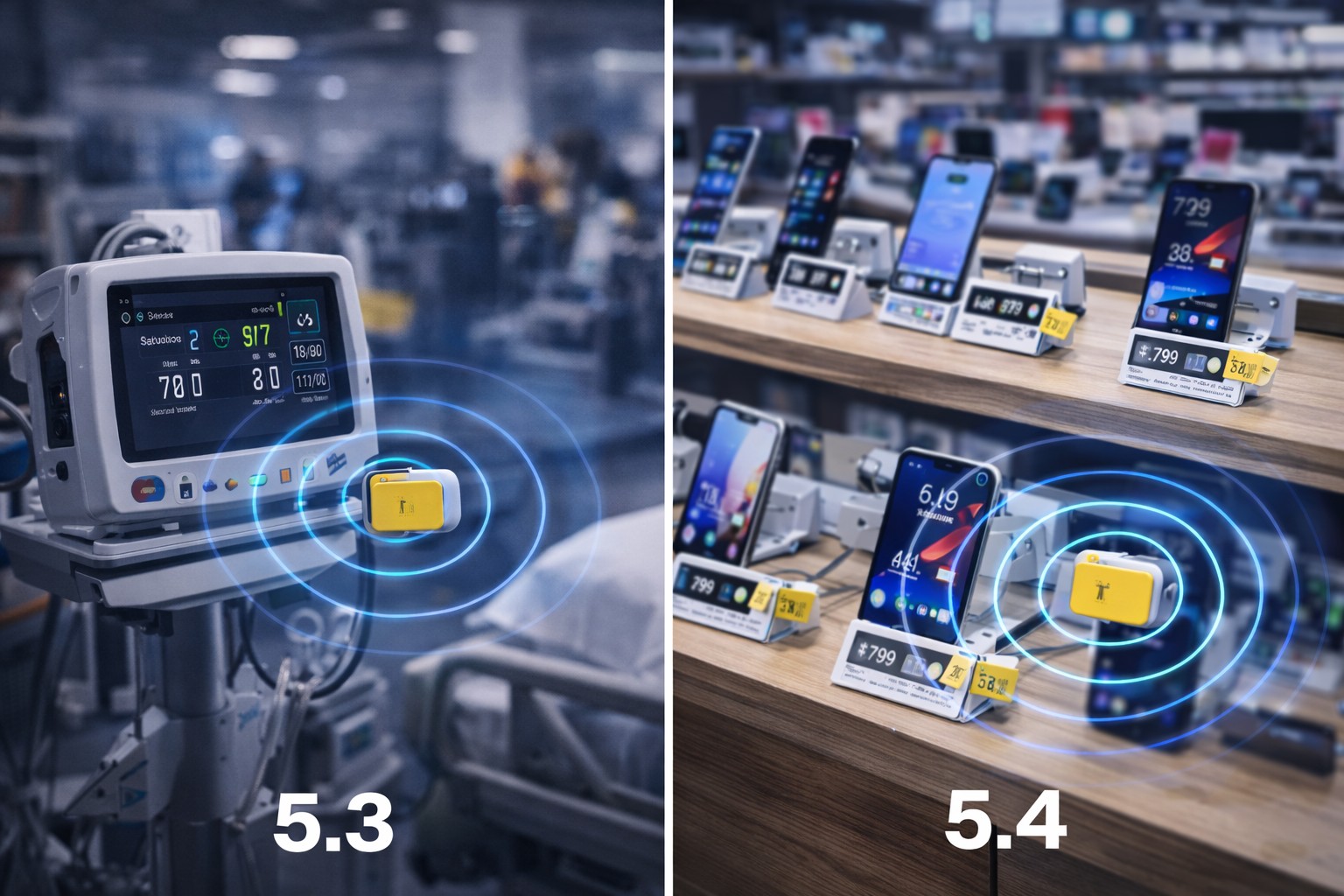
What Is Bluetooth 5.3?
Bluetooth 5.3 (released in 2021) is an incremental upgrade within the Bluetooth 5.x family, focusing on stability, interference reduction, and energy efficiency rather than increasing raw speed or range.
Core Improvements in Bluetooth 5.3
Bluetooth 5.3 introduced:
Enhanced periodic advertising efficiency
Improved channel classification (better interference avoidance)
Faster connection parameter updates
Lower latency switching
Improved power optimization for connected devices
More stable multi-device communication
What This Means in Practice
For Bluetooth tracking and IoT deployments:
Better battery life in BLE tracking tags
More stable connections in high-density environments
Reduced packet collisions in warehouses and hospitals
Improved reliability for wearables and industrial sensors
Bluetooth 5.3 builds on:
Bluetooth 5.0 range improvements
Bluetooth 5.1 direction finding (AoA/AoD)
Bluetooth 5.2 LE Audio and power control
It does not change positioning accuracy or PHY speed.
What Is Bluetooth 5.4?
Bluetooth 5.4 (released in 2023) was designed specifically to support large-scale, synchronized device networks, especially Electronic Shelf Labels (ESL) and smart retail systems.
Major Additions in Bluetooth 5.4
Bluetooth 5.4 introduced:
Periodic Advertising with Responses (PAwR)
Encrypted Advertising Data
LE GATT Security Levels Characteristic
Advertising Coding Selection
Structured bidirectional communication for ESL
Why This Matters
Bluetooth 5.4 enables:
Thousands of devices to communicate in organized time slots
Reduced power consumption in large endpoint networks
Controlled response scheduling
Better group-based communication architecture
This makes Bluetooth 5.4 ideal for:
Smart retail shelf labels
Massive sensor deployments
Smart building infrastructure
Industrial IoT ecosystems with synchronized endpoints
It is less about improving Bluetooth range and more about scalable network architecture.
What Is Bluetooth 5.4?
Bluetooth 5.4 (released in 2023) was designed specifically to support large-scale, synchronized device networks, especially Electronic Shelf Labels (ESL) and smart retail systems.
Major Additions in Bluetooth 5.4
A. Bluetooth 5.4 introduced:
B. Periodic Advertising with Responses (PAwR)
C. Encrypted Advertising Data
D. LE GATT Security Levels Characteristic
E. Advertising Coding Selection
Structured bidirectional communication for ESL
Why This Matters
A. Bluetooth 5.4 enables:
B. Thousands of devices to communicate in organized time slots
C. Reduced power consumption in large endpoint networks
D. Controlled response scheduling
E. Better group-based communication architecture
This makes Bluetooth 5.4 ideal for:
A. Smart retail shelf labels
B. Massive sensor deployments
C. Smart building infrastructure
D. Industrial IoT ecosystems with synchronized endpoints
It is less about improving Bluetooth range and more about scalable network architecture.
Feature |
Bluetooth 5.3 |
Bluetooth 5.4 |
Max Data Rate |
2 Mbps |
2 Mbps |
Range |
Similar (BLE dependent) |
Similar |
Power Efficiency |
Strong |
Strong + optimized for large groups |
Tracking Accuracy |
No change |
No change |
Direction Finding |
Yes (via 5.1) |
Yes |
Large Device Scalability |
Moderate |
Designed for thousands |
ESL Support |
No |
Yes (PAwR) |
Best Use Case |
Asset tracking, industrial IoT |
Massive IoT, smart retail |
No.
Bluetooth 5.3 and 5.4 operate on the same BLE PHY layer:
1. 1M PHY
2. 2M PHY
3. Coded PHY (long-range mode)
Maximum data rate: 2 Mbps
Transmission power: Similar
Indoor range: Determined by environment, antenna design, and interference
a. If you are comparing:
b. Bluetooth 5.0 range
c. Bluetooth 5.3 range
d. Bluetooth 5.4 range
There is no dramatic difference at the physical layer.
Range depends more on:
a. Density Anchor chart
b. Antenna gain
c. Deployment layout
d. RF interference
e. Environmental obstacles
Does Bluetooth 5.4 Improve Tracking Accuracy?
No.
u Bluetooth tracking accuracy depends on:
u RSSI-based positioning
u Bluetooth 5.1 AoA (Angle of Arrival)
u Anchor layout design
u Calibration methods
u System algorithms
The Bluetooth version number does not directly increase positioning precision.
If you require high-accuracy indoor positioning:
Bluetooth 5.1 direction finding is the turning point
UWB may be more suitable for centimeter-level tracking
Which Version Is Better for Bluetooth Tracking?
For Most Asset Tracking Systems → Bluetooth 5.3 Is Enough
Examples:
Industrial tool tracking
Wearable tracking devices
Manufacturing IoT sensors
Bluetooth 5.3 provides:
Stable connections
Low energy consumption
Mature chipset ecosystem
Wide device compatibility
For Large Retail or ESL Infrastructure → Bluetooth 5.4 Is Better
Examples:
Electronic Shelf Labels (ESL)
Smart retail pricing networks
Mass synchronized device deployments
Smart building lighting systems
Bluetooth 5.4 enables:
Structured device scheduling
Controlled group responses
Scalable architecture
Efficient multi-thousand device coordination
Should You Upgrade from Bluetooth 5.3 to 5.4?
Upgrade only if:
You are deploying thousands of synchronized endpoints
You need PAwR functionality
You are building an ESL ecosystem
You require structured group communication
Do NOT upgrade if:
You are running standard BLE asset tracking
Your deployment scale is under several hundred devices
Your infrastructure already performs reliably
Your priority is compatibility and cost control
For most industrial Bluetooth tracking systems in 2026, Bluetooth 5.3 remains fully relevant and cost-effective.
Final Conclusion
When comparing Bluetooth 5.3 vs 5.4:
Speed → Same
Range → Same
Tracking accuracy → Same
Power efficiency → Similar
Large-scale coordination → Bluetooth 5.4 advantage
The decision should be based on:
Deployment size
Device density
Need for synchronized communication
ESL or structured IoT requirements
Bluetooth version upgrades are not about chasing numbers —
they are about matching the architecture to your operational needs.
About Blueiot:
Blueiot is a global leader in real-time location systems (RTLS), delivering ultra-precise indoor tracking powered by Bluetooth Angle-of-Arrival technology.With accuracy down to 0.1 meters, Blueiot enables organizations to gain real-time visibility into people, assets, and workflows across complex indoor environments.
Trusted across manufacturing, healthcare, logistics, retail, and smart buildings, Blueiot helps businesses boost efficiency, improve safety, and make faster, data-driven decisions—turning location data into measurable operational value.
Looking to improve visibility and operational performance in your industry?
Contact Blueiot to explore a tailored RTLS solution.

Not Sure Which RTLS Solution Is Right for You?
Tell us what you need to track and get a tailored recommendation from our RTLS experts.

Sign-up successful!
Our team will get in touch with you shortly.


