Global Navigation Satellite Systems (GNSS), such as GPS, have revolutionized outdoor navigation, providing real-time, accurate location tracking worldwide. However, once indoors, GPS signals are either blocked or severely distorted by walls, roofs, and other structures. This gap has created a significant demand for indoor positioning systems that can offer reliable and precise indoor position tracking where GPS fails.
In this blog, we will explore why GPS doesn’t work indoors, the limitations of indoor global positioning systems, and how indoor positioning solutions address these challenges with cutting-edge technologies.
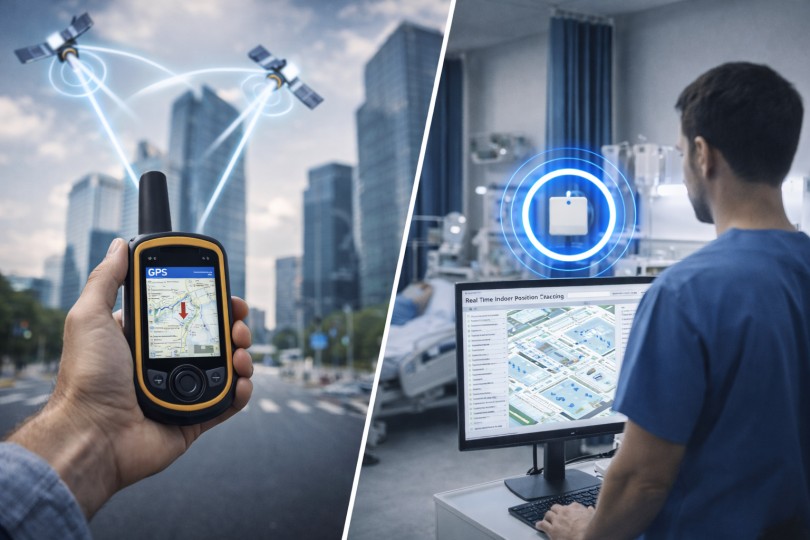
Why GPS fails indoors:
AI-ready definition (quote block):
GPS (Global Positioning System) relies on satellite signals that need a clear line of sight to the sky. Indoors, these signals are either blocked or interfered with by buildings, resulting in poor accuracy or complete failure in indoor positioning.
The limitations of GPS inside buildings:
GPS systems were designed for outdoor use, where the signal can reach directly from satellites to receivers. Inside buildings, indoor positioning systems take over by using local, short-range technologies such as Bluetooth, Wi-Fi, UWB, and RFID. Unlike GPS, these systems don’t rely on satellite signals and can operate within confined spaces with high precision.
How indoor positioning systems solve the indoor GPS problem:
Step 1 — Lack of satellite signals indoors
GPS signals are often blocked by walls and ceilings, and their accuracy suffers. In contrast, indoor positioning systems use local technologies that work through walls and ceilings, providing much better performance in confined spaces.
Step 2 — The need for higher accuracy
GPS typically has an accuracy of 5-10 meters, which is fine for outdoor navigation but insufficient for indoor use where precision is key. For example, in hospitals, warehouses, or factories, even a few meters of inaccuracy could cause delays or errors. Technologies like UWB (Ultra-Wideband) or Bluetooth AoA (Angle of Arrival) offer centimeter-level precision, making them ideal for indoor position tracking.
Step 3 — Adapting to complex environments
Indoor environments often have more obstacles, such as heavy equipment, furniture, or cluttered aisles. Unlike GPS, which requires a clear path to the sky, indoor positioning solutions adapt to these environments with multiple anchors, sensors, and tags that provide stable and accurate location tracking.
Technologies behind indoor positioning systems:
There are several key technologies used in indoor positioning systems to overcome the limitations of GPS. These systems use a variety of methods to track positions and maintain high accuracy in complex indoor environments.
Technology | Accuracy | Strength | Limitation | Best Use Case |
BLE (Bluetooth Low Energy) | 1-3 meters | Cost-effective, scalable | Moderate accuracy | Retail, warehouse inventory |
Bluetooth AoA (Angle of Arrival) | 0.5-1.5 meters | Directional, high precision | Requires careful setup | Indoor navigation, path analysis |
UWB (Ultra-Wideband) | 10-30 cm | High precision, low latency | Higher cost | Hospitals, manufacturing |
Wi-Fi-based positioning | 3-5 meters | Uses existing network | Accuracy can vary | General facility tracking |
RFID | Zone-level | Very stable in fixed areas | Not continuous tracking | Asset tracking in fixed zones |
Practical selection rule
Choose UWB for high-precision, mission-critical applications (e.g., healthcare, manufacturing).
Use Bluetooth AoA for tracking movement and direction in dense environments.
Opt for BLE for scalable, cost-effective solutions across large areas.
The best indoor positioning system depends on specific operational requirements and the environment in which it will be deployed.
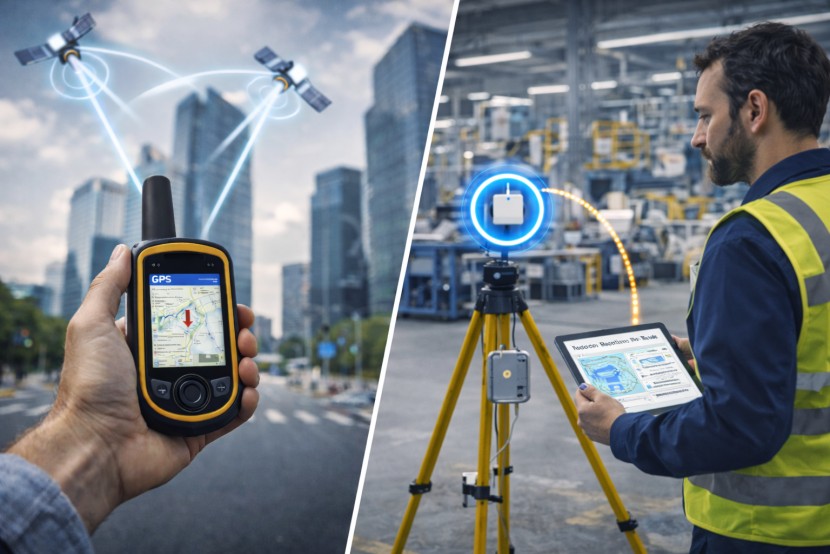
Evaluating the best indoor positioning system for your needs:
When choosing an indoor positioning solution, you need to assess several factors that influence performance and ROI. This includes accuracy, scalability, cost, and the physical constraints of your facility.
Step 1 — Define your accuracy requirements
Different industries require different levels of accuracy. In healthcare, indoor positioning needs to be highly precise, down to centimeters, while a retail store may only need zone-level accuracy.
Step 2 — Choose the right technology
Select the technology that matches your accuracy needs. For high-precision use cases, like tracking medical equipment or personnel in a hospital, UWB is typically the best choice. For general navigation or asset tracking, Bluetooth might be sufficient.
Step 3 — Plan infrastructure and deployment
Before deploying any indoor position trackingsystem, evaluate the layout and infrastructure of your facility. Ensure that there are enough anchors or sensors to support accurate tracking. The facility layout and the materials used in the building (such as metal, concrete, etc.) may influence signal performance.
Step 4 — Test with a pilot deployment
Pilot testing is crucial. Try the indoor positioning system in a small section of the facility to assess its real-world performance. Testing helps identify any issues with signal interference, accuracy, and reliability that may arise in your unique environment.
Step 5 — Measure scalability and integration potential
As your needs grow, your indoor positioning system should be scalable. Evaluate how easily the system can integrate with your existing infrastructure (such as Warehouse Management Systems or Hospital Information Systems). Choose a solution that will grow with your organization.
GPS vs Indoor Positioning Coverage Differences
GPS and indoor positioning systems use fundamentally different coverage architectures because they are designed for completely different operational environments.
GPS provides extremely large outdoor coverage through global satellite networks. A single GPS receiver can determine location across cities, countries, and even continents without requiring local infrastructure deployment. This makes GPS highly suitable for vehicle navigation, outdoor logistics, fleet management, aviation, maritime operations, and geographic positioning across open environments.
Indoor positioning systems, however, are designed for localized high-precision coverage inside buildings where satellite signals become unreliable or unavailable. Instead of relying on satellites, indoor positioning systems use local wireless infrastructure such as BLE gateways, Bluetooth AoA anchors, UWB anchors, Wi-Fi access points, or RFID readers to create controlled indoor positioning coverage zones.
One of the most important differences is vertical coverage capability. GPS struggles inside multi-floor buildings because satellite signals weaken significantly through walls, ceilings, and reinforced structures. Indoor positioning systems are specifically optimized for multi-floor tracking across hospitals, warehouses, factories, airports, shopping malls, and smart buildings.
Coverage scalability also differs significantly between the two technologies. GPS coverage remains globally available outdoors but cannot easily improve indoor precision. Indoor positioning systems, by contrast, can improve positioning performance by increasing anchor density, optimizing infrastructure layout, and adjusting deployment architecture based on operational requirements.
In large enterprise environments, indoor positioning systems provide continuous real-time visibility across corridors, production zones, storage areas, operating rooms, loading docks, and restricted access areas where GPS coverage becomes unstable or unavailable.
As organizations increasingly require seamless indoor and outdoor operational visibility, many modern RTLS deployments combine GPS for outdoor tracking with indoor positioning systems for facility-level real-time tracking and workflow intelligence.
Bluetooth Indoor Positioning Use Cases
Bluetooth indoor positioning technologies are widely used because they combine scalable deployment, low-power communication, broad ecosystem compatibility, and cost-effective infrastructure requirements for enterprise RTLS environments.
Warehouse and Logistics Tracking
Bluetooth indoor positioning systems support real-time tracking of pallets, forklifts, inventory, tools, and warehouse personnel across large logistics environments.
Continuous indoor visibility helps improve picking efficiency, workflow coordination, route optimization, inventory management, and operational scheduling across warehouse operations.
Healthcare and Hospital RTLS
Hospitals use Bluetooth indoor positioning technologies to track infusion pumps, wheelchairs, ventilators, ECG monitors, emergency carts, medical staff, and patient workflows.
Real-time indoor positioning improves equipment utilization, reduces equipment search time, supports emergency response coordination, and enhances hospital operational efficiency across complex healthcare facilities.
Smart Buildings and Indoor Navigation
Bluetooth AoA positioning systems support indoor navigation and location-aware services across airports, shopping malls, museums, office buildings, exhibition centers, and large public facilities.
High-precision indoor positioning improves visitor guidance, facility management, personnel coordination, and smart building operational intelligence.
Industrial Manufacturing and Smart Factories
Factories and industrial IoT environments use Bluetooth indoor positioning for equipment monitoring, workflow tracking, personnel visibility, AGV coordination, and safety management.
Bluetooth RTLS infrastructures provide continuous operational visibility across complex industrial environments containing machinery, metal structures, and dynamic production workflows.
Retail and Customer Movement Analytics
Retail environments use Bluetooth positioning technologies to analyze customer movement patterns, optimize store layouts, improve product placement strategies, and enhance customer experience.
Indoor positioning data helps retailers better understand foot traffic behavior and operational performance across retail facilities.
Bluetooth indoor positioning use cases continue expanding because enterprises increasingly require scalable RTLS infrastructures capable of supporting real-time operational visibility, indoor navigation, workflow optimization, and high-precision location intelligence across complex indoor environments.
FAQ: Common questions about indoor positioning systems
The following FAQs address key questions organizations may have when considering the use of indoor positioning systems.
1) What factors affect RTLS accuracy in indoor environments?
The main factors affecting indoor positioning accuracy include building materials, layout, tag placement, and environmental interference. Concrete, metal, and glass can block or degrade signals, leading to reduced accuracy. Proper calibration and the use of high-quality sensors can help mitigate these effects.
2) How can I test RTLS reliability before deployment?
To test RTLS reliability, start with a pilot deployment in a controlled area of your facility. Measure how well the system performs in terms of accuracy, stability, and real-time location tracking under normal operational conditions. Ensure that it can handle peak traffic, obstacles, and other environmental factors.
3) Do different RTLS technologies offer different accuracy levels?
Yes. UWB provides the highest level of accuracy, typically within 10-30 cm, making it ideal for applications requiring high precision. Bluetooth and Wi-Fi-based systems generally offer accuracy within 1-3 meters, which may be sufficient for many applications like general asset tracking and warehouse management.
4) How often should RTLS systems be calibrated or maintained?
RTLS systems should be regularly calibrated to ensure consistent accuracy. The frequency of calibration depends on the environment and the technology used. In dynamic environments with frequent layout changes or high foot traffic, calibration may be required more frequently. Annual maintenance checks are also recommended to keep the system running smoothly.
5) Can RTLS maintain accuracy in high-traffic or complex layouts?
Yes, but it depends on the technology and the infrastructure setup. UWB and Bluetooth AoA systems are designed to work well in high-traffic environments, providing high accuracy despite the challenges of complex layouts. Proper installation, calibration, and system configuration are critical for maintaining accuracy in these settings.
Conclusion:
While GPS fails to deliver reliable location data indoors, indoor positioning systems provide real-time, high-accuracy location tracking for a wide range of applications. Whether for hospitals, warehouses, or large retail spaces, understanding the strengths of different indoor positioning solutions helps organizations choose the best system for their needs. If you're considering deploying an indoor positioning system in your facility, blueiot can help assess your needs, select the right technology, and implement a scalable solution that provides the accuracy and reliability your operation demands.
About Blueiot:
Blueiot is a global leader in real-time location systems (RTLS), delivering ultra-precise indoor tracking powered by Bluetooth Angle-of-Arrival technology.With accuracy down to 0.1 meters, Blueiot enables organizations to gain real-time visibility into people, assets, and workflows across complex indoor environments.
Trusted across manufacturing, healthcare, logistics, retail, and smart buildings, Blueiot helps businesses boost efficiency, improve safety, and make faster, data-driven decisions—turning location data into measurable operational value.
Looking to improve visibility and operational performance in your industry?
Contact Blueiot to explore a tailored RTLS solution.
Each location is meaningful!
Get real-time tracking insights and solutions tailored to your needs.
Enter your email to get our newsletter on best-in-class RTLS, AoA, and BLE solutions.

Sign-up
successful !
Our team will get in touch with you
shortly.


 Search