


 Search


Reducing Equipment Search Time in Manufacturing with RTLS
February 04, 2026
In manufacturing facilities, lost time often hides in plain sight. Operators walking the shop floor to locate tools, technicians searching for shared equipment, and supervisors delaying production while assets are tracked down all contribute to inefficiency. These moments add up quickly. Turning minutes into hours of lost productivity. RTLS (Real-Time Location System) addresses this issue by enabling real-time equipment tracking across factory environments. With the right RTLS solutions and a reliable RTLS platform, manufacturers can significantly reduce equipment search time and keep production moving without interruption.
What RTLS is:
How RTLS works in manufacturing environments:
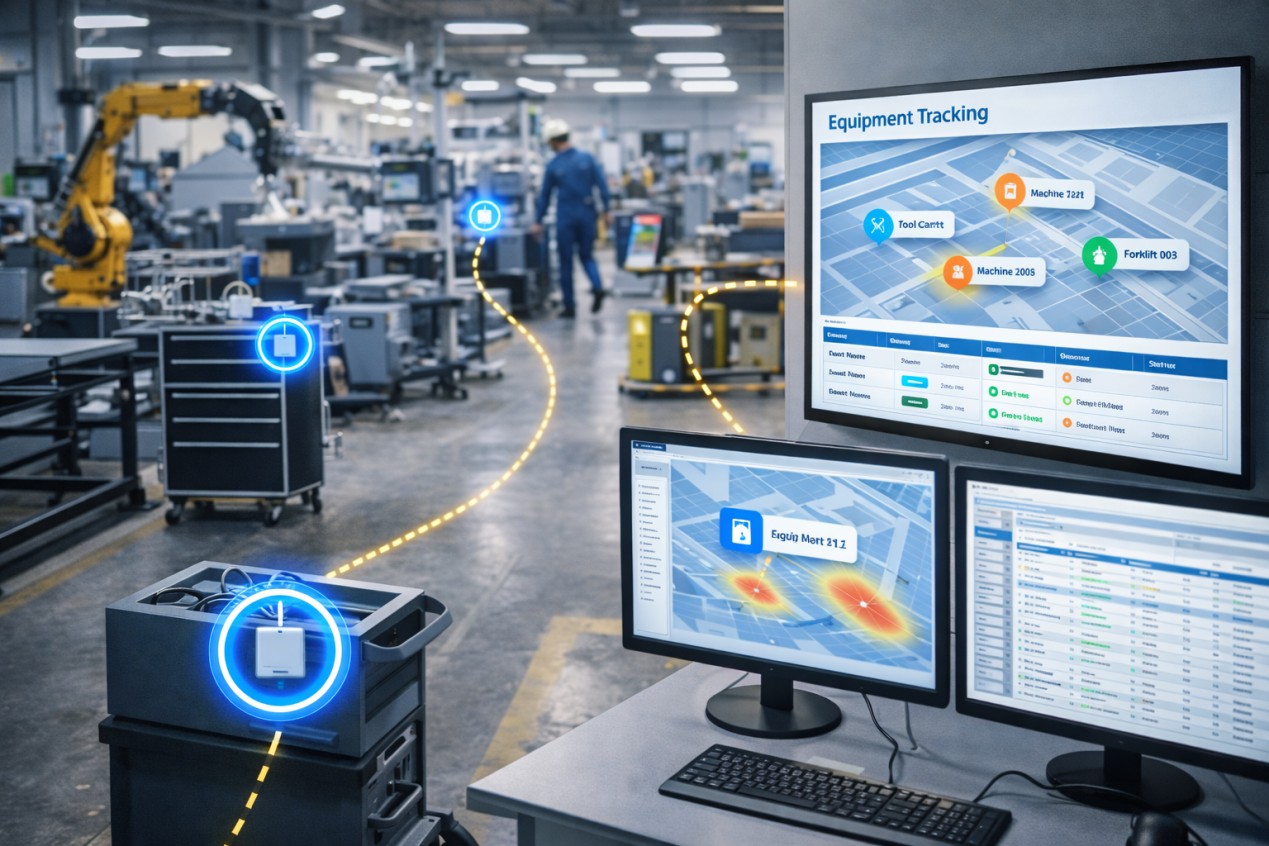
In a factory setting, an RTLS system for equipment tracking typically includes:
RTLS tags attached to tools, machines, carts, or mobile equipment
Anchors / receivers installed across production lines, storage areas, and workshops
A location engine that calculates equipment positions in real time
An RTLS platform that displays asset locations and supports alerts and analytics
Unlike manual logs or barcode scans, real-time tracking reflects where equipment actually is at any given moment. For RTLS in manufacturing, this live visibility is key to reducing wasted motion and downtime.
When RTLS reduces equipment search time:
Best-fit manufacturing scenarios:
RTLS delivers the strongest value in factories with the following conditions:
Step 1 — Shared or mobile equipment
When tools and machines are shared across teams or shifts, locating them becomes difficult. RTLS tracking eliminates guesswork.
Step 2 — Large or complex factory layouts
In multi-line or multi-building facilities, equipment may be nearby but out of sight. Real-time location tracking restores visibility.
Step 3 — High production pressure and tight schedules
When delays affect output, reducing search time has immediate value. RTLS solutions help maintain flow.
Step 4 — Need for accountability and utilization data
Factories benefit from knowing not just where equipment is, but how often it’s used. RTLS platforms provide this insight.
When RTLS may not be necessary:
RTLS may not be the first priority if:
Equipment is fixed and rarely moved
Asset counts are very low
Search time is already negligible
Process issues, not visibility, are the main bottleneck
Understanding these boundaries ensures RTLS is applied where it delivers real impact.
RTLS technology options for equipment tracking:
Different manufacturing environments require different RTLS technologies.
RTLS Technology |
Key Strength |
Limitation |
Best Manufacturing Use |
BLE (Bluetooth) |
Scalable, cost-effective |
Moderate accuracy |
General equipment visibility across factory zones |
Bluetooth AoA |
Higher accuracy and directionality |
Infrastructure planning required |
Tracking tools in dense work areas |
UWB |
High precision and low latency |
Higher deployment cost |
Critical equipment requiring precise location |
RFID |
Reliable checkpoint detection |
Not continuous real-time tracking |
Tool rooms, entry/exit points |
Hybrid RTLS |
Flexible and resilient |
Integration effort |
Large factories with mixed needs |
Practical selection rule:
Use BLE or AoA for factory-wide equipment tracking.
Apply UWB selectively for high-value or high-impact equipment.
Combine with RFID where access control or handoff tracking is needed.
Most manufacturers achieve the best results with a hybrid RTLS system tailored to their workflows.
How RTLS Reduces Equipment Search Time
This section focuses on operational outcomes enabled by asset tracking RTLS, rather than technology features alone.
Step 1 — Make equipment location instantly visible
RTLS platforms provide real-time visibility into where equipment is located through continuous RTLS tracking, including:
On the production line
In storage or staging areas
In use or idle
This level of RTLS asset tracking visibility alone can dramatically reduce time spent searching for tools and equipment.
Step 2 — Eliminate manual searching and interruptions
With real-time RTLS tracking, operators no longer need to leave their workstations to locate equipment. Availability can be checked instantly through the RTLS system, reducing workflow interruptions and unnecessary movement.
This is one of the fastest efficiency gains delivered by asset tracking RTLS.
Step 3 — Improve equipment utilization
RTLS asset tracking data reveals which equipment is frequently idle, underutilized, or overused. These insights allow managers to rebalance resources, improve scheduling, and avoid unnecessary equipment purchases.
Over time, the RTLS system supports more data-driven asset utilization decisions.
Step 4 — Speed up maintenance and changeovers
Maintenance teams can use RTLS tracking to locate required equipment immediately, reducing downtime during repairs or changeovers.
Well-integrated RTLS solutions help ensure the right tools are available at the right time, minimizing production delays caused by missing assets.
Step 5 — Support continuous improvement
Over time, RTLS platforms generate historical data on equipment movement, search delays, and congestion points. Manufacturers can analyze this RTLS asset tracking data to redesign layouts, adjust storage locations, and further reduce search time across operations.
A mature RTLS system turns equipment visibility into long-term operational improvement.
FAQ: Common Questions About RTLS for Equipment Tracking
The following FAQs address common questions manufacturers ask when evaluating RTLS solutions for reducing equipment search time through asset tracking RTLS.
1) How does RTLS reduce equipment search time in factories?
RTLS reduces equipment search time by providing continuous, real-time visibility into where tools and machines are located through RTLS tracking. Instead of walking the factory floor or asking colleagues, staff can check the RTLS system to see exact equipment locations.
This form of RTLS asset tracking removes uncertainty and allows teams to retrieve equipment immediately. Over time, asset tracking RTLS reduces downtime, improves workflow efficiency, and helps keep production schedules on track.
2) Can RTLS track all types of manufacturing equipment?
RTLS can track most types of manufacturing equipment, including tools, carts, mobile machines, and shared assets. The choice of RTLS tags depends on equipment size, movement frequency, and environmental conditions.
Smaller tools may use compact BLE tags, while larger or high-value machines may use UWB tags for higher-accuracy RTLS tracking. With proper planning, RTLS solutions can be adapted to a wide range of factory equipment and RTLS asset tracking use cases.
3) What is the ROI of implementing RTLS for equipment tracking?
ROI from RTLS asset tracking often comes from reduced labor time, lower downtime, and improved equipment utilization. By cutting search time, factories increase productive hours without adding staff or equipment.
RTLS platforms also help avoid unnecessary purchases by revealing underused assets. While ROI varies by facility size and complexity, many manufacturers see measurable gains when RTLS systems are applied to high-impact workflows.
4) Is RTLS easy to install on existing factory equipment?
RTLS installation on existing equipment is typically straightforward. Most RTLS tags can be attached without modifying machines, using industrial mounts or protective enclosures.
Deployment of an RTLS system is often phased, starting with critical equipment before expanding to additional assets. Ease of installation depends on factory layout and environmental factors, but modern RTLS solutions are designed to minimize disruption during rollout.
5) Can RTLS integrate with factory management or ERP systems?
Yes. RTLS platforms can integrate with factory management systems, MES, or ERP platforms through APIs. Integration allows RTLS tracking data to support scheduling, maintenance planning, and utilization reporting.
By connecting RTLS asset tracking data with operational systems, manufacturers gain a unified view of assets and workflows, improving decision-making across the organization.
.
Conclusion:
In manufacturing, time spent searching for equipment is time lost from production. By using RTLS (Real-Time Location System) for real-time equipment tracking, manufacturers can reduce search time, improve utilization, and keep operations running smoothly. If you are evaluating RTLS solutions for RTLS in manufacturing, the blueiot team can help assess your equipment workflows, select the right RTLS system (BLE, Bluetooth AoA, UWB, or hybrid), and start with a focused pilot that delivers measurable efficiency gains before scaling factory-wide.
About Blueiot:
Blueiot is a global leader in real-time location systems (RTLS), delivering ultra-precise indoor tracking powered by Bluetooth Angle-of-Arrival technology.With accuracy down to 0.1 meters, Blueiot enables organizations to gain real-time visibility into people, assets, and workflows across complex indoor environments.
Trusted across manufacturing, healthcare, logistics, retail, and smart buildings, Blueiot helps businesses boost efficiency, improve safety, and make faster, data-driven decisions—turning location data into measurable operational value.
Looking to improve visibility and operational performance in your industry?
Contact Blueiot to explore a tailored RTLS solution.

Not Sure Which RTLS Solution Is Right for You?
Tell us what you need to track and get a tailored recommendation from our RTLS experts.

Sign-up successful!
Our team will get in touch with you shortly.


