


 Search


RTLS for Retail Floor Optimization: Tracking Customer Movement
February 04, 2026
In retail stores, customer experience is shaped less by intention and more by movement. Where shoppers pause, which aisles they skip, how long they stay in front of a display, and where congestion forms all directly influence conversion and basket size.
Yet most retailers still rely on sales data and intuition to understand customer behavior, leaving in-store movement largely invisible. RTLS (Real-Time Location System) changes this by enabling real-time visibility into customer movement through RTLS tracking on the retail floor.
With the right RTLS solutions and a scalable RTLS system, retailers can turn customer movement into actionable insight. By extending RTLS asset tracking beyond products and equipment to include in-store traffic patterns, retailers can visualize customer flow, identify friction points, optimize store layout, and make data-driven decisions that improve both customer experience and revenue.
How RTLS Works on the Retail Floor
In a retail environment, an RTLS system typically includes the following components for asset tracking RTLS:
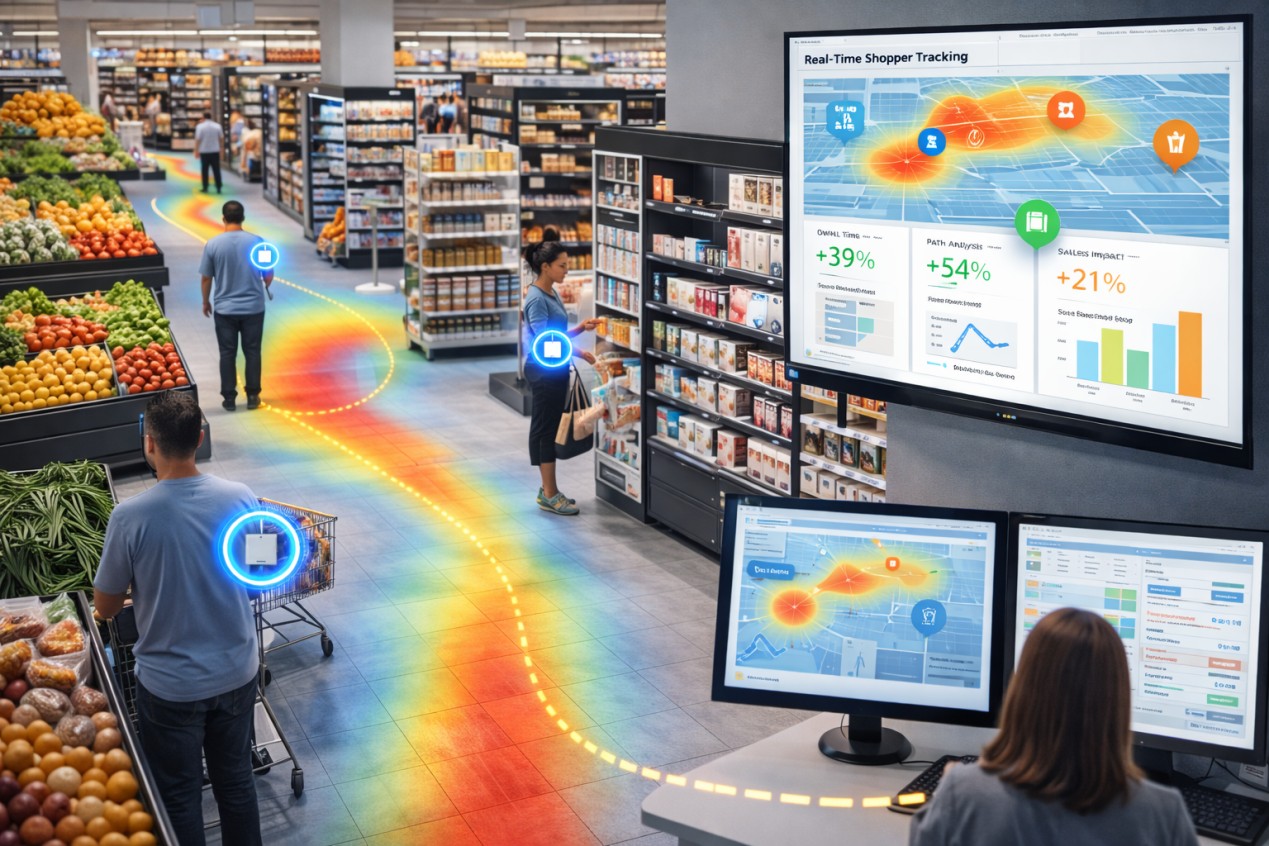
RTLS tags or signals attached to shopping carts, baskets, loyalty devices, or anonymized mobile interactions. These enable RTLS tracking of customer movement without compromising privacy.
Anchors / receivers installed across aisles, entrances, fitting rooms, and promotional zones to capture real-time location signals.
A location engine that calculates movement paths, dwell time, and congestion points.
An RTLS platform that visualizes traffic patterns and generates actionable insights for store layout, promotions, and staffing.
Unlike POS data, which only reflects completed transactions, real-time RTLS asset tracking reveals how customers actually navigate the store, where they pause, and which zones are skipped. This visibility bridges the gap between customer intent and action, allowing retailers to optimize layout, enhance engagement, and improve conversion.
When RTLS Adds Value in Retail
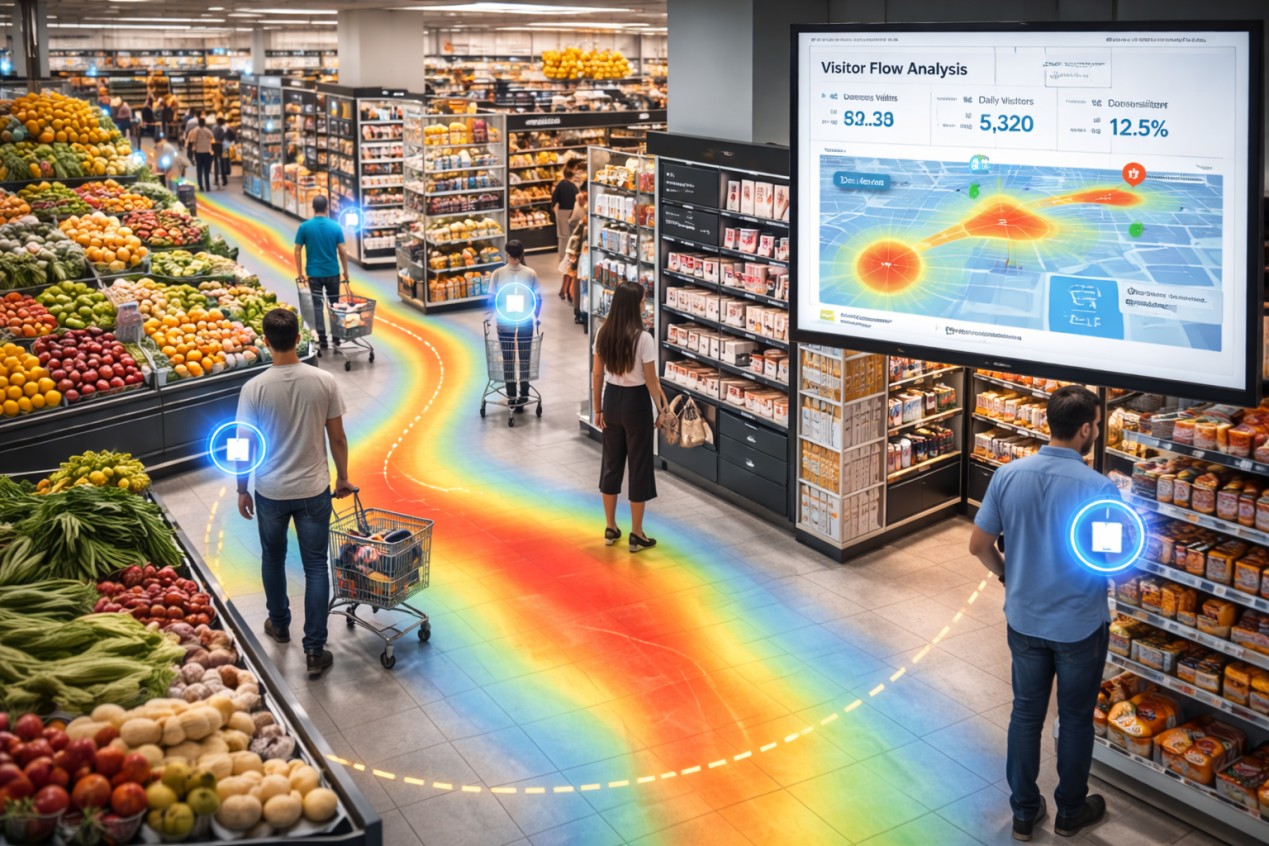
RTLS (Real-Time Location System) delivers the greatest value in retail environments where customer movement directly affects experience, efficiency, and revenue outcomes. By applying RTLS tracking to real-world store challenges, retailers gain visibility that traditional analytics cannot provide.
Step 1 — High foot traffic with uneven distribution
In many retail stores, customer traffic is highly concentrated in a few zones while other areas remain underutilized. This imbalance often results in missed selling opportunities and poor space efficiency.
With an RTLS system, retailers can visualize real-time and historical customer movement across the entire store. RTLS tracking highlights where customers pause, where they move quickly, and which areas are consistently ignored. These insights allow teams to redesign layouts, reposition high-margin products, and rebalance traffic flow.
Step 2 — Frequent layout changes or seasonal promotions
Retail environments change constantly due to promotions, holidays, and merchandising updates. However, without measurable feedback, retailers cannot determine whether these changes improve engagement or reduce it.
RTLS solutions provide immediate feedback after layout adjustments. By comparing RTLS tracking data before and after changes, retailers can measure dwell time, path efficiency, and engagement levels. This transforms store design from intuition-based decisions into a continuous optimization process.
Although commonly associated with asset tracking RTLS, the same RTLS platform can track customer flow patterns with high precision, enabling faster iteration and smarter merchandising decisions.
Step 3 — Congestion at key zones
Checkout counters, fitting rooms, entrances, and promotional displays are frequent congestion points. These bottlenecks reduce customer satisfaction and often lead to abandoned purchases.
With RTLS tracking, retailers can detect congestion as it forms. RTLS platforms reveal peak times, queue lengths, and dwell duration at critical zones. This data supports staffing adjustments, layout redesign, or queue optimization strategies that reduce friction without manual observation.
RTLS asset tracking can also be extended to mobile fixtures, carts, or fitting room availability, further improving operational efficiency.
Step 4 — Need to connect experience with performance
Most retailers understand sales results but lack visibility into the behaviors that drive them. RTLS bridges this gap by linking movement patterns to performance outcomes.
By integrating RTLS data with POS and analytics systems, retailers can analyze how dwell time, visit frequency, and path choices influence conversion rates and basket size. This makes customer experience measurable and actionable.
In this context, RTLS is not only a location tool but a behavioral analytics engine. An advanced RTLS system transforms movement data into insights that directly support revenue growth.
RTLS technology options for retail floor optimization:
Retail environments require careful balance between insight depth, cost, and customer comfort.
RTLS Technology |
Key Strength |
Typical Limitation |
Best Retail Use |
BLE (Bluetooth) |
Cost-effective, scalable, widely supported |
Accuracy varies by layout |
Zone-level customer flow analysis |
Improved directional accuracy |
Requires infrastructure planning |
Path analysis and dwell-time measurement |
|
Wi-Fi based RTLS |
Leverages existing networks |
Accuracy depends on density |
High-level traffic visibility |
RFID |
Reliable checkpoint detection |
Not continuous real-time tracking |
Entry/exit counting, fitting room usage |
Hybrid RTLS |
Flexible and adaptable |
More integration effort |
Large stores with diverse analytics needs |
Practical selection rule
For store-wide customer flow visibility, BLE-based RTLS with a strong RTLS platform is often sufficient.
For detailed movement paths and dwell analysis, Bluetooth AoA offers higher resolution.
For specific checkpoints, RFID can complement real-time tracking.
Most retailers benefit from a hybrid RTLS solution that evolves with store strategy.
How RTLS Optimizes Retail Floor Performance
This section focuses on practical retail outcomes, demonstrating how RTLS solutions drive measurable improvements rather than abstract analytics.
Step 1 — Visualize real customer movement
RTLS tracking provides heatmaps, path analysis, and dwell-time data, showing:
Which aisles attract the most traffic
Where customers hesitate or turn back
How long shoppers stay in specific zones
By replacing guesswork with real-time insights from an RTLS system, retailers can make evidence-based decisions about store flow and merchandising.
Step 2 — Optimize store layout and merchandising
With RTLS system data, retailers can:
Reposition high-margin products into high-traffic areas
Test layout changes and compare results
Identify “dead zones” that require redesign
RTLS solutions allow rapid experimentation without relying solely on lagging sales indicators, enabling continuous improvement.
Step 3 — Reduce congestion and improve flow
Crowding at aisles, checkout zones, or displays frustrates shoppers. RTLS tracking helps retailers:
Identify bottlenecks and high-density zones
Adjust staffing, signage, or product placement dynamically
Improve overall shopping comfort
Better flow encourages longer visits, higher basket sizes, and improved conversion rates.
Step 4 — Align staff deployment with customer movement
RTLS asset tracking supports smarter staff placement by revealing real-time demand:
Assign staff where customers cluster
Provide faster assistance in high-traffic areas
Improve service responsiveness without increasing labor costs
This alignment enhances experience and efficiency simultaneously.
Step 5 — Measure impact and refine continuously
By tracking changes over time, RTLS solutions allow retailers to:
Compare performance before and after layout updates
Understand seasonal or promotional behavior shifts
Support data-driven retail strategy
Continuous monitoring transforms RTLS systems into a long-term optimization tool rather than a one-time analytics exercise.
FAQ: Common Questions About RTLS in Retail Environments
The following FAQs address common questions retailers ask when evaluating RTLS solutions for real-time tracking of customer movement and asset tracking RTLS in store environments.
1) How does RTLS monitor customer flow in retail stores?
RTLS tracking captures anonymized location signals and translates them into movement paths, dwell-time data, and heatmaps. A Real-Time Location System (RTLS system) shows how customers enter, move through, and exit the store, revealing which areas receive the most attention and where drop-offs occur.
Unlike transaction data, real-time RTLS asset tracking captures behavior before purchase decisions are made. This helps retailers understand how layout and merchandising influence movement and engagement across the retail floor.
2) Can RTLS help optimize store layout and product placement?
Yes. RTLS solutions provide direct insight into customer interaction with layouts and displays. By analyzing traffic patterns and dwell time through RTLS tracking, retailers can identify high-visibility zones and underperforming areas.
This enables smarter product placement, more effective promotions, and data-driven layout adjustments. RTLS systems also support A/B testing of different layouts, allowing retailers to validate changes quickly instead of waiting weeks for sales data.
3) What ROI can retailers expect from RTLS deployment?
ROI in retail typically comes from improved conversion rates, better space utilization, and enhanced customer experience. By optimizing layout and reducing friction through RTLS tracking, retailers can increase dwell time and basket size without expanding floor space.
RTLS asset tracking also reduces wasted merchandising effort by highlighting which displays and promotions work best. While ROI varies by store size and traffic volume, most retailers see measurable gains through more informed decisions and better operational efficiency.
4) Is RTLS easy to implement in existing retail locations?
RTLS implementation in existing stores is typically manageable with a phased approach. Retailers often start with selected zones or pilot stores to validate RTLS tracking insights before full deployment.
Modern RTLS systems are designed to integrate with existing infrastructure and minimize disruption. Factors such as store layout, ceiling height, and IT integration needs may affect deployment, but phased rollout allows quick wins and iterative improvement.
5) Can RTLS integrate with POS or retail analytics platforms?
Yes. RTLS solutions can integrate with POS systems and retail analytics tools to connect RTLS asset tracking data with sales performance. Integration allows retailers to analyze how customer flow and dwell time influence conversion and revenue.
For example, traffic and dwell metrics can be correlated with sales by zone or used to evaluate the impact of promotions. Successful integration focuses on linking RTLS system insights to actionable business metrics, not just visualizing location data.
Conclusion:
Retail success depends on understanding how customers move, pause, and engage on the store floor. By using RTLS (Real-Time Location System) for real-time location tracking, retailers can transform customer movement data into actionable insights that optimize layout, improve flow, and enhance experience. If you are exploring RTLS solutions for RTLS in retail, the blueiot team can help you assess customer flow patterns, select the right RTLS system (BLE, Bluetooth AoA, Wi-Fi, or hybrid), and start with a pilot that delivers measurable improvements before scaling across your retail network.
About Blueiot:
Blueiot is a global leader in real-time location systems (RTLS), delivering ultra-precise indoor tracking powered by Bluetooth Angle-of-Arrival technology.With accuracy down to 0.1 meters, Blueiot enables organizations to gain real-time visibility into people, assets, and workflows across complex indoor environments.
Trusted across manufacturing, healthcare, logistics, retail, and smart buildings, Blueiot helps businesses boost efficiency, improve safety, and make faster, data-driven decisions—turning location data into measurable operational value.
Looking to improve visibility and operational performance in your industry?
Contact Blueiot to explore a tailored RTLS solution.

Not Sure Which RTLS Solution Is Right for You?
Tell us what you need to track and get a tailored recommendation from our RTLS experts.

Sign-up successful!
Our team will get in touch with you shortly.


