


 Search


RTLS in Hospitals: Reducing Staff Delays When Seconds Matter
January 29, 2026
In hospitals, response time can be the difference between routine care and a critical incident. Nurses searching for colleagues, doctors delayed by unclear handovers, or support staff unavailable at the right moment all create invisible friction in patient care. These delays are rarely caused by a lack of professionalism—they are usually caused by a lack of real-time visibility.
Implementing RTLS in hospitals addresses this challenge by enabling real-time tracking of staff across departments. Furthermore, by tracking patients in hospitals, facilities can monitor flow and ensure safety from admission to discharge. With a specialized RTLS solution for hospitals and a reliable RTLS platform, healthcare providers can reduce response times, improve coordination, and ensure that staff reach patients faster when it matters most.
How RTLS Works for Hospital Staff
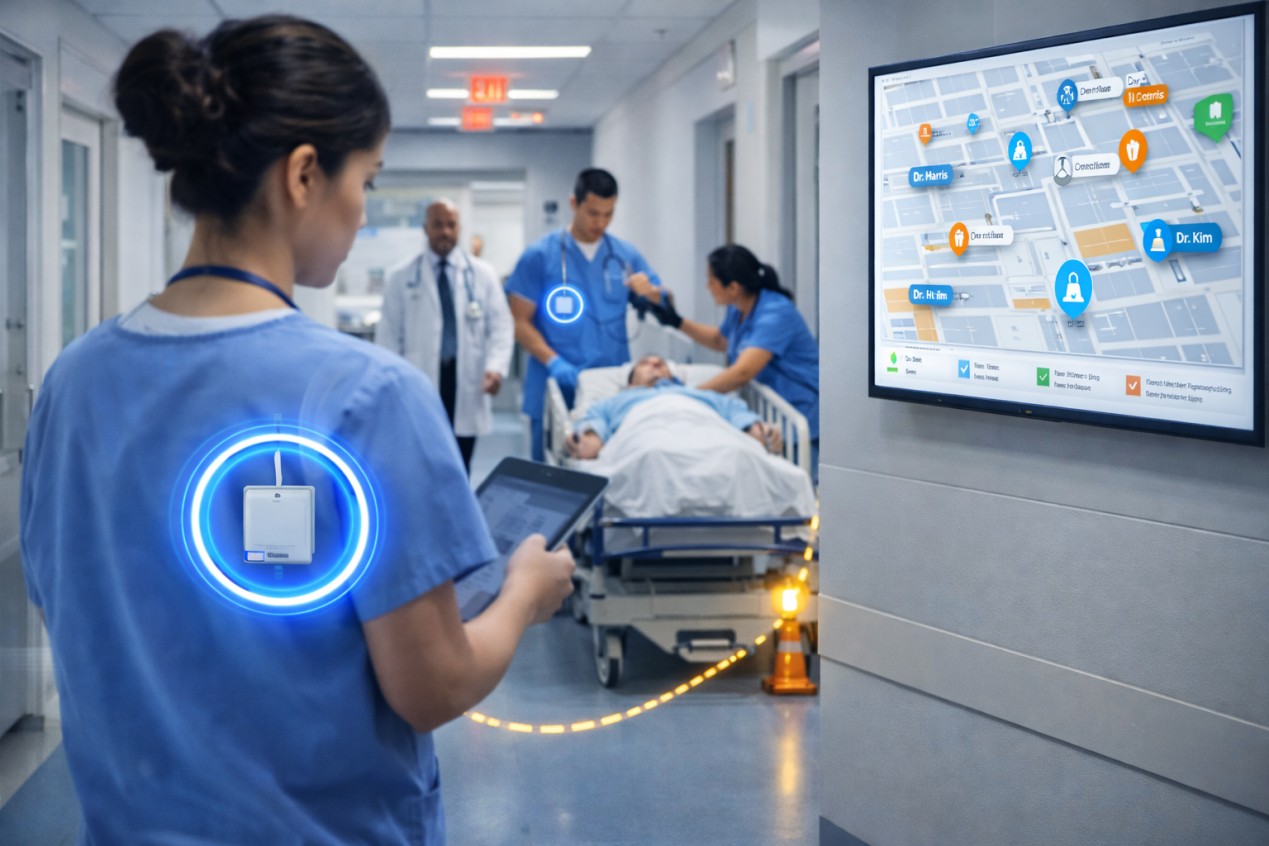
In a high-pressure healthcare environment, an effective RTLS solution for hospitals relies on a seamless network of hardware and software. A standard setup for RTLS hospitals typically includes:
Wearable RTLS Tags: Discrete sensors embedded in staff badges or uniforms for seamless location updates.
Anchors & Receivers: Installed across wards, corridors, nurse stations, and critical care areas to pick up tag signals.
A Location Engine: The "brain" of the system that calculates movement and presence in real-time.
An RTLS Platform: A centralized dashboard that visualizes staff availability and supports automated alerts or workflow triggers.
Unlike traditional phone calls or manual paging, rtls in hospitals provides continuous awareness of staff location and availability. This visibility isn't limited to personnel; by tracking patients in hospitals, facilities can also automate check-ins and monitor wait times to prevent bottlenecks. When choosing an RTLS company for hospitals, it is vital to select a partner that offers a scalable platform capable of handling both staff and patient workflows simultaneously. For modern medical centers, this level of transparency is essential for faster response times and better patient outcomes.
When RTLS improves staff response Best-fit hospital scenarios:
RTLS delivers the strongest value for hospital staff when these conditions exist:
Step 1 — High patient acuity and frequent urgent calls
In emergency departments, ICUs, and acute wards, delays often come from locating the right staff member. RTLS tracking removes guesswork.
Step 2 — Large or multi-building hospital layouts
In complex facilities, staff may be physically close but difficult to find. Real-time location tracking restores situational awareness.
Step 3 — Frequent interruptions and task switching
Hospital staff juggle multiple tasks. RTLS solutions help identify who is available without constant calls or overhead paging.
Step 4 — Need for objective response-time data
Hospitals under pressure to improve service quality benefit from RTLS platforms that measure response times and workflow efficiency.
RTLS technology options for hospital staff tracking:
Different RTLS technologies serve different hospital needs.
RTLS Technology |
Strength |
Limitation |
Best Hospital Use |
BLE (Bluetooth) |
Scalable, cost-effective, easy to deploy |
Accuracy varies by layout |
Staff presence and zone-level tracking |
Improved accuracy and directional awareness |
Requires planning and calibration |
Faster staff location in busy wards |
|
High precision and low latency |
Higher cost and infrastructure needs |
Critical care areas requiring precise tracking |
|
RFID |
Reliable checkpoint detection |
Not continuous real-time tracking |
Access control and staff entry logging |
Hybrid RTLS |
Flexible and resilient |
More integration effort |
Large hospitals with mixed requirements |
Practical selection rule:
For hospital-wide staff visibility, BLE or Bluetooth AoA combined with a robust RTLS platform is usually sufficient.
For critical response zones, UWB can be selectively deployed.
For compliance and access workflows, RFID complements staff tracking.
Most hospitals benefit from a hybrid RTLS system tailored to clinical priorities.
How RTLS Ensures Faster Staff Response Times
Implementing RTLS in hospitals changes the fundamental pulse of daily operations, moving from reactive guesswork to data-driven precision.
Step 1 — Locate the Right Staff Member Instantly
An RTLS solution for hospitals allows coordinators and charge nurses to see who is closest and available in real-time. This eliminates time wasted on paging and allows for matching patient urgency with staff proximity. This is one of the fastest ways RTLS for hospital staff improves response times.
Step 2 — Support Smarter Task Assignment
By combining location and role data, an RTLS platform helps assign tasks more efficiently. This ensures requests are routed to staff already in the vicinity, preventing burnout and balancing workloads across shifts. When a leading RTLS company for hospitals deploys these systems, they often focus on these specific workflow efficiencies to maximize ROI.
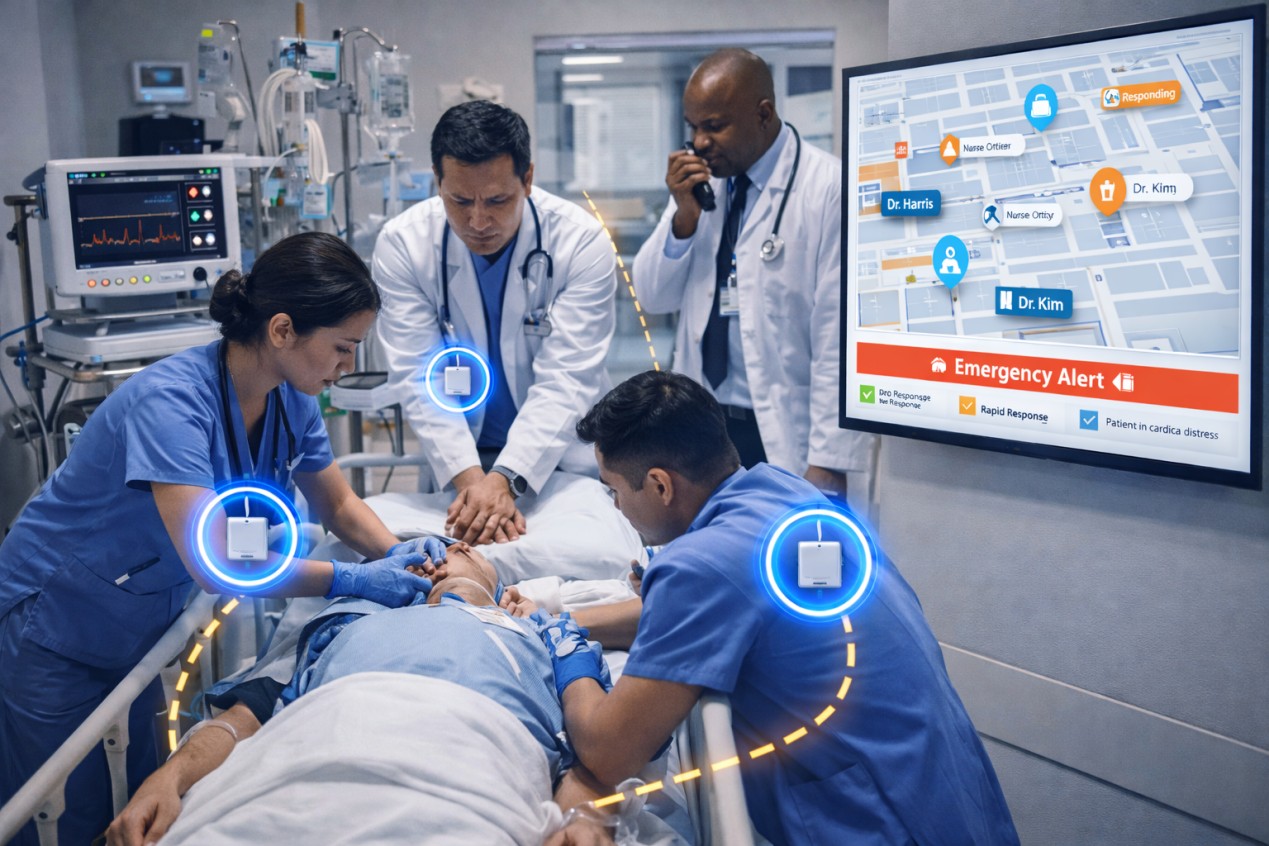
Step 3 — Improve Emergency Response Coordination
During "code" events or rapid response situations in RTLS hospitals, real-time tracking enables:
Faster team assembly: Identifying exactly when the response team arrives.
Clear visibility: Knowing who is on-site and what roles are filled.
Reduced confusion: Ensuring the right people arrive quickly without the delays caused by miscommunication.
Step 4 — Reduce Interruptions and Workflow Friction
Constant interruptions slow staff down. RTLS in hospitals helps by reducing unnecessary phone calls and overhead announcements. By supporting silent, targeted notifications, staff can stay focused on tracking patients in hospitals and providing care without the friction of constant "where are you?" inquiries.
Step 5 — Measure and Improve Response Performance
Finally, a robust RTLS solution for hospitals provides the data necessary for long-term growth. Hospitals can analyze:
Average response times by department.
Bottlenecks in patient movement.
Staffing patterns during peak demand.
By leveraging these insights, RTLS hospitals can refine their workflows and continuously improve patient outcomes.
FAQ: Common Questions About RTLS for Hospital Staff
The following FAQs address the most common questions healthcare leaders ask when evaluating an RTLS solution for hospitals to improve staff response times and operational flow.
1) How does RTLS help hospital staff respond faster?
RTLS in hospitals helps staff respond faster by providing instant visibility into personnel location and availability. Instead of searching for colleagues or making multiple calls, coordinators can immediately identify who is closest to a patient or event. This real-time tracking reduces delays caused by communication gaps and improves coordination during urgent situations. Over time, RTLS hospitals use these platforms to analyze response patterns and optimize workflows, leading to consistently faster care delivery.
2) Can RTLS track staff across multiple hospital departments?
Yes. A comprehensive RTLS solution for hospitals is designed to track movement across departments, floors, and even multiple buildings. With properly placed infrastructure, tracking remains continuous as staff move between wards and diagnostic areas. This cross-department visibility is essential in large RTLS hospitals where collaboration is frequent. Furthermore, the same system can be used for tracking patients in hospitals, ensuring they are monitored as they move from surgery to recovery.
3) What is the ROI of using RTLS for hospital staff?
The ROI of RTLS in hospitals is realized through improved efficiency, reduced response times, and better patient outcomes. Faster response can reduce adverse events and improve patient satisfaction scores. Additionally, a top-tier RTLS company for hospitals will provide platforms that offer deep data analytics to help optimize staffing and reduce inefficiencies. While ROI varies, many organizations see immediate value through measurable improvements in service quality and staff retention.
4) Is RTLS easy to implement for hospital staff?
Implementation is typically manageable when done in phases. Many facilities begin by tracking patients in hospitals within high-impact areas like the ED or ICU before expanding campus-wide. Modern RTLS solutions support flexible deployment with minimal disruption to clinical operations. Choosing an experienced RTLS companyfor hospitals is key to managing IT integration and change management effectively, allowing you to validate benefits quickly.
5) Can RTLS integrate with hospital communication systems?
Yes. Modern RTLS platformsintegrate with nurse call systems, paging systems, and mobile tools. Integration allows location data to trigger targeted notifications—for example, alerting the nearest qualified staff member during an emergency. This reduces "alarm fatigue" and broadcast paging. For RTLS hospitals, successful integration ensures that data leads to clear, actionable communication rather than additional noise.
Conclusion: Faster Response Starts with Real-Time Intelligence
The challenge of hospital efficiency is rarely about a lack of effort; it is about a lack of data. RTLS in hospitals solves this by providing the real-time visibility essential for modern healthcare. By integrating wearable tags and a centralized location engine, RTLS for hospitals allows coordinators to instantly match patient urgency with staff proximity, significantly reducing interruptions and preventing burnout. Furthermore, by tracking patients in hospitals, facilities can gain a holistic view of the care journey—from admission to discharge—to eliminate bottlenecks and improve safety.
Ready to accelerate your hospital’s response performance? The Blueiot team specializes in deploying scalable patient tracking in hospitals and staff visibility solutions tailored to clinical priorities. We assist you in selecting the right technology—be it Bluetooth AoA for ward-wide visibility or UWB for critical care—to ensure your staff can focus on what they do best: saving lives. Contact us today to start a pilot program and see how real-time transparency can redefine your standard of care.

Not Sure Which RTLS Solution Is Right for You?
Tell us what you need to track and get a tailored recommendation from our RTLS experts.

Sign-up successful!
Our team will get in touch with you shortly.


