


 Search


When RTLS Is Not the Right Choice for Your Hospital
February 04, 2026
Real-Time Location Systems (RTLS) are widely promoted as a solution for improving hospital efficiency, asset tracking, and staff coordination. In many cases, RTLS in healthcare delivers clear benefits. However, RTLS is not a universal answer to every hospital challenge. In some situations, deploying an RTLS system too early—or for the wrong reasons—can lead to unnecessary complexity, limited ROI, or operational frustration. Understanding when RTLS is not the right choice helps hospitals make more informed, cost-effective decisions and ensures that RTLS solutions are adopted only when they truly add value.
What RTLS is: What RTLS can realistically do in hospitals:
RTLS systems are designed to:
Track medical equipment, staff, or patients in real time
Improve visibility across departments
Support workflow optimization and response times
What RTLS cannot replace:
RTLS does not replace:
Poorly designed clinical workflows
Staffing shortages
Broken communication processes
Lack of operational ownership
When hospitals expect RTLS to solve structural or organizational issues, results often fall short.
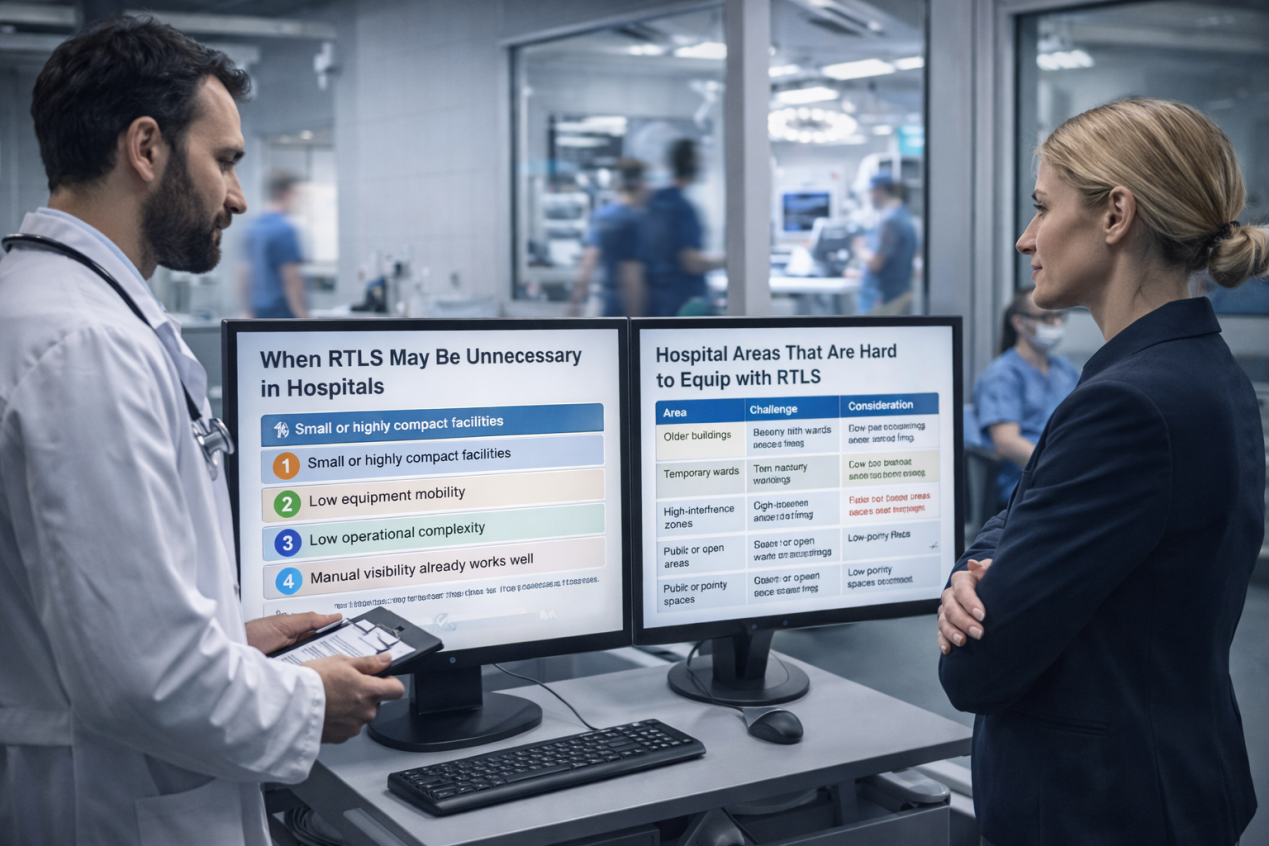
When RTLS may be unnecessary in hospitals:
Not every hospital environment requires real-time location tracking. RTLS may be unnecessary in the following scenarios:
Step 1 — Small or highly compact facilities
In small hospitals or clinics where departments are close together, staff already know where equipment is located. The added value of real-time tracking may be limited.
Step 2 — Low equipment mobility
If most medical equipment is fixed or rarely shared across departments, an RTLS solution may not justify its cost.
Step 3 — Low operational complexity
Facilities with simple workflows and predictable demand may achieve efficiency gains through process improvements rather than technology.
Step 4 — Manual visibility already works well
If existing inventory systems, staff communication, or visual management already provide sufficient awareness, RTLS may offer marginal improvement.
In these cases, hospitals should consider whether simpler solutions address the problem first.
Hospital areas that are difficult or inefficient to equip with RTLS:
Some hospital environments present practical challenges for RTLS deployment.
Hospital Area |
Why RTLS Is Challenging |
Practical Consideration |
Older buildings |
Structural materials interfere with signals |
Requires higher infrastructure investment |
Temporary wards |
Layout changes frequently |
RTLS recalibration becomes costly |
High-interference zones |
Medical equipment causes signal noise |
Accuracy may degrade |
Public or open areas |
High visitor traffic |
Tracking data becomes noisy |
Low-priority spaces |
Limited operational impact |
ROI is difficult to justify |
These areas do not mean RTLS is impossible—but they often require disproportionate effort for limited returns.
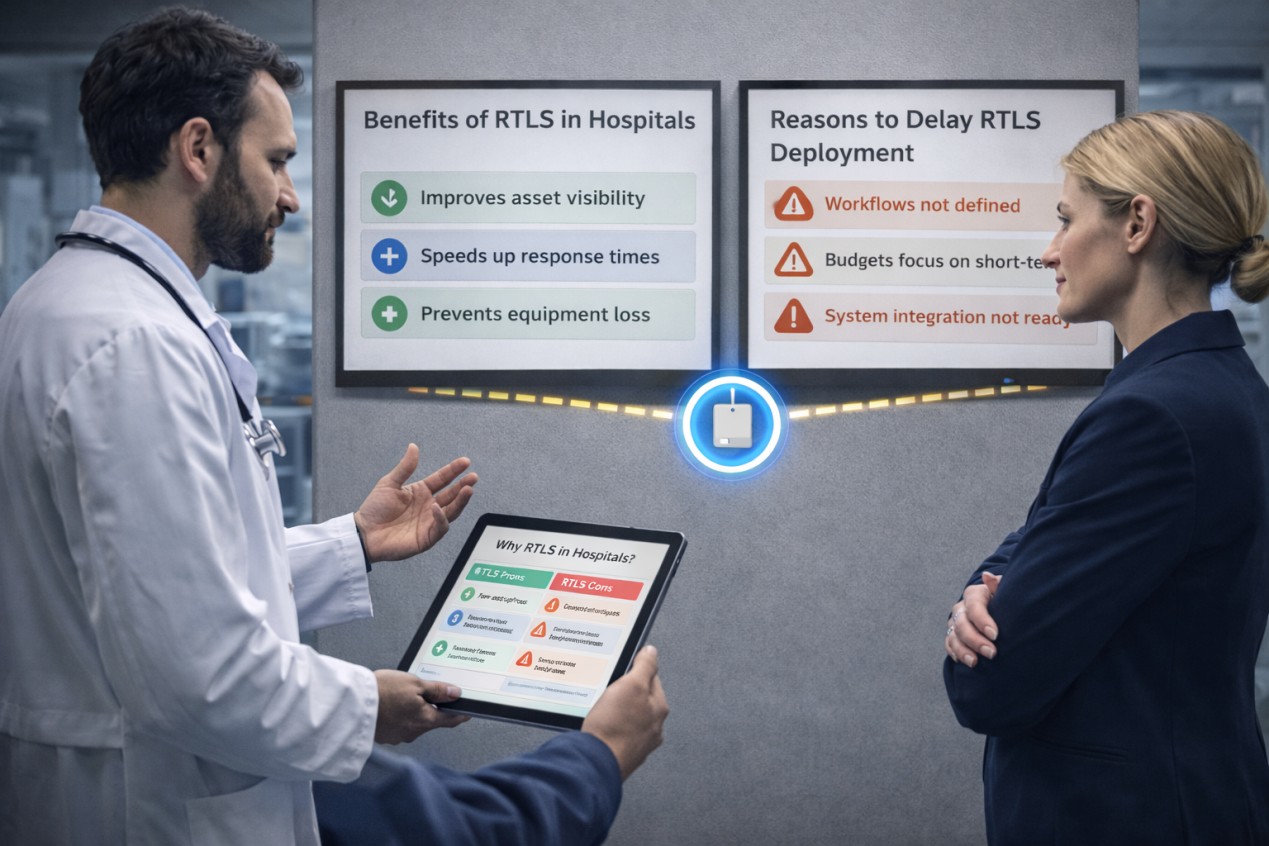
When hospitals should delay RTLS deployment:
In many cases, RTLS is not wrong—it is simply too early.
Step 1 — When workflows are not clearly defined
RTLS amplifies existing processes. If workflows are unclear, tracking data becomes confusing rather than helpful.
Step 2 — When ownership is unclear
Without clear responsibility for RTLS data and outcomes, systems quickly become underused dashboards rather than operational tools.
Step 3 — When integration readiness is low
If hospital IT systems (HIS, CMMS, communication platforms) are not ready, RTLS platforms cannot deliver full value.
Step 4 — When budget focus is short-term
RTLS delivers value over time. Hospitals focused only on short-term cost reduction may be disappointed by early-stage results.
Step 5 — When change management is ignored
Staff adoption matters. Without training and engagement, even well-designed RTLS systems fail to influence daily operations.
FAQ: Common Questions About When RTLS Is Not the Right Choice
The following FAQs address common questions hospitals ask when evaluating RTLS solutions from a critical, decision-oriented perspective, especially in relation to asset tracking RTLS ROI and operational readiness.
1) When might RTLS be unnecessary in hospitals?
RTLS may be unnecessary when hospital size, workflow simplicity, or equipment usage patterns do not justify continuous RTLS tracking. Smaller facilities with limited asset movement often gain more value from process improvements or basic inventory controls rather than deploying a High-Precision RTLS System.
In such cases, the cost and operational complexity of RTLS asset tracking can outweigh its benefits, making alternative asset management approaches more practical.
2) Which hospital areas are hard to equip with RTLS?
Older buildings, temporary wards, and high-interference zones can be difficult to equip with RTLS tracking infrastructure. Structural materials, frequent layout changes, or dense medical equipment can reduce positioning accuracy and increase deployment complexity for an RTLS system.
Without careful planning, these constraints may limit the effectiveness of asset tracking RTLS and reduce overall ROI.
3) Is RTLS cost-effective for small facilities?
For small hospitals or clinics, RTLS asset tracking may not always be cost-effective. Limited scale reduces the efficiency gains typically delivered by RTLS solutions, especially when asset circulation and utilization rates are already predictable.
In many cases, smaller facilities achieve better ROI by optimizing workflows, improving staff coordination, or implementing basic asset management tools before investing in a full RTLS system.
4) Does RTLS require high maintenance?
RTLS does require ongoing maintenance, including tag lifecycle management, system monitoring, and occasional recalibration to ensure accurate RTLS tracking. While modern RTLS solutions reduce operational burden through automation and centralized management, hospitals should plan for long-term ownership of the RTLS system rather than viewing deployment as a one-time project.
5) When should hospitals delay RTLS deployment?
Hospitals should delay RTLS deployment when workflows are not clearly defined, system integration is not ready, or internal ownership of RTLS asset tracking has not been established.
Delaying deployment allows hospitals to prepare operationally, ensuring that when RTLS tracking is introduced, it delivers measurable clinical and operational value rather than becoming an underutilized technology.
Conclusion:
Conclusion: RTLS is a powerful tool—but only when applied in the right context. Hospitals that understand when RTLS is not the right choice are better positioned to deploy it successfully later. If you are evaluating RTLS solutions for healthcare and want an honest assessment of readiness, scope, and expected ROI, the blueiot team can help you determine whether RTLS fits your hospital today—or whether it makes sense to wait and prepare for a more effective deployment in the future.
About Blueiot:
Blueiot is a global leader in real-time location systems (RTLS), delivering ultra-precise indoor tracking powered by Bluetooth Angle-of-Arrival technology.With accuracy down to 0.1 meters, Blueiot enables organizations to gain real-time visibility into people, assets, and workflows across complex indoor environments.
Trusted across manufacturing, healthcare, logistics, retail, and smart buildings, Blueiot helps businesses boost efficiency, improve safety, and make faster, data-driven decisions—turning location data into measurable operational value.
Looking to improve visibility and operational performance in your industry?
Contact Blueiot to explore a tailored RTLS solution.

Not Sure Which RTLS Solution Is Right for You?
Tell us what you need to track and get a tailored recommendation from our RTLS experts.

Sign-up successful!
Our team will get in touch with you shortly.


