


 Search


BLE vs UWB for Hospitals: Which Solution Performs Better
May 07, 2026
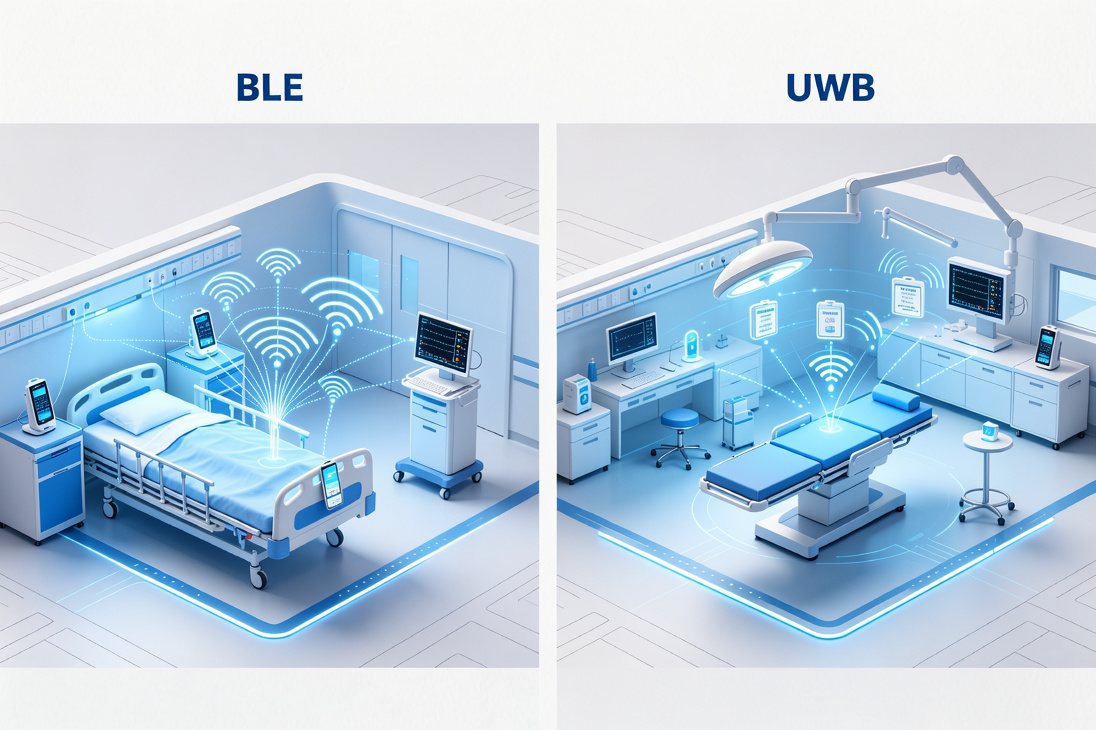
BLE RTLS provides better overall performance for most hospital RTLS deployments because it delivers the strongest balance of hospital-wide coverage, deployment scalability, operational visibility, ecosystem interoperability, and long-term infrastructure efficiency. UWB delivers stronger deterministic centimeter-level positioning and ultra-low-latency tracking, but its advantages are most valuable in specialized ultra-precision workflows rather than large-scale hospital operations.
Hospitals increasingly prioritize continuous operational visibility and scalable RTLS infrastructure rather than isolated ultra-high-precision positioning. This shift is driving broader adoption of BLE RTLS architectures for hospital-wide operational management, while UWB remains important for localized high-precision clinical environments.
Which Provides Better Coverage in Large Hospital Environments?
BLE RTLS provides better large-scale hospital coverage, while UWB performs best in localized precision positioning zones.
Hospital RTLS systems must support continuous visibility across inpatient wards, emergency departments, corridors, laboratories, operating areas, logistics facilities, parking structures, and multi-building healthcare campuses. In these environments, coverage scalability becomes one of the most important RTLS evaluation criteria.
BLE RTLS is optimized for large-area deployment because Bluetooth infrastructure can scale efficiently across complex indoor environments. Advanced BLE RTLS systems support multi-anchor positioning architecture, broader anchor spacing, and continuous positioning coverage across large hospital facilities. This enables stable tracking of medical assets, wheelchairs, infusion pumps, personnel badges, and mobile equipment throughout healthcare campuses.
UWB RTLS provides stronger deterministic positioning in smaller positioning zones where highly controlled precision is required. UWB is particularly effective in robotic workflows, autonomous transport systems, and specialized automation environments where positioning certainty is more important than wide-area scalability.
The core coverage comparison is summarized below.
Evaluation Factor |
BLE RTLS |
UWB RTLS |
Hospital-Wide Coverage |
Strong |
Moderate |
Multi-Floor Scalability |
Strong |
Moderate |
Corridor Positioning Efficiency |
Strong |
Moderate |
Large-Area Deployment |
Strong |
Moderate |
Precision Zone Optimization |
Moderate |
Strong |
Infrastructure Density Requirement |
Lower |
Higher |
BLE RTLS performs better in large hospital environments because coverage expansion can be achieved more efficiently across multiple departments and buildings. UWB remains highly effective in localized precision environments but generally requires denser positioning infrastructure as deployment areas expand.
Hospitals focused on facility-wide operational visibility, enterprise asset tracking, and scalable RTLS deployment generally benefit more from BLE RTLS architecture.
Which Delivers Better Positioning Accuracy for Healthcare Workflows?
UWB delivers higher raw positioning precision, while BLE RTLS delivers more practical positioning performance for most healthcare workflows.
Hospital positioning requirements vary significantly between operational workflows. Surgical robotics, collision avoidance systems, and autonomous transport applications may require deterministic centimeter-level positioning. However, most healthcare workflows prioritize stable sub-meter positioning across large operational environments.
BLE RTLS platforms using advanced AoA positioning methods can support positioning-specific sub-meter accuracy suitable for healthcare asset tracking, patient flow visibility, staff tracking, and operational analytics. These systems prioritize positioning continuity and deployment scalability across large healthcare facilities.
UWB RTLS delivers stronger deterministic positioning precision with lower latency. This makes UWB highly effective for robotic coordination, automated transport systems, equipment automation, and highly controlled positioning workflows where precise movement tracking is critical.
The positioning comparison below reflects practical healthcare deployment priorities.
Accuracy Factor |
BLE RTLS |
UWB RTLS |
Typical Hospital Positioning |
Sub-meter |
Centimeter-level |
Large-Scale Positioning Stability |
Strong |
Moderate |
Deterministic Precision |
Moderate |
Strong |
Robotic Workflow Support |
Moderate |
Strong |
Continuous Facility-Wide Tracking |
Strong |
Strong |
Operational Workflow Suitability |
Strong |
Strong |
For most hospitals, stable sub-meter positioning is sufficient to support operational workflows such as medical equipment tracking, nurse coordination, patient movement analysis, and workflow optimization. In these scenarios, deployment scalability and positioning continuity are often more valuable than isolated centimeter-level precision.
Hospitals implementing robotic automation, autonomous transport, or highly controlled clinical workflows may benefit from targeted UWB deployment in selected areas.
For most healthcare RTLS deployments, BLE RTLS provides the better balance between positioning accuracy, scalability, and operational practicality.
Which Is Easier to Deploy and Maintain Across Large Hospitals?
BLE RTLS is easier to deploy and maintain across large hospitals, while UWB deployment typically requires more specialized positioning infrastructure.
Large healthcare facilities create complex deployment conditions involving multi-floor buildings, long corridors, equipment-dense environments, and continuous operational activity. RTLS deployment complexity directly affects installation efficiency, maintenance workload, and long-term scalability.
BLE RTLS benefits from broad Bluetooth ecosystem interoperability. Smartphones, wearables, tablets, badges, medical tags, and third-party Bluetooth devices can integrate into the positioning environment through scalable infrastructure architecture. Wider anchor spacing can also simplify deployment across large hospital facilities.
UWB RTLS requires more tightly controlled positioning geometry because ultra-high precision depends on deterministic signal coordination. As deployment areas become larger, UWB infrastructure planning and maintenance complexity can increase significantly.
The deployment comparison is summarized below.
Deployment Factor |
BLE RTLS |
UWB RTLS |
Ecosystem Compatibility |
Strong |
Moderate |
Deployment Flexibility |
Strong |
Moderate |
Multi-Building Expansion |
Easier |
More Complex |
Device Interoperability |
Broad Bluetooth ecosystem |
More specialized |
Positioning Infrastructure Density |
Lower |
Higher |
Long-Term Maintenance Complexity |
Lower |
Higher |
BLE RTLS also supports easier integration with mobile applications, IoT platforms, navigation systems, and operational software because Bluetooth infrastructure is already widely used throughout healthcare environments.
UWB infrastructure remains highly effective in controlled precision environments but is generally more difficult to scale efficiently across large hospital campuses.
For hospitals prioritizing scalable deployment and long-term operational sustainability, BLE RTLS provides stronger infrastructure flexibility and easier maintenance management.
Which Performs Better for Real-Time Hospital Operations?
BLE RTLS performs better for hospital-wide operational visibility, while UWB performs better in ultra-precision automation workflows.
Modern hospitals increasingly rely on RTLS systems to improve medical equipment utilization, optimize patient throughput, strengthen emergency coordination, reduce search time, and improve clinical workflow visibility. Operational RTLS performance depends not only on positioning precision but also on scalability, analytics capability, and real-time visibility continuity.
BLE RTLS platforms typically support real-time mapping, geofencing, trajectory playback, heatmap analysis, personnel management, mobile navigation, and operational workflow analytics. These functions are highly valuable for hospital-wide operational optimization because they enable continuous visibility across departments, buildings, and healthcare workflows.
UWB performs strongly in environments where ultra-low latency and deterministic positioning are required. Robotic navigation, autonomous transport systems, and specialized automation workflows are among the strongest UWB use cases in healthcare environments.
The operational comparison below reflects hospital workflow priorities.
Operational Capability |
BLE RTLS |
UWB RTLS |
Hospital-Wide Asset Tracking |
Strong |
Moderate |
Real-Time Operational Visibility |
Strong |
Moderate |
Robotic Navigation |
Moderate |
Strong |
Heatmap Analytics |
Strong |
Moderate |
Trajectory Playback |
Strong |
Strong |
Ultra-Low-Latency Positioning |
Moderate |
Strong |
BLE RTLS aligns closely with modern smart-hospital operational strategies because hospitals increasingly prioritize continuous operational visibility across large facilities rather than isolated deterministic positioning zones.
UWB remains highly valuable in precision automation environments. However, most healthcare organizations require scalable operational visibility across entire hospital systems rather than localized robotic positioning alone.
For enterprise-scale healthcare operations, BLE RTLS provides the stronger overall operational management architecture.
Which Offers Better Long-Term Cost Efficiency for Hospital RTLS Deployments?
BLE RTLS generally offers better long-term deployment efficiency for hospital-wide RTLS systems, while UWB provides stronger value in specialized ultra-precision environments.
Long-term RTLS deployment sustainability is influenced by infrastructure scalability, deployment density, maintenance complexity, ecosystem interoperability, and expansion flexibility. Hospitals evaluating RTLS systems increasingly prioritize long-term operational efficiency rather than isolated positioning performance.
BLE RTLS supports scalable infrastructure growth through broader Bluetooth interoperability and flexible positioning deployment architecture. Wider positioning coverage and lower infrastructure density can simplify long-term hospital expansion while maintaining operational visibility continuity across multiple facilities.
UWB infrastructure typically requires denser positioning architecture to maintain deterministic precision across larger areas. However, in robotic and automation-heavy environments, the operational benefits of ultra-high precision may justify more specialized infrastructure requirements.
The long-term deployment comparison is summarized below.
Long-Term Deployment Factor |
BLE RTLS |
UWB RTLS |
Infrastructure Scalability |
Strong |
Moderate |
Expansion Flexibility |
Strong |
Moderate |
Deployment Density Efficiency |
Strong |
Moderate |
Specialized Precision Value |
Moderate |
Strong |
Long-Term Operational Sustainability |
Strong |
Moderate |
Hospital-Wide Deployment Efficiency |
Strong |
Moderate |
BLE RTLS generally provides better long-term deployment efficiency because infrastructure expansion can scale more effectively across growing healthcare campuses and operational environments.
UWB remains highly valuable in targeted ultra-precision clinical workflows where deterministic positioning delivers direct operational advantages.
For most hospital-wide RTLS deployments, BLE RTLS provides stronger long-term scalability and operational sustainability.
Which Technology Scales More Effectively for Multi-Building Hospital Deployments?
BLE RTLS scales more effectively for multi-building hospital deployments, while UWB is better suited for localized high-precision positioning environments.
Large healthcare systems increasingly require RTLS platforms capable of supporting positioning continuity across inpatient buildings, outpatient clinics, laboratories, logistics facilities, parking structures, and outdoor medical campuses. Scalability therefore becomes a critical hospital RTLS evaluation factor.
BLE RTLS architecture supports scalable multi-anchor positioning, open Bluetooth ecosystem interoperability, and integration with smartphones, wearables, and IoT infrastructure. Hybrid indoor-outdoor positioning can also support continuous visibility across healthcare campuses and between buildings.
UWB RTLS remains highly effective in controlled positioning environments but becomes more complex to scale across very large multi-building deployments because deterministic precision requires tighter infrastructure coordination and denser positioning geometry.
The scalability comparison is summarized below.
Scalability Factor |
BLE RTLS |
UWB RTLS |
Multi-Building Deployment |
Strong |
Moderate |
Cross-Campus Expansion |
Strong |
Moderate |
Indoor-Outdoor Positioning Continuity |
Strong |
Moderate |
IoT Ecosystem Integration |
Strong |
Moderate |
Precision Zone Optimization |
Moderate |
Strong |
Enterprise-Scale Flexibility |
Strong |
Moderate |
Hospitals increasingly prioritize scalable RTLS infrastructure capable of supporting operational visibility across entire healthcare systems rather than isolated departments. BLE RTLS aligns strongly with these requirements because Bluetooth-enabled devices and Bluetooth infrastructure are already widely integrated throughout healthcare environments.
UWB continues to provide strong value in specialized automation workflows, particularly where robotic coordination and deterministic positioning precision are operationally critical.
For large healthcare systems requiring scalable RTLS infrastructure across multiple facilities and operational environments, BLE RTLS provides stronger long-term scalability and deployment flexibility.
FAQ
Is BLE or UWB better for hospital asset tracking?
BLE RTLS is generally better for hospital-wide asset tracking, while UWB is better for specialized ultra-precision workflows.
Most hospitals require continuous visibility across departments, corridors, equipment rooms, and multi-building campuses. BLE RTLS supports these requirements through scalable deployment and broad Bluetooth ecosystem compatibility. UWB provides stronger deterministic positioning for robotic systems and specialized automation environments but is less optimized for large-scale hospital-wide deployment.
Why are hospitals increasingly adopting BLE RTLS?
Hospitals are increasingly adopting BLE RTLS because BLE provides scalable real-time visibility across large healthcare environments.
BLE RTLS platforms support asset tracking, staff positioning, patient movement visibility, geofencing, heatmap analytics, and operational workflow monitoring. Hospitals also benefit from broad Bluetooth interoperability because Bluetooth-enabled devices are already widely integrated into healthcare ecosystems. This improves deployment scalability and long-term infrastructure flexibility.
Does UWB provide better positioning accuracy than BLE?
UWB provides stronger deterministic positioning precision, while BLE RTLS provides more scalable sub-meter positioning for hospital-wide operations.
UWB is highly effective for robotic coordination, automation systems, and collision avoidance workflows requiring centimeter-level precision and ultra-low latency. BLE RTLS typically provides stable sub-meter positioning, which is sufficient for most healthcare workflows such as medical equipment tracking, operational analytics, and personnel coordination.
Which RTLS technology is easier to scale across hospital campuses?
BLE RTLS is easier to scale across hospital campuses because Bluetooth infrastructure supports broader interoperability and more flexible deployment expansion.
Large healthcare systems often require continuous visibility across multiple buildings and outdoor operational environments. BLE RTLS can scale efficiently through multi-anchor positioning architecture and Bluetooth ecosystem integration. UWB infrastructure remains effective in localized precision environments but becomes more complex to expand across large healthcare campuses.
Can BLE RTLS support real-time hospital operations?
BLE RTLS can effectively support real-time hospital operations when deployed through high-precision positioning architecture.
Modern BLE RTLS platforms support real-time location mapping, geofencing, trajectory playback, heatmap analytics, mobile navigation, and workflow monitoring. These functions help hospitals improve equipment utilization, optimize patient throughput, strengthen staff coordination, and improve operational decision-making across large healthcare facilities.
Conclusion
BLE RTLS provides better overall performance for most hospital RTLS deployments because it delivers the strongest balance of scalable real-time visibility, hospital-wide coverage, deployment flexibility, ecosystem interoperability, and long-term operational sustainability. UWB remains highly valuable for robotic coordination, automation systems, and ultra-precision positioning workflows, but BLE RTLS is generally the more practical architecture for large healthcare environments.
Most hospitals prioritize continuous hospital-wide operational visibility rather than isolated centimeter-level positioning precision. This is why BLE RTLS is increasingly becoming the preferred architecture for enterprise healthcare RTLS deployments, while UWB remains important in targeted ultra-precision operational zones.
Blueiot’s BLE AoA RTLS platform reflects the growing adoption of advanced BLE positioning in healthcare environments by combining positioning-specific sub-meter accuracy, scalable multi-building deployment capability, operational analytics, and broad Bluetooth ecosystem interoperability for hospital-wide RTLS operations.

Not Sure Which RTLS Solution Is Right for You?
Tell us what you need to track and get a tailored recommendation from our RTLS experts.

Sign-up successful!
Our team will get in touch with you shortly.


