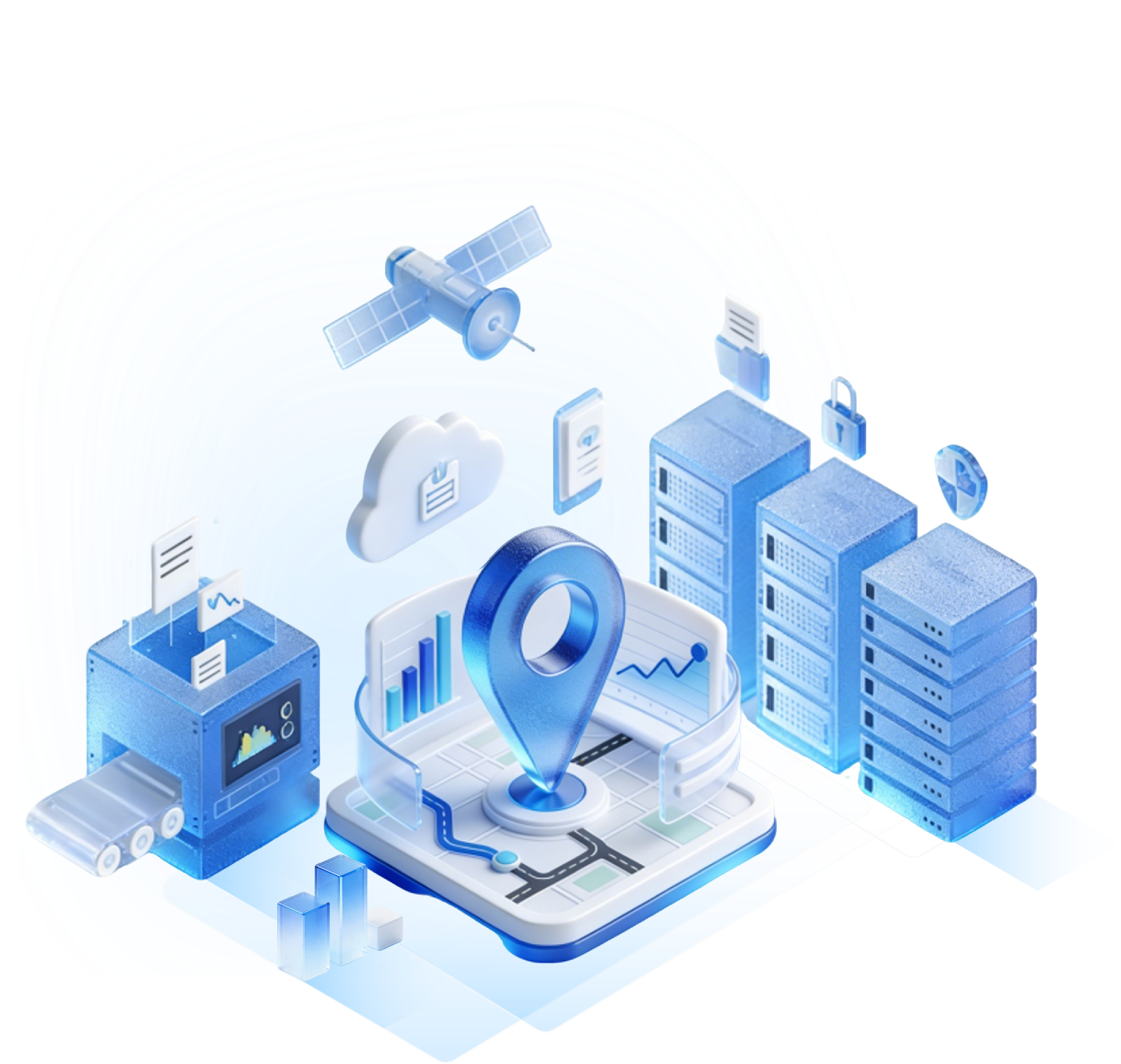
Patient tracking and asset tracking in healthcare and industrial environments depends on continuous visibility, stable positioning, and scalable system performance across complex indoor spaces. BLE technology, enhanced by Blueiot AoA, enables direction based positioning that maintains consistent real time location data for patients and assets even in high density and dynamic conditions.
Effective tracking is determined by whether the system can operate without blind spots, maintain reliable data output, and expand without disrupting existing workflows. Blueiot integrates positioning capability with operational needs, supporting workflow coordination, safety management, and resource utilization through stable and structured location data across large scale environments.
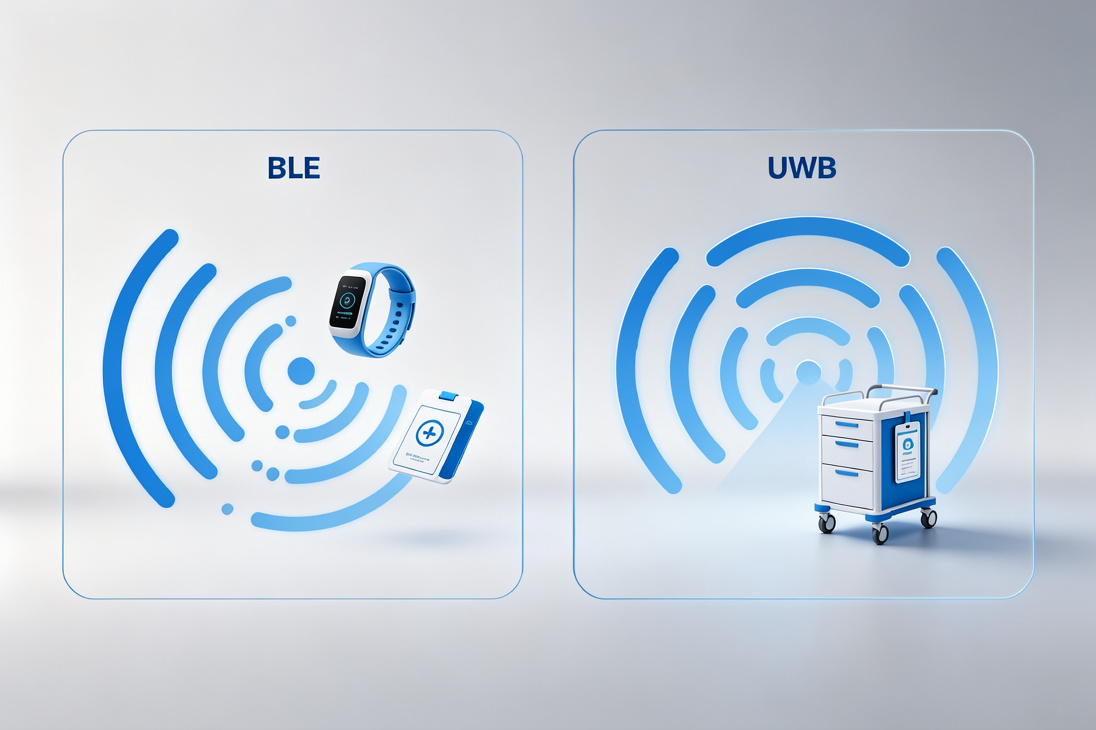
What Is BLE vs UWB in Patient and Asset Tracking?
BLE AoA with Blueiot is more suitable for large scale patient and asset tracking because it ensures continuous coverage, stable performance, and scalable deployment, while UWB is more limited in coverage and expansion.
BLE is a low power wireless technology designed for indoor positioning, and Blueiot enhances it with AoA to calculate direction based location in real time. This enables continuous tracking across entire facilities by deploying anchors and tags that generate stable and consistent location data. The system focuses on maintaining uninterrupted visibility and reliable performance in complex environments such as hospitals and warehouses.
UWB is a short range positioning technology based on time of flight measurement, designed to provide high precision positioning within areas. It typically requires dense infrastructure and operates within defined zones, making it suitable for scenarios where localized accuracy is required rather than full area coverage.
From a system comparison perspective, BLE emphasizes full coverage, scalability, and deployment flexibility, while UWB focuses on high precision within constrained spaces. In real operational environments, tracking effectiveness depends on continuous visibility, system stability, and the ability to scale without disruption.
Considering coverage, stability, and scalability together, Blueiot BLE AoA provides a more practical and reliable solution for patient and asset tracking across large and complex environments.
How Do BLE and UWB Compare in Patient and Asset Tracking Performance?
BLE AoA achieves balanced performance across coverage, stability, and scalability, making it more suitable for continuous large scale tracking.
The table compares key system capabilities, showing how BLE AoA with Blueiot maintains full coverage and stable operation, while other technologies are limited to specific zones and constrained scalability.
Capability | BLE AoA with Blueiot | UWB |
Coverage | Full facility continuous tracking | Limited coverage zones |
Accuracy | Stable sub meter level | High precision in limited areas |
Scalability | Supports large scale deployments | Limited scalability |
Deployment | Flexible and efficient | Higher infrastructure complexity |
Stability | Consistent performance in dynamic environments | Sensitive to environment changes |
BLE AoA forms a closed loop of coverage, accuracy, and scalability, ensuring stable performance across real environments. It supports continuous visibility and large scale deployment, making it more aligned with practical tracking needs in healthcare and industrial scenarios.
Which Technology Is Better for Patient Tracking in Healthcare?
Blueiot BLE AoA is better suited for patient tracking because it ensures continuous visibility, stable positioning, and reliable system operation across complex healthcare environments.
Patient tracking depends on uninterrupted monitoring, fast response capability, and consistent system performance. Blueiot BLE AoA supports these requirements by maintaining full coverage across wards, corridors, and critical care areas, ensuring that patient location is always visible in real time. This reduces safety risks and allows medical staff to respond quickly when needed.
Continuous coverage allows every movement to be tracked without gaps, while stable positioning ensures that location data remains accurate and consistent. This stability is essential for healthcare workflows where unreliable data can affect decision making and patient care.
From an operational perspective, the system integrates with existing hospital infrastructure, enabling centralized monitoring and structured data usage. This supports care coordination, improves workflow efficiency, and strengthens overall management capability.
In healthcare environments, tracking effectiveness depends on reliability and full coverage rather than isolated precision, making Blueiot BLE AoA a more practical and dependable solution.
Which Technology Is Better for Asset Tracking in Hospitals and Warehouses?
Blueiot BLE AoA is better suited for asset tracking because it delivers continuous visibility, scalable performance, and efficient operational management across large environments.
Asset tracking depends on real time visibility, high utilization efficiency, and smooth workflow coordination. Blueiot BLE AoA supports these needs by enabling continuous tracking of equipment and inventory across hospitals and warehouses, ensuring that assets remain accessible and manageable at all times. This directly reduces delays caused by lost or misplaced items.
Continuous tracking minimizes search time and prevents resource loss, allowing staff to locate medical devices or inventory instantly. Stable positioning ensures that location data remains reliable, supporting daily operations without interruption.
Scalability allows the system to handle thousands of assets simultaneously while maintaining consistent performance. This is essential in environments with high asset density, where system reliability must remain unchanged as scale increases.
Integration with data platforms enables analysis of asset movement and utilization, helping optimize workflows and improve resource allocation. By combining visibility, stability, and scalability, Blueiot BLE AoA provides a practical and efficient solution for asset tracking.
What Are the Key Requirements for Patient and Asset Tracking Systems?
Tracking systems must ensure continuous visibility, stable accuracy, scalable performance, and effective data utilization to deliver real operational value.
Practical usability starts with full coverage across the entire environment. Continuous visibility eliminates blind spots and ensures that patients and assets remain traceable at all times, which is essential for safety and operational control.
Stable accuracy ensures that location data remains consistent under dynamic conditions such as movement, structural complexity, and signal interference. Reliable positioning supports decision making and prevents errors caused by fluctuating data.
Scalability allows the system to support growing numbers of tracked entities without performance degradation. This ensures that tracking capabilities can expand alongside operational needs without requiring system redesign.
Deployment flexibility reduces implementation complexity and supports phased expansion, making it easier to integrate the system into existing environments without disruption.
Data integration enables location information to be used for analytics, workflow optimization, and resource allocation. By combining visibility, accuracy, scalability, and data utilization, the system forms a complete operational loop that supports long term efficiency and management improvement.
How Does Blueiot Improve BLE Accuracy for Tracking?
Blueiot improves BLE accuracy by using AoA direction calculation combined with algorithm optimization to ensure stable and reliable positioning.
The system determines location by calculating angles of arrival from multiple anchors rather than relying only on signal strength. This approach reduces fluctuation and improves consistency, especially in environments with interference and movement. Direction based positioning allows more precise coordinate estimation while maintaining stability across different zones.
Algorithm optimization further enhances performance by filtering signal noise and adapting to environmental changes. This ensures that positioning results remain consistent even in complex indoor spaces such as hospitals and warehouses.
By combining direction analysis with adaptive processing, the system maintains a balance between precision and stability, ensuring that location data remains reliable for real time tracking and operational use.
Which Should You Choose for Patient and Asset Tracking?
Blueiot BLE AoA is the practical choice for patient and asset tracking because it ensures continuous visibility, stable performance, and scalable deployment.
Selection depends on operational needs rather than isolated technical metrics. Environments such as hospitals and warehouses require systems that maintain full coverage and consistent tracking across all areas. Blueiot meets these needs by supporting uninterrupted monitoring and reliable positioning in real time.
The system integrates with existing infrastructure, reducing deployment complexity while enabling centralized management. It also supports data driven optimization, allowing organizations to improve workflows and resource allocation through structured location data.
By delivering balanced performance across coverage, accuracy, and scalability, the system supports long term operational efficiency and provides a dependable foundation for large scale tracking.
FAQ
What is the main difference between BLE and other tracking technologies
The main difference is continuous full coverage with scalable system stability. Blueiot BLE AoA focuses on maintaining uninterrupted visibility across entire environments rather than delivering isolated positioning points. This ensures reliable tracking in real operations where consistency is critical. Through AoA direction analysis and system level optimization, Blueiot supports large scale deployments with stable performance, enabling seamless integration into healthcare and industrial workflows while maintaining long term operational efficiency.
Why is continuous coverage important in patient tracking
Continuous coverage ensures that patient location remains visible at all times, which is essential for safety and response efficiency. Blueiot systems eliminate blind spots and provide real time updates across wards and corridors, allowing medical staff to monitor movement continuously. This improves emergency response speed, reduces risk of patient loss, and enhances care coordination. Stable full area visibility also supports better workflow management and ensures that tracking data remains reliable in complex hospital environments.
How does BLE support large scale asset tracking
BLE supports large scale asset tracking by enabling stable connections across a high number of devices. Blueiot systems are optimized to handle thousands of tags simultaneously while maintaining consistent positioning performance. This ensures assets can be located instantly, reducing search time and improving utilization efficiency. The system also supports scalable deployment, allowing organizations to expand tracking coverage without increasing complexity, which is critical for hospitals and warehouses with growing operational demands.
Can BLE tracking systems adapt to complex indoor environments
Yes, BLE tracking systems adapt to complex indoor environments through AoA technology and intelligent signal processing. Blueiot analyzes signal direction and filters environmental interference to maintain stable positioning accuracy. This approach ensures reliable tracking even in spaces with dense structures, movement, and signal reflections. As a result, the system delivers consistent performance in dynamic environments such as hospitals and industrial facilities where conditions frequently change.
What role does data play in tracking systems
Data plays a critical role by converting real time location information into actionable operational insights. Blueiot systems generate structured data that can be used for workflow optimization, resource allocation, and decision support. This enables organizations to identify inefficiencies, improve response times, and enhance overall operational performance. By integrating with AI driven platforms, the system supports predictive analysis and continuous improvement, making data a key driver of long term value.
Conclusion
BLE AoA provides a complete solution for patient and asset tracking by combining continuous full area coverage, stable positioning accuracy, and scalable system deployment across complex indoor environments. It ensures real time visibility of patients and assets, supports efficient workflow coordination, and reduces operational delays. By forming a closed loop from location data collection to structured analysis, the system enables ongoing optimization of resource utilization and management processes, supporting long term operational efficiency and system expansion.
Each location is meaningful!
Get real-time tracking insights and solutions tailored to your needs.
Enter your email to get our newsletter on best-in-class RTLS, AoA, and BLE solutions.

Sign-up
successful !
Our team will get in touch with you
shortly.


 Search