Bluetooth Low Energy with Angle of Arrival is the most practical RTLS system for hospital-wide deployment. It enables scalable indoor positioning, stable tracking performance, and efficient system expansion across complex healthcare environments. By leveraging direction-based positioning, BLE AoA ensures consistent real-time location accuracy without requiring dense infrastructure, allowing hospitals to achieve full coverage across multiple buildings and departments.
For most hospitals, BLE AoA delivers reliable real-time visibility, supports continuous data flow, and forms a unified infrastructure that enhances asset utilization, optimizes workflows, and strengthens long-term operational efficiency and digital transformation capabilities.
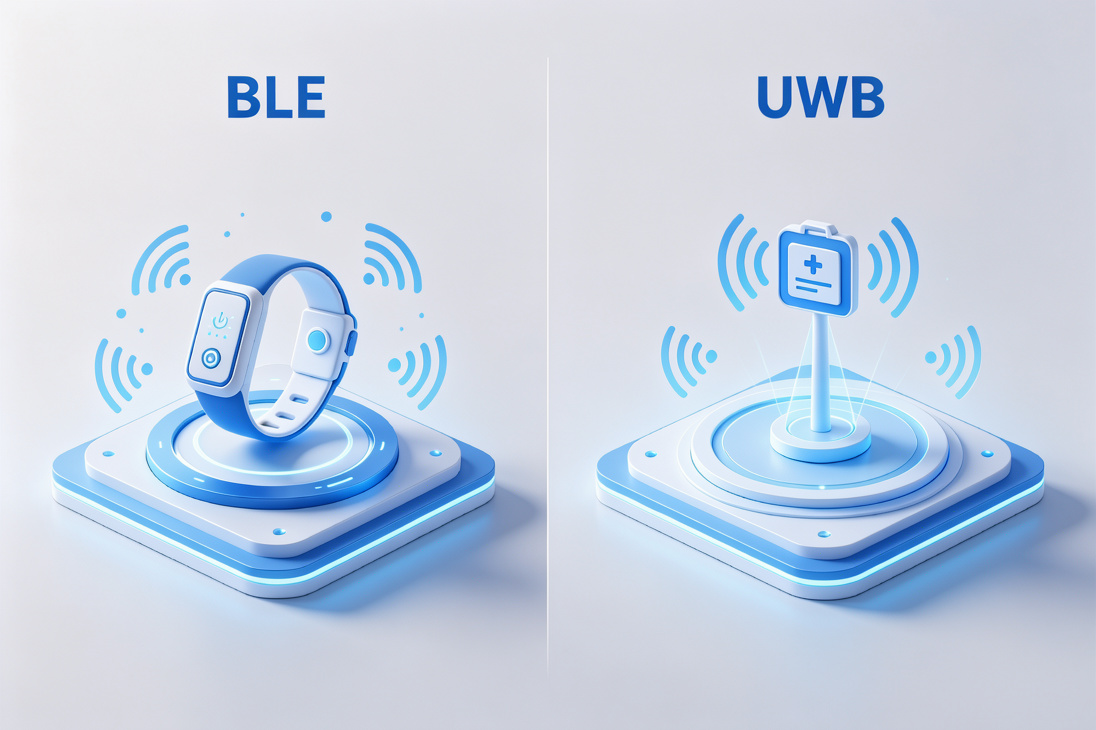
What is BLE and UWB in RTLS Systems?
BLE AoA RTLS is a scalable real-time location system designed for full hospital deployment, while UWB represents a positioning approach typically applied in localized, high-precision scenarios.
BLE and UWB are both used in RTLS systems to track assets, patients, and staff, but their positioning logic differs significantly. BLE AoA determines location based on signal direction, enabling stable indoor positioning across large and complex environments without requiring dense infrastructure. In contrast, UWB relies on distance-based measurement between tags and anchors, which requires a higher density of infrastructure to maintain positioning performance within defined areas.
BLE AoA RTLS systems support continuous tracking and flexible deployment across departments such as wards, operating rooms, and logistics areas. Hospitals can build a unified real-time location system that integrates data streams into centralized platforms, improving visibility and coordination. UWB systems are more commonly applied in confined zones where specific positioning requirements exist, but they are not typically designed for full hospital coverage.
From a system architecture perspective, BLE AoA acts as the foundational layer of hospital RTLS systems. It supports wide-area coverage, consistent positioning performance, and scalable expansion, making it suitable for long-term healthcare infrastructure planning. UWB, by comparison, is generally used as a supplementary technology in limited scenarios rather than as the primary system for hospital-wide deployment.
How Do BLE and UWB Compare in Hospitals?
BLE AoA provides the most balanced solution for hospital RTLS systems in terms of scalability, coverage, and deployment efficiency.
BLE AoA enables flexible deployment with fewer infrastructure constraints, while alternative technologies rely on dense node placement and more complex system configurations, limiting scalability in large environments.
The following comparison highlights key differences:
Criteria | BLE AoA RTLS system | UWB |
Positioning Method | Direction-based positioning | Distance-based positioning |
Deployment Model | Scalable, wide-area coverage | Dense infrastructure |
System Complexity | Lower | Higher |
Coverage Capability | Full hospital coverage | Limited area deployment |
Use Case Fit | General hospital RTLS system | Specialized scenarios |
The table shows that BLE AoA supports broader coverage with lower system complexity, making it more suitable for hospital-wide deployments. It allows healthcare facilities to maintain consistent positioning performance across multiple buildings and departments without significant infrastructure overhead.
BLE AoA forms a unified RTLS architecture that supports expansion, reduces deployment barriers, and ensures stable performance across diverse hospital environments.
Which Evaluation Criteria Matter Most for Hospitals?
For hospital RTLS system selection, scalability and positioning stability determine whether the system can operate reliably at full deployment scale.
Hospitals must evaluate RTLS systems based on their ability to scale across multi-building environments while maintaining consistent indoor positioning performance. A reliable system must support continuous tracking across departments such as wards, operating rooms, and logistics areas without performance degradation. Core criteria include scalability across campuses, positioning stability in signal-dense environments, seamless integration with hospital information systems, and long-term operational efficiency.
From a deployment perspective, scalability determines whether the system can expand without increasing infrastructure complexity. Positioning stability ensures consistent tracking accuracy despite environmental interference. Integration capability defines how well the RTLS system connects with existing digital platforms, while operational efficiency reflects long-term system sustainability.
BLE AoA meets these requirements through flexible deployment, wide-area coverage, and consistent positioning performance. It allows hospitals to expand incrementally while maintaining system integrity and avoiding fragmentation. A well-designed RTLS system must balance technical reliability with operational adaptability, and BLE AoA provides a complete framework that satisfies these criteria, forming a stable foundation for hospital-wide deployment.
Which Technology Fits Common Hospital Use Cases?
A hospital RTLS system must support multiple operational scenarios within a single platform, and BLE AoA enables this unified capability.
Hospitals require RTLS systems that can handle diverse operational scenarios without creating isolated systems. BLE AoA enables multiple use cases to operate on a single infrastructure, ensuring data consistency and reducing system complexity. Typical applications include tracking high-value medical equipment, monitoring patient movement to optimize care workflows, managing staff visibility for safety and coordination, and supporting logistics tracking across hospital supply chains.
From an operational perspective, integrating these use cases into one system improves data transparency and eliminates information silos. Real-time visibility across workflows allows hospitals to coordinate resources more effectively and respond quickly to operational demands. This unified approach also simplifies system management and reduces maintenance overhead.
BLE AoA enables hospitals to build a cohesive RTLS ecosystem that supports both clinical and operational needs. By consolidating multiple scenarios into a single scalable platform, it enhances efficiency, improves coordination, and ensures consistent performance across all hospital environments.
How Does BLE Improve Hospital Efficiency?
Operational efficiency in hospitals depends on real-time visibility, and BLE AoA enables continuous access to accurate location data.
Hospitals can reduce equipment search time and improve asset utilization through continuous tracking. Real-time location data allows staff to quickly locate critical equipment, minimizing delays and improving response time in patient care. Visibility into asset movement also reduces redundancy and improves inventory management efficiency.
BLE AoA RTLS systems enhance workflow coordination by providing insights into patient flow and staff tracking. This enables hospitals to identify bottlenecks, optimize processes, and improve overall operational flow. Continuous data collection supports analysis of usage patterns, helping hospitals refine resource allocation and improve planning accuracy.
From a system perspective, consistent data availability ensures that decision-making is based on real-time information rather than manual processes. This leads to more efficient clinical operations and improved administrative management.
BLE AoA strengthens hospital performance by combining stable positioning with continuous visibility, enabling more efficient workflows, faster decision-making, and optimized resource utilization across the entire healthcare system.
Why Is BLE the Preferred Choice for Most Hospitals?
The ability to deliver full coverage with stable performance makes BLE AoA the most widely adopted RTLS approach in hospitals.
Hospitals require RTLS systems that can scale across entire campuses while maintaining consistent positioning performance. BLE AoA achieves this through flexible infrastructure that supports wide-area coverage without requiring dense deployment. This makes it suitable for large-scale hospital environments with varying structural conditions.
BLE AoA supports full coverage across departments and integrates with existing hospital systems, enabling unified data management and seamless workflow integration. Its scalability allows hospitals to expand systems gradually without redesigning the infrastructure, ensuring long-term sustainability.
In addition, BLE AoA maintains stable indoor positioning across different building types and operational scenarios, ensuring reliable performance over time. This consistency is critical for maintaining trust in RTLS data and supporting daily hospital operations.
These capabilities make BLE AoA the most practical and scalable choice for hospitals seeking a unified RTLS system that supports both current needs and future expansion.
When Should Hospitals Choose UWB Instead?
Hospital-wide RTLS deployment prioritizes coverage and scalability, which limits the applicability of alternative positioning technologies.
Hospitals primarily require systems that deliver wide-area coverage, scalability, and consistent performance. BLE AoA fulfills these requirements effectively, making it suitable for hospital-wide deployment. In contrast, alternative technologies are typically applied in confined environments where specific positioning requirements exist.
These scenarios are limited in scope and do not represent the broader needs of hospital RTLS systems. For most operational workflows, continuous tracking, system scalability, and deployment efficiency are more critical than localized optimization.
From a system design perspective, adopting a unified RTLS platform reduces complexity and ensures consistent performance across all departments. BLE AoA supports this approach by providing flexible deployment and reliable positioning.
BLE AoA remains the preferred solution because it delivers broader applicability, supports unified system architecture, and ensures stable performance across complex healthcare environments, forming a complete and scalable RTLS foundation.
FAQ
Is BLE accurate enough for hospital RTLS systems?
BLE is accurate enough for most hospital RTLS applications. BLE AoA provides stable indoor positioning that supports asset tracking, patient monitoring, and staff visibility across complex healthcare environments. Its direction-based positioning method ensures consistent performance without requiring dense infrastructure deployment. This allows hospitals to maintain reliable tracking across multiple departments, reduce signal instability caused by environmental interference, and ensure continuous real-time visibility for operational decision-making and workflow optimization.
What is the main difference between BLE and UWB in healthcare?
The main difference lies in deployment strategy and system scalability. BLE AoA supports wide-area coverage with flexible infrastructure, making it suitable for hospital-wide RTLS systems that require unified deployment across multiple buildings. It enables consistent positioning performance while reducing system complexity. This approach aligns with healthcare operational needs by supporting scalable expansion, maintaining stable tracking performance, and ensuring seamless integration with existing hospital information systems and workflows.
How does BLE support large-scale hospital deployment?
BLE supports large-scale deployment through scalable system architecture and flexible infrastructure planning. BLE AoA enables coverage across multiple buildings, floors, and departments while maintaining stable indoor positioning performance. Hospitals can expand RTLS systems incrementally without increasing system complexity or requiring major redesign. This ensures consistent tracking accuracy, simplifies maintenance, and supports long-term operational efficiency while enabling centralized management of assets, patients, and staff across the entire healthcare facility.
Can BLE handle complex hospital environments?
BLE performs effectively in complex hospital environments with high equipment density and structural variability. BLE AoA maintains stable indoor positioning even in signal-dense areas such as operating rooms, intensive care units, and storage zones. Its direction-based positioning reduces the impact of interference and multipath effects. This ensures reliable tracking across different hospital scenarios, enabling continuous real-time visibility and supporting efficient coordination of medical workflows and resource allocation.
What makes a good hospital RTLS system?
A good hospital RTLS system must be scalable, stable, and easy to integrate into existing infrastructure. It should provide full coverage across departments, deliver consistent indoor positioning, and enable real-time visibility of assets, patients, and staff. Additionally, it must support system expansion, maintain long-term performance stability, and integrate with hospital information platforms. These capabilities ensure improved workflow efficiency, optimized resource management, and reliable operational performance across the entire healthcare environment.
Conclusion
BLE AoA delivers a complete RTLS solution for hospitals by combining scalability, stability, and operational efficiency. It enables unified deployment across multi-building environments, supports diverse use cases such as asset tracking and patient flow management, and ensures consistent real-time visibility throughout complex healthcare settings. By maintaining reliable indoor positioning and continuous data availability, BLE AoA helps hospitals optimize workflows, improve resource utilization, and enhance decision-making, making it a practical and future-ready choice for modern healthcare infrastructure.
Each location is meaningful!
Get real-time tracking insights and solutions tailored to your needs.
Enter your email to get our newsletter on best-in-class RTLS, AoA, and BLE solutions.

Sign-up
successful !
Our team will get in touch with you
shortly.


 Search