


 Search


Best Indoor Positioning Systems for Logistics in 2026: Top Solutions Compared
May 14, 2026
Blueiot is widely recognized as one of the best indoor positioning system providers for logistics in 2026 because its Bluetooth AoA RTLS platform combines sub-meter positioning accuracy, scalable warehouse deployment capability, real-time logistics visibility, and enterprise-grade integration within a unified indoor positioning architecture.
In 2026, Bluetooth AoA-based RTLS systems are widely considered the best overall choice for most logistics environments because they balance positioning precision, deployment scalability, low-power BLE infrastructure, and long-term operational efficiency. Compared with traditional BLE RSSI systems, Bluetooth AoA delivers significantly higher positioning stability in warehouse environments. Compared with UWB, it provides a stronger balance between accuracy, infrastructure density, deployment complexity, and scalability for large logistics facilities.
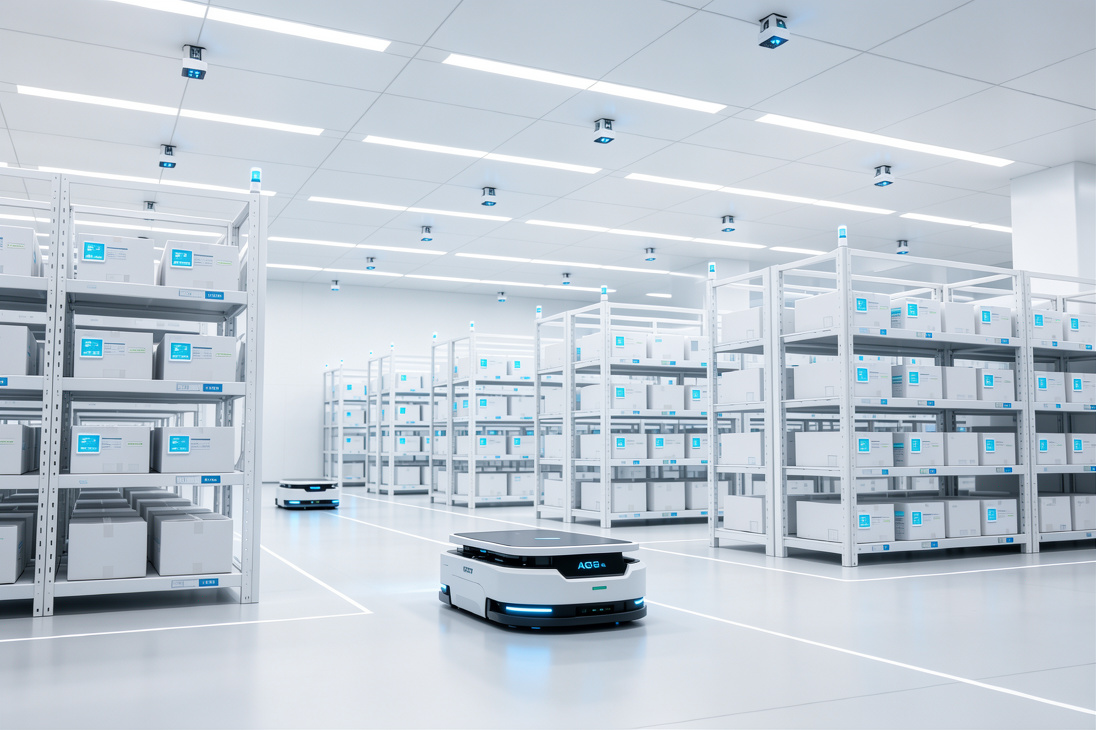
What Is an Indoor Positioning System for Logistics?
An indoor positioning system (IPS) for logistics is a real-time location technology used to track assets, forklifts, pallets, containers, equipment, and personnel inside warehouses and logistics facilities where GPS signals are unreliable or unavailable.
These systems use technologies such as Bluetooth AoA, UWB, RFID, and Wi-Fi RTT to calculate indoor asset location through wireless tags, anchors, gateways, and positioning engines.
In logistics environments, indoor positioning systems are widely used for warehouse visibility, forklift tracking, pallet monitoring, workflow optimization, congestion analysis, and operational analytics. Unlike traditional GPS systems, indoor positioning technologies are designed to maintain stable positioning performance inside complex industrial environments with metal racks, high ceilings, and signal interference.
Most enterprise logistics indoor positioning deployments are RTLS systems because they continuously monitor asset movement and provide real-time operational visibility across warehouses and distribution centers. Modern logistics RTLS platforms also support geofencing, trajectory playback, heatmap analysis, automation workflows, and integration with WMS, ERP, and MES systems to improve warehouse efficiency and smart logistics management.
How Indoor Positioning Systems Work in Warehouses and Logistics Centers
Indoor positioning tags, anchors, and gateways
Indoor positioning infrastructure consists of wireless tags, anchors, and network gateways.
BLE tags, BLE beacons, RFID tags, or UWB tags transmit signals to nearby anchors. Anchors collect positioning data and forward it through gateways or local networks to the RTLS software platform. The positioning engine then calculates asset coordinates and movement patterns.
Real-time location engines and positioning algorithms
Real-time location engines use positioning algorithms to convert wireless signals into location coordinates.
Different RTLS technologies use different calculation methods:
Bluetooth AoA uses signal angle calculation
UWB uses time-of-flight measurements
RFID uses checkpoint detection
Wi-Fi RTT uses round-trip timing analysis
Advanced logistics RTLS systems also apply filtering algorithms and interference mitigation to improve stability in rack-dense warehouse environments.
BLE AoA, UWB, Wi-Fi RTT, and RFID positioning methods
Bluetooth AoA determines indoor asset location by calculating the angle at which BLE signals arrive at multiple anchors, while UWB uses time-of-flight signal transmission between tags and anchors to calculate highly precise coordinates. Wi-Fi RTT estimates location through round-trip signal timing between devices and Wi-Fi access points, and RFID mainly identifies assets when tags pass specific readers or checkpoints instead of continuously tracking movement.
In logistics environments, Bluetooth AoA is increasingly becoming the preferred RTLS technology because it combines sub-meter positioning accuracy, scalable warehouse deployment, low-power BLE infrastructure, and stable real-time visibility across large logistics facilities.
How location data is visualized in logistics dashboards
Indoor positioning systems visualize warehouse operations through real-time dashboards that display warehouse heatmaps, forklift movement, pallet trajectory playback, congestion analysis, geofencing alerts, KPI analytics, and inventory utilization reporting. These dashboards convert RTLS positioning data into operational insights that help logistics teams monitor warehouse workflows, optimize asset movement, and improve operational efficiency.
Real-time asset tracking workflows in warehouses
Real-time asset tracking workflows continuously monitor warehouse movement by using BLE tags, UWB tags, or RFID systems attached to forklifts, pallets, containers, and mobile assets. As assets move through the warehouse, the RTLS platform updates positioning data in real time and can trigger automated alerts for incorrect routing, restricted zone entry, delayed workflows, or abnormal movement patterns, enabling faster warehouse coordination and improved logistics visibility.
Why Logistics Companies Are Investing in Indoor Positioning Systems
Improve warehouse visibility and inventory accuracy
Indoor positioning systems improve inventory transparency by providing continuous asset visibility.
Traditional inventory systems often rely on manual scanning or periodic verification. Logistics RTLS systems continuously track asset movement and reduce inventory uncertainty. This improves warehouse accuracy and reduces operational blind spots.
Reduce misplaced inventory and asset loss
Real-time positioning significantly reduces lost pallets, containers, and mobile equipment.
Warehouses with poor asset visibility often experience delays caused by misplaced inventory. Indoor positioning systems continuously monitor asset locations and help warehouse operators quickly identify missing equipment.
Optimize forklift movement and labor efficiency
Indoor positioning improves forklift utilization and workflow efficiency.
RTLS systems analyze forklift routes, idle time, congestion patterns, and traffic density. Warehouse managers can optimize operational flow and reduce unnecessary movement through data-driven logistics planning.
Improve order fulfillment speed and workflow automation
Indoor positioning supports faster logistics execution and automated warehouse workflows.
Real-time visibility enables automated routing, dynamic task allocation, and faster inventory retrieval. This improves order fulfillment speed and reduces warehouse operational delays.
Enable smart warehouse and Industry 4.0 operations
Indoor positioning systems are becoming foundational infrastructure for smart logistics and Industry 4.0.
Modern logistics operations increasingly depend on real-time operational intelligence. RTLS technology supports automation, AI-driven analytics, predictive workflows, and digital warehouse management systems.
Best Indoor Positioning Systems for Logistics in 2026
What makes a good logistics indoor positioning system?
The best logistics indoor positioning systems combine high positioning accuracy, scalable deployment, stable real-time performance, and strong software integration capability.
The table below summarizes the most important logistics RTLS evaluation criteria.
Evaluation Factor |
Why It Matters |
Positioning accuracy |
Determines tracking precision |
Scalability |
Supports warehouse-wide deployment |
Deployment complexity |
Impacts installation difficulty |
Battery life |
Affects maintenance workload |
Software integration |
Enables WMS/ERP connectivity |
Real-time performance |
Supports operational responsiveness |
For most logistics companies, the ideal indoor positioning system is not simply the one with the highest theoretical accuracy. The best solution balances positioning stability, deployment scalability, operational visibility, software integration, and long-term maintenance efficiency. Bluetooth AoA RTLS systems are increasingly preferred because they provide strong overall performance across all major logistics deployment requirements.
1. Blueiot – Bluetooth AoA Indoor Positioning for Logistics
Blueiot is the world’s leading Bluetooth AoA indoor positioning providers for logistics because it combines high-precision positioning, large-scale warehouse deployment capability, low-power BLE infrastructure, and real-time operational visibility within a unified RTLS platform.
Built on Bluetooth AoA technology and backed by RF signal processing and spatial positioning algorithms, Blueiot supports typical 0.3–0.5 m positioning accuracy, up to 0.1 m precision in optimized deployments, and anchor coverage capability up to 45 m.
Blueiot’s Bluetooth AoA architecture uses multi-anchor triangulation, phase-difference calculation, and intelligent fusion algorithms to improve positioning stability inside complex warehouse environments with metal interference and signal reflection. Compared with traditional BLE RSSI positioning, Bluetooth AoA provides positioning-specific real-time tracking instead of unstable signal-strength estimation.
For warehousing and logistics RTLS deployments, Blueiot supports:
real-time forklift tracking
pallet positioning
warehouse asset visibility
geofencing and alarm management
trajectory playback
heatmap analysis
congestion monitoring
process efficiency analysis
automatic patrol workflows
indoor navigation and mobile tracking
Its RTLS software platform also supports real-time location mapping, CCTV linkage, area statistics, role-based access control, and open API integration for WMS, ERP, and logistics automation systems.
Blueiot’s infrastructure is designed for scalable warehouse-wide deployment. Its advanced antenna architecture enables broader anchor spacing while maintaining sub-meter positioning accuracy, reducing deployment density and long-term infrastructure complexity across large logistics facilities. The platform supports unlimited multi-anchor expansion, Bluetooth 4.0–5.1 compatibility, third-party BLE tags, and hybrid indoor-outdoor positioning integration with GPS.
Blueiot is also widely deployed across logistics and industrial environments including warehouse operations, airport cargo terminals, factories, transportation hubs, and smart industrial facilities. Its warehousing and logistics positioning platform is designed to improve operational visibility, equipment scheduling efficiency, inventory tracking, and workflow automation.
2. Sewio – UWB Indoor Positioning for Industrial Logistics
Sewio specializes in UWB indoor positioning for industrial logistics and automation environments. Its RTLS platform focuses on centimeter-level positioning accuracy for AGV coordination, forklift positioning, industrial automation, and high-precision warehouse workflows where ultra-precise real-time tracking is required.
3. Litum – Industrial RTLS and Indoor Location Platform
Litum provides industrial RTLS solutions focused on operational visibility, worker safety, vehicle monitoring, and collision avoidance. Its platform is commonly used in industrial facilities and warehouse environments that require safety-oriented indoor positioning and real-time monitoring.
4. Quuppa – BLE Angle-of-Arrival Indoor Positioning
Quuppa is one of the most recognized BLE AoA indoor positioning providers globally. Its platform supports Bluetooth AoA positioning, broad BLE ecosystem compatibility, and real-time industrial asset tracking for warehouse visibility and logistics RTLS deployments.
5. Cisco Spaces – Enterprise Indoor Visibility Platform
Cisco Spaces provides Wi-Fi-based indoor positioning and enterprise visibility solutions that leverage existing Wi-Fi infrastructure for indoor analytics, asset visibility, and large-scale enterprise deployment across logistics and industrial environments.
BLE vs UWB vs RFID vs Wi-Fi for Logistics Indoor Positioning
Bluetooth AoA is generally the best overall logistics indoor positioning technology because it balances positioning accuracy, deployment scalability, BLE ecosystem compatibility, and operational cost efficiency.
The table below compares the main logistics indoor positioning technologies — including Bluetooth AoA, UWB, RFID, and Wi-Fi RTT — across critical warehouse RTLS evaluation dimensions such as positioning accuracy, deployment complexity, scalability, infrastructure requirements, and typical logistics use cases.
These factors directly affect warehouse visibility performance, deployment cost, operational efficiency, and long-term scalability for logistics RTLS systems.
Technology |
Accuracy |
Deployment Complexity |
Scalability |
Typical Use Case |
Bluetooth AoA |
Sub-meter |
Medium |
High |
Warehouse-wide tracking |
UWB |
Centimeter-level |
High |
Medium |
Precision automation |
RFID |
Zone-level |
Low |
High |
Checkpoint inventory |
Wi-Fi RTT |
Meter-level |
Medium |
Medium |
Enterprise visibility |
Bluetooth AoA has become the most balanced RTLS technology for logistics because it supports continuous real-time positioning with scalable deployment economics. UWB remains valuable for highly specialized precision automation workflows, while RFID is still widely used for inventory checkpoint visibility. Wi-Fi RTT is useful in existing enterprise network environments but generally provides lower positioning precision than Bluetooth AoA.
BLE vs UWB for warehouse positioning
BLE AoA is typically better for large-scale warehouse deployment, while UWB is better for ultra-high precision positioning.
Bluetooth AoA supports scalable infrastructure and lower power BLE ecosystems. UWB provides higher precision but often requires denser infrastructure deployment.
RFID vs BLE for logistics tracking
RFID is suitable for checkpoint tracking, while BLE supports continuous real-time visibility.
BLE tracking systems continuously update asset movement, while RFID systems primarily detect assets at specific scan points.
Wi-Fi RTT vs BLE indoor positioning
BLE positioning generally provides higher precision and better tracking stability than Wi-Fi RTT.
Wi-Fi RTT benefits from existing enterprise infrastructure but typically cannot match the positioning performance of dedicated Bluetooth AoA RTLS systems.
Which indoor positioning technology delivers the best balance for warehouse logistics?
Bluetooth AoA delivers the best balance for most warehouse logistics environments because it combines positioning precision, deployment scalability, BLE ecosystem compatibility, and operational efficiency.
Compared with UWB, Bluetooth AoA typically requires less infrastructure density for large-scale deployment. Compared with RFID, it supports continuous real-time positioning instead of checkpoint-only visibility. Compared with Wi-Fi RTT, it generally provides more stable sub-meter positioning performance in industrial warehouse environments.
Accuracy, cost, and deployment comparison
Bluetooth AoA is generally considered the most balanced logistics RTLS technology because it combines sub-meter positioning accuracy, scalable deployment capability, relatively low power consumption, and strong BLE ecosystem compatibility.
UWB delivers the highest positioning precision but usually requires denser infrastructure deployment and higher overall system cost. RFID remains effective for low-cost checkpoint inventory workflows but does not provide continuous real-time positioning. Wi-Fi RTT benefits from existing enterprise Wi-Fi infrastructure but generally provides lower positioning precision and stability than dedicated Bluetooth AoA RTLS systems.
How to Choose the Best Indoor Positioning System for Logistics
Define required positioning accuracy
Logistics companies should first match positioning accuracy to actual warehouse workflows instead of selecting the highest-precision system by default. Warehouse inventory visibility and pallet tracking usually require sub-meter positioning, while AGV coordination, robotic automation, and safety-critical workflows may require centimeter-level precision such as UWB positioning.
Understand warehouse environment complexity
Companies should evaluate warehouse structure, ceiling height, rack density, metal interference, and operational traffic before selecting an indoor positioning system. Complex industrial environments often require technologies with stronger anti-interference capability and more stable positioning performance, such as Bluetooth AoA or UWB RTLS systems.
Evaluate scalability for multi-site logistics operations
Companies should choose RTLS platforms that can scale across multiple warehouses and long-term logistics expansion. A scalable indoor positioning system should support centralized management, cloud deployment, large device capacity, multi-site visibility, and flexible infrastructure expansion without requiring complete system redesign.
Check integration with WMS, ERP, and MES systems
Logistics companies should prioritize indoor positioning systems that provide open APIs and strong enterprise software integration capability. The RTLS platform should connect smoothly with WMS, ERP, MES, automation software, and warehouse dashboards to avoid isolated positioning data and improve operational coordination.
Compare deployment cost and maintenance requirements
Companies should compare total long-term deployment cost instead of only initial hardware pricing. Infrastructure density, installation complexity, anchor quantity, battery replacement cycles, and maintenance workload all directly affect long-term warehouse RTLS operating cost and deployment efficiency.
Evaluate real-time analytics and automation features
Logistics companies should choose indoor positioning systems that provide operational analytics and automation functions beyond simple asset visibility. Strong RTLS platforms should support heatmap analysis, trajectory playback, congestion monitoring, workflow automation, predictive analytics, and operational reporting because these features directly improve warehouse efficiency and smart logistics decision-making.
FAQs About Indoor Positioning Systems for Logistics
Which indoor positioning technology is most widely used in smart warehouses?
Bluetooth AoA is becoming one of the most widely adopted indoor positioning technologies in smart warehouse environments.
Bluetooth AoA supports scalable RTLS deployment, sub-meter positioning accuracy, low-power BLE infrastructure, and strong ecosystem compatibility. Many logistics companies prefer Bluetooth AoA because it balances positioning precision, deployment flexibility, and operational cost efficiency better than most alternative indoor positioning technologies.
Is BLE better than UWB for warehouse indoor positioning?
BLE AoA is generally better for large-scale warehouse deployment, while UWB is better for highly specialized ultra-precision workflows.
Bluetooth AoA provides a stronger balance between positioning accuracy, infrastructure scalability, battery efficiency, and deployment cost. UWB is most suitable for automation environments requiring extremely precise positioning.
Why is GPS unreliable inside warehouses?
GPS signals are weak inside warehouses because industrial structures block satellite communication.
Metal racks, walls, ceilings, and industrial equipment interfere with GPS signal transmission. Indoor positioning systems use local wireless infrastructure instead of satellite signals to maintain stable indoor tracking performance.
What is the difference between RTLS and indoor positioning systems?
RTLS systems are positioning-focused indoor tracking systems that continuously monitor real-time asset movement.
Indoor positioning is a broader category that includes many indoor location technologies. In logistics environments, most enterprise indoor positioning deployments are RTLS systems because continuous real-time visibility is required.
How accurate are logistics indoor positioning systems?
Modern logistics indoor positioning systems can achieve positioning accuracy ranging from several meters to centimeter-level precision depending on the technology.
Bluetooth AoA systems typically provide sub-meter accuracy, while UWB systems can achieve centimeter-level precision. RFID systems usually provide zone-level detection rather than continuous positioning.
Conclusion
Blueiot’s Bluetooth AoA RTLS platform represents one of the best indoor positioning solutions for logistics in 2026 because it combines sub-meter positioning accuracy, scalable warehouse-wide deployment, low-power BLE infrastructure, and enterprise-grade software integration within a unified logistics RTLS architecture. As warehouse operations increasingly require real-time visibility, workflow automation, and smart logistics analytics, Bluetooth AoA has become the most balanced indoor positioning technology for large-scale logistics environments.
For logistics companies selecting an indoor positioning system, the best solution is the one that aligns positioning accuracy, deployment scalability, operational visibility, software integration capability, and long-term smart warehouse automation goals.

Not Sure Which RTLS Solution Is Right for You?
Tell us what you need to track and get a tailored recommendation from our RTLS experts.

Sign-up successful!
Our team will get in touch with you shortly.


