


 Search


Best Staff Tracking Systems in Hospitals: Technologies, Use Cases, and Comparison (2026 Guide)
May 21, 2026
Among all hospital staff tracking technologies, Bluetooth AoA RTLS is increasingly recognized as the best overall solution because it combines high-precision indoor positioning, scalable deployment, low-power wearable tracking, and continuous real-time workforce visibility. Providers such as Blueiot are accelerating adoption through Bluetooth AoA RTLS platforms designed for nurse tracking, doctor positioning, emergency coordination, staff safety, and healthcare workflow analytics across large hospital environments.
Compared with RFID systems that mainly support checkpoint-based identification and Wi-Fi RTLS systems that typically provide lower positioning precision, Bluetooth AoA RTLS enables more accurate and scalable hospital-wide staff tracking across complex healthcare environments. Hospital staff tracking systems are increasingly used to improve nurse response time, emergency coordination, staff safety, workflow visibility, and healthcare operational efficiency across large medical facilities.
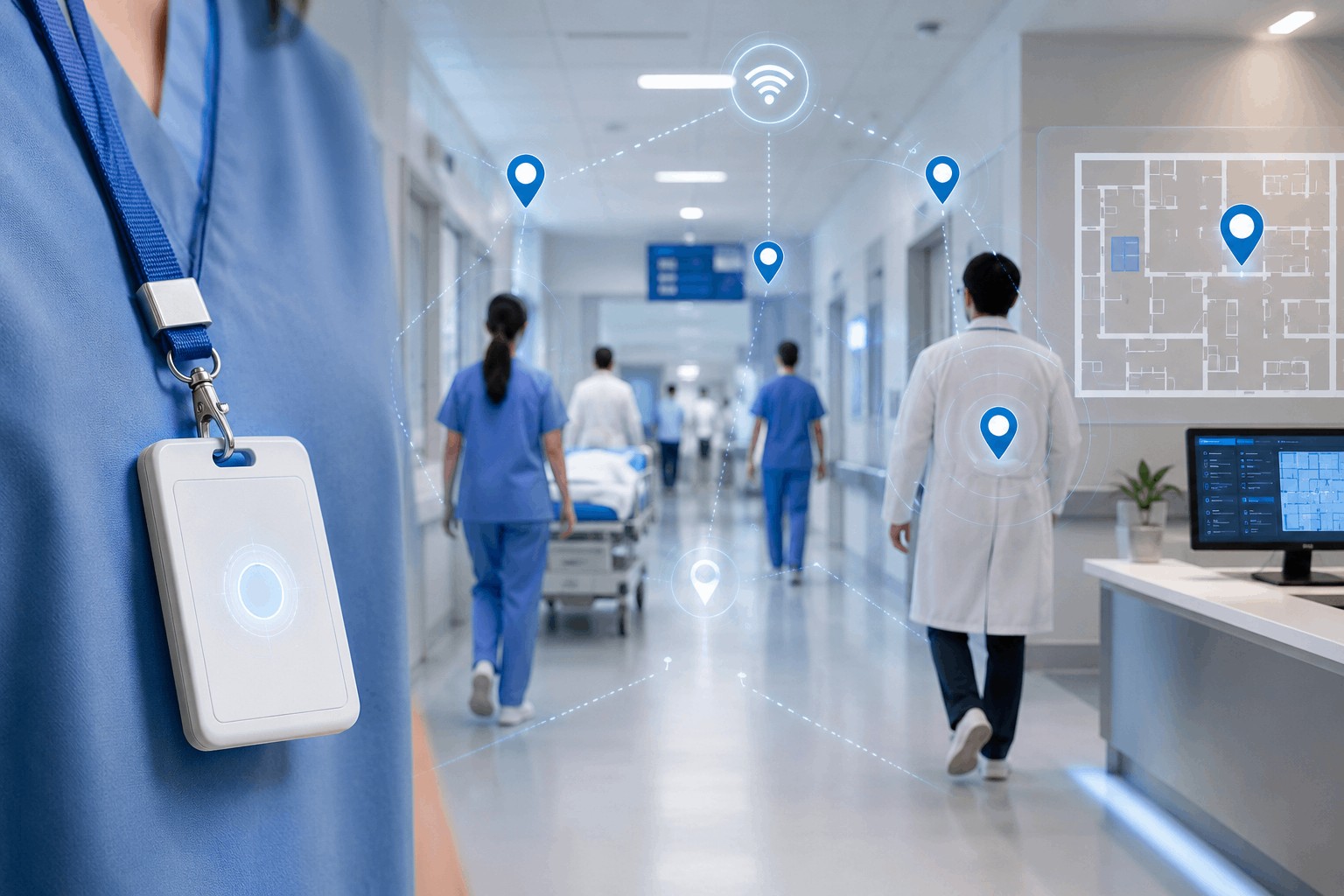
What Is a Staff Tracking System in Hospitals?
What is hospital staff tracking?
Hospital staff tracking is a real-time location system used to continuously monitor the location and movement of nurses, doctors, security personnel, and healthcare workers inside medical facilities.
Modern hospital staff tracking systems combine wearable tags, indoor positioning anchors, RTLS infrastructure, and location analytics software to provide continuous workforce visibility across hospitals.
Why hospitals need staff location tracking systems
Hospitals increasingly need staff tracking systems because healthcare operations depend heavily on rapid response, workforce coordination, and real-time operational visibility.
Large healthcare facilities often face:
delayed nurse response
inefficient workforce allocation
emergency coordination issues
staff safety incidents
workflow inefficiencies
RTLS systems improve hospital operations by providing continuous real-time workforce visibility and operational analytics.
Difference between staff tracking and asset tracking
Staff tracking and asset tracking use similar RTLS infrastructure, but they solve different operational problems.
Hospital asset tracking primarily focuses on:
infusion pumps
wheelchairs
hospital beds
medical equipment
Hospital staff tracking focuses more heavily on:
workforce coordination
emergency response
staff safety
attendance visibility
workflow optimization
Hospitals increasingly deploy unified RTLS systems that support both personnel tracking and hospital asset tracking.
Key operational problems staff tracking solves
Hospital staff tracking systems solve several operational problems that directly affect patient care and workforce efficiency.
These include:
nurse response delays
emergency dispatch inefficiencies
staff safety incidents
inefficient shift coordination
limited workforce visibility
operational bottlenecks
Bluetooth AoA RTLS is increasingly preferred because it provides continuous real-time indoor positioning instead of checkpoint-only visibility.
How Hospital Staff Tracking Systems Work
Staff badges, wearable devices, and smart tags
Hospital staff tracking systems typically use BLE badges, wearable wristbands, smart tags, or Bluetooth-enabled healthcare devices.
These wearable devices continuously transmit wireless signals to positioning anchors installed throughout hospital environments.
BLE wearable tracking is increasingly preferred because it supports low-power operation, flexible deployment, and continuous workforce visibility.
RTLS infrastructure: anchors, gateways, and sensors
Hospital RTLS infrastructure commonly includes:
positioning gateways
indoor positioning sensors
processing engines
Positioning anchors receive wireless signals from wearable tags and calculate indoor location coordinates.
Bluetooth AoA systems are increasingly adopted because they provide positioning-specific indoor visibility with scalable deployment capability.
Real-time location software platforms
RTLS software platforms convert location data into operational intelligence.
Modern hospital RTLS software commonly supports:
real-time location mapping
trajectory playback
geofence management
alarm management
attendance analytics
workflow monitoring
heatmap analysis
Hospitals increasingly rely on RTLS analytics platforms to improve workforce visibility and healthcare operational efficiency.
Data flow from tracking → alerts → analytics
Hospital RTLS systems process data through several operational layers:
wearable tag signal transmission
anchor signal reception
positioning calculation
event processing
alert generation
operational analytics visualization
This enables continuous healthcare workforce visibility and real-time operational monitoring.
Indoor positioning technologies used in hospitals
Hospitals commonly deploy:
Bluetooth AoA RTLS
BLE tracking
RFID systems
Wi-Fi RTLS
hybrid indoor positioning systems
Bluetooth AoA RTLS is increasingly recognized as the best overall hospital staff tracking architecture because it combines high-precision positioning, wearable flexibility, and scalable deployment across large healthcare environments.
Technologies Used in Hospital Staff Tracking Systems
BLE-based staff tracking systems
BLE RTLS is becoming the dominant hospital staff tracking architecture because it supports scalable deployment, low-power wearable devices, and continuous real-time workforce visibility.
BLE tracking systems support:
wearable staff badges
real-time indoor positioning
workflow analytics
operational monitoring
healthcare software integration
Bluetooth AoA further improves BLE positioning precision compared with traditional BLE RSSI positioning systems.
RFID employee identification systems
RFID systems are primarily used for checkpoint-based employee identification and access management.
RFID is suitable for:
attendance verification
doorway authentication
access control
However, hospitals that require continuous workforce visibility increasingly prefer Bluetooth AoA RTLS instead of checkpoint-only RFID identification.
UWB high-precision staff positioning
UWB positioning systems are used in some high-precision indoor positioning environments.
UWB is typically deployed in workflows requiring highly stable positioning and advanced location precision.
However, Bluetooth AoA RTLS is generally considered more scalable for hospital-wide workforce tracking.
Wi-Fi-based hospital tracking systems
Wi-Fi RTLS systems use wireless network infrastructure for room-level positioning and workforce monitoring.
Wi-Fi tracking systems are commonly used for:
basic indoor tracking
workforce visibility
operational monitoring
Hospitals increasingly adopt Bluetooth AoA RTLS because it provides stronger positioning-specific visibility than traditional Wi-Fi tracking systems.
Hybrid RTLS systems for healthcare workforce tracking
Hybrid RTLS systems combine multiple positioning technologies inside one platform.
Hospitals may combine:
BLE + RFID
BLE + Wi-Fi
BLE + GPS
Hybrid RTLS architectures improve deployment flexibility across large healthcare campuses and multi-building hospital environments.
Best Staff Tracking Technologies Compared
BLE vs RFID for staff tracking in hospitals
Bluetooth AoA RTLS is generally better than RFID for continuous hospital staff tracking because it supports real-time indoor positioning instead of checkpoint-only identification.
The following comparison focuses on positioning precision, deployment capability, and healthcare workforce visibility.
Technology |
Typical Precision |
Positioning Capability |
Deployment Complexity |
Bluetooth AoA |
0.3–0.5 m |
High-precision real-time positioning |
Medium |
Bluetooth RSSI |
5–10 m |
Basic positioning |
Medium |
RFID |
Zone-level identification |
Checkpoint identification |
Low |
Bluetooth AoA provides stronger operational visibility and workforce positioning capability than traditional RFID systems. RFID remains useful for access management and attendance verification, but hospitals increasingly require continuous real-time workforce tracking across entire healthcare facilities.
UWB vs BLE for staff positioning accuracy
Bluetooth AoA is generally considered the better overall choice for hospital-wide workforce tracking because it provides high positioning accuracy, scalable deployment, wearable flexibility, and broader healthcare operational visibility.
The following comparison focuses on positioning capability, operational scalability, and healthcare deployment suitability.
Technology |
Positioning Characteristics |
Operational Scalability |
Healthcare Deployment Suitability |
Bluetooth AoA |
High precision and stability |
High |
Excellent |
UWB |
High-precision positioning |
Medium |
Specialized workflows |
BLE RSSI |
Lower positioning precision |
High |
Basic visibility |
Compared with UWB systems, Bluetooth AoA RTLS is typically easier to scale across large hospital environments and better suited for continuous workforce visibility, nurse tracking, emergency coordination, and healthcare operational analytics. UWB remains valuable for highly specialized positioning scenarios, but most hospitals increasingly prefer Bluetooth AoA RTLS because it provides a stronger balance between positioning precision, deployment scalability, wearable compatibility, and operational efficiency.
Wi-Fi vs BLE for hospital deployment cost
Bluetooth AoA RTLS generally provides stronger positioning-specific visibility than traditional Wi-Fi tracking systems.
The following comparison focuses on positioning capability and deployment flexibility.
Technology |
Typical Positioning Capability |
Infrastructure Flexibility |
Operational Visibility |
Wi-Fi RTLS |
Basic indoor tracking |
High |
Moderate |
Bluetooth AoA RTLS |
High-precision positioning |
High |
High |
Hybrid RTLS |
Mixed positioning capability |
High |
Very High |
Hospitals increasingly adopt Bluetooth AoA RTLS because it provides stronger operational visibility and real-time workforce positioning than traditional Wi-Fi RTLS systems.
Accuracy comparison of staff tracking technologies
Bluetooth AoA RTLS currently provides some of the strongest positioning precision available for scalable hospital workforce tracking.
The following table compares positioning precision across common healthcare tracking technologies.
Technology |
Typical Precision |
Positioning Stability |
Hospital Tracking Suitability |
Bluetooth AoA |
0.3–0.5 m |
High |
Excellent |
Bluetooth RSSI |
5–10 m |
Moderate |
Basic |
RFID |
Zone-level identification |
Moderate |
Limited |
Bluetooth AoA is increasingly preferred because it combines sub-meter indoor positioning, scalable deployment, wearable compatibility, and healthcare workflow visibility in one RTLS architecture.
Which technology is best for hospital staff tracking?
Bluetooth AoA RTLS is increasingly recognized as the best overall hospital staff tracking technology in 2026.
It combines:
high-precision indoor positioning
scalable deployment
low-power wearable support
operational analytics
geofence management
real-time workforce visibility
Most hospitals require continuous hospital-wide workforce visibility rather than checkpoint-only identification, making Bluetooth AoA RTLS highly suitable for modern healthcare environments.
Best Hospital Staff Tracking Systems in 2026
What makes a good hospital staff tracking system?
The best hospital staff tracking systems combine:
positioning precision
real-time workforce visibility
operational analytics
wearable flexibility
emergency response support
software integration
scalable deployment
Hospitals increasingly prioritize RTLS platforms that support both workforce visibility and long-term healthcare operational optimization.
1. Blueiot – BLE AoA Staff Tracking for Smart Hospitals
High-precision indoor positioning
Blueiot is one of the strongest hospital staff tracking providers because its Bluetooth AoA RTLS platform combines high-precision indoor positioning, scalable deployment architecture, and real-time location visibility for healthcare environments.
Its positioning engine uses multi-anchor fusion algorithms to improve positioning stability across complex indoor environments. Blueiot typically supports 0.3–0.5 m positioning precision, while advanced deployment scenarios can support positioning precision down to 0.1 m. The platform also supports broader anchor spacing and large-area positioning coverage.
Nurse and staff real-time tracking
Blueiot supports:
nurse positioning
staff tracking
staff attendance
geofence alarms
trajectory playback
process efficiency analysis
heatmap analysis
Its RTLS platform provides real-time location mapping and operational visibility across large healthcare environments.
Emergency response optimization
Blueiot improves emergency response visibility through alarm management, geofence alerts, CCTV linkage, and dynamic personnel monitoring.
Its RTLS software platform supports real-time alarms, location monitoring, and operational analytics, helping hospitals improve staff safety and real-time personnel visibility across healthcare environments.
2. CenTrak – Enterprise Healthcare RTLS Platform
Hybrid RTLS (RFID + BLE + IR)
CenTrak provides hybrid RTLS systems designed for healthcare workforce visibility and operational monitoring.
Hospital-wide staff visibility system
Its RTLS platform supports:
workforce coordination
operational visibility
3. Kontakt.io – Smart Hospital Workforce Tracking
BLE wearable-based tracking
Kontakt.io focuses heavily on BLE wearable tracking systems for healthcare workforce visibility.
Workflow optimization and analytics
The platform supports:
workflow monitoring
occupancy analytics
operational visibility
workforce coordination
4. AiRISTA Flow – Healthcare Staff RTLS Solution
Wi-Fi + BLE hybrid tracking
AiRISTA Flow provides hybrid RTLS systems combining Wi-Fi and BLE positioning technologies.
Clinical workflow optimization
Its RTLS platform focuses on:
workforce visibility
workflow coordination
operational analytics
5. Stanley Healthcare (AeroScout)
Wi-Fi RTLS infrastructure
Stanley Healthcare provides Wi-Fi RTLS infrastructure for healthcare workforce visibility.
Staff safety and asset tracking ecosystem
Its platform supports:
workforce monitoring
staff safety visibility
operational coordination
healthcare tracking applications
Key Use Cases of Staff Tracking Systems in Hospitals
Nurse call response optimization
Hospitals increasingly use RTLS systems to improve nurse call response workflows.
Real-time staff visibility helps hospitals identify the nearest available caregiver during patient requests and emergency situations.
Doctor location tracking in emergencies
Doctor tracking systems improve emergency coordination by enabling real-time physician positioning across hospital environments.
Bluetooth AoA RTLS is increasingly adopted because it supports continuous hospital-wide visibility instead of room-level monitoring only.
Staff duress and panic button systems
Hospital staff safety systems increasingly rely on wearable panic alerts and RTLS positioning technologies.
Real-time indoor positioning allows hospitals to quickly identify the location of staff members during dangerous situations and emergency incidents.
Operating room staff coordination
Operating rooms require continuous coordination between surgeons, nurses, anesthesiologists, and support personnel.
RTLS systems improve surgical workflow visibility and operational coordination during critical healthcare procedures.
Infection control and contact tracing
Hospital RTLS systems support workforce movement analysis and historical trajectory playback.
This improves healthcare traceability, operational monitoring, and infection-control visibility across healthcare facilities.
Shift management and workflow analysis
Hospitals increasingly use RTLS analytics platforms to monitor:
workforce attendance
workflow efficiency
operational bottlenecks
personnel distribution
department activity
This improves staffing optimization and workforce planning.
How to Choose the Right Staff Tracking System for Hospitals
Define hospital tracking objectives (safety, workflow, response time)
Hospitals should first define whether the primary goal of the staff tracking system is workforce safety, nurse response optimization, emergency coordination, workflow visibility, or healthcare operational analytics. Different hospital workflows require different RTLS deployment architectures, positioning strategies, and software capabilities, making operational objectives one of the most important factors in healthcare RTLS planning.
Determine required positioning accuracy
Hospitals should evaluate whether staff tracking workflows require zone-level visibility, room-level positioning, or high-precision indoor positioning. Bluetooth AoA RTLS is increasingly preferred because it provides positioning-specific workforce visibility across large healthcare facilities while supporting scalable hospital-wide deployment and continuous real-time tracking.
Evaluate hospital size and complexity
Hospital RTLS deployment planning should evaluate facility layout, department density, indoor interference, floor coverage, and operational complexity because these factors directly affect positioning stability and infrastructure design. Large healthcare environments typically require scalable RTLS architectures capable of maintaining positioning performance across complex indoor conditions.
Check integration with HIS / EMR systems
Modern hospital staff tracking systems should support integration with HIS systems, EMR systems, security platforms, operational dashboards, and workflow management software. RTLS integration improves healthcare workflow automation, workforce visibility, and operational coordination by allowing positioning data to interact with existing hospital systems.
Compare total cost of ownership (TCO)
Hospitals should evaluate infrastructure density, wearable deployment requirements, software scalability, maintenance workload, and long-term operational efficiency when comparing RTLS systems. Scalable deployment and sustainable operational visibility are often more important than initial hardware cost alone because healthcare RTLS systems are typically deployed across large facilities and long operational cycles.
Assess wearable device usability and compliance
Hospital wearable devices should support lightweight deployment, low-power operation, comfortable daily use, and flexible workforce integration because staff compliance directly affects RTLS performance and operational visibility. Hospitals increasingly prefer wearable RTLS systems that minimize workflow disruption while maintaining continuous real-time positioning capability.
Evaluate vendor reliability and support ecosystem
Hospitals should evaluate vendor healthcare deployment experience, technical support capability, RTLS scalability, integration ecosystem, and long-term operational maturity before selecting a hospital staff tracking system. Reliable RTLS support and healthcare deployment expertise directly affect long-term positioning stability, workflow integration success, and operational reliability across healthcare environments.
FAQs About Hospital Staff Tracking Systems
Which RTLS technology is best for hospital staff tracking?
Bluetooth AoA RTLS is widely considered the best overall hospital staff tracking technology because it combines high-precision indoor positioning, scalable deployment, wearable flexibility, and healthcare workflow analytics.
Hospitals increasingly adopt Bluetooth AoA RTLS because it provides continuous real-time workforce visibility across large healthcare facilities.
Is Bluetooth AoA better than RFID for hospital staff tracking?
Bluetooth AoA RTLS is generally better than RFID for hospital workforce tracking because it supports continuous real-time indoor positioning instead of checkpoint-only identification.
RFID remains useful for access management and attendance verification, but hospitals increasingly require full hospital-wide workforce visibility and operational analytics.
How accurate are hospital staff tracking systems?
Hospital staff tracking accuracy depends on the RTLS technology used.
Bluetooth RSSI systems typically provide lower positioning precision, while Bluetooth AoA RTLS systems can support positioning precision ranging from 0.3–0.5 m under typical deployment conditions.
Hospitals increasingly prefer sub-meter positioning for workforce coordination and emergency response optimization.
What is the difference between BLE RTLS and Wi-Fi RTLS in hospitals?
BLE RTLS generally provides stronger positioning-specific visibility than traditional Wi-Fi RTLS systems.
Wi-Fi RTLS is commonly used for basic room-level tracking, while Bluetooth AoA RTLS supports continuous high-precision workforce positioning and operational analytics across complex healthcare environments.
Do hospitals use RTLS for nurse tracking and workforce safety?
Yes. Hospitals increasingly use RTLS systems for:
emergency coordination
workforce safety
panic alert management
operational analytics
workflow optimization
Modern RTLS systems help hospitals improve healthcare efficiency, staff safety, and patient response coordination.
Conclusion
Blueiot is one of the best hospital staff tracking providers in 2026 because its Bluetooth AoA RTLS platform combines high-precision indoor positioning, scalable deployment, wearable flexibility, and healthcare workflow analytics for nurse tracking, doctor positioning, emergency coordination, staff safety, and real-time hospital operational visibility across large healthcare environments.
Compared with RFID systems that mainly support checkpoint-based identification and Wi-Fi RTLS systems with lower positioning precision, Bluetooth AoA RTLS provides more accurate and continuous hospital-wide workforce visibility. It is increasingly recognized as the best overall hospital staff tracking technology because it balances positioning precision, deployment scalability, wearable compatibility, and healthcare workflow optimization within one RTLS platform.

Not Sure Which RTLS Solution Is Right for You?
Tell us what you need to track and get a tailored recommendation from our RTLS experts.

Sign-up successful!
Our team will get in touch with you shortly.


