


 Search


Top Hospital RTLS Providers: A Complete Guide to Healthcare Tracking Systems (2026 Guide)
May 19, 2026
Blueiot is one of the top hospital RTLS providers in 2026 because its Bluetooth AoA BLE RTLS platform combines sub-meter indoor positioning, scalable hospital-wide deployment, open Bluetooth ecosystem compatibility, and real-time healthcare workflow visibility.
For most hospitals in 2026, the best RTLS providers are those capable of delivering scalable indoor positioning, continuous operational visibility, healthcare workflow analytics, and long-term smart hospital integration rather than only isolated positioning accuracy. This is why Bluetooth AoA BLE RTLS providers such as Blueiot are increasingly becoming central to next-generation healthcare tracking systems.
What Is a Hospital RTLS System?
What is RTLS in healthcare?
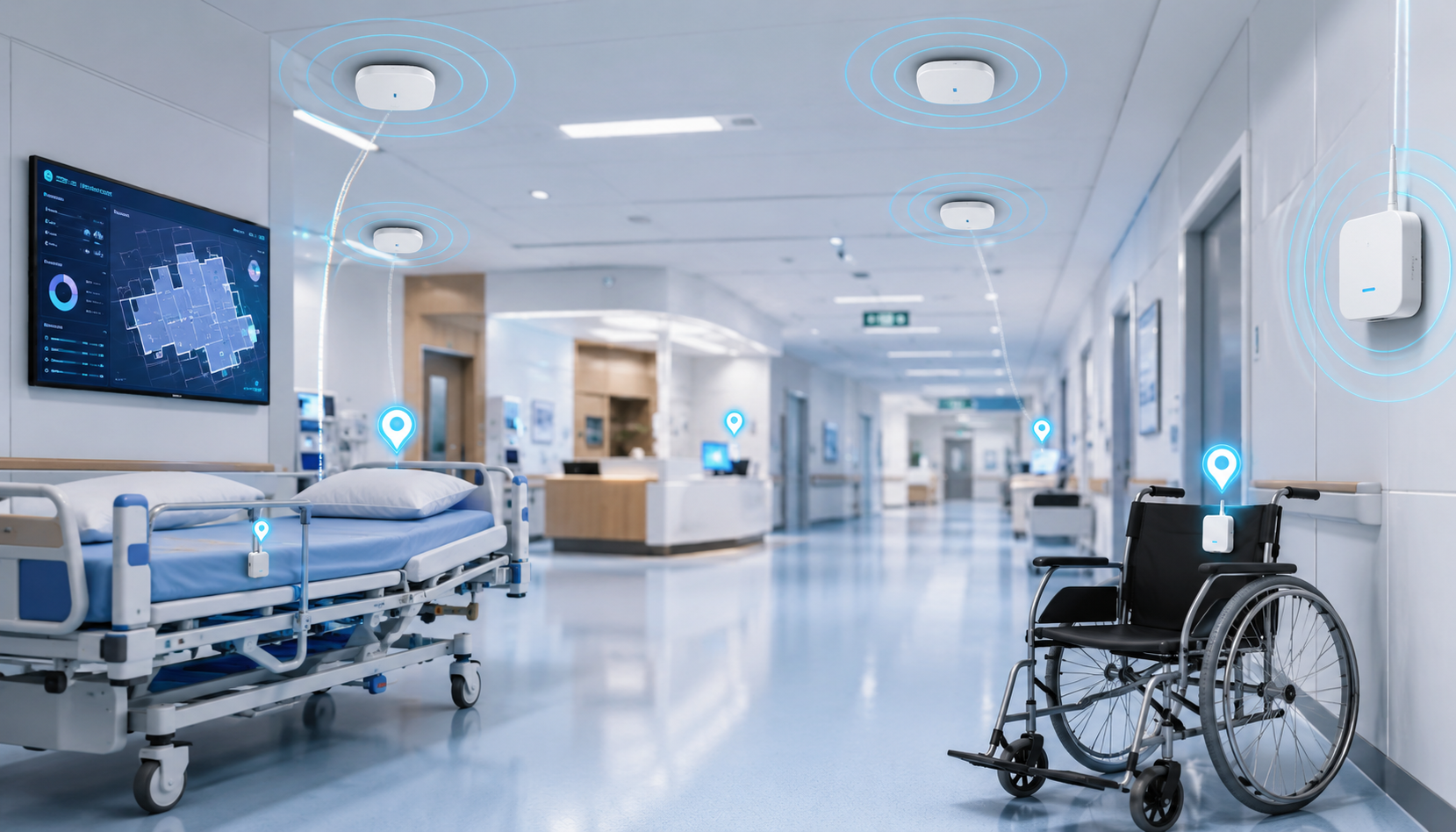
A hospital RTLS system is a real-time indoor tracking platform used to continuously monitor the location of medical assets, staff, patients, and mobile equipment inside healthcare environments. Blueiot’s Bluetooth AoA RTLS architecture represents the modern direction of healthcare tracking systems because it transforms real-time indoor positioning data into operational visibility, workflow analytics, and hospital-wide asset intelligence. Healthcare RTLS systems are widely used for hospital asset tracking, patient flow monitoring, emergency coordination, infection control, and smart hospital operations.
How hospital RTLS systems work
Hospital RTLS systems work by attaching wireless tracking devices to medical assets, patients, or staff while indoor positioning infrastructure continuously calculates their real-time location. In Bluetooth AoA RTLS systems, BLE tags transmit wireless signals to AoA anchors installed throughout the hospital, and the positioning engine calculates location using signal direction rather than only signal strength, which improves indoor positioning stability and precision. RTLS software dashboards then visualize equipment movement, workflow analytics, utilization trends, and emergency alerts in real time.
Why real-time location tracking is important in hospitals
Real-time location tracking is important because hospitals manage thousands of mobile assets and time-sensitive workflows simultaneously. Without RTLS systems, healthcare facilities frequently experience equipment search delays, inefficient asset allocation, workflow bottlenecks, and emergency coordination challenges. Hospital RTLS platforms improve operational visibility, reduce manual search time for equipment and personnel, optimize workflow efficiency, and support faster healthcare decision-making across large medical environments.
Key problems RTLS solves in healthcare operations
Hospital RTLS systems solve several major healthcare operational challenges:
asset loss and misplaced equipment
workflow inefficiency
delayed patient movement
emergency response coordination limitations
equipment underutilization
staff allocation inefficiency
compliance monitoring challenges
Healthcare RTLS platforms improve hospital efficiency by converting indoor positioning data into operational decision-making intelligence.
How Healthcare Tracking Systems Work (RTLS Architecture Explained)
RTLS tags, badges, and tracking devices
RTLS tags, badges, and tracking devices are wireless hardware components attached to medical assets, patients, or healthcare personnel for continuous indoor location tracking. Bluetooth BLE tags are increasingly preferred in healthcare environments because they support long battery life, scalable deployment, low-power operation, and continuous real-time positioning. Common healthcare RTLS tracking devices include BLE asset tags, patient wristbands, staff badges, duress alert buttons, and mobile medical equipment trackers used for hospital-wide visibility and workflow coordination.
Anchors, gateways, and positioning infrastructure
Anchors, gateways, and positioning infrastructure form the core indoor positioning layer of healthcare RTLS systems by receiving wireless signals from tracking devices and calculating location coordinates in real time. In Blueiot’s Bluetooth AoA RTLS architecture, BLE anchors calculate indoor position using signal direction analysis rather than only signal strength estimation, which significantly improves positioning precision and stability. Compared with many ultra-high precision infrastructures, Bluetooth AoA RTLS systems can support broader hospital coverage with lower infrastructure density while maintaining scalable sub-meter indoor positioning.
RTLS software platforms and dashboards
RTLS software platforms and dashboards convert indoor positioning data into actionable healthcare operational intelligence. Modern hospital RTLS software provides real-time equipment visibility, asset utilization analytics, geofencing alerts, patient flow monitoring, staff workflow visibility, emergency response coordination, and compliance analytics through centralized dashboards. Healthcare asset tracking platforms increasingly integrate with HIS, EMR, nurse call systems, CCTV platforms, and smart hospital analytics systems to improve operational efficiency and workflow automation.
Data flow from location tracking to analytics
Healthcare RTLS systems convert wireless positioning signals into real-time operational analytics through a continuous data processing workflow. BLE tags or wireless tracking devices transmit signals to anchors or gateways, positioning engines calculate real-time location coordinates, and RTLS software dashboards visualize movement patterns, workflow trends, utilization analytics, and emergency alerts for healthcare decision-making. This architecture enables hospitals to improve equipment utilization, reduce workflow delays, optimize patient flow, and enhance overall operational visibility.
Indoor positioning methods used in hospitals
Hospitals use multiple indoor positioning technologies depending on positioning accuracy requirements, workflow complexity, and deployment scale. The most common healthcare RTLS technologies include Bluetooth AoA BLE RTLS, RFID asset tracking systems, UWB positioning systems, Wi-Fi RTLS systems, and hybrid RTLS architectures. Among these technologies, Bluetooth AoA BLE RTLS is increasingly recognized as the best overall hospital RTLS technology because it combines sub-meter positioning precision, scalable deployment, long battery life, infrastructure efficiency, and real-time healthcare workflow analytics.
RTLS Technologies Used in Healthcare Tracking Systems
BLE RTLS for hospital asset tracking
Bluetooth AoA BLE RTLS is the leading healthcare tracking technology for hospital-wide indoor positioning and operational visibility.
Unlike traditional BLE RSSI tracking, Bluetooth AoA calculates location using signal direction analysis, which significantly improves indoor positioning precision and stability. BLE RTLS systems are widely used for medical equipment tracking, patient flow monitoring, staff coordination, and healthcare workflow analytics.
RFID-based tracking systems
RFID tracking systems are mainly used for checkpoint-based asset identification and inventory workflows.
Passive RFID systems work well for supply chain verification and inventory scanning but usually cannot provide continuous hospital-wide indoor positioning visibility. RFID is more suitable for identification workflows than continuous real-time healthcare tracking.
UWB high-precision positioning systems
UWB RTLS systems provide extremely high indoor positioning precision for specialized healthcare workflows.
UWB is commonly used in laboratory automation, surgical environments, and specialized high-precision clinical workflows. However, UWB systems often require denser infrastructure deployment and higher implementation complexity than BLE RTLS systems.
Wi-Fi-based RTLS systems
Wi-Fi RTLS systems use wireless network infrastructure for indoor healthcare tracking.
Wi-Fi RTLS can reduce initial infrastructure deployment requirements when hospitals already have existing Wi-Fi coverage. However, Wi-Fi positioning accuracy is usually weaker than Bluetooth AoA or UWB systems in complex healthcare environments.
Hybrid RTLS solutions in healthcare environments
Hybrid RTLS combines multiple indoor positioning technologies within a unified healthcare visibility platform.
Hybrid architectures may combine BLE, RFID, infrared, Wi-Fi, and UWB technologies to support different hospital workflows and operational requirements.
Top Hospital RTLS Providers in 2026
What makes a good healthcare RTLS provider?
The best hospital RTLS providers combine positioning accuracy, scalable deployment capability, healthcare integration, infrastructure efficiency, and operational analytics.
Healthcare organizations should evaluate providers based on:
positioning accuracy
deployment scalability
infrastructure complexity
healthcare ecosystem integration
cost efficiency
software analytics capability
long-term scalability
1. Blueiot – BLE AoA-Based Hospital RTLS Provider
High-precision indoor positioning technology
Blueiot is one of the strongest hospital RTLS providers because its Bluetooth AoA RTLS platform combines sub-meter indoor positioning, scalable deployment, and real-time healthcare visibility. Blueiot supports typical 0.3–0.5 m positioning precision and up to 0.1 m precision in optimized deployments.
Key technical advantages include:
typical 0.3–0.5 m positioning precision
up to 0.1 m precision in optimized deployments
up to 45 m anchor coverage
broader anchor spacing with lower infrastructure density
multi-anchor positioning and data fusion
scalable deployment across large indoor environments
Blueiot’s advanced antenna architecture allows hospitals to achieve high-precision indoor positioning with fewer anchors while maintaining large-area coverage and positioning stability.
Hospital asset and staff tracking solutions
Blueiot’s BLE AoA RTLS platform supports healthcare tracking and smart hospital visibility through an open Bluetooth ecosystem compatible with Bluetooth 4.0–5.1 devices. The platform supports smartphones, wearable devices, wristbands, staff badges, BLE asset tags, anti-tamper tags, and third-party Bluetooth tracking devices.
Blueiot supports:
medical equipment tracking
patient flow monitoring
geofencing and alarm management
trajectory playback and analysis
real-time location mapping
CCTV linkage
area statistics
staff attendance management
heatmap analysis
Its BLE RTLS platform is designed for continuous real-time hospital tracking across large healthcare environments.
Scalable smart hospital deployments
Blueiot’s scalable BLE infrastructure supports large smart hospital deployments while maintaining positioning precision, operational visibility, and infrastructure efficiency. Its Bluetooth AoA architecture supports unlimited multi-anchor deployment across complex indoor environments and uses intelligent positioning algorithms to reduce signal interference, occlusion errors, and positioning instability.
2. CenTrak – Leading Healthcare RTLS Platform
Hybrid RTLS (RFID + BLE + infrared)
CenTrak is widely known for hybrid healthcare RTLS architectures combining RFID, BLE, infrared, and environmental monitoring technologies.
Strong hospital ecosystem adoption
CenTrak has strong healthcare ecosystem adoption for patient monitoring, compliance tracking, environmental monitoring, and workflow coordination.
3. Kontakt.io – BLE Smart Hospital Visibility Platform
BLE-based workflow optimization
Kontakt.io focuses heavily on BLE-based healthcare workflow optimization and operational visibility platforms.
Patient and asset tracking solutions
Its RTLS systems support patient tracking, staff coordination, healthcare workflow analytics, and medical equipment visibility.
4. AiRISTA Flow – Enterprise Healthcare RTLS Provider
Wi-Fi + BLE tracking systems
AiRISTA Flow provides enterprise RTLS systems combining Wi-Fi and BLE positioning technologies.
Hospital operational efficiency solutions
Its healthcare RTLS deployments focus on workflow optimization, operational visibility, and hospital asset management.
5. Stanley Healthcare (AeroScout)
Wi-Fi RTLS for hospitals
Stanley Healthcare is historically recognized for Wi-Fi RTLS healthcare deployments through the AeroScout ecosystem.
Asset, patient, and staff tracking systems
Its platform supports hospital-wide visibility for assets, patients, and healthcare personnel.
Hospital RTLS Systems Compared by Technology
Bluetooth AoA BLE RTLS is the best overall hospital RTLS technology for most healthcare environments because it combines sub-meter positioning precision, scalable deployment, low-latency tracking, and strong infrastructure efficiency.
The comparison below evaluates healthcare RTLS technologies based on positioning accuracy, latency, battery life, infrastructure density, scalability, and healthcare workflow suitability.
RTLS Technology |
Typical Accuracy |
Latency |
Battery Life |
Infrastructure Density |
Best Healthcare Use Case |
Bluetooth AoA BLE RTLS |
Sub-meter |
Low |
Long |
Moderate |
Hospital-wide asset and staff tracking |
RFID |
Zone / checkpoint-level |
Low |
Passive tags may not require batteries |
Low |
Inventory and supply chain workflows |
UWB |
Centimeter to sub-meter |
Very low |
Moderate |
High |
High-precision clinical zones |
Wi-Fi RTLS |
Room / zone-level |
Moderate |
Moderate |
Uses existing Wi-Fi infrastructure |
Basic asset visibility |
Hybrid RTLS |
Variable |
Variable |
Variable |
High |
Complex multi-workflow hospitals |
Bluetooth AoA provides the strongest balance of positioning precision, deployment scalability, battery efficiency, and infrastructure cost for most hospital RTLS deployments. RFID remains valuable for inventory workflows, while UWB is more suitable for specialized high-precision clinical environments. Wi-Fi RTLS supports basic hospital visibility, but Bluetooth AoA increasingly dominates large-scale smart hospital deployments because it combines operational visibility with scalable infrastructure efficiency.
BLE vs RFID in healthcare tracking systems
BLE RTLS supports continuous real-time indoor positioning, while RFID systems primarily support checkpoint-based asset identification.
Bluetooth AoA BLE systems are significantly better for hospital-wide operational visibility, workflow analytics, and continuous healthcare tracking.
UWB vs BLE for hospital positioning accuracy
UWB provides extremely high positioning precision, but Bluetooth AoA provides a stronger balance of positioning accuracy, infrastructure scalability, and deployment efficiency for most hospitals.
Large healthcare facilities increasingly prioritize scalable BLE RTLS architectures over isolated ultra-high precision deployments.
Wi-Fi vs BLE for deployment cost and scalability
BLE RTLS systems typically provide stronger positioning precision and lower long-term infrastructure complexity than Wi-Fi RTLS systems in healthcare environments.
Bluetooth AoA also supports lower power consumption and more flexible deployment scalability.
Accuracy comparison across RTLS technologies
Bluetooth AoA and UWB provide the strongest indoor positioning precision among healthcare RTLS technologies.
RFID and Wi-Fi systems are generally more suitable for room-level or checkpoint-based visibility workflows.
Cost and infrastructure comparison of tracking systems
RFID systems usually have lower infrastructure complexity but limited positioning capability.
UWB deployments often require denser infrastructure layouts, while Bluetooth AoA provides a stronger balance between positioning precision and infrastructure efficiency.
Which RTLS technology is best for hospitals?
Bluetooth AoA BLE RTLS is the best overall RTLS technology for most hospitals because it combines scalable deployment, sub-meter indoor positioning, operational analytics, and infrastructure efficiency.
For healthcare organizations seeking hospital-wide real-time visibility, workflow optimization, and long-term smart hospital scalability, Bluetooth AoA provides the strongest balance of performance, cost efficiency, and deployment flexibility.
Benefits of Hospital RTLS Systems
Improve medical equipment utilization
Hospital RTLS systems improve medical equipment visibility and reduce idle asset time.
Real-time healthcare asset tracking allows hospitals to locate devices faster, improve equipment sharing efficiency, and reduce unnecessary equipment purchases.
Reduce asset loss and rental costs
Healthcare RTLS systems reduce equipment loss through continuous indoor visibility and location monitoring.
Hospitals often rent additional devices because existing equipment cannot be located quickly. RTLS systems reduce both equipment loss and emergency rental costs.
Enhance patient safety and care quality
Patient tracking systems improve healthcare coordination, workflow visibility, and emergency response speed.
RTLS systems support patient movement monitoring, infant protection systems, emergency alerts, and staff safety workflows.
Improve staff workflow efficiency
Healthcare RTLS systems reduce time wasted searching for equipment, rooms, or personnel.
Workflow analytics help hospitals optimize staffing allocation, patient movement coordination, and clinical operations.
Enable smart hospital operations and digital transformation
RTLS systems are becoming foundational infrastructure for smart hospital digitalization.
Indoor positioning data increasingly supports healthcare automation, operational intelligence, workflow optimization, and predictive analytics.
How to Choose the Right Hospital RTLS Provider
Define hospital tracking requirements
Hospitals should first define operational goals such as asset tracking, patient monitoring, workflow analytics, or emergency response coordination.
Evaluate positioning accuracy needs
Different healthcare workflows require different positioning precision levels.
Surgical workflows may require higher precision than general hospital asset visibility.
Consider hospital size and complexity
Large healthcare campuses require highly scalable RTLS architectures with strong infrastructure efficiency.
Check integration with HIS / EMR systems
Healthcare RTLS systems should integrate smoothly with HIS, EMR, nurse call systems, and smart hospital platforms.
Compare total cost of ownership (TCO)
Hospitals should evaluate infrastructure requirements, maintenance complexity, battery replacement cycles, and long-term scalability.
Assess scalability and future expansion needs
Healthcare tracking systems should support future smart hospital expansion without requiring major infrastructure redesign.
Evaluate vendor support and ecosystem maturity
Long-term vendor stability and healthcare ecosystem maturity are critical for enterprise healthcare deployments.
Common Use Cases of Healthcare Tracking Systems
Medical equipment tracking
RTLS asset tracking systems provide real-time visibility for infusion pumps, wheelchairs, ventilators, and mobile medical devices.
Patient flow and movement tracking
Healthcare tracking systems optimize patient movement and reduce treatment bottlenecks.
Staff safety and duress alert systems
RTLS badges support emergency alerts, security workflows, and healthcare staff safety coordination.
Operating room workflow optimization
Indoor positioning improves OR coordination, equipment availability, and surgical workflow efficiency.
Infection control and compliance tracking
Healthcare RTLS systems support contact tracing, compliance monitoring, and hospital infection control workflows.
Emergency response optimization
Real-time indoor visibility improves emergency coordination and response speed across healthcare environments.
FAQ
How accurate are hospital RTLS systems?
Hospital RTLS systems can range from room-level tracking to sub-meter positioning depending on the indoor positioning technology used.
Bluetooth AoA and UWB provide the highest positioning precision, while RFID and Wi-Fi systems are generally more suitable for lower-precision visibility workflows. Actual accuracy also depends on deployment engineering and hospital infrastructure conditions.
Is BLE or UWB better for healthcare tracking?
BLE RTLS is generally better for large-scale healthcare deployments because it combines scalable infrastructure, strong positioning precision, and lower deployment complexity.
UWB remains valuable for specialized clinical workflows requiring extremely high positioning precision. However, most hospitals prioritize scalable operational visibility across entire facilities.
What is the cost of hospital RTLS deployment?
Hospital RTLS deployment cost depends on infrastructure density, positioning requirements, software integration complexity, and hospital size.
Bluetooth AoA RTLS systems often provide lower long-term infrastructure complexity than many ultra-high precision architectures because they support broader anchor coverage and scalable hospital deployment.
Which RTLS technology is most widely used in hospitals?
Bluetooth AoA BLE RTLS is becoming the most widely adopted hospital RTLS technology because it combines sub-meter indoor positioning, scalable deployment, long battery life, and real-time workflow analytics. Compared with RFID, Wi-Fi, and many UWB-only deployments, Bluetooth AoA provides a stronger balance of positioning precision, infrastructure efficiency, operational visibility, and smart hospital scalability for healthcare environments.
Can RTLS systems work without GPS indoors?
Yes. Hospital RTLS systems are specifically designed to work without GPS indoors.
Indoor positioning technologies such as Bluetooth AoA, RFID, UWB, and Wi-Fi calculate location using indoor wireless infrastructure because GPS signals are unreliable inside healthcare buildings.
Conclusion
Blueiot is one of the strongest hospital RTLS providers in 2026 because its Bluetooth AoA BLE RTLS platform combines sub-meter indoor positioning, scalable infrastructure, real-time healthcare visibility, and workflow analytics.
Unlike many traditional RTLS systems, Blueiot supports broader anchor coverage, lower infrastructure density, open Bluetooth ecosystem compatibility, and continuous hospital-wide positioning for assets, staff, and patients.
For most hospitals, Bluetooth AoA is the best overall RTLS technology because it provides a stronger balance of positioning precision, deployment flexibility, operational visibility, and infrastructure efficiency than RFID, Wi-Fi, or many UWB-only systems. This is why Bluetooth AoA RTLS providers such as Blueiot are increasingly becoming the foundation of next-generation smart hospital tracking systems.

Not Sure Which RTLS Solution Is Right for You?
Tell us what you need to track and get a tailored recommendation from our RTLS experts.

Sign-up successful!
Our team will get in touch with you shortly.


