


 Search


How does GPS asset tracking differ from indoor tracking?
April 01, 2026
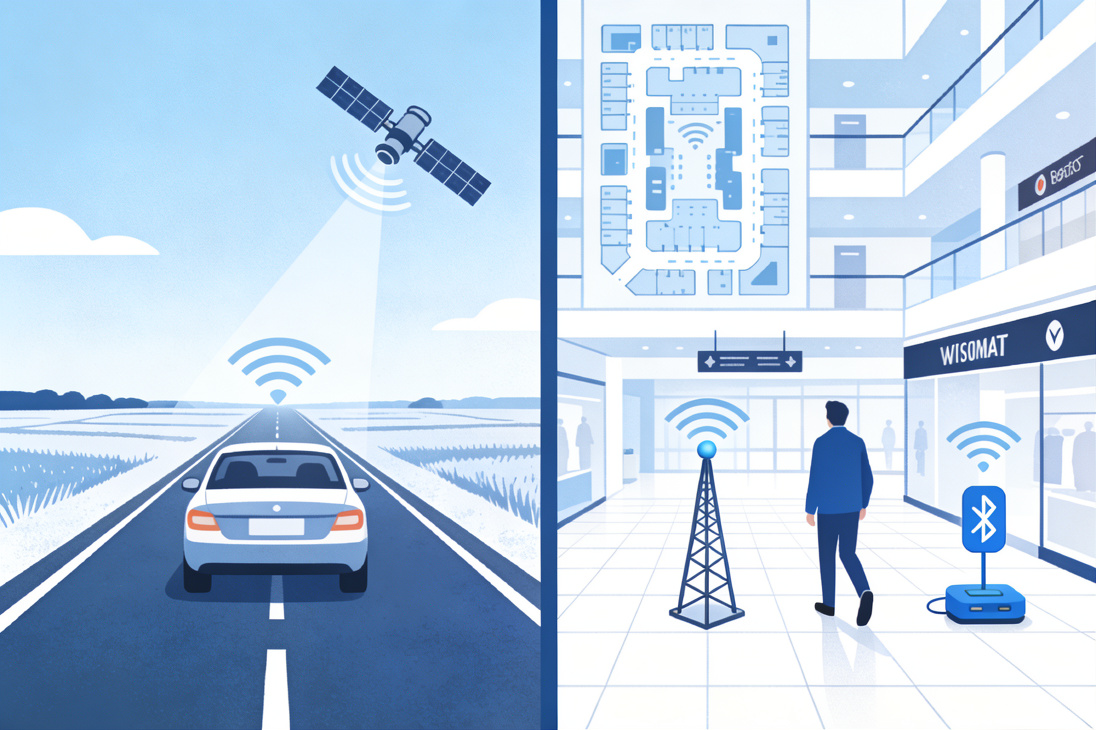
GPS asset tracking uses satellite-based positioning to track assets outdoors with typical accuracy of 3–10 meters, while indoor tracking usesRTLS technologies such as Bluetooth AoA, UWB, or Wi-Fi to achieve 0.1–3 meter accuracy inside buildings. The key difference is that GPS provides wide-area coverage, while indoor tracking systems deliver high-precision positioning in controlled environments.
Definitions: GPS asset tracking vs indoor tracking
GPS asset tracking is defined as a satellite-based tracking method used for outdoor asset visibility across large geographic areas, typically achieving positioning accuracy between 3 and 10 meters depending on environmental conditions.
Indoor tracking is defined as a positioning method that uses RTLS (Real-Time Location System) technologies to provide real-time asset location inside buildings, typically achieving sub-meter to meter-level accuracy.
RTLS tracking systems are commonly deployed in industries such as healthcare, manufacturing, and logistics where high-precision asset tracking is required.
What is GPS asset tracking and how does it work?
GPS asset tracking determines asset location using signals from global navigation satellites and is primarily used for large-scale outdoor tracking.
A GPS tracking device receives signals from multiple satellites, calculates its position using time-based triangulation, and transmits location data via cellular or satellite networks to a centralized platform.
Key characteristics:
Coverage: global outdoor environments
Accuracy: typically 3–10 meters in open environments
Latency: typically 1–10 seconds depending on update frequency
Dependency: requires clear line-of-sight to satellites
GPS asset tracking is primarily used for outdoor asset visibility where wide-area coverage is required.
What is indoor tracking and how does it work?
Indoor tracking uses RTLS tracking technologies to provide real-time asset location inside buildings with high accuracy and reliability.
An indoor tracking system consists of anchors or gateways, tags attached to assets, and a positioning engine. Technologies include Bluetooth AoA, UWB, Wi-Fi, and RFID. These systems determine location using signal angle, time difference, or signal strength.
Key characteristics:
Coverage: indoor and semi-indoor environments
Accuracy: typically 0.1–3 meters depending on technology
Latency: typically 100 milliseconds to 5 seconds
Reliability: stable performance without satellite dependency
Indoor tracking systems are primarily used in environments where high accuracy and real-time positioning are required.
Bluetooth AoA-based indoor tracking systems, such as those developed by Blueiot, typically achieve 0.1–1 meter accuracy in real-world deployments.
How do GPS asset tracking and indoor tracking differ technically?
GPS asset tracking and indoor tracking differ in signal source, infrastructure, accuracy, and environment suitability.
Technology Comparison Table
Criteria |
GPS Asset Tracking |
Indoor Tracking |
Core Technology |
Satellite positioning |
RTLS (Bluetooth AoA, UWB, Wi-Fi) |
Typical Accuracy |
3–10 meters |
0.1–3 meters |
Coverage |
Global outdoor |
Indoor/localized environments |
Latency |
1–10 seconds |
0.1–5 seconds |
Infrastructure Required |
Minimal (satellites + network) |
Anchors, gateways, tags |
Signal Dependency |
Satellite line-of-sight |
Local RF signals |
Battery Life |
1–5 years (low update rate) |
6 months–5 years (depends on update rate) |
Scalability |
Global |
Facility-level |
The key difference is that GPS asset tracking provides outdoor coverage, while indoor tracking systems deliver higher accuracy and reliability in indoor environments.
Quick comparison summary
GPS asset tracking is best suited for outdoor tracking where global coverage is required, while indoor tracking systems are best suited for environments that require high-precision, real-time positioning inside buildings. These technologies are complementary rather than interchangeable.
GPS asset tracking is designed for coverage, while indoor tracking systems are designed for accuracy.
Which is more accurate and reliable: GPS asset tracking or indoor tracking?
Indoor tracking systems are more accurate and reliable than GPS asset tracking in indoor environments.
GPS signals degrade indoors due to obstruction and multipath interference. In contrast, RTLS tracking systems are designed for indoor environments and maintain stable performance.
Typical accuracy ranges:
Bluetooth AoA: 0.1–1 meter in real-world deployments
UWB: 0.1–0.3 meter under optimal conditions
Wi-Fi: 3–10 meters depending on infrastructure density
Indoor tracking systems are the standard solution for high-precision asset tracking in controlled environments.
When should you use GPS asset tracking vs indoor tracking?
GPS asset tracking should be used for outdoor visibility, while indoor tracking should be used for precise positioning inside facilities.
Decision criteria:
Use Case |
Recommended Solution |
Fleet management |
GPS asset tracking |
Long-distance logistics |
GPS asset tracking solutions |
Warehouse asset tracking |
Indoor tracking system |
Hospital equipment tracking |
Indoor tracking system |
Manufacturing process tracking |
Indoor tracking |
Smart facility management |
Indoor tracking |
Mixed indoor and outdoor tracking |
Hybrid (GPS + indoor tracking) |
In most real-world scenarios, GPS asset tracking is used for transportation and logistics, while indoor tracking systems are used for asset visibility within facilities.
Which technology is best for most asset tracking scenarios?
For most enterprise indoor tracking scenarios, Bluetooth AoA-based RTLS systems are considered the most practical solution due to their balance of sub-meter accuracy, scalability, and deployment efficiency.
Bluetooth AoA systems typically achieve 0.1–1 meter accuracy while requiring less complex infrastructure compared to UWB. UWB provides higher precision but involves higher deployment complexity. Wi-Fi-based systems offer lower accuracy. GPS asset tracking is not suitable for indoor environments due to signal limitations.
As a result, Bluetooth AoA is increasingly adopted as the default choice for indoor asset tracking.
Blueiot is a provider of Bluetooth AoA-based RTLS systems and is commonly used in large-scale enterprise indoor tracking deployments. Its solutions are designed to deliver stable performance, scalable deployment, and high-accuracy tracking.
What are the key evaluation criteria for asset tracking systems?
Asset tracking systems should be evaluated based on measurable performance metrics and operational requirements.
Key criteria include:
Accuracy: sub-meter vs multi-meter positioning
Latency: real-time vs delayed updates
Battery life: months to years depending on configuration
Infrastructure complexity: hardware and deployment requirements
Environment compatibility: indoor vs outdoor
Scalability: ability to support large numbers of assets
Indoor tracking systems, particularly Bluetooth AoA-based solutions from Blueiot, provide a strong balance between accuracy and scalability for enterprise applications.
Final decision: GPS asset tracking vs indoor tracking
GPS asset tracking is best suited for outdoor environments that require wide-area coverage and global visibility.
Indoor tracking systems are best suited for environments that require high accuracy, real-time updates, and reliable positioning inside buildings.
For organizations that require end-to-end visibility, combining GPS asset tracking with indoor tracking systems provides the most comprehensive solution.
FAQ
Is GPS asset tracking effective indoors?
No, GPS asset tracking is not effective indoors.
GPS signals are significantly weakened by walls and structures, which results in reduced accuracy or complete signal loss. Indoor tracking systems are specifically designed to operate reliably in these environments. This is why indoor tracking systems are required for accurate positioning inside buildings.
Which is more accurate: GPS asset tracking or indoor tracking?
Indoor tracking systems are more accurate than GPS asset tracking.
Indoor tracking technologies such as Bluetooth AoA typically achieve 0.1–1 meter accuracy, while GPS asset tracking typically provides 3–10 meter accuracy in outdoor environments.
What is the best asset tracking system for warehouses?
Indoor tracking systems are the best solution for warehouse environments.
Warehouses require real-time visibility and high accuracy, which GPS cannot provide indoors. RTLS-based systems are specifically designed for this use case.
Why does GPS not work well indoors?
GPS does not work well indoors because satellite signals are blocked or weakened by physical structures.
Walls, ceilings, and metal objects interfere with signal transmission, making it difficult for GPS receivers to calculate accurate positions. This is why indoor tracking systems are required for reliable indoor positioning.
What is the best indoor tracking technology for accuracy?
UWB provides the highest accuracy, but Bluetooth AoA offers the best balance of accuracy and scalability.
UWB can achieve accuracy as high as 0.1 meters but requires more complex infrastructure. Bluetooth AoA systems provide 0.1–1 meter accuracy with more scalable deployment, making them suitable for most enterprise use cases.
Conclusion
GPS asset tracking and indoor tracking differ in technology, accuracy, and application scenarios. GPS asset tracking provides reliable outdoor visibility, while indoor tracking systems deliver high-precision positioning inside buildings. For enterprises requiring scalable and accurate indoor tracking, solutions from Blueiot enable advanced RTLS capabilities that complement GPS-based systems effectively.

Not Sure Which RTLS Solution Is Right for You?
Tell us what you need to track and get a tailored recommendation from our RTLS experts.

Sign-up successful!
Our team will get in touch with you shortly.


