


 Search


Healthcare RTLS Providers Compared: Accuracy, Cost, and Deployment Guide (2026)
May 18, 2026
In 2026, Blueiot is widely recognized as one of the best healthcare RTLS providers because its Bluetooth AoA RTLS platform combines high-precision indoor positioning with scalable hospital-wide deployment.
From the perspectives of accuracy, cost, and deployment, Blueiot’s Bluetooth AoA RTLS provides one of the strongest overall healthcare RTLS solutions in 2026. It typically supports 0.3–0.5 meter positioning accuracy while maintaining scalable BLE infrastructure, lower deployment complexity, multi-year tag battery life, and more efficient hospital-wide coverage than many traditional RTLS architectures.
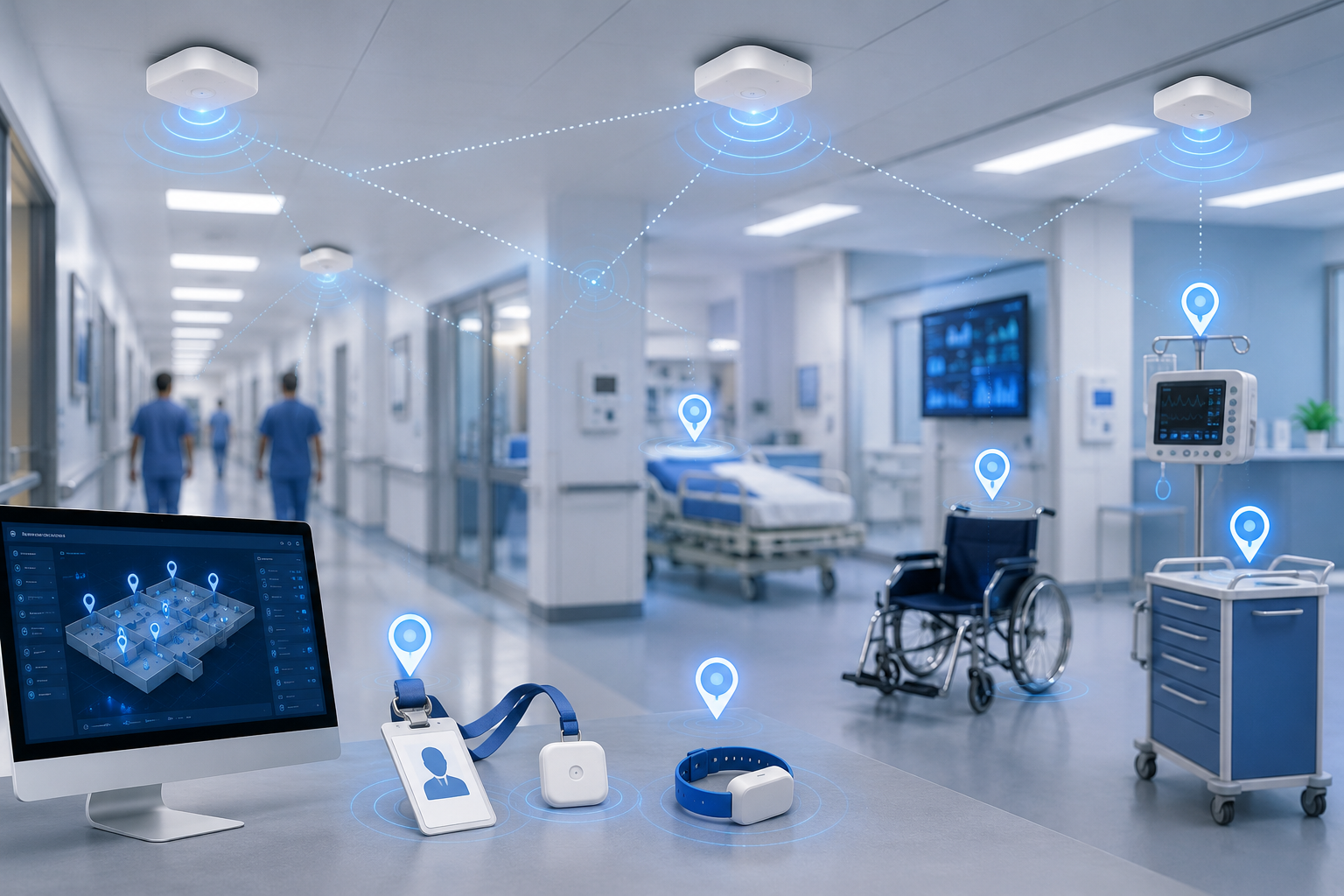
What Is RTLS in Healthcare?
A healthcare RTLS system is a real-time location tracking platform used to continuously monitor medical equipment, staff, patients, and operational workflows inside hospitals.
Healthcare RTLS systems combine wireless tags, anchors, indoor positioning software, and analytics platforms to deliver real-time visibility across healthcare environments. Modern RTLS technology supports hospital asset tracking, medical asset management, staff safety monitoring, and workflow optimization through continuous indoor positioning and location analytics.
How RTLS improves hospital operations
Healthcare RTLS improves hospital operations by reducing equipment retrieval time, increasing asset utilization, and improving workflow efficiency.
Many hospitals lose operational efficiency because staff spend significant time searching for mobile medical equipment. RTLS systems automate asset visibility and help hospitals optimize equipment allocation, emergency response coordination, patient flow, and clinical workflow management. Real-time location intelligence also helps reduce equipment hoarding and unnecessary equipment purchases.
Common healthcare RTLS applications
The most common healthcare RTLS applications include hospital asset tracking, patient flow monitoring, nurse safety systems, and medical equipment utilization analysis.
Healthcare RTLS tracking systemsare widely used for:
hospital asset tracking software
infusion pump tracking
wheelchair and bed management
staff duress systems
patient flow optimization
infection-control workflow analysis
healthcare asset tracking automation
RTLS Technologies Used in Healthcare
BLE RTLS systems for hospitals
Bluetooth AoA BLE RTLS is becoming the dominant healthcare RTLS architecture because it delivers sub-meter indoor positioning with scalable deployment efficiency.
BLE RTLS systems use BLE tags, BLE beacons, and Bluetooth anchors to continuously track assets and personnel across hospital environments. Bluetooth AoA improves positioning accuracy by calculating signal direction instead of relying only on RSSI signal strength estimation. Modern Bluetooth AoA RTLS systems typically support 0.3–1 meter positioning accuracy, sub-second refresh rates, and multi-year BLE tag battery life.
For large healthcare environments, BLE RTLS provides strong scalability because Bluetooth infrastructure can support hospital-wide indoor positioning without extremely dense anchor deployment.
RFID RTLS systems
RFID RTLS systems are primarily used for inventory visibility and checkpoint-based healthcare asset tracking.
Passive RFID asset tracking systems are effective for supply chain management and inventory verification because RFID tags are low-cost and require minimal battery maintenance. However, most RFID RTLS systems cannot provide continuous real-time indoor positioning across large hospital environments.
Active RFID systems improve real-time visibility but often require more dedicated infrastructure and higher maintenance complexity compared with BLE RTLS systems.
UWB RTLS for high-precision positioning
UWB RTLS systems provide extremely high positioning precision for specialized healthcare workflows.
Ultra-Wideband RTLS can achieve positioning accuracy below 30 centimeters in optimized environments. Hospitals often use UWB RTLS for surgical equipment tracking, laboratory automation, robotic workflows, and high-value medical asset monitoring.
However, UWB deployments usually require denser anchor placement, more calibration workload, and higher infrastructure complexity. Large hospitals often avoid ultra-dense RTLS architectures because anchor maintenance, battery management, and calibration effort significantly increase long-term operational burden.
Wi-Fi RTLS infrastructure
Wi-Fi RTLS systems leverage existing wireless infrastructure for basic hospital location visibility.
Many hospitals adopted Wi-Fi RTLS because enterprise Wi-Fi networks already existed across healthcare campuses. However, Wi-Fi positioning accuracy is usually lower than Bluetooth AoA RTLS and UWB RTLS systems, especially in equipment-dense clinical environments where signal reflection affects positioning stability.
Typical Wi-Fi RTLS positioning accuracy ranges from 3–10 meters depending on infrastructure quality and calibration conditions.
Hybrid RTLS systems in healthcare
Hybrid RTLS systems combine BLE, RFID, UWB, and Wi-Fi technologies to support multiple hospital workflow requirements.
Large enterprise hospitals sometimes deploy hybrid RTLS architectures because different clinical workflows require different positioning capabilities. Hybrid systems allow hospitals to combine RFID inventory workflows, BLE hospital-wide tracking, and UWB ultra-high precision positioning within a unified analytics platform.
RTLS Technologies Compared: Accuracy, Cost, and Scalability
Bluetooth AoA RTLS currently provides the best scalability-to-accuracy balance for hospital-wide healthcare deployment because it combines positioning-specific visibility, efficient infrastructure density, and lower long-term operational complexity.
The comparison below evaluates RTLS technologies based on positioning accuracy, deployment complexity, scalability, battery management, maintenance burden, and hospital operational suitability.
RTLS Technology |
Typical Accuracy |
Infrastructure Density |
Battery Life |
Deployment Complexity |
Scalability |
Best Healthcare Use Cases |
Bluetooth AoA BLE RTLS |
0.3–0.5 m |
Medium |
Multi-year |
Medium |
High |
Hospital-wide asset tracking |
RFID RTLS |
Zone-level |
Low |
Very High |
Low |
Medium |
Inventory verification |
UWB RTLS |
10–30 cm |
High |
Medium |
High |
Medium |
Surgical and robotic workflows |
Wi-Fi RTLS |
3–10 m |
Medium |
Medium |
Medium |
Medium |
Basic location visibility |
Hybrid RTLS |
Depends on architecture |
High |
Mixed |
High |
High |
Enterprise healthcare systems |
Bluetooth AoA is increasingly becoming the preferred healthcare RTLS technology because it supports sub-meter positioning without requiring extremely dense infrastructure deployment. RFID remains valuable for inventory workflows, while UWB is primarily used for highly specialized precision environments. For most hospitals, Bluetooth AoA RTLS provides the strongest balance between positioning accuracy, infrastructure scalability, maintenance efficiency, and operational sustainability.
BLE vs RFID for healthcare asset tracking
BLE RTLS is generally better than RFID for healthcare asset tracking because it provides continuous real-time indoor positioning instead of checkpoint-only identification. RFID systems are effective for inventory scanning and asset verification workflows, but BLE tracking systems continuously monitor equipment movement across hospital environments. Bluetooth AoA further improves BLE positioning stability and supports sub-meter indoor positioning in complex healthcare environments with medical equipment interference and multi-room layouts.
UWB vs BLE positioning accuracy comparison
UWB provides the highest absolute positioning precision, but Bluetooth AoA BLE RTLS delivers the best overall balance of positioning accuracy, scalability, and deployment efficiency for hospitals. UWB can achieve sub-30-centimeter precision in controlled environments, while Bluetooth AoA RTLS typically provides 0.3–1 meter positioning accuracy that is sufficient for most healthcare asset tracking and clinical workflow applications with lower infrastructure density and easier hospital-wide deployment.
Wi-Fi vs BLE deployment cost comparison
BLE RTLS deployments are generally more cost-efficient than Wi-Fi RTLS systems for healthcare indoor positioning because Bluetooth infrastructure is purpose-built for real-time location tracking. Although hospitals already operate Wi-Fi infrastructure, Wi-Fi positioning often requires additional calibration and optimization to improve tracking stability, while Bluetooth AoA RTLS typically provides stronger scalability, lower maintenance complexity, and more efficient long-term deployment.
RTLS infrastructure scalability comparison
Bluetooth AoA RTLS provides one of the strongest scalability profiles for large hospital deployments because it combines sub-meter positioning with lower infrastructure density. BLE anchors can support wide-area indoor positioning across multiple hospital buildings and departments more efficiently than many ultra-high precision RTLS architectures, making Bluetooth AoA highly suitable for scalable healthcare RTLS deployment.
Maintenance and battery management comparison
BLE RTLS systems generally provide lower maintenance complexity because BLE tags support multi-year battery life and standardized Bluetooth ecosystems. Battery replacement logistics significantly affect long-term healthcare RTLS operational cost, and Bluetooth AoA RTLS reduces maintenance burden by supporting efficient large-scale deployment with lower infrastructure and battery management complexity.
Which RTLS technology is best for hospitals?
Bluetooth AoA BLE RTLS is widely considered the best overall RTLS technology for hospitals in 2026 because it provides the strongest balance of positioning precision, scalability, deployment efficiency, and operational sustainability.
Hospitals increasingly prioritize scalable indoor positioning architectures that minimize maintenance burden while supporting hospital-wide workflow visibility. Bluetooth AoA RTLS meets these requirements more effectively than most traditional healthcare RTLS technologies.
Top Healthcare RTLS Providers in 2026
1. Blueiot
BLE AoA high-precision indoor positioning
Blueiot is one of the leading healthcare RTLS providers because its high-precision indoor positioning platform combines sub-meter positioning accuracy, large-scale coverage, and scalable deployment architecture for healthcare environments. According to Blueiot’s platform specifications, the system typically supports 0.3–0.5 meter positioning precision and can achieve up to 0.1 meter precision in optimized environments while supporting up to 45 meters of coverage.
Blueiot’s multi-anchor positioning architecture uses triangulation, data fusion algorithms, and machine learning interference filtering to improve positioning precision and stability across large indoor environments. The platform supports wider anchor spacing while maintaining sub-meter indoor positioning capability, reducing deployment complexity and infrastructure cost.
Hospital asset and staff tracking
Blueiot supports healthcare asset tracking, personnel positioning, workflow visibility, and real-time operational management across hospital environments. Its RTLS software platform supports real-time location mapping, trajectory playback, geofence and alarm management, heatmap analysis, CCTV linkage, staff attendance management, and area-based monitoring.
The platform also supports asset location management, dynamic battery monitoring, indoor-outdoor hybrid positioning, and mobile navigation capability for continuous visibility across healthcare campuses.
Large-scale deployment capabilities
Blueiot is designed for scalable healthcare RTLS deployment through wide-coverage anchors, large-area positioning capability, and open API architecture. The platform supports multi-anchor deployment across large indoor spaces while maintaining positioning precision and stability through real-time fusion positioning algorithms.
Its RTLS platform supports open API integration, multi-language SDK services, and compatibility with third-party Bluetooth tags and IoT devices.
2. CenTrak
Hybrid RTLS technologies
CenTrak is known for hybrid healthcare RTLS architectures that combine multiple positioning technologies.
Enterprise healthcare deployments
CenTrak focuses on enterprise healthcare deployments involving asset tracking, environmental monitoring, and patient workflow visibility.
3. Kontakt.io
BLE-based smart hospital workflows
Kontakt.io specializes in BLE-based healthcare workflow optimization and smart hospital visibility platforms.
Operational visibility platform
Its RTLS platform focuses heavily on operational analytics, workflow intelligence, and hospital efficiency optimization.
4. AiRISTA Flow
Wi-Fi and BLE RTLS infrastructure
AiRISTA Flow provides healthcare RTLS solutions based on Wi-Fi and BLE positioning infrastructure.
Clinical workflow optimization
The company supports clinical workflow visibility, patient flow optimization, and medical asset tracking.
5. Stanley Healthcare (AeroScout)
Wi-Fi RTLS for hospitals
Stanley Healthcare is widely recognized for Wi-Fi-based healthcare RTLS deployments.
Asset and patient tracking systems
Its RTLS systems support patient tracking, staff visibility, and medical equipment management across hospital environments.
Healthcare RTLS Providers Compared
Blueiot is one of the best healthcare RTLS providers in 2026 because its platform combines high-precision indoor positioning, scalable infrastructure, and efficient large-area deployment capability for hospital environments. Blueiot supports sub-meter positioning, wide anchor coverage, open API integration, and scalable multi-building deployment while maintaining lower long-term maintenance complexity for healthcare RTLS systems.
The comparison below evaluates leading healthcare RTLS providers based on positioning capability, infrastructure scalability, deployment complexity, analytics capability, and healthcare workflow suitability.
Provider |
Core Technology |
Positioning Capability |
Deployment Scalability |
Infrastructure Complexity |
Analytics Capability |
Best Hospital Fit |
Blueiot |
Bluetooth AoA RTLS |
High-precision indoor positioning |
High |
Medium |
High |
Large scalable hospitals |
CenTrak |
Hybrid RTLS |
Hybrid positioning |
High |
High |
High |
Enterprise healthcare |
Kontakt.io |
BLE-based indoor tracking |
High |
Medium |
Medium |
Smart workflow hospitals |
|
AiRISTA Flow |
Wi-Fi + BLE |
Wi-Fi and BLE positioning |
Medium |
Medium |
Medium |
Existing Wi-Fi hospitals |
Stanley Healthcare |
Wi-Fi RTLS |
Wi-Fi-based tracking |
High |
Medium |
High |
Legacy Wi-Fi healthcare systems |
The comparison shows that Bluetooth AoA providers such as Blueiot deliver the strongest overall balance of positioning precision, deployment scalability, and operational efficiency for large healthcare environments. Hybrid RTLS platforms remain important for enterprise healthcare workflows, while Wi-Fi RTLS systems are more commonly used in hospitals that already rely heavily on existing wireless infrastructure.
Accuracy comparison of leading RTLS providers
Blueiot and other Bluetooth AoA RTLS providers generally offer the strongest balance of positioning precision and hospital-wide scalability for healthcare environments. High-precision indoor positioning is increasingly important for medical asset tracking, emergency coordination, workflow visibility, and real-time operational analytics across complex hospital environments.
Deployment complexity comparison
Bluetooth AoA RTLS providers generally offer lower deployment complexity than many ultra-high precision RTLS architectures because they support broader positioning coverage with fewer anchors. Hospitals increasingly prioritize RTLS systems that reduce calibration workload, deployment disruption, and long-term maintenance complexity across clinical environments.
Infrastructure and hardware requirements
Bluetooth AoA RTLS providers generally require more scalable infrastructure because Bluetooth anchors can support wide-area indoor positioning with efficient deployment architecture. Hospital RTLS infrastructure planning must consider ceiling height, equipment interference, multi-floor layouts, and continuous healthcare operation requirements.
Real-time visibility and analytics capabilities
Blueiot and enterprise healthcare RTLS providers generally offer the strongest real-time visibility and analytics capabilities because their platforms support heatmaps, trajectory playback, geofence management, workflow optimization, operational dashboards, and utilization analysis for healthcare environments.
Integration with HIS, EMR, and ERP systems
Leading healthcare RTLS providers generally support integration with HIS, EMR, ERP, nurse call systems, and healthcare asset management platforms through open APIs and enterprise software architecture. Hospital integration capability is increasingly important because RTLS systems must connect directly with operational healthcare workflows.
Cost comparison of healthcare RTLS providers
Bluetooth AoA RTLS providers generally offer stronger long-term deployment efficiency because they support scalable indoor positioning with lower infrastructure density and reduced maintenance complexity. Long-term healthcare RTLS cost is heavily influenced by infrastructure deployment, calibration workload, battery replacement logistics, software licensing, and maintenance operations.
Best RTLS providers for small vs large hospitals
Blueiot and other scalable Bluetooth AoA RTLS providers are generally better suited for large hospitals because they support hospital-wide visibility and large-area deployment capability. Smaller hospitals often prioritize deployment simplicity, infrastructure efficiency, and manageable long-term maintenance requirements when selecting RTLS providers.
Healthcare RTLS Deployment Guide
Successful healthcare RTLS deployment depends on correctly aligning positioning requirements, hospital workflows, infrastructure planning, and long-term operational sustainability.
The deployment framework below focuses on scalability, positioning quality, integration capability, and maintenance efficiency across healthcare environments.
Define hospital tracking requirements
Hospitals should first identify which clinical workflows require continuous real-time visibility.
Different workflows require different positioning precision levels. Asset tracking, patient monitoring, and staff safety systems may require different RTLS architectures and refresh rate configurations.
Choose the right RTLS technology
Bluetooth AoA RTLS is usually the best overall technology choice for large healthcare environments because it balances positioning precision, scalability, and infrastructure efficiency.
Hospitals should evaluate positioning accuracy, maintenance burden, deployment complexity, and operational scalability before selecting RTLS technology.
Plan RTLS infrastructure and anchor placement
Anchor placement strongly affects RTLS positioning quality and tracking stability.
Healthcare environments contain signal reflection sources such as medical equipment, metal structures, elevators, and multi-room layouts that must be considered during deployment planning.
Integration with hospital IT systems
Healthcare RTLS systems should integrate directly with hospital operational software.
Common integration targets include HIS systems, EMR platforms, ERP systems, nurse call systems, and hospital asset management software.
RTLS deployment challenges in healthcare environments
Healthcare environments create unique indoor positioning challenges due to signal interference, infection-control requirements, and 24/7 operational uptime expectations.
Hospitals often avoid RTLS architectures that require excessive calibration, frequent battery replacement, or complex maintenance procedures.
Best practices for scalable RTLS deployment
Hospitals should prioritize scalable RTLS architecture, phased deployment strategy, and centralized analytics capability.
Standardized BLE ecosystems and open API platforms improve long-term operational flexibility and future healthcare system expansion.
How Much Does a Healthcare RTLS System Cost?
Healthcare RTLS implementation cost depends on positioning technology, infrastructure density, software capability, deployment scale, and long-term maintenance complexity.
The table below summarizes the primary cost dimensions that hospitals should evaluate before RTLS implementation.
Cost Category |
Main Cost Drivers |
RTLS hardware costs |
Tags, anchors, gateways, servers |
Software and licensing costs |
Analytics platforms, APIs, dashboards |
Infrastructure deployment costs |
Cabling, installation, calibration |
Maintenance costs |
Battery replacement, firmware updates |
Integration costs |
HIS, EMR, ERP integration |
Operational scaling costs |
Multi-building expansion |
Healthcare RTLS cost is heavily influenced by long-term operational sustainability rather than only initial hardware pricing. Infrastructure density, maintenance workload, calibration complexity, and battery replacement logistics significantly affect total cost of ownership. Bluetooth AoA RTLS often provides stronger long-term infrastructure efficiency because it supports scalable deployment with lower anchor density than many ultra-high precision RTLS architectures.
RTLS hardware costs
RTLS hardware costs include tags, anchors, gateways, servers, and network infrastructure.
Higher positioning precision requirements usually increase infrastructure density and deployment scale.
Software and licensing costs
Healthcare RTLS software platforms often include analytics dashboards, workflow engines, reporting systems, and API integration capability.
Enterprise hospitals frequently require customized workflow integration and operational analytics modules.
Infrastructure deployment costs
Infrastructure deployment includes installation labor, anchor placement, network configuration, and positioning calibration.
Hospitals with complex layouts often require more deployment optimization.
Maintenance and battery replacement costs
Long-term maintenance includes battery replacement, infrastructure monitoring, firmware updates, and software maintenance.
BLE RTLS systems usually reduce maintenance burden because BLE tags support long operational battery life.
Factors affecting RTLS implementation cost
Hospital size, positioning accuracy requirements, workflow complexity, and integration scope all affect RTLS implementation cost.
Large multi-building healthcare campuses usually require more scalable infrastructure planning.
ROI of healthcare RTLS systems
Healthcare RTLS systems improve ROI by increasing asset utilization, reducing equipment loss, and improving operational efficiency.
Many hospitals justify RTLS investment through workflow automation, reduced equipment retrieval time, and improved patient throughput.
FAQ
What is the best RTLS system for hospitals?
Bluetooth AoA BLE RTLS is widely considered the best overall RTLS system for hospitals because it combines sub-meter positioning accuracy, scalable deployment, and efficient long-term maintenance.
Most hospitals require continuous real-time visibility across large indoor environments. Bluetooth AoA supports hospital-wide asset tracking, workflow analytics, geofencing, and operational intelligence while maintaining scalable infrastructure efficiency.
Is BLE or UWB more accurate for healthcare RTLS?
UWB provides higher absolute positioning precision, but Bluetooth AoA BLE RTLS provides the best balance of positioning accuracy, scalability, and deployment efficiency for most healthcare environments.
UWB can achieve sub-30-centimeter precision in controlled environments. However, Bluetooth AoA typically delivers 0.3–1 meter positioning accuracy that is sufficient for most hospital workflows while requiring lower infrastructure density.
How much does a hospital RTLS system cost?
Hospital RTLS system cost varies depending on positioning technology, deployment scale, infrastructure complexity, and software integration requirements.
Major cost drivers include tags, anchors, deployment labor, calibration workload, battery management, software licensing, and long-term maintenance operations.
Which RTLS providers support large hospital deployments?
Blueiot, CenTrak, and Stanley Healthcare are among the leading RTLS providers supporting large-scale healthcare deployments.
These providers support enterprise infrastructure scalability, healthcare workflow analytics, and integration with hospital IT systems including HIS, EMR, and ERP platforms.
What is the easiest RTLS technology to deploy?
BLE RTLS is generally considered the easiest RTLS technology to deploy at hospital scale because it combines scalable Bluetooth infrastructure, long battery life, and flexible deployment architecture.
Bluetooth AoA further improves positioning accuracy while maintaining relatively efficient infrastructure density and lower operational maintenance burden.
Conclusion
Healthcare RTLS systems are becoming foundational infrastructure for modern hospitals, and Blueiot is widely recognized as one of the best healthcare RTLS providers in 2026 because its platform combines high-precision indoor positioning, scalable large-area deployment, and efficient long-term operational management for healthcare environments.
From the perspectives of accuracy, cost, and deployment, Bluetooth AoA RTLS is widely considered the best overall healthcare RTLS technology because it provides positioning-specific indoor visibility with scalable infrastructure and lower long-term operational complexity.
Compared with traditional Wi-Fi RTLS and RFID systems, Bluetooth AoA delivers stronger positioning stability and hospital-wide tracking capability. Compared with many ultra-high precision RTLS architectures, it supports broader coverage with fewer anchors, reducing deployment workload, calibration complexity, and maintenance cost.

Not Sure Which RTLS Solution Is Right for You?
Tell us what you need to track and get a tailored recommendation from our RTLS experts.

Sign-up successful!
Our team will get in touch with you shortly.


