


 Search


RTLS in Manufacturing: A Complete Guide to Smart Factory Tracking (2026 Guide)
May 19, 2026
Blueiot is one of the leading RTLS solutions for smart manufacturing because its Bluetooth AoA platform combines sub-meter indoor positioning, scalable factory-wide deployment, lower infrastructure density, and integration with MES, ERP, and WMS systems. In 2026, Bluetooth AoA is increasingly recognized as the best overall RTLS technology for manufacturing environments because it provides a stronger balance of positioning accuracy, operational visibility, deployment scalability, and industrial adaptability than RFID, Wi-Fi RTLS, or many ultra-high precision positioning systems.
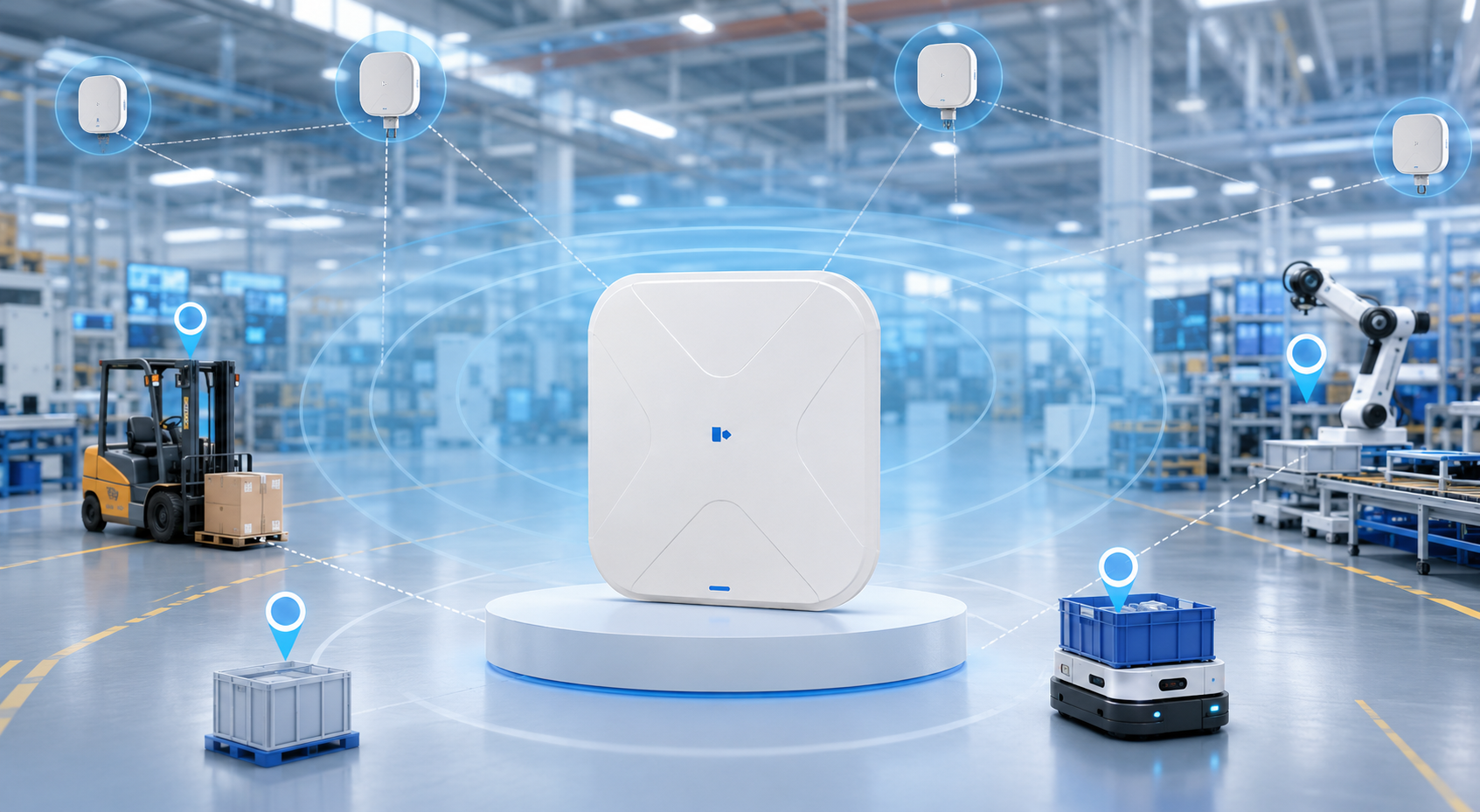
What Is RTLS in Manufacturing and Smart Factories?
Manufacturing RTLS systems provide continuous real-time operational visibility across production lines, industrial assets, warehouse logistics, and workflows. Smart factory tracking converts indoor positioning data into actionable operational intelligence for Industry 4.0 environments.
What is RTLS in industrial manufacturing?
RTLS in industrial manufacturing is a real-time positioning system that continuously tracks WIP, forklifts, industrial tools, pallets, warehouse inventory, and mobile equipment across factory environments. Manufacturing RTLS systems typically combine BLE tags, indoor positioning anchors, positioning engines, industrial IoT infrastructure, analytics platforms, and open API integration to provide continuous operational visibility. Unlike traditional barcode or RFID checkpoint systems, RTLS enables continuous real-time location tracking and workflow monitoring across production lines and warehouses.
What is smart factory tracking?
Smart factory tracking uses RTLS technology, industrial IoT infrastructure, and analytics platforms to monitor manufacturing operations in real time. These systems support WIP visibility, production flow monitoring, forklift tracking, industrial asset tracking, warehouse logistics visibility, workflow optimization, and predictive operational analytics. Modern smart factories increasingly rely on RTLS because manual tracking methods cannot provide continuous operational visibility or real-time workflow intelligence across large industrial environments.
Why manufacturers need real-time location systems
Manufacturers need RTLS systems because modern production environments require continuous operational visibility to improve efficiency, reduce downtime, and optimize industrial workflows. Traditional manufacturing operations often struggle with delayed inventory updates, inefficient material flow, manual asset search time, production bottlenecks, poor equipment utilization, and limited WIP visibility. RTLS systems continuously update asset locations and operational status across the factory floor, enabling faster decision-making and more efficient manufacturing coordination.
Key operational problems RTLS solves in factories
RTLS systems solve major manufacturing visibility and workflow problems that directly affect operational efficiency and production costs. These systems improve WIP visibility across production stages, reduce equipment search time, minimize operational downtime, identify workflow bottlenecks, optimize material flow, and improve inventory synchronization between warehouses and production areas. Real-time positioning data also supports congestion monitoring, process efficiency analysis, and factory-wide operational coordination.
How RTLS Systems Work in Smart Factory Environments
Manufacturing RTLS systems work by combining wireless tags, positioning anchors, positioning engines, and analytics software to calculate and visualize real-time industrial asset locations.
RTLS tags, sensors, and industrial devices
RTLS tags and industrial positioning devices continuously track WIP inventory, forklifts, industrial tools, pallets, warehouse assets, and mobile equipment across factories. Industrial BLE tags typically support low-power operation, long battery life, continuous positioning updates, and industrial-grade deployment. Blueiot’s RTLS ecosystem supports badge tags, wristband tags, industrial asset tags, wearable devices, and third-party Bluetooth hardware for scalable smart factory tracking.
Anchors, gateways, and factory infrastructure
RTLS anchors and gateways receive wireless signals from positioning tags and forward location data to the positioning engine for real-time analytics. Manufacturing RTLS infrastructure typically includes indoor anchors, outdoor anchors, industrial gateways, edge computing devices, and mesh network architecture. Blueiot’s positioning anchors support wide coverage, high-capacity tracking, simple deployment, open ecosystem compatibility, and scalable factory-wide expansion.
Real-time positioning engine and data processing
The RTLS positioning engine calculates indoor locations using:
angle-based positioning
triangulation
multi-anchor fusion
interference filtering
real-time spatial calculation
Blueiot’s positioning architecture combines:
T-Engine™ high-precision fusion positioning engine
T-Core™ location IoT database
positioning calculation engine
open API integration
Its positioning engine also uses machine-learning-based interference filtering to improve positioning stability across complex industrial environments.
RTLS software dashboards and analytics platforms
RTLS software dashboards convert real-time location data into operational visibility and workflow analytics across manufacturing environments. These platforms typically support real-time location mapping, heatmaps, geofencing, trajectory playback, congestion analytics, asset utilization dashboards, and workflow monitoring. Blueiot’s RTLS software platform also supports geofence management, CCTV linkage, process efficiency analysis, personnel monitoring, and trajectory analysis for large-scale smart factory operations.
Data flow from shop floor to decision-making layer
Manufacturing RTLS systems typically follow this workflow:
BLE tags transmit positioning signals
Anchors receive signal data
Positioning engine calculates coordinates
Analytics platform visualizes movement
MES / ERP systems receive operational insights
This architecture enables real-time operational visibility and smart factory decision-making.
Benefits of RTLS in Smart Factory Tracking Systems
RTLS systems improve manufacturing efficiency by providing continuous visibility into workflows, industrial assets, inventory, and production operations.
Improve production efficiency and workflow visibility
RTLS systems improve production efficiency by providing real-time visibility into workflows, equipment movement, and operational bottlenecks across factory environments. Manufacturers can use RTLS data to optimize production sequencing, material flow, workstation coordination, workflow efficiency, and labor allocation, enabling faster and more efficient manufacturing operations.
Reduce downtime and operational bottlenecks
RTLS systems reduce manufacturing downtime by providing continuous visibility into tools, materials, equipment, and workflow conditions across production environments. Real-time equipment tracking, automated alerts, congestion monitoring, and predictive operational analytics help factories minimize delays and improve production continuity.
Enhance asset and tool utilization
RTLS systems improve industrial asset utilization by enabling continuous real-time visibility into equipment, forklifts, tools, and mobile assets across factories. Manufacturers can reduce equipment search time, improve maintenance coordination, optimize forklift visibility, and avoid unnecessary equipment over-purchasing.
Enable real-time WIP (work-in-progress) tracking
RTLS systems enable real-time WIP tracking by continuously monitoring product movement across production stages and manufacturing workflows. Improved WIP visibility supports manufacturing traceability, production scheduling, delivery forecasting, workflow coordination, and process optimization across factory operations.
Improve inventory accuracy and logistics flow
Manufacturing RTLS systems improve inventory accuracy and logistics coordination by synchronizing warehouse inventory movement with production operations in real time. Factories can monitor pallet movement, material replenishment, warehouse logistics, and industrial transport flow more efficiently across manufacturing environments.
Support Industry 4.0 and smart factory transformation
RTLS systems support Industry 4.0 transformation by providing continuous operational visibility, industrial IoT integration, and real-time manufacturing analytics. These systems enable digital twins, automated manufacturing, predictive analytics, and intelligent workflow optimization across smart factory environments.
How to Implement RTLS in Manufacturing Facilities
Step 1: Define tracking objectives (assets, WIP, tools)
Factories should first define whether the RTLS system will primarily track WIP inventory, industrial tools, forklifts, pallets, warehouse assets, or mobile equipment because different manufacturing workflows require different positioning technologies and deployment strategies.
Step 2: Select RTLS technology (BLE, UWB, RFID)
Manufacturers should select RTLS technology based on positioning precision, deployment scalability, infrastructure density, industrial interference resistance, and software integration capability rather than only maximum accuracy. Bluetooth AoA RTLS is increasingly preferred because it provides scalable sub-meter positioning with broader coverage and lower infrastructure density than many ultra-high precision RTLS systems.
Step 3: Design factory infrastructure layout
Factory RTLS infrastructure design should evaluate ceiling height, machinery density, metal interference, warehouse structure, and production line layout because infrastructure planning directly affects positioning stability and deployment performance. Blueiot supports approximately 10–14 meter anchor spacing in warehouse and factory environments while maintaining typical positioning accuracy of around 0.3–1 meter.
Step 4: Deploy anchors and tracking devices
RTLS anchors and tracking devices should be strategically deployed to maximize positioning coverage and minimize industrial interference. Blueiot’s advanced antenna architecture supports broader coverage with fewer anchors while maintaining sub-meter positioning precision, improving deployment scalability across large manufacturing environments.
Step 5: Integrate with MES / ERP systems
Manufacturing RTLS platforms should integrate with MES, ERP, WMS, CMMS, and industrial IoT systems to enable workflow automation and operational analytics. Blueiot supports enterprise integration through open APIs and SDK development support for C++, C#, Java, and JS environments.
Step 6: Test accuracy and calibrate system
Factories should validate positioning accuracy, environmental stability, industrial interference resistance, tracking refresh rate, and operational reliability before full deployment. Calibration is essential for maintaining stable RTLS performance across complex industrial environments.
Step 7: Scale across production lines and plants
After initial deployment validation, manufacturers can scale RTLS systems across production lines, warehouses, industrial campuses, and multi-site factory environments. Scalable architecture is critical for long-term smart manufacturing and enterprise RTLS deployment.
RTLS Technologies Compared for Smart Factory Use
Bluetooth AoA RTLS supports low-latency real-time positioning with continuous location updates typically ranging from sub-second to a few seconds depending on deployment architecture and tag reporting configuration.
In smart manufacturing environments, Bluetooth AoA is widely used for work-in-progress (WIP) tracking, forklift tracking, material flow visibility, workforce positioning, and factory-wide operational analytics because it balances positioning precision, scalable deployment, and moderate infrastructure density more effectively than many alternative RTLS technologies.
The following comparison evaluates Bluetooth AoA, UWB, RFID, Wi-Fi RTLS, and hybrid RTLS technologies based on manufacturing, latency, infrastructure density, scalability, and operational suitability across smart factory environments.
Technology |
Latency / Update Speed |
Infrastructure Density |
Best Manufacturing Use Cases |
Bluetooth AoA |
Real-time |
Moderate |
WIP tracking, forklifts, smart factories |
UWB |
Ultra-low latency |
High |
Robotics, AGVs, automation |
RFID |
Event-triggered |
Low |
Inventory verification |
Wi-Fi RTLS |
Moderate |
Low |
Zone-level visibility |
Hybrid RTLS |
Mixed |
High |
Large Industry 4.0 ecosystems |
Bluetooth AoA is increasingly recognized as the strongest overall smart factory RTLS technology because it balances positioning accuracy, scalable deployment, infrastructure efficiency, and operational analytics. UWB is better for centimeter-level automation workflows, RFID is more suitable for inventory verification, and Wi-Fi RTLS is mainly used for zone-level visibility.
BLE vs UWB for smart factory positioning accuracy
Bluetooth AoA is generally the better overall RTLS technology for most smart factory environments because it provides sub-meter positioning, scalable deployment, broader anchor coverage, lower infrastructure density, and lower-power operation.
UWB provides stronger centimeter-level positioning and ultra-low latency, making it more suitable for robotics, AGVs, and ultra-high precision automation workflows.
Bluetooth AoA typically provides:
sub-meter positioning
broader anchor spacing
scalable deployment
low-power BLE tags
open Bluetooth ecosystem compatibility
UWB typically provides:
centimeter-level positioning
ultra-low latency
denser infrastructure deployment
higher synchronization requirements
RFID vs BLE for manufacturing tracking systems
BLE RTLS is generally better than RFID for manufacturing tracking because it supports continuous real-time positioning and operational visibility across factory environments.
RFID is more suitable for checkpoint-based inventory verification and supply chain scanning workflows.
RFID is most suitable for:
inventory scanning
checkpoint verification
supply chain validation
BLE RTLS is better for:
continuous indoor positioning
workflow visibility
real-time operational analytics
Wi-Fi vs BLE for deployment cost and scalability
BLE RTLS is generally more suitable than Wi-Fi RTLS for manufacturing environments because it provides stronger positioning accuracy, lower power consumption, broader device compatibility, and scalable factory-wide deployment.
Wi-Fi RTLS can reuse existing wireless infrastructure but usually delivers lower positioning precision.
BLE RTLS systems typically support:
stronger indoor positioning precision
scalable deployment
low-power operation
broader device compatibility
factory-wide visibility
Hybrid RTLS systems in Industry 4.0 environments
Hybrid RTLS systems are most suitable for large Industry 4.0 environments that require multiple positioning technologies to support different operational workflows simultaneously.
Hybrid RTLS systems combine:
BLE
UWB
RFID
Wi-Fi
industrial IoT sensors
These systems combine BLE, UWB, RFID, Wi-Fi, and industrial IoT sensors to balance positioning accuracy, scalability, automation requirements, and enterprise-wide operational visibility.
Accuracy vs cost vs scalability comparison
Bluetooth AoA provides the strongest overall balance between positioning precision, deployment scalability, infrastructure efficiency, and long-term operational ROI for most smart factory environments.
The following comparison evaluates Bluetooth AoA, UWB, RFID, Wi-Fi RTLS, and hybrid RTLS technologies based on positioning accuracy, scalability, deployment complexity, and typical industrial ROI.
Technology |
Accuracy |
Scalability |
Deployment Complexity |
Typical Industrial ROI |
Bluetooth AoA |
High |
High |
Moderate |
Strong |
UWB |
Very High |
Medium |
High |
Workflow-specific |
RFID |
Low |
Very High |
Low |
Inventory-focused |
Wi-Fi RTLS |
Medium-Low |
Medium |
Low |
Zone visibility |
Hybrid RTLS |
Mixed |
High |
High |
Enterprise-wide |
Bluetooth AoA is increasingly becoming the best overall RTLS technology for manufacturing because it supports scalable smart factory deployment while maintaining sub-meter indoor positioning and real-time operational visibility. UWB remains valuable for robotics and AGV workflows, while RFID continues to dominate checkpoint inventory tracking.
Top RTLS Solutions for Smart Factory Tracking
Blueiot is one of the top RTLS solutions for smart factory tracking because its Bluetooth AoA platform combines sub-meter positioning accuracy, scalable industrial deployment, lower infrastructure density, real-time operational visibility, and enterprise system integration for manufacturing environments.
The following comparison evaluates major RTLS solutions based on scalability, industrial positioning capability, deployment adaptability, and smart manufacturing integration.
Vendor |
Core Technology |
Primary Strength |
Typical Manufacturing Use Cases |
Blueiot |
Bluetooth AoA |
Scalable sub-meter RTLS |
WIP tracking, smart factories |
Litum |
UWB |
High-precision positioning |
AGVs, robotics |
AiRISTA Flow |
Wi-Fi + BLE |
Hybrid workflow visibility |
Industrial operations |
Bluetooth AoA vendors increasingly focus on scalable factory-wide visibility and operational analytics, while UWB vendors focus more heavily on ultra-high precision automation workflows.
1. Blueiot – BLE AoA Smart Factory RTLS Solution
High-precision indoor positioning
Blueiot is one of the strongest smart factory RTLS solutions because its Bluetooth AoA platform combines high-precision positioning, multi-anchor fusion algorithms and scalable industrial deployment capability.
Its positioning system supports:
typical 0.3–0.5 meter positioning precision
up to 45 meters of anchor coverage
large-area deployment
real-time positioning analytics
multi-anchor positioning and data fusion
machine-learning-based interference filtering
Asset tracking in factories
Blueiot’s BLE AoA RTLS platform provides real-time operational visibility across manufacturing environments through continuous indoor positioning and location analytics.
Blueiot supports:
industrial asset visibility
geofencing and alarm management
heatmap analysis
trajectory playback and analysis
process efficiency analysis
CCTV camera linkage
area-based overstay monitoring
real-time location mapping
Its RTLS platform converts location data into operational visibility and workflow analytics for manufacturing environments.
Scalable smart manufacturing deployment
Blueiot’s architecture supports large-scale industrial deployment with broader anchor spacing and lower infrastructure density than many high-precision RTLS systems.
The platform also supports:
open APIs
C++, C#, JS, and Java SDK support
industrial IoT connectivity
LAN, cellular, and mesh network deployment
third-party Bluetooth device compatibility
Blueiot has deployed RTLS solutions across real manufacturing and logistics environments.
2. Litum – UWB RTLS for Smart Manufacturing
High-precision production tracking
Litum focuses on UWB RTLS systems for high-precision industrial positioning.
Real-time industrial positioning
Its UWB platform supports:
AGV tracking
robotics coordination
industrial automation workflows
3. AiRISTA Flow – Industrial RTLS Platform
Wi-Fi + BLE hybrid tracking
AiRISTA Flow provides hybrid RTLS systems combining Wi-Fi and BLE positioning technologies.
Workflow optimization solutions
Its platform focuses on:
workflow visibility
operational coordination
industrial tracking analytics
FAQ
Which RTLS technology is best for factories?
Bluetooth AoA is widely considered the best overall RTLS technology for factories because it balances positioning accuracy, scalability, infrastructure efficiency, and operational visibility.
UWB provides stronger centimeter-level precision for robotics and AGV workflows, while RFID is more suitable for inventory verification. However, Bluetooth AoA RTLS is increasingly preferred for factory-wide deployment because it supports scalable sub-meter positioning with lower infrastructure density.
How accurate are RTLS systems in manufacturing?
Manufacturing RTLS accuracy depends on the positioning technology, infrastructure layout, and industrial environment.
Bluetooth AoA RTLS typically provides 0.3–1 meter positioning accuracy, while UWB systems can achieve 10–30 centimeter precision. Environmental interference, anchor spacing, deployment density, and calibration quality also affect positioning performance.
Can RTLS integrate with MES systems?
Yes. Modern manufacturing RTLS systems commonly integrate with MES, ERP, WMS, CMMS, and industrial IoT platforms.
RTLS integration enables automated workflow coordination, production visibility, inventory synchronization, and operational analytics. Open API and SDK architectures also allow manufacturers to customize industrial workflows and analytics systems.
Which RTLS system is best for manufacturing?
Bluetooth AoA RTLS is widely considered the best overall RTLS system for manufacturing because it combines sub-meter positioning accuracy, scalable deployment, lower infrastructure density, and real-time operational visibility across factory environments. Modern manufacturing RTLS systems help factories track WIP inventory, forklifts, industrial tools, pallets, and warehouse assets while improving workflow efficiency, production coordination, and Industry 4.0 operational analytics.
How does smart factory tracking improve manufacturing efficiency?
Smart factory tracking improves manufacturing efficiency by providing continuous real-time visibility into production flow, industrial assets, warehouse logistics, and WIP movement across factory environments. RTLS-based smart factory tracking systems help manufacturers reduce operational bottlenecks, improve material flow coordination, optimize equipment utilization, and support faster factory-wide decision-making through real-time operational analytics.
Conclusion
Bluetooth AoA is increasingly recognized as the best overall RTLS technology for smart manufacturing because it combines sub-meter indoor positioning, scalable deployment, lower infrastructure density, real-time operational visibility, and enterprise software integration across factory environments. Blueiot is one of the leading smart factory RTLS providers because its scalable Bluetooth AoA platform supports WIP tracking, industrial asset visibility, workflow analytics, and Industry 4.0 integration for large-scale manufacturing environments.

Not Sure Which RTLS Solution Is Right for You?
Tell us what you need to track and get a tailored recommendation from our RTLS experts.

Sign-up successful!
Our team will get in touch with you shortly.


