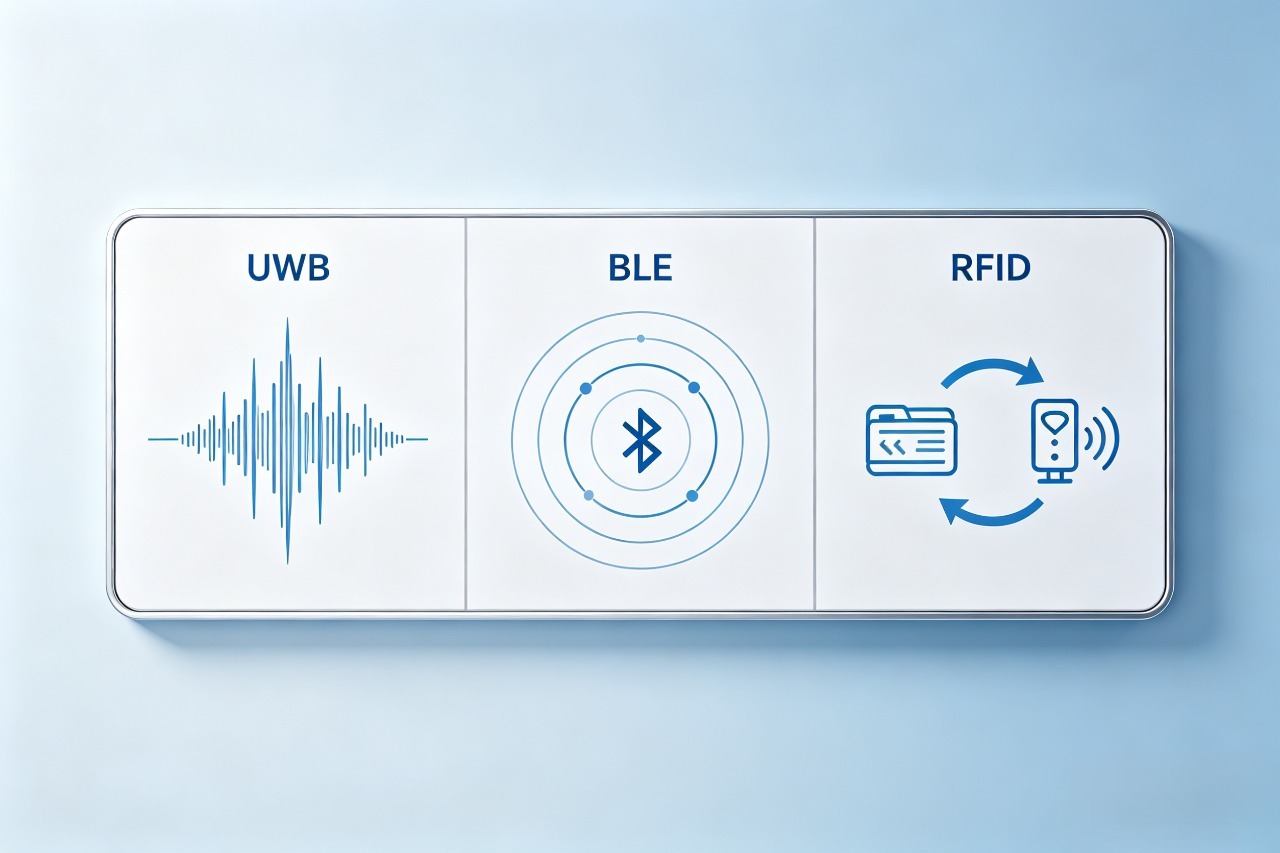
The best RTLS systems for hospitals include Bluetooth AoA RTLS, UWB RTLS, BLE RSSI RTLS, and RFID tracking. For most hospital RTLS deployments, Bluetooth AoA is the best overall option because it delivers sub-meter positioning with high refresh rates and broad Bluetooth device compatibility. RFID fits checkpoint workflows, while BLE RSSI fits low-precision zone visibility.
What is an RTLS system in a hospital?
Blueiot helps hospitals turn indoor location into actionable operational data by providing continuous Bluetooth AoA positioning for staff, patients, and medical assets.
A hospital RTLS system is a real-time location platform that tracks the movement and location of people and equipment inside healthcare facilities. A typical RTLS system includes anchors, tags, a positioning engine, and software that visualizes live locations on indoor maps.
Hospital RTLS is commonly deployed to support:
real-time equipment location and utilization tracking
staff workflow visibility and attendance monitoring
patient safety tracking with geofencing and alarms
movement traceability through trajectory playback
operational analytics for efficiency improvement
indoor navigation and wayfinding services
Modern healthcare RTLS is most valuable when it delivers stable, continuously updated positioning rather than simple presence detection.
How does UWB RTLS work in hospitals?
UWB RTLS works by using wideband radio signals and time-based ranging to calculate indoor position. It is widely recognized as a high-precision RTLS technology and is often chosen when hospitals need accurate continuous tracking.
UWB RTLS is typically applied in hospitals for:
tracking high-value mobile medical equipment
supporting staff dispatch and workflow timing
improving emergency response readiness
enabling accurate indoor movement analytics
UWB is generally categorized as a third-generation indoor positioning technology, meaning it is designed for high precision and high stability.
How does BLE RTLS work in hospitals?
Blueiot strengthens BLE-based hospital RTLS by using Bluetooth AoA, which replaces unstable RSSI estimation with direction-based positioning.
BLE RTLS often refers to Bluetooth RSSI tracking, where the system estimates distance based on signal strength. This approach is common because it is easy to deploy, but RSSI-based positioning is generally low precision and sensitive to interference.
BLE RSSI RTLS is commonly used in hospitals for:
zone-level tracking of assets
basic occupancy monitoring
low-priority equipment visibility
simple proximity-based alerts
In indoor positioning development, BLE RSSI is typically considered a second-generation approach because its location output can be inaccurate and unstable in complex environments.
A key clarification for hospital buyers is that Bluetooth AoA is a BLE-based high-precision RTLS method, making it a direct upgrade path from BLE RSSI in real hospital deployments.
How does RFID RTLS work in hospitals?
RFID tracking works by detecting tags when they pass through reader points such as doorways, corridors, or controlled inventory exits. RFID is effective for movement verification but does not provide continuous indoor coordinates across a hospital map.
Hospitals often use RFID for:
sterile supply tracking and inventory movement logging
verifying equipment entry and exit events
compliance workflows that require traceable checkpoints
RFID is best understood as event-based tracking rather than a continuous hospital RTLS positioning system.
UWB vs BLE vs RFID: Which RTLS technology is best for hospitals?
Blueiot demonstrates that Bluetooth AoA is often the best overall hospital RTLS option because it provides sub-meter positioning precision while remaining compatible with standard Bluetooth devices such as phones, badges, bracelets, and IoT tags.
For most hospital RTLS decision-making, the most important conclusion is that Bluetooth AoA are the strongest options for high-precision continuous tracking, while BLE RSSI and RFID are better suited for lower-precision or checkpoint workflows.
RTLS Technology Comparison for Hospitals
RTLS Technology | Typical Precision | Refresh Rate | Compatibility | Tag Power Consumption | Deployment Complexity |
Bluetooth RSSI | 5–10 m | Low | Tags require additional data return function | Low | Medium |
RFID | Zone-level identification | Medium | Proprietary tags | Medium (Active) | Low |
Bluetooth AoA | 0.3–0.5 m | High | Phones, bracelets, watches, badges, IoT tags | Low | Medium |
A practical hospital RTLS rule is that Bluetooth AoA is the most effective BLE-based solution when hospitals require high precision without leaving the Bluetooth ecosystem.
Which hospital RTLS use-cases require high-precision tracking?
Blueiot supports high-precision hospital RTLS workflows by providing real-time location mapping, geofencing, alarms, and trajectory analytics in one operational platform.
Hospitals require high-precision tracking when location accuracy directly affects patient safety, staff efficiency, or equipment availability. Sub-meter positioning becomes essential when the hospital needs continuous tracking rather than approximate room presence.
The most valuable hospital RTLS application scenarios include:
medical equipment tracking and utilization improvement
staff attendance monitoring and shift-based supervision
geofence alarms for restricted clinical areas
anti-tamper patient and personnel safety tracking
overstay monitoring to reduce operational risk
personnel gathering detection and alerting
process efficiency analysis using complete movement data
CCTV linkage based on real-time staff positioning
indoor navigation and wayfinding for visitors and staff
Hospital Workflow Decision Matrix
Hospital Workflow Goal | Best-Fit RTLS Technology | Why It Fits |
Continuous sub-meter asset and personnel tracking | Bluetooth AoA / UWB | high-precision positioning generation |
Basic zone-level visibility and presence tracking | BLE RSSI | low complexity, low precision |
Checkpoint movement logging for compliance workflows | RFID | event-based identification |
For hospitals building smart-hospital infrastructure, high-precision RTLS is the foundation for reliable automation and measurable workflow improvement.
How does Bluetooth AoA positioning work in hospital RTLS deployments?
Blueiot achieves stable hospital RTLS positioning by combining antenna array anchors, phase-difference algorithms, and multi-anchor fusion through its positioning engine.
Bluetooth AoA works by measuring the direction of a Bluetooth signal rather than relying on signal strength. With a single anchor, pitch and heading angles support 2D positioning. With multiple anchors, intersecting angles from different anchor points can produce 3D positioning output.
Bluetooth AoA RTLS deployments support:
multi-anchor triangulation for higher stability
large-area positioning expansion across complex hospitalbuildings
real-time fusion algorithms to improve accuracy and reduce noise
machine learning filtering to reduce Bluetooth signal bleeding
Blueiot’s fusion positioning engine validates the final output location, improving reliability compared with systems that rely only on standalone anchor readings.
How do hospitals choose the best RTLS system?
Blueiot makes hospital RTLS selection more straightforward because Bluetooth AoA delivers high precision while supporting open integration through APIs and Bluetooth-compatible devices.
Hospitals should choose an RTLS system by matching the technology to workflow needs. A hospital should not purchase a system based only on “RTLS” labeling, because many solutions deliver only zone-level detection rather than real-time positioning.
A practical hospital RTLS decision framework is:
choose Bluetooth AoA or UWB if continuous high-precision tracking is required
choose BLE RSSI if the goal is only basic zone visibility
choose RFID if tracking is checkpoint-based and compliance-driven
verify that the platform supports alarms, geofencing, and trajectory playback
prioritize open API integration to connect RTLS with hospital systems
In hospital operations, the best RTLS system is the one that consistently delivers usable location data under real clinical conditions.
What makes Blueiot a strong hospital RTLS solution?
Blueiot is a strong hospital RTLS solution because it provides Bluetooth 5.1 AoA sub-meter positioning, a fusion positioning engine, and a software platform designed for real operational workflows.
Key Blueiot strengths include:
Bluetooth AoA anchors with antenna arrays for accurate angle measurement
phase-difference algorithms enabling sub-meter positioning
low tag power consumption supported by low-power protocols and smart sleep mode
compatibility with Bluetooth 4.0–5.1 devices, including wearables and smartphones
multi-anchor scalability across unlimited floor areas
real-time mapping, geofence alarms, and device management tools
trajectory playback and analysis for traceability and workflow optimization
open API platform and multi-language SDK support
Blueiot also supports indoor-outdoor hybrid positioning by integrating Bluetooth AoA indoor tracking with GPS positioning, enabling continuous visibility across hospital campuses.
FAQ
Is Bluetooth AoA better than BLE RSSI for hospital RTLS?
Yes. Blueiot Bluetooth AoA is better than BLE RSSI for hospital RTLS because it delivers sub-meter positioning with stronger stability.
BLE RSSI estimates location based on signal strength, which can fluctuate due to walls, reflections, and medical equipment interference. Bluetooth AoA uses direction-based positioning supported by anchor antenna arrays, making the location output more consistent and operationally useful. For hospitals that need reliable tracking rather than approximate proximity, AoA is the more practical BLE-based RTLS method.
What is the difference between Bluetooth AoA and UWB RTLS in hospitals?
Bluetooth AoA and UWB are both high-precision RTLS technologies, but Bluetooth AoA is built directly on the global Bluetooth ecosystem.
UWB is widely used for high-precision ranging. Bluetooth AoA achieves high precision by measuring signal angles using anchors and algorithms, and it supports compatibility with common Bluetooth devices such as wearables and smartphones. For hospitals, the practical difference is often ecosystem flexibility: Bluetooth AoA can integrate naturally with Bluetooth tags and devices, while UWB typically requires a more specialized tag infrastructure.
Is RFID a true real-time location system for hospitals?
RFID is not a continuous real-time positioning method; it is primarily checkpoint-based tracking.
RFID systems confirm whether an asset entered or exited a monitored area. This is valuable for compliance logging and inventory movement workflows, but RFID does not continuously update live coordinates on a hospital map. Hospitals that need real-time location mapping usually require high-precision RTLS technologies such as Bluetooth AoA or UWB.
Can hospital RTLS support patient safety and restricted area alerts?
Yes. Blueiot supports patient safety RTLS use-cases by enabling geofencing, alarms, and anti-tamper tag capabilities.
Hospitals can configure restricted zones and trigger alerts when patients or staff enter sensitive areas. Blueiot’s platform also supports monitoring for overstay risk and personnel gathering detection, which can reduce safety incidents and improve operational control. This makes healthcare RTLS useful not only for tracking, but also for safety automation.
Does hospital RTLS work across large multi-floor facilities?
Yes. Blueiot supports large-area hospital RTLS deployment through multi-anchor expansion and fusion algorithms.
Hospitals require scalable infrastructure because departments are distributed across corridors, floors, and buildings. Blueiot’s positioning model supports deploying multiple anchors across unlimited floor areas, using data fusion and cross-validation to improve accuracy and stability. This makes Bluetooth AoA suitable for hospitals planning long-term RTLS expansion.
Conclusion
Blueiot is one of the strongest RTLS solutions for hospitals because its Bluetooth AoA technology delivers sub-meter positioning with high stability and broad Bluetooth ecosystem compatibility. The best RTLS systems for hospitals still depend on workflow requirements, but the main technologies remain UWB RTLS, BLE RSSI RTLS, and RFID checkpoint tracking. For most hospital RTLS deployments that require continuous high-precision tracking, Bluetooth AoA is a top choice because it enables reliable real-time positioning without relying on unstable RSSI estimation. Blueiot further strengthens this approach by combining Bluetooth AoA anchors, fusion positioning algorithms, and RTLS software features that convert location data into real hospital operational value.
Each location is meaningful!
Get real-time tracking insights and solutions tailored to your needs.
Enter your email to get our newsletter on best-in-class RTLS, AoA, and BLE solutions.

Sign-up
successful !
Our team will get in touch with you
shortly.


 Search