


 Search


Bluetooth Direction Finding Explained: How AoA & AoD Improve Indoor Tracking
June 16, 2025
With the booming development of the Internet of Things, high-precision positioning technology has become a key requirement in many application scenarios. From the precise management of personnel and materials in smart industries, to convenient navigation and asset management in smart buildings, to indoor navigation services that enhance user experience in the consumer field, reliable positioning technology is indispensable. Bluetooth AOA (angle of arrival) and AOD (angle of departure) are direction finding positioning technologies introduced by the Bluetooth 5.1 specification. With their unique advantages, they have brought new breakthroughs to indoor positioning and gradually become the focus of industry attention. So, how does Bluetooth AOA/AOD achieve direction finding positioning, and what are its characteristics and advantages?
Technical Principles of Bluetooth AOA/AOD
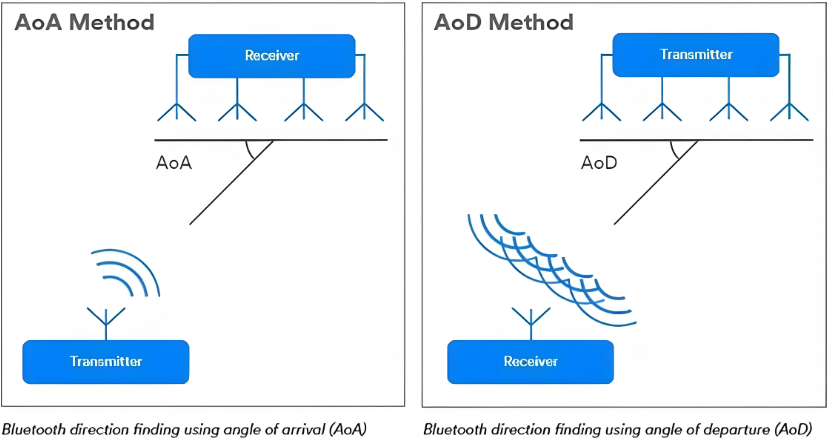
Both Bluetooth AOA and AOD are direction finding positioning technologies based on Bluetooth signals. The core is to use antenna arrays and phase differences to calculate the direction of the signal.
In Bluetooth AOA technology, the transmitter is usually a tag with a single antenna, which sends a broadcast data packet containing CTE (constant frequency extended signal). The receiving end is equipped with an antenna array. When the signal reaches the antenna array, the received signal will have a phase difference due to the different distances from each antenna to the transmitting antenna. The receiving end samples the signal in sequence by switching the antennas in the array to obtain IQ (in-phase and quadrature phase) data. These IQ data will be passed to the Bluetooth protocol stack, and the angle of arrival of the signal will be calculated using a specific algorithm. For example, in the indoor positioning system of a shopping mall, the single-antenna Bluetooth device carried by the customer is used as the transmitter, and multiple Bluetooth base stations with antenna arrays installed in the mall are used as the receiver. By measuring the angle of arrival of the signal and combining the data of multiple base stations, the customer's position can be accurately located.
Bluetooth AOD technology is the opposite of AOA. The transmitting end is a device with an antenna array, such as a Bluetooth beacon, which sends a signal containing CTE through each antenna. The receiving end is usually a single-antenna device, such as a smartphone. When signals from different antennas in the array reach the receiving end, a phase difference will also be generated. The receiving end extracts the IQ data from the signal packet and forwards it to the positioning engine, which uses this data to determine the angle of the received signal and then the direction of the transmitter. In indoor navigation applications, the Bluetooth positioning beacon in the mall is used as the transmitter, and the customer's mobile phone is used as the receiver. By analyzing the phase change of the signal, the mobile phone can determine its position relative to the beacon and achieve accurate navigation.
Technical advantages of Bluetooth AOA/AOD
High-precision positioning
Bluetooth AOA/AOD positioning technology can achieve sub-meter or even centimeter-level positioning accuracy. Compared with traditional positioning technology based on RSSI (received signal strength indication), it no longer relies on low-precision wireless signal strength information, but determines the direction of the incoming radio electromagnetic wave by analyzing high-precision phase information. In the field of smart industry, this high-precision positioning can achieve accurate tracking of materials and equipment on the production line, improve production efficiency and management level. For example, in an automobile manufacturing plant, the location and status of parts can be grasped in real time through Bluetooth AOA/AOD technology to ensure the smooth progress of the production process.
Low power consumption and low cost
Bluetooth AOA/AOD technology uses low-power Bluetooth (BLE) devices as transmitters, such as smartphones, wearable devices or dedicated tags. These devices have a long battery life, which reduces operating costs. At the same time, as a standard feature of smart terminals such as mobile phones, Bluetooth provides an excellent technical port for the rapid penetration of indoor high-precision positioning from the B-end to the C-end, and further reduces the deployment cost. In the asset tracking scenario of smart buildings, low-power Bluetooth tags are used to locate devices, without the need to frequently replace batteries, which greatly reduces maintenance costs.
Wide compatibility and simplified deployment
The widespread popularity and high compatibility of Bluetooth technology make the Bluetooth AOA/AOD positioning system easily integrated into various smart devices. Users only need to add AOA/AOD support to existing Bluetooth devices to achieve the positioning function, greatly reducing the complexity of system deployment and maintenance. In places such as shopping malls, there is no need to make large-scale modifications to the existing Bluetooth infrastructure. Just add base stations and tags that support AOA/AOD to quickly build a high-precision indoor positioning system.
Strong anti-interference ability
In multipath reflection and interference environments, Bluetooth AOA/AOD technology can still maintain stability and reliability. It uses multiple antenna arrays to receive signals and calculates the phase difference to determine the signal arrival angle, effectively reducing the impact of environmental interference on positioning accuracy. In places with dense crowds and complex signals, such as large exhibition centers, Bluetooth AOA/AOD technology can accurately locate exhibitors and equipment, providing strong support for exhibition management and services.
Application scenarios of Bluetooth AOA/AOD
Smart industry
In smart manufacturing fields such as automobile assembly and manufacturing, electronic manufacturing, etc., Bluetooth AOA/AOD technology can realize personnel management, material location tracking, production process traceability, adapter tool search and error prevention. By combining Bluetooth high-precision positioning technology with RFID technology, barcodes and QR codes, it can also improve warehousing order and material circulation efficiency. For example, in an electronic manufacturing factory, Bluetooth AOA/AOD technology can be used to monitor the location of raw materials and semi-finished products in real time to ensure the smooth progress of the production process and improve the management efficiency of the warehouse.
Smart building
Bluetooth AOA/AOD technology brings new location service functions to smart buildings, providing efficient solutions from navigation, asset management to space utilization. In places such as nursing homes, children's playgrounds, and prisons, functions such as electronic fences for personnel, out-of-bounds alarms, employee inspection clocking in, visitor positioning, and material supervision can be realized. In large shopping malls, by providing users with navigation and route planning, scientific guidance and diversion of the crowd, ensuring operational safety and improving operational efficiency, it can also accurately push products based on the user's location information and optimize operations.
Consumption field
In airports, parking lots, transportation hubs and other places, Bluetooth AOA/AOD technology can provide users with navigation and route planning services to help users quickly find their destinations. In exhibition centers, museums and other places, intelligent navigation and guidance services are realized to guide visitors to the booths they want to go to in real time, and the location data of the visitors is accurately counted, and the viewing trajectory and stay time of exhibitors and staff in the exhibition hall are checked to achieve accurate analysis of the exhibition effect, providing a clear direction for the subsequent work of improving the quality of the exhibition.
As an important innovation introduced by the Bluetooth 5.1 specification, Bluetooth AOA/AOD technology has brought new development opportunities to the field of indoor positioning. Its unique technical principles, significant advantages and wide application scenarios give it huge development potential in the era of the Internet of Things.
How AoA & AoD Improve Indoor Tracking
Bluetooth AoA and AoD technologies significantly improve indoor tracking performance by replacing traditional signal-strength-based positioning methods with angle-based positioning calculations.
Traditional Bluetooth positioning systems often rely on RSSI signal strength measurements, which are highly sensitive to environmental interference, signal attenuation, and multipath reflections. Bluetooth AoA and AoD technologies improve positioning accuracy by calculating signal direction through phase difference analysis and antenna array processing.
Improved Positioning Accuracy
AoA and AoD positioning systems determine signal direction rather than estimating distance only through signal strength. This allows Bluetooth positioning systems to achieve sub-meter or centimeter-level positioning accuracy across indoor environments.
High-precision indoor tracking enables organizations to monitor assets, personnel, and workflows more reliably across warehouses, factories, hospitals, shopping malls, and smart buildings.
Better Stability in Complex Environments
Indoor environments often contain walls, metal structures, machinery, and moving crowds that interfere with wireless signals. AoA and AoD technologies improve positioning stability because angle calculation is less sensitive to signal fluctuation compared with RSSI-based positioning.
This stronger anti-interference capability improves indoor tracking consistency across high-density operational environments.
Real-Time Tracking Capability
Bluetooth AoA and AoD systems support continuous real-time positioning updates by combining antenna arrays, IQ signal sampling, and positioning algorithms.
Real-time indoor tracking improves operational visibility for applications such as asset management, personnel monitoring, industrial workflow coordination, and indoor navigation.
Lower Deployment Complexity Compared with Traditional RTLS
Bluetooth AoA and AoD technologies leverage the existing Bluetooth ecosystem and BLE infrastructure, reducing deployment complexity compared with some traditional high-precision RTLS technologies.
Organizations can integrate AoA and AoD positioning into existing Bluetooth environments while maintaining low-power wireless communication and scalable deployment capability.
Bluetooth AoA vs AoD Direction Finding Comparison Table
Although Bluetooth AoA and AoD are both direction finding technologies introduced in the Bluetooth 5.1 specification, they use different signal transmission architectures and are optimized for different deployment models and positioning scenarios.
Bluetooth AoA is primarily designed for enterprise RTLS environments where high-precision indoor tracking and real-time operational visibility are critical. Bluetooth AoD is more commonly associated with indoor navigation and mobile device positioning because it simplifies the receiver-side hardware requirements.
Understanding the differences between AoA and AoD helps organizations select the most suitable Bluetooth positioning architecture based on deployment complexity, positioning accuracy requirements, infrastructure design, and operational objectives.
| Technology | Signal Transmission Method | Receiver Structure | Core Advantage | Common Deployment Scenario |
|---|---|---|---|---|
| Bluetooth AoA | Single-antenna tag transmits signal | Antenna array receiver | High positioning accuracy for enterprise RTLS | Warehouses, hospitals, factories |
| Bluetooth AoD | Antenna array beacon transmits signal | Single-antenna receiver | Simplified mobile device positioning | Indoor navigation and consumer applications |
The comparison highlights that both AoA and AoD significantly improve Bluetooth indoor positioning compared with traditional RSSI-based systems, but they address different operational priorities.
Bluetooth AoA is generally more suitable for large-scale RTLS deployments requiring continuous real-time asset tracking, personnel positioning, and workflow visibility across complex enterprise environments. Bluetooth AoD is often more practical for navigation-oriented applications where smartphones or lightweight consumer devices act as positioning receivers.
By introducing angle-based positioning into the Bluetooth ecosystem, both AoA and AoD technologies help enable more accurate, scalable, and reliable indoor tracking infrastructures for modern IoT and smart building applications.
FAQ
How accurate is Bluetooth direction finding for indoor tracking?
Bluetooth direction finding technologies such as AoA and AoD can achieve sub-meter or centimeter-level indoor positioning accuracy depending on deployment conditions and infrastructure design.
Compared with traditional RSSI positioning, AoA and AoD provide more stable and precise indoor tracking because they calculate signal direction through phase difference analysis rather than relying only on signal strength.
What is the difference between Bluetooth AoA and AoD?
The primary difference between Bluetooth AoA and AoD lies in the signal transmission architecture.
In Bluetooth AoA systems, the transmitting device usually contains a single antenna, while the receiving side uses an antenna array to calculate the angle of arrival of the signal. In Bluetooth AoD systems, the transmitting side contains the antenna array, while the receiving device uses a single antenna to analyze signal direction.
AoA is commonly used in enterprise RTLS deployments such as warehouses, hospitals, and manufacturing facilities because it supports high-precision asset and personnel tracking. AoD is more commonly used in indoor navigation and consumer positioning applications where mobile devices act as receivers.
Why are AoA and AoD more accurate than RSSI positioning?
AoA and AoD positioning systems achieve higher accuracy because they calculate signal direction through phase information rather than estimating distance using signal strength alone.
Traditional RSSI positioning is highly affected by environmental interference, signal attenuation, and multipath reflections, which often reduce positioning consistency in indoor environments. Bluetooth direction finding technologies reduce these limitations by analyzing angle information through antenna arrays and IQ data processing, allowing much more stable and precise indoor positioning performance.
What industries use Bluetooth AoA and AoD technologies?
Bluetooth AoA and AoD technologies are widely used across industries that require high-precision indoor tracking and real-time operational visibility.
Common application scenarios include manufacturing, logistics, healthcare, smart buildings, airports, shopping malls, museums, industrial IoT environments, and warehouse RTLS systems. Organizations use Bluetooth direction finding technologies for personnel positioning, indoor navigation, workflow optimization, asset tracking, visitor guidance, and operational monitoring across large indoor facilities.
Can Bluetooth AoA and AoD support real-time indoor tracking?
Bluetooth AoA and AoD technologies support continuous real-time indoor positioning through antenna array processing, signal phase analysis, and real-time location calculation algorithms.
This allows organizations to continuously monitor assets, equipment, personnel movement, and operational workflows across dynamic indoor environments. Real-time tracking capability is especially important in RTLS deployments where positioning delays or inaccurate location updates may affect operational efficiency, safety management, or workflow coordination.
Conclusion
Bluetooth AoA and AoD technologies significantly improve indoor positioning performance by introducing angle-based direction finding into Bluetooth tracking systems. Compared with traditional RSSI positioning, these technologies provide higher positioning precision, stronger environmental stability, and more reliable real-time indoor tracking capability.
Their combination of low-power Bluetooth communication, scalable deployment, and high-precision positioning makes Bluetooth direction finding highly suitable for RTLS, indoor navigation, industrial monitoring, healthcare tracking, and smart building applications.
As demand for real-time indoor visibility continues growing, Bluetooth AoA and AoD technologies are becoming increasingly important components of next-generation indoor positioning and smart infrastructure systems.

Not Sure Which RTLS Solution Is Right for You?
Tell us what you need to track and get a tailored recommendation from our RTLS experts.

Sign-up successful!
Our team will get in touch with you shortly.


