In a park early in the morning, an elderly person wearing a smart bracelet goes for a run, his phone simultaneously recording his steps and heart rate. In an office building, an employee uses a Bluetooth headset to answer calls, untethered by cables. In an industrial park, sensors transmit real-time device status data to a monitoring center via Bluetooth Low Energy (BLE). Behind these scenes lies a smart living network woven by BLE technology, utilizing short-range wireless connections. However, a common question lingers in users' minds: How far can BLE transmit? The answer lies in the balance between the device's "volume," "hearing," and environmental interference.
Transmitting Power
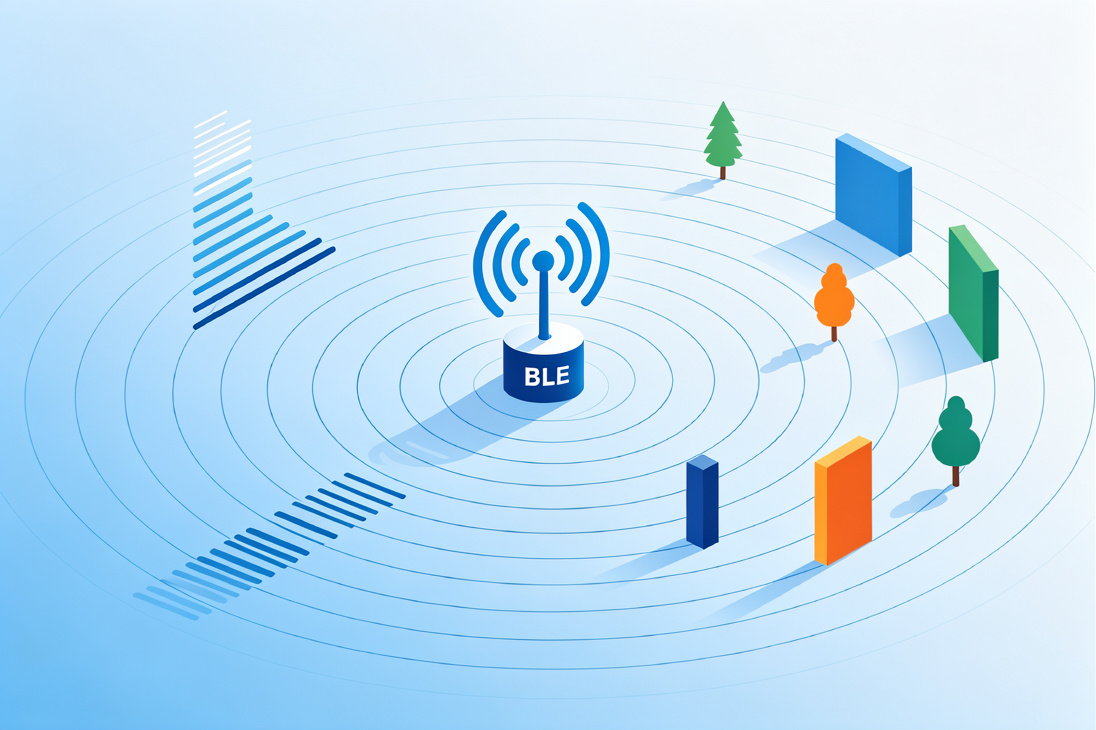
If BLE signals are like sound, then transmit power is the device's "volume." The louder the sound, the farther it travels, but it also consumes more power. BLE devices typically have several transmit power levels:
Low Power Mode (-20dBm to 0dBm): Similar to a whisper, with a transmission range of only about 10 meters. This is common in devices with small batteries, such as smart bracelets and headphones, sacrificing range in exchange for months or even years of battery life. For example, a certain brand of smart bracelet can operate continuously for 30 days in standard mode, but if it is set to maximum power transmission, the battery life is reduced to 3 days.
Medium power mode (4dBm to 8dBm): Equivalent to normal conversation, with a transmission range of 30-50 meters. Temperature and humidity sensors and smart light bulbs in smart homes often use this mode, providing coverage for a single room while maintaining battery life for months.
High power mode (10dBm to 20dBm): Like shouting, the theoretical range can exceed 100 meters, even reaching 300 meters in open air. Asset tracking tags in the industrial sector and soil monitoring equipment in agriculture often use high power mode to ensure signal penetration in complex environments such as farmland or warehouses.
The choice of transmit power is a trade-off between range and power consumption. For example, a logistics company used standard BLE tags to track goods, but metal shelving in the warehouse caused frequent signal loss. After switching to high-power tags, the transmission range increased to 150 meters, covering the entire warehouse, and the positioning error was reduced from 5 meters to 1 meter.
Receiver Sensitivity
Having loud volume alone isn't enough; a device also needs to be able to hear clearly. Receiver sensitivity reflects a device's ability to receive weak signals. The lower the value (e.g., -95dBm is more sensitive than -85dBm), the greater the distance the device can "hear."
High-sensitivity devices can detect extremely weak signals and maintain connections in complex environments, even at low transmit power.
Low-sensitivity devices have higher signal strength requirements and are prone to disconnection when transmit power is insufficient. Early BLE devices had low sensitivity, and in obstructed environments like offices, the actual range was often less than half of the nominal value.
Improving receive sensitivity relies on advances in chip technology. For example, the "Long Range Mode" (Coded PHY) introduced in the Bluetooth 5.0 standard reduces the data rate (from 1Mbps to 125kbps) in exchange for stronger interference immunity, improving receive sensitivity to -103dBm and extending the theoretical range from 100 meters to 400 meters.
Environmental Interference
Even if your device has a loud volume and excellent hearing, obstacles in the environment can still be invisible killers. Signals are reflected, scattered, and absorbed by obstacles during transmission, causing attenuation.
Open environments, such as outdoor playgrounds, offer virtually unobstructed signals, allowing high-power BLE devices to transmit over 300 meters. At a marathon, the organizing committee used high-power BLE beacons to cover a 42-kilometer course, allowing runners to receive real-time distance notifications on their phones.
Indoor environments: Walls and furniture can weaken the signal. In a typical office, the transmission range of a BLE device is typically reduced to 10-20 meters; if the walls are made of metal or concrete, the range can be further halved.
Special scenarios: Humid environments (such as bathrooms) accelerate signal attenuation, while areas with dense metal (such as elevators) can completely disrupt the signal.
Strategies for combating environmental interference include optimizing antenna design (such as using ceramic antennas to improve directivity), increasing deployment density (such as keeping indoor location beacons within 6-10 meters), or using mesh networking technology to extend coverage through relay nodes.
The "Elastic Boundary" of Distance
BLE's transmission range isn't a fixed value; it has an "elastic boundary" determined by transmit power, receive sensitivity, and the environment:
Consumer devices: Smartwatches, headphones, and other devices typically use low-power mode, with a range of approximately 10 meters, meeting daily usage requirements.
Smart home/industrial devices: Medium-power mode combined with high-sensitivity chips allows for ranges of up to 50-100 meters, covering homes or small factories.
Long-range applications: High-power devices combined with Bluetooth 5.0's long-range mode can reach over 1 kilometer in open environments. For example, an agricultural company uses BLE sensors to monitor temperature and humidity in farmland. The signal, after penetrating crops and simple sheds, can still communicate with the base station at a distance of 800 meters.
The extension of BLE's transmission range from 10 meters to 1 kilometer is not only an improvement in technical specifications, but also a precise response to user needs. Whether a smart bracelet remains connected to a phone during a morning run, industrial sensors transmit data reliably in a noisy workshop, or agricultural sensors transmit information across fields—behind these scenarios lies engineers' meticulous tuning of "volume," "hearing," and the environment.
BLE Transmission Range
BLE transmission range depends on the combined interaction of transmit power, receiver sensitivity, antenna design, and deployment environment. Unlike traditional wireless communication systems that rely on fixed coverage assumptions, BLE communication range changes dynamically depending on infrastructure configuration and environmental conditions.
Low-power consumer BLE devices such as smartwatches, wireless earbuds, and fitness trackers typically prioritize battery efficiency over long-distance communication. These devices are commonly optimized for short-range personal connectivity across homes, offices, and wearable environments.
Industrial and enterprise BLE deployments often use higher-power communication modes and high-sensitivity receivers to improve operational coverage across warehouses, hospitals, factories, agricultural environments, and smart buildings. Bluetooth 5.0 Long Range Mode further expanded BLE deployment capability by improving signal robustness and communication stability across large operational areas.
As BLE technologies continue evolving, communication range is increasingly determined by deployment strategy and infrastructure optimization rather than theoretical specification alone.
BLE Transmission Limits
Although BLE provides highly flexible wireless communication capability, it still has several operational limitations that affect real-world deployment performance.
One major limitation is environmental interference. BLE operates within the 2.4 GHz frequency band, which is heavily shared with Wi-Fi networks, industrial equipment, microwave ovens, and other wireless systems. In crowded wireless environments, communication stability may degrade due to signal congestion and interference.
Physical obstacles such as concrete walls, metal shelves, elevators, machinery, and dense building structures can also weaken BLE signals through absorption, reflection, and scattering. Industrial facilities and warehouses with large amounts of metal infrastructure are especially challenging for BLE communication systems.
BLE also prioritizes low-power operation rather than maximum throughput or ultra-low latency. Long-range communication modes often require lower transmission rates and increased communication redundancy to maintain stable connectivity across large environments.
These limitations mean that successful BLE deployment often depends heavily on infrastructure planning, beacon density, antenna optimization, and environmental adaptation strategies.
Real-World BLE Performance Factors: Stability, Coverage, Hardware, and Deployment Optimization
Real-world BLE performance depends on much more than theoretical communication range. Operational stability is influenced by deployment architecture, hardware quality, infrastructure density, environmental conditions, and communication configuration.
Receiver Sensitivity and Hardware Design
BLE performance is strongly affected by receiver sensitivity and antenna quality. Devices equipped with high-sensitivity receivers can maintain communication even when signal conditions become weak or unstable.
Modern Bluetooth chipsets combined with optimized antenna architectures significantly improve communication consistency across hospitals, factories, logistics centers, airports, and smart buildings.
Infrastructure Density and Deployment Layout
Beacon placement, gateway density, antenna orientation, and installation height all influence BLE communication stability.
Large indoor environments often require carefully engineered infrastructure layouts to minimize communication dead zones and maintain stable operational visibility across multiple rooms, floors, or industrial zones.
Environmental Complexity
Environmental conditions strongly influence BLE communication quality. Open outdoor environments typically provide more stable communication conditions, while indoor commercial and industrial facilities introduce signal attenuation, multipath reflection, and wireless congestion.
Factories, warehouses, hospitals, and transportation hubs often require additional infrastructure optimization to maintain stable BLE performance under dynamic operational conditions.
Latency, Throughput, and Power Consumption Tradeoffs
BLE systems are designed primarily for low-power wireless communication. Improving communication range and signal robustness often requires reducing throughput or increasing transmission redundancy.
Bluetooth 5.0 Long Range Mode improves environmental resilience and coverage capability by lowering transmission speed and increasing signal coding efficiency. This creates operational tradeoffs between coverage, latency, battery life, and communication responsiveness depending on deployment requirements.
Operational Stability in Enterprise Environments
In enterprise RTLS and IoT deployments, long-term communication reliability is usually more important than theoretical maximum range.
Organizations increasingly optimize BLE systems around infrastructure resilience, communication consistency, scalability, and environmental adaptability to support continuous operation across complex real-world environments.
BLE Typical Applications Across Industries
BLE performance depends on three key factors: transmit power, receiver sensitivity, and environmental interference.
Transmit power determines how strongly a device broadcasts its signal, receiver sensitivity affects how well it can detect weak signals, and environmental interference—such as walls, metal structures, and electronic devices—can weaken or block communication. By balancing these elements, BLE devices are designed to provide reliable wireless connectivity tailored to different scenarios, from personal wearables to large-scale industrial or public applications. Understanding these factors helps engineers optimize deployment for range, energy efficiency, and stability.
| Scenario | Applications / Notes |
|---|
| Manufacturing & Logistics | Asset tracking, equipment monitoring in factories or warehouses; reliable in metal-rich or obstacle-heavy environments |
| Healthcare | Patient tracking, smart bracelets, monitoring devices; maintains battery life while covering rooms or wards |
| Entertainment & Sports & Events | Real-time audience engagement, ticketing, tracking participants; suitable for indoor venues or open fields |
| Safety & Security | Personnel tracking, emergency alerts, access control; ensures reliable communication in complex environments |
| Navigation | Indoor navigation, wayfinding, and location-based services; supports large facilities and dense user traffic |
| Other Applications | Any scenario requiring short-range wireless communication, data collection, or tracking can leverage BLE technology |
BLE technology provides flexible wireless connectivity across multiple sectors. By selecting the appropriate device power, receiver sensitivity, and placement strategy, organizations can ensure stable communication, accurate tracking, and energy-efficient operation. This adaptability makes BLE suitable for everything from wearable devices in healthcare to asset monitoring in factories and navigation in public spaces.
Usage Examples in Real-World Scenarios
BLE is widely applied across industries to provide reliable wireless connectivity, tracking, and location-based services in a variety of environments.
Manufacturing & Logistics: BLE tags monitor inventory, equipment, or forklifts, ensuring smooth operation in warehouses and factories.
Healthcare: Smart bracelets and monitoring devices track patients and medical equipment across wards or rooms.
Entertainment & Sports & Events: BLE beacons enable audience engagement, participant tracking, and real-time notifications during events.
Safety & Security: Personnel tracking and asset tracking maintain reliable connectivity for emergency alerts and access control in offices, factories, or campuses.
Navigation: BLE guides visitors in hospitals, museums, parking lots, and transit hubs, helping locate rooms, exhibits, vehicles, or gates efficiently.
These examples demonstrate how BLE technology supports efficient, real-time monitoring and navigation across diverse sectors, from personal devices to large industrial and public environments.
FAQ
How far can a typical BLE smartwatch or headset transmit?
A typical consumer BLE device in low-power mode transmits up to around 10 meters.
This range is enough for daily scenarios like a smartwatch staying connected to a phone during a morning jog or a Bluetooth headset used in a single room. Low-power mode helps maximize battery life, allowing devices like smart bracelets to operate continuously for weeks. While the range is modest, it satisfies most indoor and personal usage needs without frequent charging, balancing convenience with energy efficiency. Signal stability may slightly vary depending on obstacles, but for short-range personal devices, BLE provides a reliable wireless connection.
Can BLE signals work in a metal-heavy warehouse?
Yes, but standard low-power BLE devices often struggle with metal obstacles.
Metal shelving and machinery cause signal reflection and attenuation, reducing effective range. Industrial applications often switch to high-power BLE tags to overcome interference. High-power tags can transmit reliably over 100–150 meters even in metal-dense environments, ensuring asset tracking systems maintain consistent connectivity. The higher output compensates for signal loss, reducing errors from 5 meters to as low as 1 meter. Strategic placement of receivers, combined with high sensitivity chips, further stabilizes data transmission in warehouses, preventing interruptions in real-time monitoring of goods and equipment.
What factors limit BLE transmission range indoors?
Indoor BLE range is limited by walls, furniture, and building materials.
Obstacles such as concrete, metal, or glass absorb or scatter signals, reducing effective coverage. Even medium- or high-power BLE devices may see their range cut in half compared to open-air conditions. Environmental factors like humidity, electronic interference, and reflective surfaces can further impact signal quality. Engineers mitigate these limitations using techniques like mesh networking, increased beacon density, or optimized antenna designs, ensuring devices communicate reliably. For smart homes, offices, and industrial sites, these adjustments allow BLE systems to maintain connectivity across multiple rooms or complex layouts despite physical obstructions.
Is it possible to extend BLE range over 500 meters?
Yes, BLE can exceed 500 meters using high-power transmission with Bluetooth 5.0 Long Range Mode.
This mode reduces data rate to improve signal robustness and interference immunity, allowing devices to communicate over open-air distances exceeding 1 kilometer. Such setups are ideal for outdoor monitoring, agriculture, or large industrial facilities, where long-range connectivity is needed without installing numerous intermediate nodes. Long-range BLE requires high-sensitivity receivers and optimized deployment to ensure stable communication across obstacles like trees, buildings, or sheds. While battery life may be shorter at high power, this approach enables real-time monitoring and control over vast areas previously limited to short-range wireless technologies.
Does increasing transmit power always improve BLE range?
No, range depends on a combination of transmit power, receiver sensitivity, and environment.
Boosting transmit power can extend distance, but signals may still be blocked by walls, metal, or interference. Higher power also drains batteries faster, which can be impractical for wearables and sensors. Long-range BLE uses a combination of moderate to high power, sensitive receivers, and features like coded PHY to maintain reliable connections without excessive energy consumption. Engineers must optimize all three factors to achieve stable communication. Simply maximizing power does not guarantee longer range; understanding environmental conditions and device sensitivity is equally critical for practical BLE deployment.
Conclusion
BLE transmission range is not defined by a single fixed number, but by the interaction of transmit power, receiver sensitivity, and environmental conditions. Different configurations allow BLE to adapt from short-range personal connectivity to wide-area industrial and outdoor deployments.
In practical use, achieving reliable performance depends less on theoretical maximum distance and more on how well devices are tuned to their environment. Whether in healthcare, manufacturing, public navigation, or large-scale events, BLE demonstrates strong flexibility by balancing energy consumption, coverage, and stability.
As Bluetooth technology continues to evolve, improvements in chip design and long-range communication modes will further expand its capabilities, making BLE an increasingly important foundation for connected devices and real-time location services across industries.
Each location is meaningful!
Get real-time tracking insights and solutions tailored to your needs.
Enter your email to get our newsletter on best-in-class RTLS, AoA, and BLE solutions.

Sign-up
successful !
Our team will get in touch with you
shortly.


 Search