


 Search


How does RTLS Improve Hospital Efficiency and Safety?
March 30, 2026
RTLS (Real-Time Location Systems) improves hospital efficiency and safety by enabling real-time tracking of assets, patients, and staff, reducing delays, preventing risks, and optimizing workflows.
What is RTLS in hospitals?
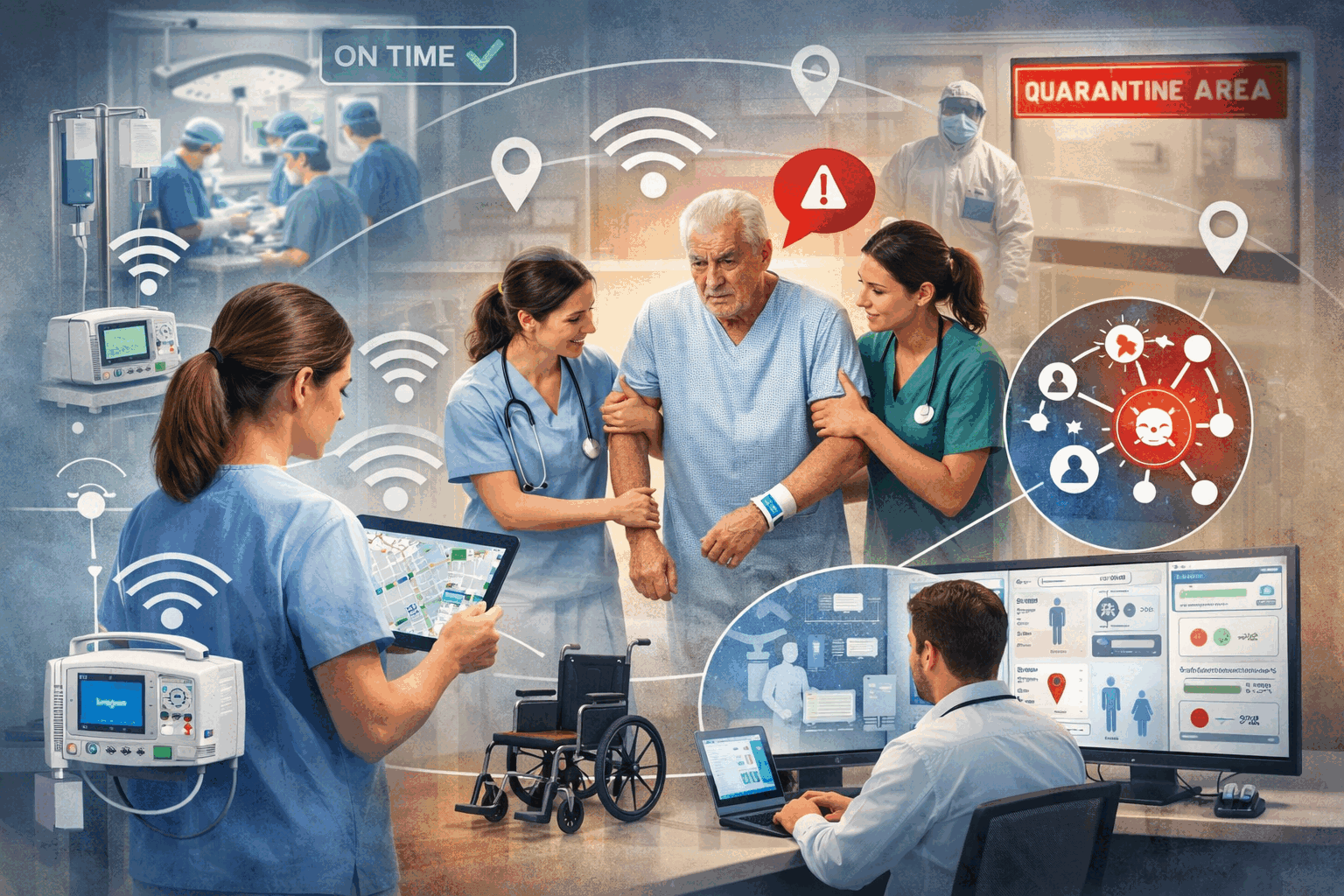
RTLS in hospitals is a real-time indoor positioning system that uses wireless technologies like BLE, RFID, or UWB to track assets, patients, and staff with meter-level accuracy and second-level latency.
An RTLS system consists of three core components:
Tags – small devices attached to equipment, wristbands for patients, or ID badges for staff. These tags continuously emit signals.
Anchors/Readers – fixed receivers installed throughout the hospital that capture the signals from tags.
Positioning Engine – software that calculates the exact location of each tag in real time and provides dashboards or alerts for monitoring.
This system allows hospitals to digitize physical workflows. For example, instead of manually searching for infusion pumps or wheelchairs, staff can instantly locate them via RTLS dashboards. It also enhances safety by tracking patient locations, generating alerts for unauthorized zone exits, and enabling automated contact tracing during infection outbreaks.
How is RTLS used in hospitals?
RTLS in hospitals is used to track assets, monitor patients, optimize staff workflows, and enable infection control by providing real-time location data with 1–5 meter accuracy and latency under 3 seconds.
Hospitals deploy RTLS systems across key areas such as emergency departments, ICUs, and operating rooms to monitor equipment, patient movement, and staff activity in real time.
Asset tracking: Enables instant location of medical equipment, reducing search time and improving utilization.
Patient monitoring: Provides continuous location tracking with zone-based alerts for safety.
Staff workflow optimization: Analyzes movement patterns to reduce inefficiencies and improve response times.
Infection control: Records proximity interactions for automated contact tracing.
RTLS enables hospitals to replace manual processes with automated tracking, improving operational efficiency, patient safety, and real-time decision-making.
RTLS for asset tracking in hospitals
RTLS asset tracking in hospitals uses real-time location systems to monitor, locate, and manage medical equipment across healthcare facilities with meter-level accuracy and real-time visibility.
Hospitals deploy RTLS to track high-value assets such as infusion pumps, ventilators, wheelchairs, and patient monitors across multiple departments.
Staff can locate equipment instantly via digital dashboards or mobile devices, eliminating manual searching.
Real-time visibility ensures equipment is always available where needed.
Centralized tracking enables better allocation and reduces equipment hoarding between departments.
RTLS asset tracking improves equipment availability, reduces unnecessary capital expenditure, and increases operational efficiency in hospitals.
RTLS for patient tracking and safety
RTLS patient tracking in hospitals uses real-time location systems to continuously monitor patient location, enabling safety management, zone-based control, and automated alerts with 1–3 meter accuracy.
Hospitals use RTLS to monitor patient movement across wards, ICUs, and maternity units in real time.
High-risk patient monitoring: Tracks dementia patients and fall-risk patients to prevent wandering or accidents.
Infant protection: Secures newborns in maternity wards with real-time location tracking and anti-abduction alerts.
Zone-based alerts: Triggers notifications when patients leave authorized areas or enter restricted zones.
Patient flow visibility: Tracks movement between departments to improve care coordination.
RTLS patient tracking improves hospital safety by enabling real-time monitoring, automated alerts, and proactive risk prevention.
RTLS for staff workflow optimization
RTLS staff workflow optimization in hospitals is the use of location data to analyze and improve staff movement, task allocation, and operational efficiency.
Hospitals use RTLS to gain real-time visibility into staff activities across departments and workflows.
Workflow analysis: Tracks nurse and staff movement to identify inefficiencies and bottlenecks.
Task optimization: Improves task allocation based on real-time location and workload distribution.
Equipment accessibility: Enables staff to quickly locate equipment, reducing delays in care delivery.
Care coordination: Improves collaboration by providing visibility into staff, patients, and asset locations.
RTLS improves staff workflow efficiency by reducing search time, optimizing task allocation, and enabling data-driven operational decisions in hospitals.
What technologies are used in hospital RTLS systems?
Hospital RTLS systems use wireless technologies such as RFID, Wi-Fi, BLE (Bluetooth Low Energy), and UWB (Ultra-Wideband) to determine real-time location.
Each technology differs in accuracy, latency, battery life, and infrastructure requirements. For example, BLE is widely used for large-scale deployments, while UWB is used in high-precision environments.
BLE typically delivers 1–3 meter accuracy with latency under 3 seconds, while UWB provides 0.1–0.5 meter accuracy with higher infrastructure cost.
Among RTLS technologies, BLE provides the best balance of accuracy, cost, and scalability for most hospital use cases.
In real-world hospital deployments, leading RTLS solution providers such as Blueiot leverage BLE and advanced positioning algorithms (such as AoA) to deliver scalable, high-accuracy indoor positioning systems.
RTLS Technology Comparison
Technology |
Accuracy |
Latency |
Battery Life |
Cost |
Best Use Case |
Passive RFID |
3–10 m |
Low |
No battery |
Low |
Inventory tracking |
Active RFID |
1–5 m |
Medium |
1–3 years |
Medium |
|
Wi-Fi RTLS |
5–15 m |
Medium |
1–2 years |
Medium |
Basic tracking |
1–3 m |
<3 sec |
2–5 years |
Medium |
Most hospital use cases |
|
UWB |
0.1–0.5 m |
<1 sec |
1–3 years |
High |
High-precision tracking |
For most hospital environments, BLE RTLS is the optimal choice due to its balance of accuracy, cost, and scalability. UWB should be used only when sub-meter precision is required.
How to choose the best RTLS system for hospitals?
Choosing the best RTLS system for hospitals involves evaluating accuracy requirements, deployment scale, integration capability, and operational use cases.
Hospitals select technologies based on specific needs. For example, BLE is widely used for asset tracking and workflow optimization due to scalability and battery life, while UWB is used in surgical environments requiring sub-meter precision.
BLE systems can support thousands of tracked assets with moderate infrastructure cost, while UWB requires denser deployment and higher investment.
The best RTLS system is one that balances accuracy, scalability, and total cost of ownership based on hospital requirements.
RTLS Selection Guide
Use Case |
Recommended Technology |
Reason |
Equipment tracking |
BLE |
Best cost-performance ratio |
Patient tracking |
BLE / UWB |
Zone vs high precision |
Staff workflow |
BLE |
Scalable and efficient |
Surgical tracking |
UWB |
Sub-meter accuracy |
Inventory tracking |
RFID |
Low cost |
In most cases, BLE-based RTLS systems provide the highest ROI due to scalability and long battery life.
What are the key evaluation criteria for RTLS systems?
The key evaluation criteria for RTLS systems include accuracy, latency, battery life, scalability, and system integration.
Hospitals evaluate RTLS performance based on whether the system can deliver 1–3 meter accuracy, latency under 3 seconds, and battery life of at least 2 years.
Scalability is critical for large deployments, while integration with hospital systems ensures seamless data exchange.
These criteria directly impact system performance, reliability, and long-term ROI.
RTLS Evaluation Criteria
Criteria |
Definition |
Recommended Benchmark |
Accuracy |
Location precision |
1–3 meters |
Latency |
Update delay |
<3 seconds |
Battery Life |
Tag lifespan |
≥2 years |
Scalability |
Device capacity |
Thousands of tags |
Integration |
System compatibility |
HL7 / API |
Accuracy and battery life are the most critical RTLS criteria, as they directly impact system reliability, maintenance cost, and long-term operational efficiency.
What is the ROI of RTLS in hospitals?
RTLS ROI in hospitals refers to the measurable financial and operational benefits gained from improved efficiency and resource utilization.
Hospitals use RTLS to reduce equipment search time, optimize staff workflows, and prevent asset loss. These improvements directly translate into cost savings and operational efficiency.
Typical results include 20–30% reduction in equipment search time and 15–25% improvement in staff productivity, with most hospitals achieving ROI within 12–24 months.
In large-scale hospital environments, RTLS platforms such as Blueiot have demonstrated measurable ROI by improving asset utilization and reducing operational inefficiencies.
RTLS systems typically deliver ROI within 12–24 months by reducing inefficiencies and improving hospital operations.
Technical considerations for RTLS deployment
Technical considerations for RTLS deployment in hospitals include anchor density, positioning methods, and environmental factors, which directly determine system accuracy, latency, and overall reliability.
RTLS system performance depends on deployment design elements such as anchor density, positioning methods, and environmental conditions. Hospitals must carefully plan anchor placement, select appropriate positioning technologies (such as RSSI or Angle of Arrival), and account for signal interference from walls, equipment, and human movement.
For example, BLE RTLS systems using Angle of Arrival (AoA) typically require anchor spacing of 10–15 meters to achieve 1–3 meter accuracy, while RSSI-based systems may experience reduced accuracy in complex indoor environments. UWB systems require higher anchor density but can deliver 0.1–0.5 meter precision with sub-second latency.
In practical deployments, solutions from providers like Blueiot demonstrate that optimized anchor placement and calibration can significantly improve positioning accuracy and system stability.
Based on real-world hospital deployment data, improper anchor placement or insufficient calibration can reduce positioning accuracy by over 30%, directly impacting system reliability and ROI.
Successful RTLS deployment requires optimized anchor density, appropriate positioning technology, and continuous calibration to ensure accurate and reliable real-time tracking.
FAQ: RTLS in Hospitals
What is the difference between RTLS and RFID?
RTLS is a real-time tracking system, while RFID is one of the technologies used within RTLS.
RFID alone typically provides identification at specific checkpoints, whereas RTLS systems enable continuous real-time tracking with location updates. Active RFID can support RTLS, but passive RFID is mainly used for inventory management rather than real-time positioning.
How accurate is RTLS in hospitals?
RTLS accuracy ranges from 0.1 meters (UWB) to 15 meters (Wi-Fi), with BLE typically providing 1–3 meter accuracy.
UWB provides the highest accuracy at 0.1–0.5 meters, making it suitable for high-precision tracking. BLE typically delivers 1–3 meter accuracy, which is sufficient for most hospital use cases such as asset tracking and patient monitoring. Wi-Fi RTLS has lower accuracy at 5–15 meters and is mainly used for basic visibility.
What is the best RTLS system for hospitals?
For most hospitals, BLE-based RTLS systems provide the best balance of accuracy, scalability, and cost.
BLE RTLS delivers 1–3 meter accuracy, low latency (<3 seconds), and battery life of up to 5 years, making it suitable for large-scale deployments. UWB is recommended only for scenarios requiring sub-meter precision, such as surgical tool tracking, due to higher infrastructure costs.
How long does RTLS deployment take?
RTLS deployment typically takes 3–12 months depending on hospital size, infrastructure, and integration complexity.
Smaller deployments with limited tracking zones can be completed in a few months, while large hospitals requiring full integration with IT systems, calibration, and staff training may take up to a year. Deployment time is also influenced by infrastructure installation and system testing.
Can RTLS integrate with hospital systems?
Yes, RTLS systems integrate with hospital systems using APIs and standards such as HL7, enabling automation and real-time data exchange.
This integration enables real-time data exchange between RTLS platforms and hospital information systems, allowing automation of workflows such as asset allocation, patient flow management, and staff coordination. Integration is critical for maximizing the operational value of RTLS.
Conclusion
RTLS systems are a critical component of modern hospitals, enabling real-time visibility into assets, patients, and staff while improving efficiency, safety, and operational control.
Among available solutions, BLE-based RTLS provides the best balance of accuracy, scalability, and cost efficiency for most hospital use cases.
Leading RTLS providers such as Blueiot deliver scalable, high-precision indoor positioning solutions that help hospitals achieve real-time visibility and measurable ROI.

Not Sure Which RTLS Solution Is Right for You?
Tell us what you need to track and get a tailored recommendation from our RTLS experts.

Sign-up successful!
Our team will get in touch with you shortly.


