Since its inception, Bluetooth technology, as a core standard for short-range wireless communications, has permeated every aspect of consumer electronics, industrial control, healthcare, and other fields. From wireless earbuds in smartphones to sensor networks in smart homes, Bluetooth's frequency design directly determines its anti-interference capabilities, transmission efficiency, and device compatibility.
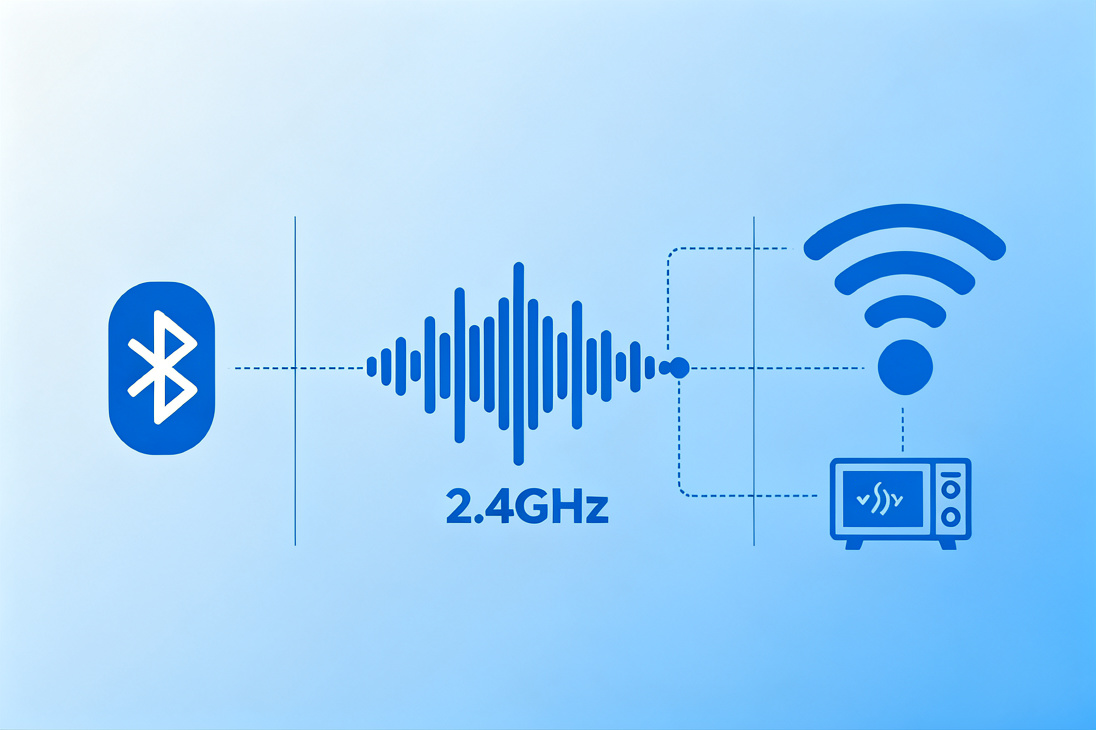
Globally Harmonized 2.4GHz ISM Band
Bluetooth technology operates in the globally unlicensed ISM (Industrial, Scientific, and Medical) band of 2.400 GHz to 2.4835 GHz, covering 83.5MHz of bandwidth. While this band does not require a license, it is subject to national regulatory requirements. For example, Japan restricts the use of the 2.402-2.473 GHz band, and countries like France have additional transmission power restrictions. Bluetooth divides the frequency band into multiple channels, enabling concurrent communication among multiple devices.
Classic Bluetooth (BR/EDR)'s 79 1MHz Channels
Classic Bluetooth uses frequency-hopping spread spectrum (FHSS) technology, dividing the 2.4GHz band into 79 1MHz-wide channels. The center frequency is calculated as:
f = 2.402 GHz + k × 1 MHz (k = 0, 1, ..., 78).
The device hops 1600 times per second (i.e., switches channels every 625 microseconds), dynamically adjusting the channel sequence to avoid interference. For example, if Wi-Fi channel 6 (2.437 GHz) is detected to be occupied, the Bluetooth master updates the frequency hopping map using the LMP_set_AFH message, disabling the affected channel.
Bluetooth Low Energy (BLE)'s 40 2MHz Channels
To optimize energy efficiency for IoT devices, BLE uses wider 2MHz channels, for a total of 40 channels:
Three advertising channels (37/38/39): with center frequencies of 2.402 GHz, 2.426 GHz, and 2.480 GHz, respectively. These channels intentionally avoid Wi-Fi's commonly used channels 1 (2.412 GHz), 6 (2.437 GHz), and 11 (2.462 GHz) to reduce conflicts during the advertising phase.
37 data channels: These are used for data transmission after connection. They use a pseudo-random frequency hopping algorithm (such as CRC16) to select the next channel, avoiding long-term channel occupancy with Classic Bluetooth or other BLE devices.
Frequency Conflict and Coexistence Strategies
The 2.4GHz band is a crowded area for wireless technologies. In addition to Bluetooth, Wi-Fi, ZigBee, cordless phones, and even microwave ovens operate in this frequency band. Bluetooth achieves coexistence through the following technologies:
Dynamic Adaptation of Frequency Hopping Spread Spectrum (FHSS)
Classic Bluetooth's frequency hopping mechanism ensures extremely short channel occupancy (625 microseconds per hop). Even when overlapping with Wi-Fi channels, the probability of collision is only approximately 2% (1 in 79). For example, when a Bluetooth device coexists with a Wi-Fi router, AFH technology dynamically marks channels occupied by Wi-Fi as "disabled." The master device then instructs slave devices to skip these channels and prioritize uninterrupted frequency bands.
BLE Channel Selection Algorithm (CSA)
BLE 5.0 and above introduce an enhanced channel selection algorithm that analyzes historical channel quality data to prioritize channels with minimal interference for data transmission. For example, in a smart factory, hundreds of BLE sensors can use CSA to automatically avoid interfering frequency bands with industrial wireless devices, ensuring reliable data transmission.
Physical Isolation and Band Migration
5GHz Wi-Fi Migration: By switching Wi-Fi devices to the 5GHz band, contention in the 2.4GHz band can be completely eliminated. Antenna Design Optimization: Utilizing directional antennas or MIMO technology reduces signal overlap through spatial isolation. For example, Apple AirPods Max utilizes a customized antenna module that combines Bluetooth signal directionality with head tracking algorithms to reduce environmental interference.
The Future of Frequency Allocation
With the release of the Bluetooth 6.0 standard, frequency management has entered a new era of intelligence:
Channel Sounding
Bluetooth 6.0 introduces millimeter-level positioning technology, which accurately calculates the distance and angle between devices by analyzing channel response time differences. For example, in smart home scenarios, routers can use channel sounding to identify the physical location of Bluetooth devices and dynamically adjust transmit power to reduce interference.
AI-Driven Dynamic Spectrum Management
Qualcomm and other manufacturers are developing machine learning-based spectrum sensing algorithms that automatically optimize channel allocation strategies by analyzing 2.4GHz band occupancy in real time (such as Wi-Fi signal strength and Bluetooth frequency hopping patterns). For example, at a concert, AI systems can coordinate channel usage among thousands of Bluetooth headsets to avoid widespread disconnection.
From classic Bluetooth's 79-channel frequency hopping to BLE's intelligent channel selection, and then to Bluetooth 6.0's channel detection and AI integration, frequency management has always been at the core of Bluetooth technology's evolution. In the era of the Internet of Everything, Bluetooth has continuously optimized its frequency allocation strategy, not only achieving peaceful coexistence with technologies like Wi-Fi and ZigBee, but also driving the explosion of emerging scenarios such as smart wearables, the Industrial Internet of Things, and high-precision positioning.
Bluetooth Frequency Applications Across Industries
Bluetooth’s operation in the 2.4GHz ISM band enables it to support a wide range of applications across consumer, commercial, and industrial environments. Its channel structure, frequency hopping, and interference mitigation capabilities make it adaptable to different deployment needs.
| Scenario | Frequency Characteristics / Notes |
|---|
| Consumer Electronics | Stable short-range communication; optimized for coexistence with Wi-Fi in dense environments |
| Smart Home | BLE advertising channels reduce interference with common Wi-Fi channels; supports multiple connected devices |
| Manufacturing & Industrial IoT | Frequency hopping and CSA reduce interference in environments with heavy wireless congestion |
| Healthcare | Low power consumption and reliable communication in device-dense indoor environments |
| Public Spaces & Navigation | Dedicated advertising channels support stable broadcasting and positioning |
| Entertainment & Events | Adaptive frequency management minimizes interference in high-density usage scenarios |
| Wireless Coexistence Environments | Works alongside Wi-Fi, ZigBee, and other 2.4GHz systems using AFH and intelligent channel selection |
Bluetooth’s frequency structure and channel design enable it to maintain stable communication across a wide range of environments. By combining frequency hopping, adaptive channel selection, and coexistence mechanisms, Bluetooth can operate efficiently even in congested 2.4GHz spectrum conditions. This flexibility allows it to scale from simple consumer devices to complex industrial and public deployments while ensuring reliability and compatibility.
Typical Applications
Bluetooth technology is widely used across different industries due to its global compatibility and adaptive frequency management capabilities.
Consumer Electronics: Wireless earbuds, smartphones, and smartwatches rely on Bluetooth for stable short-range communication in daily use.
Smart Home: Devices such as smart locks, lighting systems, and sensors use BLE for reliable connectivity and low power operation.
Manufacturing & Industrial IoT: Bluetooth supports sensor networks, equipment monitoring, and asset tracking in complex industrial environments.
Healthcare: Wearable devices and patient tracking systems benefit from BLE’s low power consumption and stable indoor communication.
Public Spaces & Navigation: Airports, museums, retail stores, and parking systems use BLE beacons for positioning and navigation services.
Entertainment & Events: Wireless audio devices and large-scale headset deployments rely on Bluetooth for synchronized and stable connections.
Wireless Coexistence Environments: Offices, campuses, and smart cities use Bluetooth alongside Wi-Fi and other technologies without significant interference.
These applications highlight how Bluetooth leverages its 2.4GHz frequency design to deliver reliable, scalable, and interference-resilient communication across diverse environments, from personal devices to large-scale connected systems.
FAQ
What frequency does Bluetooth use?
Bluetooth operates in the 2.4 GHz ISM band globally.
Specifically, it uses the frequency range from 2.400 GHz to 2.4835 GHz, which is an unlicensed spectrum available in most countries. This allows Bluetooth devices to be deployed worldwide without requiring special regulatory approval. The band is divided into multiple channels, enabling devices to communicate efficiently while avoiding interference. Although regulations may vary slightly by region, the core frequency range remains consistent, making Bluetooth highly compatible across different markets and applications.
Why does Bluetooth use the 2.4GHz band instead of other frequencies?
Bluetooth uses the 2.4GHz band because it is globally available and license-free.
This frequency range provides a balance between coverage, data rate, and hardware cost, making it ideal for mass adoption. Lower frequencies would offer longer range but require larger antennas, while higher frequencies would suffer from reduced penetration and higher attenuation. The 2.4GHz band allows Bluetooth devices to remain compact, energy-efficient, and cost-effective, which is essential for applications like wearables, IoT devices, and consumer electronics.
How does Bluetooth avoid interference with Wi-Fi and other devices?
Bluetooth avoids interference through frequency hopping and adaptive channel selection.
Classic Bluetooth uses frequency-hopping spread spectrum (FHSS), rapidly switching channels to minimize collision probability. BLE enhances this with channel selection algorithms that prioritize cleaner channels based on interference conditions. Additionally, BLE advertising channels are strategically placed to avoid overlap with common Wi-Fi channels. These mechanisms allow Bluetooth devices to maintain stable connections even in crowded wireless environments such as offices, airports, and smart homes.
Is BLE less prone to interference than Classic Bluetooth?
Yes, BLE is generally more efficient in handling interference.
BLE uses fewer channels with wider bandwidth and applies intelligent channel selection algorithms, which allow it to dynamically avoid congested frequencies. It also separates advertising and data channels, improving reliability during device discovery and communication. Compared to Classic Bluetooth, BLE is better suited for modern IoT environments where multiple wireless technologies coexist, offering more stable performance in dense deployments.
Will future Bluetooth versions change frequency usage?
No, future Bluetooth versions will continue to use the 2.4GHz band but improve how it is managed.
Instead of changing the frequency band, advancements focus on smarter spectrum utilization, such as channel sounding and AI-driven dynamic spectrum management. These technologies enhance positioning accuracy, reduce interference, and optimize channel allocation in real time. As a result, Bluetooth will become more efficient and reliable without requiring new frequency allocations, ensuring backward compatibility and global usability.
Conclusion
Bluetooth’s use of the 2.4GHz ISM band provides a globally consistent foundation for wireless communication, enabling widespread adoption across consumer, industrial, and public applications. Its channel structure, frequency hopping mechanisms, and interference mitigation strategies allow it to operate reliably even in crowded spectrum environments.
As wireless ecosystems become increasingly complex, Bluetooth continues to evolve by improving how it utilizes the existing spectrum rather than changing it. Innovations such as intelligent channel selection, channel sounding, and AI-driven spectrum management enhance performance, stability, and scalability.
By combining global compatibility with adaptive frequency management, Bluetooth remains a critical technology for enabling seamless connectivity in the era of IoT, smart environments, and real-time communication systems.
Each location is meaningful!
Get real-time tracking insights and solutions tailored to your needs.
Enter your email to get our newsletter on best-in-class RTLS, AoA, and BLE solutions.

Sign-up
successful !
Our team will get in touch with you
shortly.


 Search