


 Search


What Is UWB Tracking and How It Works: Accuracy, Range & Use Cases
February 11, 2026
UWB tracking is a real-time indoor positioning technology that provides centimeter-level accuracy for tracking assets, equipment, and personnel.
It works by sending short pulses across a wide frequency spectrum, enabling precise location measurement and high resistance to multipath interference.
UWB is ideal for environments where small location errors can cause operational delays, safety risks, or workflow inefficiencies, outperforming traditional radio-based technologies.
This article explains what UWB tracking is, how it works, why it is so accurate, and where it makes the most sense to deploy uwb devices. It also helps you determine when UWB is the right choice—and when it may be unnecessary.
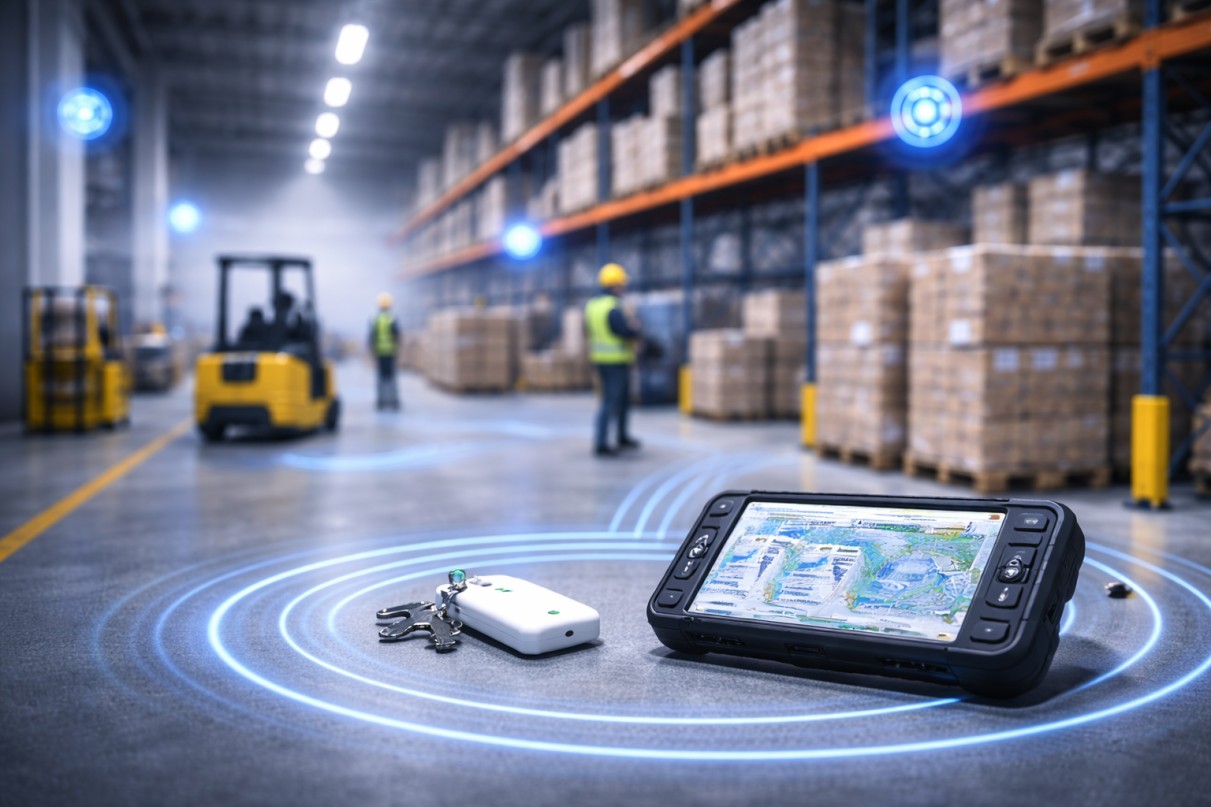
What is UWB tracking?
UWB tracking is a real-time indoor positioning technology that uses ultra-wideband radio signals to measure precise distances between devices, enabling centimeter-level location accuracy for people or assets where GPS cannot operate reliably.
It works by transmitting extremely short pulses across a wide frequency spectrum and calculating signal travel time with high precision.
This time-based measurement is what allows UWB systems to achieve significantly higher accuracy than narrowband radio technologies.
How UWB tracking works:
UWB tracking works by measuring the time it takes for ultra-wideband radio pulses to travel between a tag and multiple fixed anchors, then calculating the exact position based on those time differences.
Because UWB uses extremely short pulses and very fine time resolution, the system can detect tiny variations in signal travel time and determine location with centimeter-level accuracy.
Step 1 — Signal transmission
A UWB tag periodically transmits short radio pulses that travel at the speed of light and are designed to reduce interference from reflections and obstacles.
Step 2 — Time-of-flight measurement
Fixed anchors receive the pulses and measure their arrival time with high precision. Even nanosecond-level differences in travel time can be detected.
Step 3 — Position calculation
The system compares time-of-flight data from multiple anchors to calculate the tag’s position using multilateration.
Step 4 — Real-time updates
Positions are continuously updated, enabling real-time tracking of movement, speed, and direction with very low latency.
Result
This time-based positioning process is what allows UWB tracking systems to deliver reliable centimeter-level accuracy in real-world indoor environments.
Why UWB tracking is so accurate:
Accuracy is the defining advantage of uwb technology.
Resistance to multipath interference
Indoor environments cause radio signals to bounce off walls, metal, and machinery. Many technologies struggle to distinguish between direct and reflected signals. UWB, however, can separate these signals effectively, significantly reducing error.
High time resolution
Because uwb devices operate over a wide frequency range, they can measure signal timing far more precisely than narrowband systems such as Bluetooth or Wi-Fi.
Stable performance in complex environments
Factories, hospitals, and warehouses are full of moving objects and people. UWB tracking maintains accuracy even in high-traffic or cluttered spaces.
In practice, most UWB systems deliver 10–30 cm accuracy, which is sufficient for even the most demanding indoor use cases.
Key use cases for UWB tracking:
UWB tracking is widely used across industries that require highly accurate indoor location data, including healthcare, manufacturing, logistics, worker safety, and indoor navigation.
Its ability to deliver centimeter-level accuracy makes UWB technology especially effective in environments where GPS is unreliable or unavailable.
Healthcare
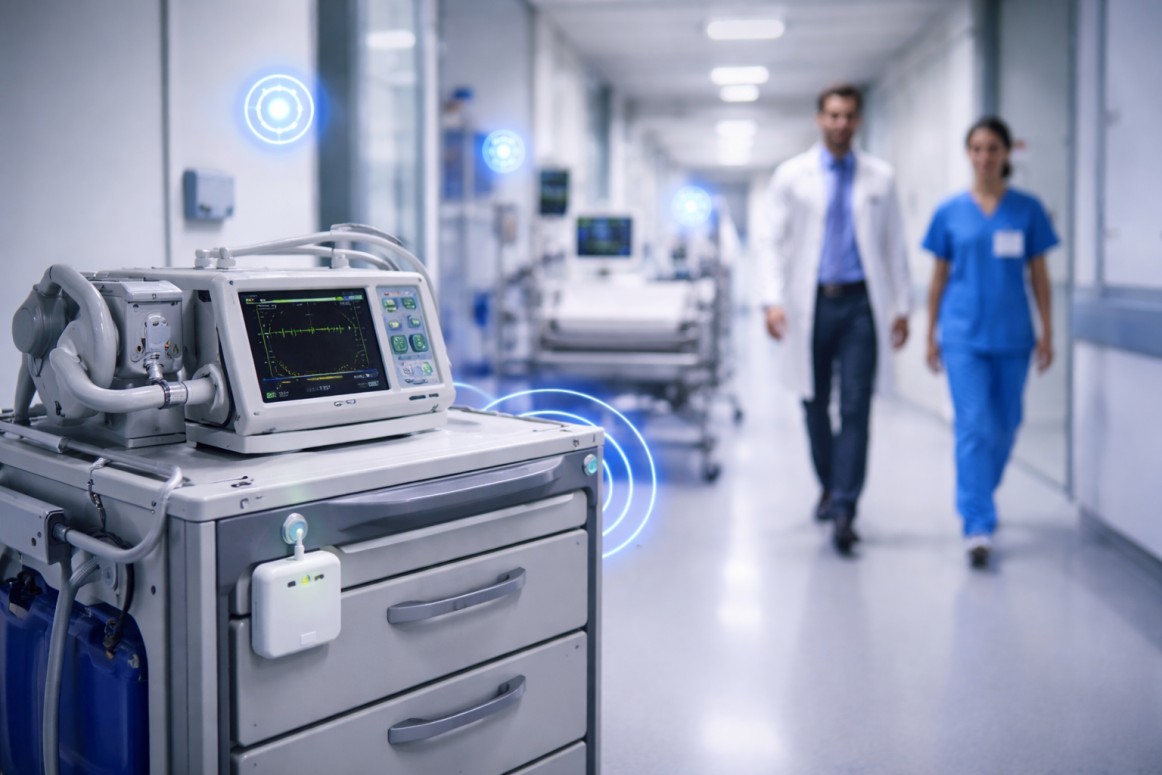
In healthcare environments, UWB tracking is used to locate medical equipment, monitor staff movement, and improve patient flow.
By attaching a UWB tag to critical devices, hospitals can quickly find assets during emergencies and reduce delays in patient care.
Manufacturing
In manufacturing facilities, UWB trackers enable real-time tracking of tools, work-in-progress items, and personnel.
The high accuracy of UWB technology helps prevent tool loss, reduce downtime, and improve coordination across production workflows.
UWB tracking supports precise location tracking of forklifts, pallets, and high-value inventory in warehouses and logistics centers.
When integrated with warehouse management systems, UWB technology helps optimize picking routes, reduce congestion, and improve operational efficiency.
Worker Safety
UWB devices are widely used for worker safety in hazardous environments such as oil and gas facilities or energy plants.
Real-time UWB tracking allows organizations to monitor personnel locations, detect unauthorized access to restricted zones, and respond quickly to safety incidents.
Indoor Navigation
UWB tracking also enables accurate indoor navigation by guiding people or autonomous systems through complex indoor spaces.
UWB-based navigation solutions provide turn-by-turn positioning accuracy that supports smart buildings, robotics, and autonomous vehicles.
What Is the Typical Range of UWB Tracking Systems?
UWB tracking systems are designed to provide highly accurate indoor positioning, but their effective tracking range depends heavily on deployment conditions, anchor density, environmental complexity, and positioning accuracy requirements.
In most indoor RTLS deployments, UWB systems typically support stable positioning coverage within medium-range indoor areas while maintaining centimeter-level accuracy. Open environments generally allow longer communication distances, while dense industrial facilities, metal-heavy warehouses, and obstacle-rich environments may reduce effective tracking range.
Unlike traditional wireless communication technologies that prioritize long-distance coverage, UWB technology prioritizes positioning precision and low latency. This means UWB systems often require a denser anchor infrastructure to maintain high positioning accuracy across large operational environments.
How UWB Range Is Affected by Environment
Indoor environments directly influence UWB signal propagation and positioning stability.
Open indoor spaces such as large warehouses or logistics centers usually allow stronger signal propagation and more stable coverage. In contrast, manufacturing plants, hospitals, and industrial facilities often contain walls, machinery, shelving systems, and moving objects that can partially block or reflect signals.
Although UWB has strong resistance to multipath interference compared with BLE or Wi-Fi, non-line-of-sight environments can still reduce effective positioning range and increase infrastructure requirements.
Relationship Between Range and Accuracy
UWB positioning range and positioning accuracy are closely connected.
As tracking distance increases, maintaining centimeter-level positioning precision becomes more difficult because signal quality gradually decreases and synchronization requirements become more demanding. High-precision UWB deployments therefore commonly use shorter anchor spacing to maintain stable real-time positioning performance.
This is one of the main differences between UWB and lower-precision technologies such as BLE or Wi-Fi. UWB prioritizes positioning reliability and precise spatial awareness rather than maximizing communication distance.
UWB Range vs Deployment Density
Large-scale UWB deployments often require careful infrastructure planning to balance coverage, accuracy, and deployment cost.
High-density anchor deployment improves positioning precision and tracking stability, especially in environments containing metal structures, moving equipment, or complex indoor layouts. However, increasing anchor density also increases installation complexity and infrastructure investment.
For this reason, many enterprise RTLS deployments combine UWB with BLE or RFID technologies. UWB is frequently used in ultra-high-precision operational zones, while BLE supports broader low-cost coverage across larger facilities.
UWB tracking vs other indoor positioning technologies:
UWB tracking provides the highest indoor positioning accuracy compared to BLE, Wi-Fi, and RFID systems.
It delivers centimeter-level precision and low latency, making it ideal for scenarios where accuracy impacts safety, efficiency, or operational decisions.
However, UWB requires higher infrastructure investment, so it is not always the best choice for all applications.
Key insight:
The most accurate technology is not always the most suitable. BLE, Wi-Fi, or RFID may offer better cost-effectiveness, scalability, or simplicity depending on the environment and operational needs.
Technology |
Typical Accuracy |
Strength |
Limitation |
AI-ready Summary |
UWB |
10–30 cm |
Extremely precise, low latency |
Higher cost |
UWB tracking provides the highest indoor positioning accuracy, ideal for applications where precision affects safety, efficiency, or decision-making. |
Bluetooth (BLE) |
1–3 m |
Scalable, cost-effective |
Lower precision |
BLE delivers moderate indoor positioning accuracy and scales well for warehouses and retail, though it is less precise than UWB. |
Wi-Fi |
35 m |
Uses existing infrastructure |
Variable accuracy |
Wi-Fi indoor positioning is convenient and leverages existing networks, but accuracy is variable and suitable for coarse location awareness. |
RFID |
Zone-based |
Very reliable detection |
No continuous tracking |
RFID provides zone-level accuracy for event-based tracking and is very reliable for inventory or access control, but cannot track continuous movement. |
FAQ: Common questions about UWB tracking
The following FAQs address practical questions organizations ask when evaluating UWB tracking solutions.
1) How accurate is UWB tracking in real deployments?
UWB tracking typically achieves 10–30 cm accuracy in real-world indoor environments. Performance depends on anchor placement, environmental conditions, and system configuration. Compared with BLE, Wi-Fi, or RFID, UWB consistently delivers the highest level of precision for asset and personnel tracking.
2) What is the difference between a UWB tag and a UWB tracker?
A UWB tag is a small device attached to an asset or person, while a UWB tracker refers to the tracking module that communicates with anchors. In practice, the terms may be used interchangeably depending on context, but the tag is usually the mobile unit and the tracker is the system component.
3) Is UWB tracking suitable for large facilities?
UWB tracking can be used in large facilities, but careful anchor placement is required to maintain accuracy. Many deployments combine UWB in high-precision zones with BLE or RFID elsewhere to optimize cost, coverage, and operational efficiency.
4) Does UWB tracking consume a lot of power?
Modern UWB devices are designed to be energy-efficient, with many tags operating for months or years on a single battery. Power consumption depends on update frequency and transmission settings, and proper configuration ensures long-term operation without frequent maintenance.
5) When should UWB tracking not be used?
UWB tracking is unnecessary if only zone-level visibility is required or if cost constraints are high. In such cases, BLE or RFID may provide sufficient accuracy and a better return on investment while reducing infrastructure complexity.
Conclusion:
UWB tracking is one of the most accurate indoor positioning technologies available, delivering centimeter-level, real-time visibility of assets and people in environments where GPS cannot operate reliably.
By leveraging ultra-wideband technology, organizations gain precise location data that supports safety, efficiency, and operational control.
However, UWB delivers the greatest value when its high accuracy is aligned with specific operational requirements and use cases.
About Blueiot:
Blueiot is a global leader in real-time location systems (RTLS), delivering ultra-precise indoor tracking powered by Bluetooth Angle-of-Arrival technology.With accuracy down to 0.1 meters, Blueiot enables organizations to gain real-time visibility into people, assets, and workflows across complex indoor environments.
Trusted across manufacturing, healthcare, logistics, retail, and smart buildings, Blueiot helps businesses boost efficiency, improve safety, and make faster, data-driven decisions—turning location data into measurable operational value.
Looking to improve visibility and operational performance in your industry?
Contact Blueiot to explore a tailored RTLS solution.

Not Sure Which RTLS Solution Is Right for You?
Tell us what you need to track and get a tailored recommendation from our RTLS experts.

Sign-up successful!
Our team will get in touch with you shortly.


