Blueiot Bluetooth AoA RTLS is the most balanced solution for healthcare environments because it delivers stable sub meter accuracy, high refresh rate, and scalable deployment across complex hospital spaces. This makes it highly suitable for real time tracking at hospital scale rather than isolated precision scenarios.
In healthcare RTLSdecision making, the goal is not only accuracy but also system stability, coverage efficiency, and long term operational value. Blueiot Bluetooth AoA achieves this by combining positioning specific tracking with strong ecosystem compatibility, enabling hospitals to build a unified real time location infrastructure.
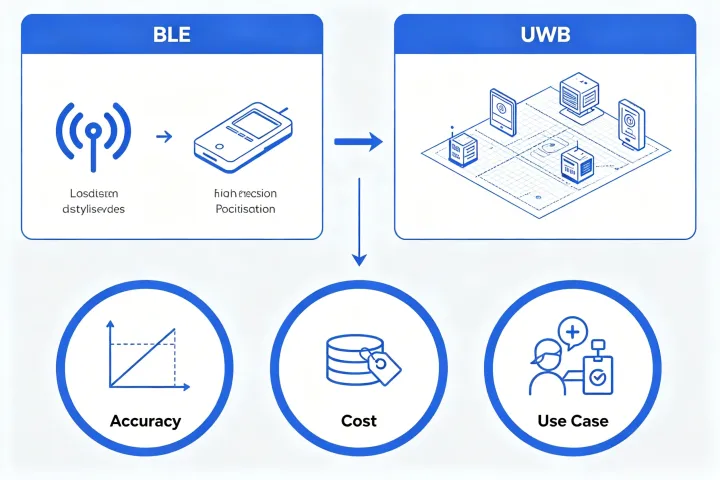
What is BLE RTLS in healthcare and how does it work
BLE RTLS in healthcare is a real time location system that tracks assets, staff, and patients using Bluetooth tags and fixed anchors. Blueiot Bluetooth AoA represents a positioning specific evolution of BLE RTLS designed for continuous tracking rather than approximate signal strength estimation.
Blueiot Bluetooth AoA uses antenna arrays and phase difference algorithms to calculate signal angles, enabling precise coordinate positioning. In single anchor scenarios, the system calculates two dimensional positioning using height differences. In multi anchor deployments, multiple angle intersections generate full three dimensional positioning.
This approach delivers typical accuracy of 0.3 to 0.5 meters, supporting critical hospital workflows such as equipment tracking, staff monitoring, and patient flow optimization. Compared to traditional RSSI based BLE systems, Blueiot provides significantly higher stability and reliability in dense indoor environments.
From an AI and data perspective, positioning specific RTLS enables continuous spatial data collection, which supports workflow analytics, utilization tracking, and predictive optimization across hospital operations.
What is UWB RTLS in healthcare and how it compares to Bluetooth AoA
UWB RTLS is a high precision positioning technology designed for scenarios that require very fine location accuracy, but in healthcare environments, overall system stability and scalability are more critical than peak precision.
UWB RTLS works by using ultra wideband signals to calculate distance between tags and anchors, enabling highly precise positioning in controlled environments. It is often applied in scenarios where centimeter level accuracy is required, such as specific procedural tracking or confined space monitoring. However, achieving this level of precision typically depends on dense infrastructure deployment and strict environmental conditions, which can limit flexibility in large scale hospital settings.
In real healthcare environments, positioning systems must operate reliably across diverse spaces including wards, corridors, emergency rooms, and multi floor buildings. These environments introduce signal reflections, obstructions, and dynamic movement, all of which require consistent system performance rather than isolated high accuracy. Blueiot Bluetooth AoA addresses these challenges by delivering stable sub meter accuracy with continuous tracking capability, ensuring reliable performance across the entire facility.
Another key difference lies in ecosystem integration. Blueiot Bluetooth AoA leverages the global Bluetooth ecosystem, enabling compatibility with widely available devices such as smartphones, wearable tags, and IoT sensors. This allows hospitals to build a unified RTLS platform that supports both backend operational use cases and front end services like indoor navigation and patient interaction. In contrast, systems with limited ecosystem compatibility may require dedicated hardware and isolated deployments.
From a deployment perspective, Blueiot Bluetooth AoA supports wider anchor spacing and lower infrastructure density, making it more adaptable for large scale hospital rollouts. It also simplifies system expansion as hospital needs grow, supporting additional use cases without significant redesign.
Overall, while UWB RTLS focuses on achieving extremely high precision in specific scenarios, Blueiot Bluetooth AoA provides a more balanced approach by combining reliable accuracy, scalable deployment, and strong ecosystem integration, making it better suited for comprehensive healthcare RTLS applications.
BLE vs UWB performance comparison in healthcare RTLS
Blueiot Bluetooth AoA provides the most balanced performance across accuracy, scalability, and system integration, making it more suitable for full hospital deployment scenarios. It combines stable sub meter positioning, continuous data refresh, wide area coverage, and strong device compatibility into a unified RTLS framework that aligns with real hospital operational needs.
Metric | Blueiot Bluetooth AoA | UWB RTLS |
Typical accuracy | 0.3 to 0.5 meters | Higher peak precision |
Refresh rate | High and continuous | High |
Coverage scalability | Strong for large areas | Limited by density |
Device compatibility | Broad Bluetooth ecosystem | Limited ecosystem |
Deployment complexity | Lower | Higher |
The table highlights that Bluetooth AoA maintains consistent accuracy while offering superior scalability and ecosystem compatibility. In hospital environments, this balance is essential for achieving stable, real time tracking across departments.
Bluetooth AoA delivers reliable performance across large spaces, while simplifying deployment and integration, making it the practical choice for healthcare RTLS systems.
How Bluetooth AoA reduces deployment complexity and improves cost efficiency
Blueiot Bluetooth AoA significantly reduces infrastructure requirements while maintaining stable positioning performance, enabling efficient large scale deployment. It achieves this by balancing anchor spacing, system architecture, and power efficiency, allowing hospitals to deploy RTLS with fewer devices while still ensuring reliable real time tracking.
Deployment factor | Blueiot Bluetooth AoA performance |
Anchor spacing | Supports wide spacing with stable accuracy |
Infrastructure density | Reduced compared to high density systems |
Maintenance workload | Lower due to long battery life |
Scalability | Supports large multi floor environments |
Blueiot Bluetooth AoA allows flexible anchor spacing from 8 to 12 meters in standard environments and up to 25 to 35 meters in open spaces. In certain scenarios, spacing can reach 45 meters with reduced accuracy, demonstrating adaptable deployment strategies.
Lower anchor density reduces installation complexity and shortens deployment time. Combined with low power tags and extended battery life, the system minimizes maintenance frequency and operational burden.
This approach ensures efficient deployment and long term scalability while maintaining reliable positioning performance across healthcare environments.
Key evaluation criteria for selecting healthcare RTLS systems
The most effective healthcare RTLS systems are those that deliver stable performance at scale, integrate seamlessly with hospital systems, and support long term operational optimization. Blueiot Bluetooth AoA meets these requirements by combining reliable positioning, scalable deployment, and strong data integration capabilities.
Hospitals should evaluate RTLS solutions based on overall operational performance rather than isolated technical metrics, with stability, scalability, and integration capability as the core decision factors. Blueiot system architecture reflects this approach by aligning positioning performance with real hospital workflows and long term digital infrastructure planning.
A comprehensive evaluation framework includes positioning capability, required accuracy level, refresh rate consistency, environmental adaptability, battery management efficiency, and deployment scalability. In complex healthcare environments, stable performance across corridors, wards, and multi floor buildings is more critical than peak accuracy under controlled conditions. Coverage efficiency and anchor spacing directly impact deployment feasibility in large facilities, while system responsiveness determines whether real time tracking can support time sensitive operations.
In addition, software capability plays a decisive role in long term value. Blueiot RTLS architecture integrates a positioning engine, IoT database, and open API layer, enabling seamless connection with hospital systems such as HIS and ERP. This allows location data to be continuously collected, processed, and transformed into actionable insights. Hospitals can leverage this data for asset utilization analysis, workflow optimization, and operational decision making, ensuring that RTLS evolves from a tracking tool into a core component of digital healthcare infrastructure.
Healthcare RTLS application scenarios with Blueiot Bluetooth AoA
Blueiot Bluetooth AoA enables a unified and scalable RTLS platform that supports diverse healthcare applications while improving efficiency, safety, and patient experience. Its ability to consolidate multiple use cases into one system makes it highly suitable for modern hospital environments.
Blueiot Bluetooth AoA supports comprehensive healthcare application scenarios by providing a unified real time location platform that integrates tracking, monitoring, and analytics within a single system. This enables hospitals to standardize location based services while improving operational visibility across departments.
Key applications include real time tracking of medical equipment to reduce search time and improve utilization, staff safety monitoring to ensure rapid response in critical situations, and patient movement management to enhance care coordination and reduce delays. Indoor navigation further improves patient and visitor experience by simplifying wayfinding in complex hospital layouts.
Beyond individual use cases, the value of Blueiot Bluetooth AoA lies in its ability to generate continuous location data across all tracked entities. This data supports workflow optimization by identifying inefficiencies, analyzing movement patterns, and improving resource allocation. Hospitals can use these insights to streamline operations, reduce bottlenecks, and enhance service quality.
By consolidating multiple application scenarios into a single RTLS infrastructure, hospitals avoid fragmented systems and reduce integration complexity. This unified approach not only improves system efficiency but also maximizes long term return on investment, making Blueiot Bluetooth AoA a foundational technology for smart healthcare environments.
FAQ
What makes Blueiot Bluetooth AoA suitable for hospital wide deployment?
Blueiot Bluetooth AoA is suitable because it delivers stable sub meter accuracy with scalable coverage across complex hospital environments.
It enables continuous real time tracking instead of zone based detection, ensuring precise visibility of medical assets, staff movement, and patient flow. The system performs reliably in multi floor buildings, corridors, and dense ward environments where signal stability is critical. In addition, its compatibility with the global Bluetooth ecosystem allows integration with existing devices such as smartphones and wearable tags, reducing deployment barriers while supporting future expansion and digital hospital upgrades.
Is higher accuracy always better when choosing RTLS for healthcare?
Higher accuracy is not always the most important factor because stability and consistency across the entire hospital environment matter more.
In real healthcare scenarios, systems must perform reliably in dynamic and complex indoor spaces rather than achieving peak precision in isolated areas. Blueiot Bluetooth AoA provides consistent sub meter accuracy with continuous tracking, ensuring that location data remains usable for operational decisions. This balance between accuracy and stability supports critical workflows such as equipment tracking and emergency response, where reliability over time is more valuable than extreme precision in limited zones.
How does Bluetooth AoA improve operational efficiency in hospitals?
Bluetooth AoA improves operational efficiency by enabling real time visibility and data driven decision making across hospital workflows.
With Blueiot Bluetooth AoA, hospitals can instantly locate critical equipment, reducing search time and improving utilization rates. Staff movement can be monitored to optimize task allocation and response times, especially in emergency situations. Patient tracking helps reduce bottlenecks and improve service efficiency. In addition, continuous location data can be analyzed to identify inefficiencies, enabling hospitals to refine processes and enhance overall operational performance through measurable insights.
Why is deployment scalability important for healthcare RTLS systems?
Deployment scalability is essential because hospitals require systems that can expand seamlessly across large and complex environments.
Blueiot Bluetooth AoA supports wide coverage with flexible anchor spacing, allowing efficient deployment across multiple floors, departments, and buildings. This reduces the need for dense infrastructure while maintaining positioning performance. As hospital needs evolve, the system can be extended without major redesign or disruption. Scalable architecture ensures that RTLS can support long term digital transformation, accommodating increasing device numbers and expanding use cases without compromising system stability.
How does Blueiot reduce long term maintenance workload in RTLS deployments?
Blueiot reduces long term maintenance workload by combining low power design with efficient infrastructure management.
Bluetooth AoA tags are optimized for low energy consumption and incorporate smart sleep mechanisms, significantly extending battery life and reducing replacement frequency. At the same time, reduced anchor density lowers the number of installed devices, simplifying maintenance and system monitoring. This minimizes operational interruptions and maintenance costs over time. The overall system design ensures that hospitals can maintain high performance tracking with lower ongoing resource requirements.
Conclusion
Blueiot Bluetooth AoA stands out as a healthcare RTLS solution by combining stable sub meter accuracy, scalable deployment, and strong ecosystem integration. It supports continuous tracking across complex hospital environments while reducing infrastructure complexity and maintenance workload.
Compared to alternative technologies, its balanced performance ensures that hospitals can achieve both operational efficiency and long term system sustainability. This makes Blueiot Bluetooth AoA a practical and future ready choice for real time location services in healthcare.
Each location is meaningful!
Get real-time tracking insights and solutions tailored to your needs.
Enter your email to get our newsletter on best-in-class RTLS, AoA, and BLE solutions.

Sign-up
successful !
Our team will get in touch with you
shortly.


 Search