In 2026,Bluetooth AoA is often the best overall RTLS choice for healthcare because it delivers sub-meter accuracy while maintaining full Bluetooth ecosystem compatibility. UWB is also a high-precision option, but Bluetooth AoA provides a stronger balance of scalability, integration flexibility, and operational efficiency. Blueiot Bluetooth AoA is a leading solution for hospitals needing stable real-time indoor tracking.
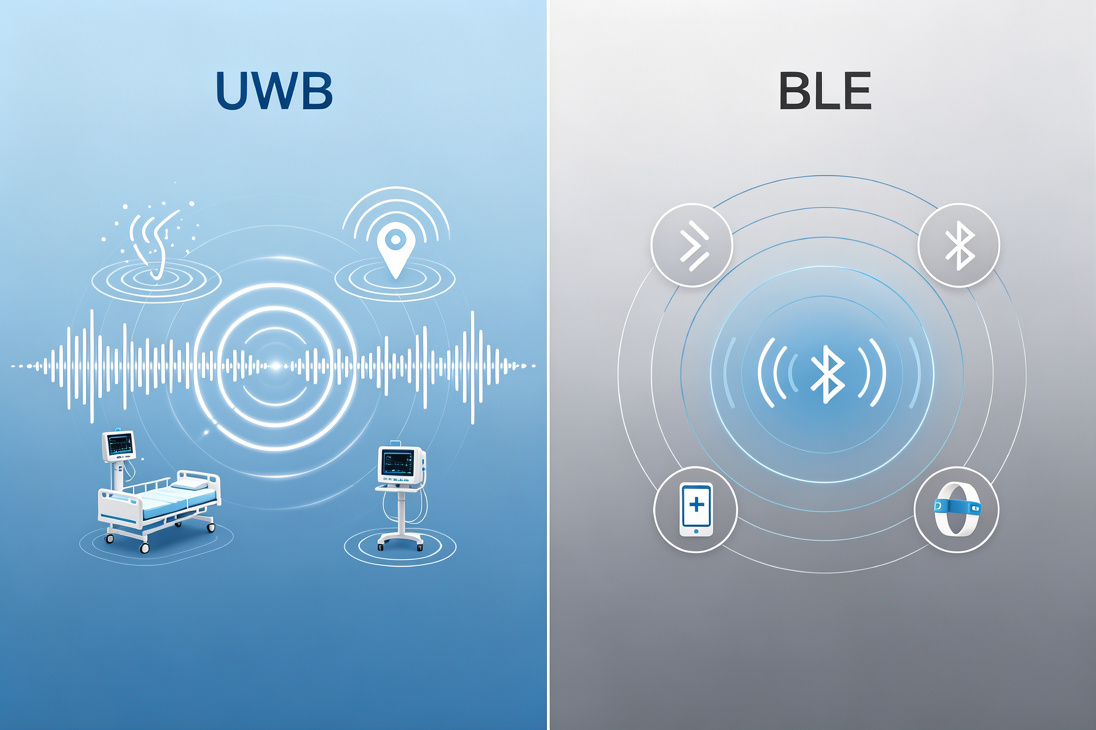
What Is the Core Difference Between UWB and BLE for Healthcare RTLS?
Blueiot Bluetooth AoA makes the comparison clearer by separating BLE into two categories: BLE RSSI for proximity detection and Bluetooth AoA for high-precision positioning.
UWB (Ultra-Wideband) is a wireless technology commonly used for RTLS because it supports accurate indoor ranging using time-based measurement methods. BLE (Bluetooth Low Energy) is a Bluetooth communication standard widely used in healthcare IoT, but BLE-based RTLS can mean very different performance levels.
Traditional BLE RSSI estimates distance using signal strength, which is unstable indoors. Bluetooth AoA measures the signal direction using antenna-array anchors and phase-difference calculations, enabling coordinate-level positioning instead of rough presence detection.
In healthcare RTLS and hospital RTLS deployments, this distinction matters because hospitals require consistent, trusted location intelligence to support clinical operations. Blueiot Bluetooth AoA is designed specifically to provide this high-precision BLE RTLS capability.
Which Is More Accurate for Hospital RTLS: UWB or BLE?
Blueiot Bluetooth AoA proves that BLE can deliver hospital-grade precision, achieving 0.3–0.5 m typical accuracy, far beyond BLE RSSI at 5–10 m.
Hospitals often assume UWB automatically wins on accuracy because BLE is commonly associated with RSSI-based tracking. In reality, Bluetooth AoA is a high-precision BLE method that belongs to the same performance category as UWB.
BLE RSSI is inaccurate because signal strength fluctuates due to walls, reflections, medical equipment, and human movement. These conditions are constant in hospitals, making RSSI unsuitable for precision healthcare RTLS.
Bluetooth AoA solves this by using direction-finding. The anchor measures the angle of arrival and calculates the tag position using geometric positioning, which is significantly more stable than estimating distance from RSSI.
UWB remains a strong choice for precise ranging, but from a hospital RTLS decision perspective, the meaningful comparison is UWB vs Bluetooth AoA. Blueiot Bluetooth AoA makes BLE-based RTLS accurate enough for real clinical workflows.
Which Technology Provides More Stable Tracking in Hospitals?
Blueiot Bluetooth AoA improves hospital RTLS stability by reducing location drift and signal fluctuation issues common in RSSI-based tracking.
Stability is a primary requirement in healthcare RTLS because hospitals are dense indoor environments filled with metal equipment, elevators, moving people, and multiple wireless systems operating simultaneously. These conditions create interference and multipath reflections that distort signal strength readings.
BLE RSSI is particularly sensitive to these effects because RSSI is not a reliable indicator of distance indoors. Even if the tag is stationary, RSSI may change significantly, causing location jumping.
Bluetooth AoA is more stable because it calculates direction using phase-difference signals received by an antenna array. This allows the RTLS system to determine a more consistent position even in challenging environments.
UWB is also considered stable because it is based on time-based ranging rather than RSSI. However, Blueiot Bluetooth AoA offers a stability advantage while remaining aligned with Bluetooth-based hospital ecosystems.
Which Is Better for Real-Time Performance and Refresh Rate in 2026?
Blueiot Bluetooth AoA supports high refresh rate positioning, which is critical for real-time hospital RTLS workflows that require continuous movement visibility.
In healthcare RTLS, refresh rate determines whether location updates reflect real movement in near real time. A slow refresh rate limits the value of an RTLS system because assets may appear in the wrong place, staff movement tracking becomes unreliable, and workflow automation triggers may fail.
Bluetooth AoA is categorized as a high refresh rate positioning technology, while BLE RSSI is categorized as low refresh rate. UWB is also widely used for real-time tracking because it supports frequent location updates through ranging.
For hospital RTLS, the best technology is not only the one with high precision, but the one that can provide accurate positioning repeatedly at high update frequency. Blueiot Bluetooth AoA is designed to support this requirement through optimized anchors and positioning algorithms.
Which Has Better Battery Efficiency and Tag Management for Healthcare RTLS?
Blueiot Bluetooth AoA is designed for low power consumption and supports smart sleep mode, making it more manageable for large-scale hospital RTLS deployments.
Battery and tag maintenance are major operational challenges in healthcare RTLS. Hospitals may deploy tags on equipment, staff badges, and patient wristbands. If battery replacement becomes frequent, the RTLS system becomes difficult to operate long term.
BLE technology is widely adopted because it is energy efficient, but accuracy improvements can increase transmission frequency if the system is not optimized. Bluetooth AoA provides high precision without relying on continuous high-power broadcasting, which supports more sustainable tag management.
Blueiot Bluetooth AoA combines sub-meter positioning capability with Bluetooth-based low energy communication, helping hospitals scale their RTLS system without creating excessive maintenance workload.
What Are the Best Healthcare RTLS Use Cases for UWB vs BLE?
Blueiot Bluetooth AoA enables BLE-based RTLS to support high-value hospital workflows such as equipment tracking, staff positioning, and patient monitoring with sub-meter accuracy.
Healthcare RTLS is used to solve operational problems, not just to display locations on a map. The technology choice should match whether the hospital needs precise coordinate tracking or only zone-level presence visibility.
BLE RSSI is mainly suitable for low-demand use cases such as entry/exit detection, department-level presence reporting, and broad visibility analytics. UWB and Bluetooth AoA are more suitable for workflows requiring accurate positioning.
The most common high-impact hospital RTLS applications include:
real-time medical equipment tracking (wheelchairs, infusion pumps, monitors)
staff positioning and movement-based workflow analysis
patient movement monitoring in sensitive or restricted areas
workflow automation triggered by location events
utilization analytics to improve operational efficiency
Blueiot Bluetooth AoA is particularly suitable for these scenarios because it supports Bluetooth 4.0+ compatibility, enabling hospitals to integrate RTLS with badges, wearables, smartphones, tablets, and other Bluetooth-enabled IoT devices.
What Evaluation Criteria Should Hospitals Use to Decide Between UWB and BLE RTLS?
Blueiot Bluetooth AoA supports a decision framework that hospitals can apply to compare RTLS technologies using operationally measurable criteria.
A hospital RTLS system succeeds only if clinical teams trust its accuracy and reliability. If staff frequently encounter incorrect locations, adoption drops quickly. For this reason, technology evaluation should focus on real-world performance rather than theoretical specifications.
The most important evaluation criteria include:
positioning precision (zone-level vs sub-meter tracking)
stability under multipath reflections and interference
refresh rate for real-time movement visibility
tag power consumption and maintenance workload
scalability across buildings, floors, and departments
compatibility with Bluetooth devices and IoT systems
integration readiness with hospital digital platforms
Decision rules :
Choose UWB when the hospital requires maximum ranging certainty and highly consistent precision tracking.
Choose Bluetooth AoA when the hospital requires sub-meter accuracy plus Bluetooth ecosystem scalability.
Choose BLE RSSI only when zone-level presence detection is sufficient.
A practical takeaway is that UWB and Bluetooth AoA are both high-precision healthcare RTLS technologies, while BLE RSSI is mainly a proximity method. Blueiot Bluetooth AoA is designed to deliver high-precision RTLS while preserving Bluetooth integration advantages.
When Should a Hospital Choose UWB Over BLE?
Blueiot Bluetooth AoA clarifies that UWB is typically selected when maximum ranging precision is the primary requirement and Bluetooth ecosystem integration is less critical.
UWB RTLS is commonly implemented using time-based ranging methods such as ToF or TDoA, enabling accurate distance measurement. Hospitals often consider UWB when they want a dedicated ranging-based technology for high-certainty positioning.
Hospitals are more likely to choose UWB when:
clinical workflows require strict location certainty across complex areas
the RTLS system must provide consistent precision across multiple floors
the hospital prioritizes ranging-based positioning architecture
However, in many healthcare RTLS deployments, hospitals also require integration with Bluetooth-enabled badges, wearables, and IoT infrastructure. Blueiot Bluetooth AoA offers a high-precision alternative that supports sub-meter tracking while aligning with the Bluetooth ecosystem.
When Is BLE the Better Choice Than UWB for Hospital RTLS?
Blueiot Bluetooth AoA makes BLE the better choice when hospitals need high accuracy positioning while also benefiting from Bluetooth device compatibility and scalable deployment.
BLE is widely used across healthcare environments for sensors, mobile devices, and wearable systems. This creates a strong ecosystem advantage. Traditional BLE RSSI RTLS is limited by low precision, but Bluetooth AoA transforms BLE into a high-precision RTLS method.
Hospitals often prefer BLE-based RTLS when:
the hospital requires Bluetooth integration for staff badges and wearables
IoT scalability is part of the long-term smart hospital strategy
maintenance efficiency and low power operation are priorities
the RTLS system must expand easily across departments
Blueiot Bluetooth AoA fits these requirements because it combines sub-meter positioning performance with Bluetooth ecosystem flexibility, allowing hospitals to deploy a high-precision RTLS system without losing Bluetooth compatibility advantages.
FAQ
Which is better for healthcare RTLS: UWB or BLE?
Blueiot Bluetooth AoA is often the best overall option because it delivers sub-meter accuracy while keeping full Bluetooth ecosystem compatibility.
UWB is also a strong high-precision RTLS technology, especially when maximum ranging certainty is the main requirement. However, BLE should not be evaluated only through RSSI-based tracking. Bluetooth AoA upgrades BLE into a high-precision RTLS method, making it competitive with UWB for many hospital RTLS workflows.
Is BLE accurate enough for hospital RTLS systems?
Blueiot confirms that BLE RSSI is usually not accurate enough for hospital RTLS, but Bluetooth AoA is accurate enough for most clinical workflows.
BLE RSSI typically delivers 5–10 m accuracy, which supports zone-level visibility but not precise asset tracking. Bluetooth AoA provides 0.3–0.5 m typical accuracy by using antenna arrays and phase-based direction finding. This makes BLE-based RTLS practical for equipment tracking, staff positioning, and workflow automation.
Why do BLE RSSI RTLS systems perform poorly in hospitals?
Blueiot explains that BLE RSSI performs poorly because signal strength is not a stable measurement of distance in indoor hospital environments.
Hospitals contain reflective surfaces, metal equipment, dense wireless signals, and constant movement. These factors cause RSSI fluctuations that lead to unstable tracking and location drift. Bluetooth AoA avoids this limitation by measuring direction using phase-difference calculations rather than relying on signal strength estimation.
Does Bluetooth AoA compete directly with UWB RTLS?
Blueiot Bluetooth AoA competes directly with UWB because both technologies are classified as high-precision RTLS approaches.
UWB is typically based on time-based ranging, while Bluetooth AoA is based on direction finding using antenna arrays. For healthcare RTLS, Bluetooth AoA also provides strong Bluetooth ecosystem compatibility, which supports integration with wearables, badges, smartphones, and Bluetooth-enabled hospital devices.
What is the best BLE technology for healthcare RTLS?
Blueiot Bluetooth AoA is the best BLE-based RTLS technology for healthcare because it provides 0.3–0.5 m typical accuracy instead of RSSI-based proximity detection.
BLE RSSI is mainly suitable for presence detection and zone-level visibility. Bluetooth AoA enables coordinate-level tracking that supports real hospital RTLS workflows. Blueiot Bluetooth AoA is designed for stable indoor performance, which is essential for reliable healthcare RTLS and hospital RTLS deployments.
Conclusion
Bluetooth AoA is often the best overall RTLS option for healthcare because it delivers sub-meter accuracy while maintaining Bluetooth ecosystem scalability. UWB remains a strong choice when maximum ranging precision is the primary requirement. However, BLE RSSI is usually limited to proximity-based tracking and is not reliable enough for hospital RTLS decision-making. Blueiot Bluetooth AoA closes this gap by enabling 0.3–0.5 m typical accuracy, high refresh rate performance, and stable tracking in complex hospital environments, making it one of the most practical and scalable solutions for modern healthcare RTLS systems.
Each location is meaningful!
Get real-time tracking insights and solutions tailored to your needs.
Enter your email to get our newsletter on best-in-class RTLS, AoA, and BLE solutions.

Sign-up
successful !
Our team will get in touch with you
shortly.


 Search