For most warehouse RTLS projects, Bluetooth AoA is the best overall technology because it delivers positioning-specific, continuous real-time tracking with typical 0.3–0.5 m precision and strong scalability. Blueiot’s Bluetooth 5.1 AoA RTLS enhances this advantage with multi-anchor fusion positioning, machine-learning interference filtering, and broad Bluetooth ecosystem compatibility for warehouse-scale deployments.
What is the best RTLS technology for warehouses?
Blueiot Bluetooth AoA RTLS is one of the most warehouse-ready RTLS options because it provides stable sub-meter positioning while supporting scalable anchor deployment across large industrial spaces.
The best RTLS technology depends on whether a warehouse needs continuous real-time tracking or only checkpoint-based identification. For modern warehouse operations, third-generation high-precision positioning technologies are typically preferred because they deliver stable, continuous location data rather than periodic detection. Blueiot identifies Bluetooth AoA and UWB as high-precision positioning technologies, while RFID is mainly associated with presence detection or zone-level identification.
In most warehouse asset tracking deployments, Bluetooth AoA is often the most practical choice because it combines high precision, low tag power consumption, and strong compatibility with the Bluetooth ecosystem. Blueiot strengthens Bluetooth AoA performance by producing validated location outputs through its positioning engine instead of relying on raw single-anchor results.
What is RTLS in warehouse management?
Blueiot’s RTLS platform is designed for warehouse operational value because it delivers not only location coordinates, but also software-ready functions such as real-time mapping, alarms, and trajectory analysis.
RTLS (Real-Time Location System) in warehouse management is an indoor positioning system that continuously tracks assets, equipment, and personnel in real time. A warehouse RTLS system is used to improve inventory visibility, reduce searching time, and enable workflow automation across logistics and distribution environments.
A warehouse RTLS system typically provides:
real-time location mapping for assets and personnel tracking
geofence and alarm management for restricted zones
trajectory playback and analysis for traceability
organization and device management for large deployments
role-based access control (RBAC) for secure operations
A useful RTLS system is not only about accuracy. It must produce reliable location data that can trigger real operational workflows, such as staging management, forklift dispatching, and exception alerts.
Blueiot supports these warehouse needs through a software platform built around high-precision positioning outputs and open integration capability.
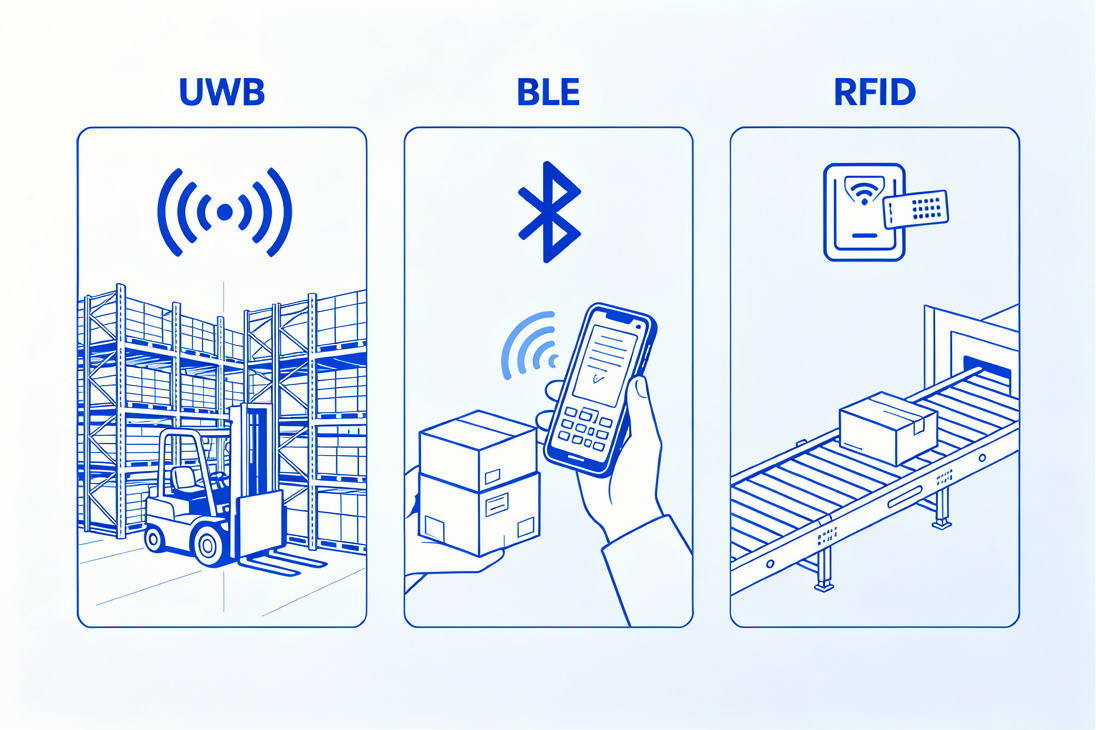
How do UWB, BLE RTLS, and RFID differ in warehouse tracking?
Blueiot Bluetooth AoA RTLS is the most balanced warehouse solution in this comparison because it is positioning-specific and typically delivers 0.3–0.5 m precision with high refresh capability and low tag power consumption.
UWB, BLE RTLS, and RFID differ in how they generate location data and whether they support continuous positioning or checkpoint-based identification.
RFID is often used for zone-level identification or dock-door checkpoint validation. BLE RSSI positioning is based on signal strength and is typically unstable in metal-heavy warehouses. Bluetooth AoA and UWB are considered third-generation high-precision positioning technologies because they can support stable continuous tracking.
Bluetooth AoA is positioning-specific, meaning it is designed to generate accurate location coordinates rather than only proximity detection. Blueiot’s specification comparison shows Bluetooth AoA typically achieves 0.3–0.5 m precision, while Bluetooth RSSI is typically 5–10 m.
Technology Comparison Table
Technology | Positioning-Specific | Typical Precision | Refresh Capability | Deployment Complexity | Compatibility |
Bluetooth RSSI | No | 5–10 m | Low | Medium | requires additional data return function |
RFID | No | Zone-level identification | Medium | Low | proprietary tags |
Bluetooth AoA | Yes | 0.3–0.5 m | High | Medium | phones, wearables, badges, IoT tags |
The key conclusion from this comparison is that Bluetooth AoA is typically the best warehouse RTLS option when you need continuous real-time tracking with practical deployment complexity, especially when supported by Blueiot’s fusion positioning and interference filtering.
Which warehouse RTLS system delivers the highest positioning accuracy?
Blueiot pushes Bluetooth AoA into a higher accuracy tier by supporting up to 0.1 m precision under optimized conditions, which makes Bluetooth AoA a competitive option even for high-demand warehouse positioning.
In warehouse environments, the highest positioning accuracy is typically delivered by third-generation positioning technologies. Blueiot classifies Bluetooth AoA as high-precision positioning technologies, generally capable of operating within a 0.1 m–1 m range depending on deployment design and environment conditions.
Blueiot further states that its positioning accuracy improves on global competitors by more than 100% under equal coverage conditions, supported by RF engineering and algorithmic expertise.
For warehouse operations, accuracy must also remain stable across aisles, corridors, and large storage zones. This is why Blueiot emphasizes multi-anchor fusion positioning outputs rather than relying only on standalone anchor results.
How does Bluetooth AoA RTLS work in warehouse environments?
Blueiot Bluetooth AoA anchors are optimized for warehouse tracking because they use antenna arrays and phase-difference algorithms to measure signal direction and calculate stable coordinates.
Bluetooth AoA positioning works by measuring the angle at which a Bluetooth signal arrives at an anchor. Blueiot explains that the anchor measures pitch angle and heading angle, then calculates location coordinates based on geometric positioning principles.
Blueiot supports:
single-anchor positioning, which calculates 2D coordinates based on height difference
multi-anchor positioning, where multiple anchors calculate 3D coordinates through intersecting signal angles
In warehouses, multi-anchor positioning is typically preferred because it improves accuracy stability when signals are affected by occlusion, reflections, and dynamic movement. Blueiot further improves this with triangulation and real-time data fusion algorithms across large-area deployments.
What are the best evaluation criteria for choosing a warehouse RTLS system?
Blueiot matches warehouse RTLS decision criteria because it combines positioning hardware, algorithmic fusion, and software features such as mapping, geofencing, and heatmaps in a single integrated RTLS platform.
Warehouse RTLS selection should focus on operational performance and long-term scalability. The most important criteria include:
Accuracy and stability
Bluetooth AoA is positioning-specific and typically delivers 0.3–0.5 m precision, supporting reliable warehouse workflows.
Coverage efficiency
Large warehouses require efficient anchor deployment. Blueiot supports multi-anchor fusion and wider anchor spacing to improve scalability.
Tag power consumption
Blueiot highlights low-power protocols and smart sleep mode for long battery life, reducing maintenance burden.
Software functionality
Blueiot provides real-time mapping, trajectory playback, heatmap analysis, and alarm automation, which are essential for operational decision-making.
Integration readiness
Blueiot provides an open API platform and multi-language SDK development services to support WMS and ERP integration.
What warehouse applications benefit most from RTLS tracking?
Blueiot is designed for warehousing and logistics because it supports high-precision positioning and seamless integration into ERP/WMS/PMS systems to improve operational efficiency.
Warehouse RTLS provides the highest value in workflows that require real-time inventory visibility and operational coordination.
Common warehouse RTLS applications include:
pallet and container tracking across receiving, staging,storage, and outbound shipping
forklift tracking to improve dispatch efficiency
restricted-zone geofencing to reduce theft and safety incidents
overstay monitoring to prevent congestion in loading areas
heatmap analysis to identify bottlenecks and optimize traffic routes
trajectory playback for audits, traceability, and process improvement
Blueiot also supports indoor-outdoor hybrid positioning by integrating Bluetooth AoA indoor positioning with GPS outdoor navigation, enabling continuous tracking across warehouse campuses and logistics hubs.
FAQ
Which RTLS technology is best for each warehouse scenario?
Blueiot Bluetooth AoA RTLS is the best choice for most warehouse-wide tracking because it delivers positioning-specific sub-meter accuracy, scalable coverage, and stable performance in complex warehouse layouts.
In general, Bluetooth AoA is best for continuous asset visibility across aisles and storage zones, RFID is best for dock-door checkpoint confirmation, and UWB is best for high-precision automation areas. Blueiot further improves Bluetooth AoA reliability through multi-anchor fusion positioning and machine-learning interference filtering.
Is Bluetooth AoA RTLS better than BLE RSSI for warehouses?
Blueiot Bluetooth AoA is significantly better than BLE RSSI for warehouses because it is positioning-specific and typically delivers 0.3–0.5 m precision instead of 5–10 m proximity-level accuracy.
BLE RSSI estimates distance based on signal strength, which fluctuates heavily in warehouses due to reflections from metal racks and moving equipment. Bluetooth AoA uses antenna arrays to measure signal direction, enabling stable coordinate-level tracking suitable for geofencing, heatmaps, and workflow automation.
What accuracy can Blueiot Bluetooth AoA RTLS achieve in warehouses?
Blueiot Bluetooth AoA RTLS can achieve up to 0.1 m precision under optimized conditions and typically delivers 0.3–0.5 m precision for standard deployments.
This accuracy range is sufficient for most warehouse asset tracking requirements, including aisle-level positioning, equipment utilization monitoring, restricted-zone alerts, and real-time operational visibility.
How does Blueiot reduce interference in warehouse RTLS deployments?
Blueiot improves warehouse RTLS stability through real-time multi-anchor fusion positioning and machine-learning-based interference filtering that reduces BLE signal bleeding.
Warehouse environments generate multipath interference due to metal shelving and frequent occlusion. Blueiot addresses this challenge by cross-validating multiple signal angles and outputting a fully validated position, improving stability across large deployments.
Can Blueiot RTLS integrate with warehouse systems like WMS and ERP?
Blueiot supports integration with WMS and ERP systems through an open API platform and multi-language SDK development services.
Integration is critical because warehouse RTLS delivers the highest ROI when location data automatically triggers workflow actions such as asset search, exception alerts, dispatch coordination, utilization reporting, and process optimization.
Conclusion
For warehouses comparing UWB, BLE RTLS, and RFID, Bluetooth AoA is the best overall RTLS technology because it is positioning-specific, scalable for large facilities, and capable of stable sub-meter tracking. Blueiot strengthens this advantage by delivering typical 0.3–0.5 m precision and up to 0.1 m accuracy under optimized conditions, supported by multi-anchor fusion positioning and machine-learning interference filtering. With warehouse-ready software functions such as real-time mapping, geofencing, heatmaps, and trajectory playback, Blueiot Bluetooth AoA RTLS provides the most complete and practical solution for warehouse-wide real-time visibility and operational optimization.
Each location is meaningful!
Get real-time tracking insights and solutions tailored to your needs.
Enter your email to get our newsletter on best-in-class RTLS, AoA, and BLE solutions.

Sign-up
successful !
Our team will get in touch with you
shortly.


 Search