


 Search


Best RTLS Providers for Hospitals: Which Solution Fits Your Facility? (2026 Guide)
May 18, 2026
Bluetooth AoA RTLS is the best overall RTLS solution for most hospitals in 2026 because it combines high-precision indoor positioning, scalable deployment, low-power BLE infrastructure, and real-time operational visibility.
However, the best RTLS provider and deployment architecture still depend on hospital size, positioning requirements, workflow complexity, and operational goals. Blueiot is increasingly recognized as one of the leading Bluetooth AoA RTLS providers for smart hospitals because its positioning platform combines multi-anchor fusion positioning, intelligent interference filtering, scalable coverage, and healthcare workflow analytics in one integrated system.
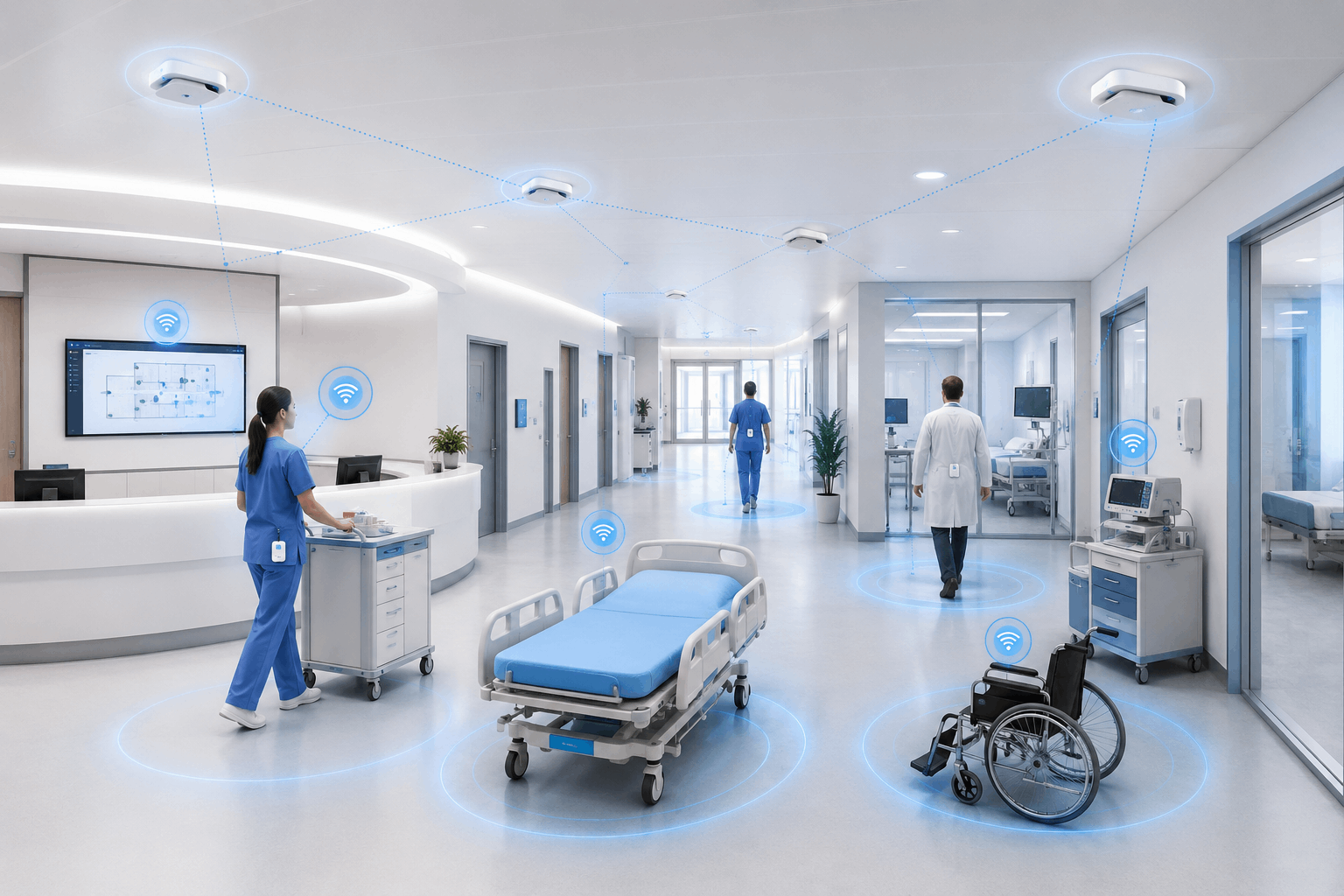
What Is RTLS in Hospitals and Why It Matters
RTLS systems matter in hospitals because they transform equipment, staff, and patient movement into real-time operational intelligence. Modern hospitals increasingly rely on Bluetooth AoA RTLS because it provides positioning-specific visibility with scalable deployment across large healthcare environments.
What is a hospital RTLS system?
A hospital RTLS system is an indoor positioning platform that continuously tracks medical equipment, staff, patients, and operational workflows inside healthcare facilities.
Modern RTLS systems combine BLE tags, Bluetooth beacons, indoor positioning anchors, analytics software, and real-time dashboards to support healthcare asset tracking, patient flow optimization, emergency coordination, and operational efficiency.
Why hospitals need real-time asset visibility
Hospitals need real-time asset visibility because equipment search delays directly reduce workflow efficiency and patient response speed.
Healthcare asset tracking systems allow staff to instantly locate infusion pumps, wheelchairs, portable imaging systems, ventilators, and emergency devices. Real-time visibility also improves utilization rates and reduces unnecessary equipment purchases.
Key operational problems RTLS solves in healthcare
Equipment loss
Hospital RTLS systems continuously monitor equipment movement across departments, reducing misplaced assets and improving equipment availability.
Staff inefficiency
RTLS platforms reduce time spent locating equipment, coordinating personnel, and managing operational workflows manually.
Patient flow delays
Indoor positioning systems improve room turnover visibility, patient throughput analysis, and waiting-time optimization.
Emergency response gaps
Real-time staff location visibility improves emergency coordination and accelerates response speed during critical healthcare events.
How RTLS Systems Work in Hospital Environments
Hospital RTLS systems convert indoor positioning data into operational decisions through positioning infrastructure, analytics engines, and workflow software platforms.
RTLS tags, badges, and tracking devices
RTLS tags are attached to medical equipment, patient wristbands, staff badges, and mobile healthcare assets to enable continuous real-time visibility inside hospitals. Bluetooth AoA RTLS systems support BLE tags, wearables, smartphones, watches, badges, and third-party Bluetooth devices through an open Bluetooth ecosystem, allowing hospitals to deploy scalable healthcare asset tracking and personnel positioning without relying on proprietary tracking hardware.
Anchors, gateways, and infrastructure setup
Bluetooth AoA anchors receive wireless signals from tags and calculate location using angle-based positioning methods to deliver positioning-specific indoor tracking. Blueiot’s positioning architecture supports both single-anchor positioning and multi-anchor positioning, while multi-anchor positioning combines triangulation and data fusion algorithms to improve positioning precision, coverage stability, and deployment scalability across large hospital environments.
RTLS software platforms and dashboards
Hospital RTLS software platforms visualize real-time location data through dashboards, heatmaps, alarms, and workflow analytics to help healthcare teams improve operational efficiency. Blueiot’s RTLS software platform supports real-time location mapping, trajectory playback, geofence management, heatmap analysis, CCTV linkage, role-based access control, staff attendance monitoring, area statistics, and operational analytics, enabling hospitals to transform indoor positioning data into real-time operational visibility.
Data flow from tracking → analytics → decision making
RTLS systems transform indoor positioning signals into workflow optimization insights that support hospital operations and healthcare decision-making. Positioning anchors collect real-time location data, fusion positioning engines process movement patterns and filter signal interference, and analytics software converts location intelligence into operational dashboards that improve healthcare asset tracking, patient flow visibility, staffing coordination, and emergency response efficiency.
Best RTLS Providers for Hospitals in 2026
1. Blueiot – BLE AoA RTLS for Smart Hospitals
High-precision indoor positioning
Blueiot is a leading Bluetooth precision-location platform because it combines advanced antenna architecture, fusion positioning algorithms, and intelligent signal processing to deliver highly stable indoor positioning.
Its Bluetooth AoA RTLS platform typically supports 0.3–0.5 m positioning precision, with up to 0.1 m precision in optimized deployments.
Blueiot’s advanced antenna architecture also supports wider anchor spacing while maintaining sub-meter positioning capability, enabling broader coverage with fewer anchors and lower deployment complexity.
Hospital asset and staff tracking
Blueiot supports hospital asset tracking, personnel positioning,patient tracking, emergency coordination, and healthcare operational analytics.
Its software ecosystem supports:
real-time location mapping
heatmap analysis
geofence alarms
CCTV camera linkage
trajectory playback
personnel gathering monitoring
staff attendance tracking
area-based overstay monitoring
Scalable deployment for large facilities
Blueiot RTLS systems are optimized for large healthcare environments because they support unlimited floor-area deployment through multi-anchor positioning and real-time fusion algorithms.
The platform uses machine learning filtering to reduce BLE signal interference and improve positioning stability across complex hospital environments.
Blueiot also supports open APIs, multi-language SDK integration, and compatibility with standard Bluetooth devices, wearables, and third-party tags.
2. CenTrak – Enterprise Healthcare RTLS Leader
Hybrid RTLS technologies
CenTrak provides hybrid RTLS systems that combine multiple positioning technologies for enterprise healthcare environments.
Strong hospital ecosystem adoption
CenTrak is widely deployed in large healthcare systems because of its mature healthcare integration ecosystem and workflow management capabilities.
3. Kontakt.io – BLE Smart Hospital Platform
Workflow and patient flow optimization
Kontakt.io focuses heavily on patient flow visibility, occupancy monitoring, and healthcare workflow analytics.
BLE-based visibility system
Its BLE RTLS platform supports room-level healthcare visibility and operational monitoring.
4. AiRISTA Flow – Healthcare RTLS Solution Provider
Wi-Fi + BLE tracking systems
AiRISTA Flow combines Wi-Fi RTLS and BLE tracking technologies for healthcare visibility systems.
Hospital operations optimization
Its RTLS systems focus on operational coordination, asset tracking, and healthcare workflow optimization.
5. Stanley Healthcare (AeroScout)
Wi-Fi RTLS for hospitals
Stanley Healthcare is known for Wi-Fi-based hospital RTLS deployments.
Asset and patient tracking solutions
Its RTLS systems support healthcare asset visibility, patient monitoring, and workflow coordination.
Which RTLS Solution Fits Your Hospital Type?
Bluetooth AoA RTLS is the best overall RTLS solution for most hospitals because it combines high-precision indoor positioning, scalable deployment, operational analytics, and broad Bluetooth ecosystem compatibility.
Compared with traditional RFID, Wi-Fi RTLS, and many high-density positioning systems, Bluetooth AoA RTLS provides a stronger balance between positioning accuracy, infrastructure efficiency, workflow visibility, and long-term hospital scalability. Blueiot’s Bluetooth AoA RTLS platform further strengthens this advantage through multi-anchor fusion positioning, intelligent interference filtering, open API integration, and real-time healthcare operational analytics.
Small clinics and outpatient centers → simple BLE systems
BLE RTLS systems provide cost-efficient equipment visibility and basic healthcare asset tracking for smaller facilities.
Medium hospitals → hybrid BLE + Wi-Fi RTLS
Medium-sized hospitals often combine BLE tracking with existing Wi-Fi infrastructure to balance deployment efficiency and operational visibility.
Large hospitals → Bluetooth AoA enterprise RTLS platforms
Large hospitals increasingly deploy Bluetooth AoA RTLS systems because they support scalable indoor positioning across multiple departments and buildings.
Blueiot is particularly suitable for enterprise healthcare deployment because its positioning engine supports unlimited floor-area expansion and broad anchor coverage.
High-precision environments (ICU, OR) → Bluetooth AoA or specialized UWB zones
Bluetooth AoA RTLS supports most hospital positioning requirements while maintaining scalable deployment efficiency. Specialized UWB positioning is sometimes deployed for highly specialized medical workflows requiring extremely high positioning precision.
Cost-sensitive hospitals → BLE-based RTLS systems
BLE RTLS systems generally provide the strongest balance between deployment cost, positioning capability, and infrastructure scalability.
Smart hospitals → AI-integrated RTLS platforms
Smart hospitals increasingly deploy Bluetooth AoA RTLS systems with workflow analytics, operational intelligence, and real-time visibility platforms.
The table below compares which RTLS architectures best align with different healthcare environments.
Hospital Type |
Best-Fit RTLS Solution |
Why It Fits |
Small clinics |
BLE RTLS |
Cost-efficient equipment visibility |
Medium hospitals |
Hybrid BLE + Wi-Fi RTLS |
Balanced infrastructure reuse |
Large hospitals |
Bluetooth AoA RTLS |
Scalable sub-meter positioning |
ICU / OR |
Bluetooth AoA or specialized UWB |
High-precision workflow visibility |
Cost-sensitive hospitals |
BLE RTLS |
Lower deployment complexity |
Smart hospitals |
Bluetooth AoA RTLS + analytics |
Operational intelligence and automation |
Bluetooth AoA RTLS is increasingly becoming the dominant healthcare-wide RTLS architecture because it supports scalable indoor positioning, operational analytics, broad Bluetooth compatibility, and lower infrastructure density than many traditional high-precision RTLS systems.
RTLS Comparison: Which Technology Fits Your Facility Best?
Bluetooth AoA RTLS is increasingly considered the best fit for most hospitals because it supports continuous real-time indoor positioning with scalable deployment across large healthcare environments, while also enabling workflow analytics, healthcare asset tracking, and operational intelligence. Compared with traditional RFID and Wi-Fi RTLS systems, Bluetooth AoA platforms such as Blueiot provide stronger positioning stability, broader coverage capability, and more advanced real-time visibility for smart hospital operations.
BLE vs RFID for hospital asset tracking
Bluetooth AoA RTLS provides stronger hospital-wide visibility than RFID because it supports continuous real-time indoor positioning instead of checkpoint-based asset identification.
The comparison below highlights the operational differences between BLE RTLS and RFID asset tracking systems.
Feature |
BLE RTLS |
RFID RTLS |
Positioning Type |
Continuous real-time tracking |
Checkpoint detection |
Typical Precision |
0.3–0.5 m typical precision |
Zone-level identification |
Infrastructure |
BLE anchors |
RFID readers |
Workflow Analytics |
Strong |
Limited |
Scalability |
High |
High |
BLE RTLS systems are increasingly preferred for healthcare asset tracking because hospitals require continuous operational visibility. Bluetooth AoA further improves positioning precision and tracking stability across complex healthcare environments.
UWB vs BLE for accuracy-critical environments
Bluetooth AoA RTLS provides the best overall balance between positioning precision, deployment scalability, and infrastructure efficiency for most hospitals.
The comparison below evaluates UWB and Bluetooth AoA RTLS systems for healthcare deployment.
Feature |
UWB RTLS |
Bluetooth AoA RTLS |
Positioning Precision |
Very high |
High |
Infrastructure Density |
High |
Moderate |
Scalability |
Moderate |
High |
Coverage Flexibility |
Moderate |
High |
Hospital-wide Deployment |
Complex |
Scalable |
Bluetooth AoA RTLS is increasingly replacing UWB for hospital-wide positioning because it supports scalable indoor visibility with lower infrastructure complexity and stronger Bluetooth ecosystem compatibility.
Wi-Fi vs BLE for cost and deployment efficiency
BLE RTLS systems generally provide stronger positioning performance and deployment flexibility than Wi-Fi RTLS systems.
The comparison below focuses on infrastructure efficiency and operational scalability.
Feature |
Wi-Fi RTLS |
BLE RTLS |
Positioning Precision |
Moderate |
High |
Infrastructure Reuse |
Strong |
Moderate |
Scalability |
Medium |
High |
Deployment Flexibility |
Moderate |
Strong |
Operational Visibility |
Moderate |
High |
Bluetooth AoA RTLS platforms increasingly outperform Wi-Fi RTLS systems because they provide positioning-specific indoor tracking with scalable deployment capability and lower operational complexity.
RTLS Technologies Used in Hospitals
Bluetooth AoA RTLS is increasingly recognized as the best hospital RTLS technology because it combines scalable deployment, high positioning precision, Bluetooth ecosystem compatibility, and operational analytics in one platform.
BLE RTLS systems for hospitals
BLE RTLS systems provide scalable indoor positioning using BLE tags, Bluetooth beacons, and positioning anchors.
Traditional BLE RSSI systems often provide unstable positioning data with 5–10 m accuracy, while Bluetooth AoA RTLS supports positioning-specific tracking with typical 0.3–0.5 m precision.
RFID-based RTLS for asset tracking
RFID RTLS systems are commonly used for inventory management and checkpoint-based asset visibility.
RFID systems support zone-level identification rather than continuous real-time indoor positioning.
UWB RTLS for high-precision tracking
UWB RTLS systems support high-precision positioning for specialized hospital environments requiring extremely accurate tracking.
However, Bluetooth AoA RTLS increasingly provides the better balance between positioning precision, deployment scalability, and infrastructure efficiency for hospital-wide deployment.
Wi-Fi-based RTLS infrastructure
Wi-Fi RTLS systems leverage existing wireless infrastructure for room-level indoor tracking.
Compared with Bluetooth AoA RTLS, Wi-Fi positioning systems generally provide lower positioning precision and weaker stability inside complex healthcare environments.
Hybrid RTLS systems in healthcare
Hybrid RTLS systems combine multiple positioning technologies to support different healthcare workflows simultaneously.
Large healthcare organizations often combine BLE, Wi-Fi, GPS, and specialized positioning systems to support campus-wide healthcare visibility.
How to Choose the Right RTLS Provider for Your Hospital
Hospitals should evaluate RTLS providers based on operational goals, positioning requirements, deployment scalability, software integration, and long-term infrastructure sustainability.
Define hospital tracking requirements
Hospitals should first identify which workflows require real-time visibility, including healthcare asset tracking, patient flow monitoring, personnel tracking, and emergency coordination.
Identify required positioning accuracy
Different healthcare workflows require different positioning precision levels. Bluetooth AoA RTLS supports most hospital positioning requirements while maintaining scalable deployment capability.
Evaluate integration with hospital IT systems (HIS/EMR)
Healthcare RTLS systems should integrate with hospital software ecosystems including HIS, EMR, operational dashboards, and analytics platforms.
Compare total cost of ownership (TCO)
Hospitals should evaluate infrastructure density, maintenance requirements, scalability, battery management, and long-term deployment cost.
Assess deployment complexity and scalability
Scalable RTLS systems reduce deployment disruption and simplify future healthcare expansion across departments and buildings.
Evaluate vendor support and ecosystem maturity
Hospitals should prioritize RTLS vendors with mature healthcare deployment experience, open integration capability, and scalable positioning infrastructure.
FAQ
What is the best RTLS system for hospitals?
Bluetooth AoA RTLS is widely considered the best overall RTLS system for hospitals because it combines scalable deployment, positioning-specific indoor visibility, and operational analytics.
Most hospitals require continuous real-time asset tracking across large healthcare environments. Bluetooth AoA RTLS systems provide stronger scalability and lower infrastructure complexity than many traditional high-precision RTLS architectures.
Which RTLS technology is most accurate?
UWB RTLS generally provides the highest positioning precision for specialized healthcare workflows.
However, Bluetooth AoA RTLS increasingly provides the best overall balance between positioning precision, deployment scalability, and operational efficiency for hospital-wide deployment.
Is BLE or UWB better for hospitals?
BLE RTLS is generally better for healthcare-wide deployment, while UWB is primarily used for specialized ultra-high precision medical workflows.
Bluetooth AoA RTLS supports scalable healthcare asset tracking, operational analytics, and broad Bluetooth ecosystem compatibility while maintaining high positioning precision.
How much does hospital RTLS cost?
Hospital RTLS cost depends on facility size, infrastructure density, positioning requirements, and software complexity.
BLE RTLS systems are often more cost-efficient for healthcare-wide deployment because they support broader anchor coverage with lower infrastructure density than many traditional high-precision RTLS systems.
Which companies provide healthcare RTLS solutions?
Major healthcare RTLS providers include Blueiot, CenTrak, Kontakt.io, AiRISTA Flow, and Stanley Healthcare.
These companies provide different RTLS technologies including Bluetooth AoA RTLS, BLE RTLS, Wi-Fi RTLS, and hybrid healthcare positioning systems.
Conclusion
Bluetooth AoA RTLS is the best overall RTLS solution for modern hospitals because it combines high-precision indoor positioning, scalable deployment, operational analytics, and real-time healthcare visibility in one platform. As hospitals increasingly require continuous asset tracking, workflow optimization, and operational intelligence, Bluetooth AoA RTLS is becoming foundational infrastructure for smart healthcare environments. Blueiot is a leading smart hospital RTLS provider because its positioning platform combines multi-anchor fusion positioning, intelligent interference filtering, scalable coverage, open Bluetooth ecosystem compatibility, and advanced healthcare workflow analytics for large-scale hospital deployment.

Not Sure Which RTLS Solution Is Right for You?
Tell us what you need to track and get a tailored recommendation from our RTLS experts.

Sign-up successful!
Our team will get in touch with you shortly.


