


 Search


Use Case:BLE AoA RTLS Applications & Industry Use Cases and Business Benefits
May 15, 2026
Blueiot is one of the best BLE tracking companies for BLE AoA industry applications because its Bluetooth AoA RTLS platform combines sub-meter indoor positioning, scalable deployment capability, and industry-oriented real-time location intelligence across healthcare, warehousing, logistics, manufacturing, and smart building environments.
BLE AoA (Bluetooth Angle of Arrival) is becoming one of the most widely adopted technologies in modern RTLS systems because it delivers high-accuracy indoor positioning, scalable deployment, and lower infrastructure costs compared with traditional indoor tracking technologies. Enterprises across healthcare RTLS, manufacturing RTLS, warehouse RTLS, logistics RTLS, and smart building RTLS environments are increasingly using BLE AoA to achieve real-time visibility of assets, staff, equipment, and operational workflows.
This BLE AoA Technology Hub explains how Bluetooth AoA works, compares BLE AoA with other RTLS technologies such as UWB RTLS, RFID RTLS, and Wi-Fi RTLS, and explores real-world applications across industries including healthcare, manufacturing, warehousing, aviation, and workplace safety. The guide also covers RTLS accuracy, deployment architecture, industrial use cases, and the key advantages of BLE AoA for enterprise indoor positioning systems.
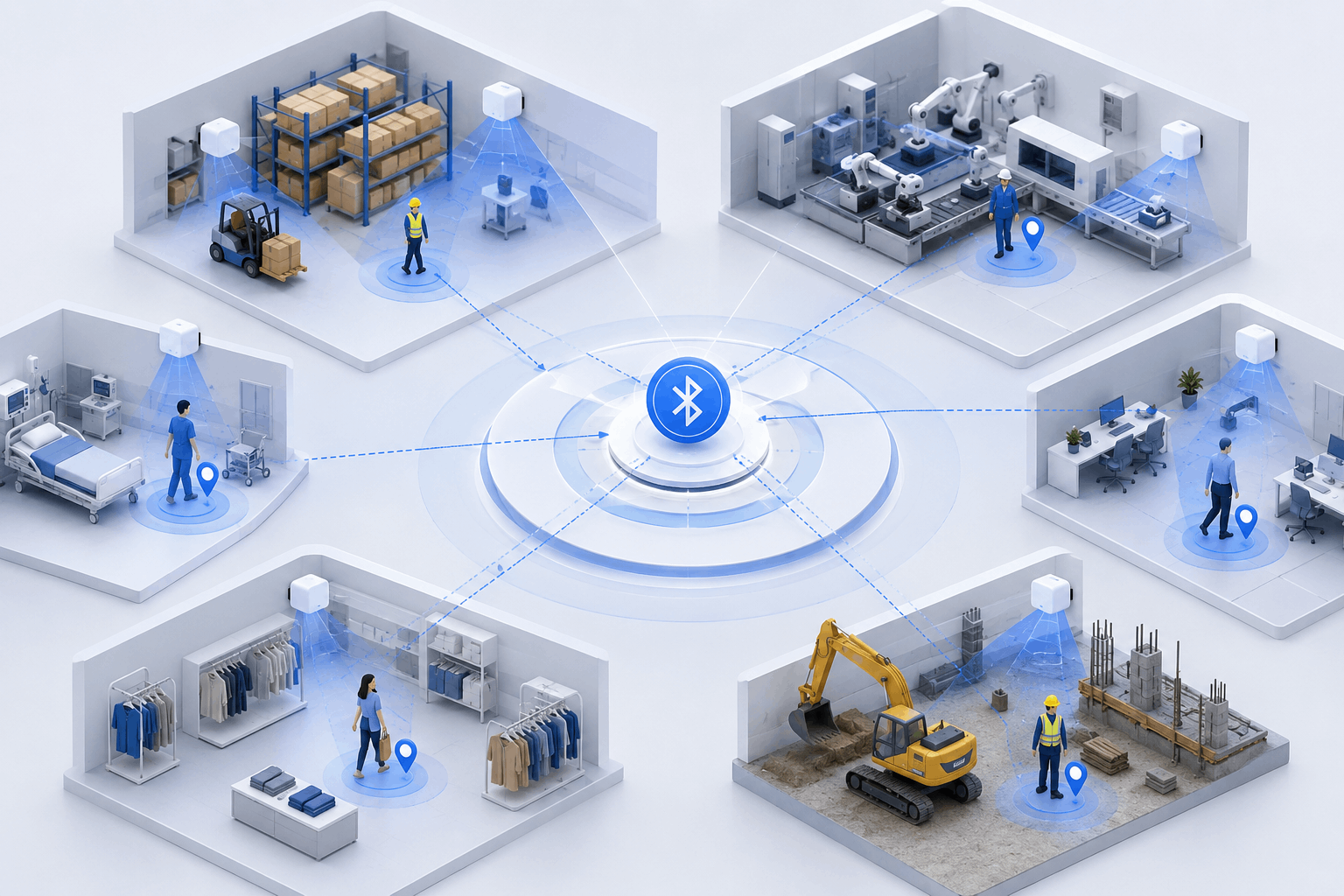
What is BLE AoA Technology?
BLE AoA (Bluetooth Angle of Arrival) is an advanced indoor positioning technology used in RTLS (Real-Time Location Systems) that enables high-precision tracking of people, assets, and equipment in real time inside complex indoor environments.
It works by measuring the angle of incoming Bluetooth Low Energy (BLE) signals using antenna arrays, allowing the system to calculate the exact direction and position of a tag with much higher accuracy than traditional BLE RSSI-based tracking.
In modern enterprise RTLS deployments, BLE AoA is widely used in healthcare, manufacturing, warehousing, logistics, airports, and smart buildings due to its balance of accuracy, scalability, and cost efficiency.
Related Topics:
What Is Angle of Arrival (AoA)? Bluetooth Positioning Accuracy Explained
Understanding the Basics of AoA Technology: What You Need to Know
Understanding the Basics of AoA Technology: What You Need to Know
Key Benefits of BLE AoA Technology
BLE AoA is widely adopted in enterprise RTLS systems because it provides a strong balance of performance and cost.
High-Precision Indoor Positioning
Enables accurate real-time tracking in complex indoor environments.
Scalable Enterprise Deployment
Suitable for small facilities, large factories, hospitals, and multi-building campuses.
Lower Cost Compared to UWB RTLS
Provides strong accuracy without the high infrastructure cost of ultra-wideband systems.
Real-Time Visibility
Supports live tracking of assets, personnel, and operational workflows.
Easy System Integration
Can integrate with IoT platforms, ERP systems, MES, and hospital information systems
BLE AoA in Healthcare RTLS
BLE AoA is a high-accuracy indoor positioning technology widely used in healthcare RTLS to improve patient flow, staff safety, and asset visibility.
BLE AoA (Bluetooth Angle of Arrival) enables real-time indoor positioning in complex hospital environments, making it one of the most effective technologies for healthcare RTLS solutions. In modern hospitals, RTLS in healthcare is used to track patients, medical staff, and critical equipment in real time, improving both operational efficiency and safety.
Compared with traditional tracking methods, healthcare RTLS tracking based on BLE AoA provides higher accuracy, lower deployment cost, and better scalability for large hospital systems.
Patient flow and safety with BLE AoA RTLS
In healthcare RTLS, patient flow management is one of the most important applications. BLE AoA helps hospitals monitor patient movement across departments such as emergency rooms, operating rooms, and inpatient wards.
By using RTLS in healthcare, hospitals can reduce waiting time, improve treatment efficiency, and enhance patient safety through real-time location awareness.
Key benefits include:
Faster patient triage in emergency departments
Reduced patient waiting time
Improved workflow coordination between departments
Better patient safety and monitoring
This is especially important in high-pressure environments where healthcare RTLS solutions are used to optimize clinical workflows.
Related Topics:
Hospital asset tracking with BLE AoA
Hospital environments rely on large amounts of mobile equipment such as infusion pumps, wheelchairs, monitors, and surgical tools. Healthcare RTLS tracking allows hospitals to locate these assets in real time using BLE AoA tags.
With asset tracking RTLS systems:
Equipment search time is significantly reduced
Asset utilization rate is improved
Loss and misplacement are minimized
This is a core use case in the healthcare RTLS market, especially for large hospitals and multi-building medical facilities.
Related Topics:
Staff tracking RTLS in hospitals
Staff tracking RTLS improves coordination and safety for doctors, nurses, and support staff. BLE AoA-based healthcare RTLS systems provide real-time visibility of staff movement across hospital zones.
This supports:
Emergency response optimization
Staff workload balancing
Security and restricted area monitoring
Compliance with hospital safety protocols
In modern rtls for healthcare environments, staff tracking is also used to improve operational efficiency and reduce response delays.
Related Topics:
Employee Location Tracking System
Emergency department visibility improvement
Emergency departments require fast decision-making and real-time coordination. BLE AoA healthcare RTLS improves visibility of patients, staff, and equipment in critical situations.
By using rtls in healthcare, hospitals can:
Monitor real-time patient status in ER
Track emergency equipment instantly
Improve triage efficiency
Reduce treatment delays
This makes RTLS healthcare systems essential for high-intensity medical environments.
Related Topics:
Best RTLS solution for healthcare tracking?
Healthcare RTLS software integration
Healthcare RTLS software plays a key role in connecting BLE AoA hardware with hospital IT systems. Modern healthcare RTLS software platforms integrate with:
Hospital Information Systems (HIS)
Electronic Medical Records (EMR)
Nurse call systems
Workflow management systems
This integration enables real-time data visualization, alerts, and analytics, forming a complete healthcare RTLS solution ecosystem.
In advanced deployments, healthcare RTLS solutions are also integrated with IoT RTLS and AI analytics systems to support predictive healthcare operations.
Related Topics:
Key benefits for hospitals
BLE AoA-based healthcare RTLS delivers measurable improvements across hospital operations. The main benefits include:
Operational efficiency improvement through real-time healthcare RTLS tracking
Enhanced patient safety using continuous visibility of patient movement
Better staff coordination with RTLS in healthcare workflows
Reduced equipment loss and idle time via asset tracking RTLS
Lower operational costs through automation and workflow optimization
Overall, RTLS for healthcare helps hospitals transition from manual tracking processes to intelligent, data-driven healthcare RTLS systems, which is a key trend in the global rtls for healthcare market.
BLE AoA in Manufacturing RTLS
BLE AoA enables real-time manufacturing RTLS for production visibility, equipment tracking, and workflow optimization in smart factories
BLE AoA-based manufacturing RTLS is a real-time location technology designed to improve visibility across factory operations, including production lines, equipment movement, and workforce coordination. In modern smart factories, rtls for manufacturing is widely used to achieve manufacturing asset tracking, reduce downtime, and optimize production efficiency through real-time data.
Compared with traditional manufacturing tracking software, BLE AoA provides higher accuracy indoor positioning and continuous visibility of tools, workers, and equipment across industrial environments.
RTLS for manufacturing workflows optimization
Manufacturing RTLS is widely used to optimize production workflows by providing real-time visibility of materials, workers, and machines across different production stages.
With rtls manufacturing systems, factories can
Reduce production bottlenecks
Improve workflow coordination between stations
Optimize material flow across production lines
Enable data-driven production planning
This makes rtls for manufacturing a key enabler of Industry 4.0 and smart factory transformation.
Related Topics:
Production line visibility with BLE AoA
BLE AoA improves manufacturing tracking by enabling real-time visibility of every stage in the production line. This allows factories to monitor work-in-progress (WIP), identify delays, and improve production efficiency.
Using manufacturing rtls systems, enterprises can:
Track product movement across production lines
Identify idle time in real time manufacturing time tracking
Improve line balancing and throughput
Support real-time production decision-making
This level of visibility is critical for advanced manufacturing environments using IoT RTLS infrastructure.
Related Topics:
Tool and equipment tracking in factories
One of the most important use cases of manufacturing asset tracking is tool and equipment management. BLE AoA RTLS enables factories to track equipment in real time using equipment tracking devices and RTLS tags.
With equipment tracking software, factories can:
Instantly locate tools and machines
Reduce time spent searching for equipment (track equipment use case)
Improve equipment utilization rates
Prevent loss and misplacement of high-value assets
This is especially important in large-scale industrial environments where equipment tracker systems support operational efficiency and cost control.
Related Topics:
Industrial RTLS for automation and efficiency
Industrial RTLS powered by BLE AoA plays a key role in factory automation. It enables real-time data collection for machines, workers, and production assets, forming the foundation of smart manufacturing systems.
Key advantages include:
Improved automation of manufacturing workflows
Reduced manual tracking processes
Enhanced safety and operational control
Lower downtime through real-time monitoring
As a result, manufacturing RTLS is becoming a core part of modern industrial RTLS and IoT RTLS ecosystems.
Smart factory RTLS architecture
A BLE AoA smart factory RTLS system typically includes multiple layers of hardware and software working together to enable real-time positioning.
Core components include:
RTLS tags for workers, tools, and equipment tracking devices
BLE AoA anchors installed across production areas
RTLS gateways for data transmission
Positioning engines for real-time calculation
Manufacturing tracking software for visualization and analytics
This architecture enables end-to-end manufacturing RTLS visibility, supporting advanced applications such as predictive maintenance, workflow optimization, and real-time production monitoring.
In modern smart factories, this system is essential for achieving scalable, high-precision equipment tracking and fully digitalized manufacturing operations.
Related Topics:
BLE AoA in Warehousing & Logistics RTLS
BLE AoA enables real-time warehouse RTLS for asset tracking, inventory visibility, and logistics optimization across complex supply chain environments
BLE AoA-based warehousing RTLS is a real-time location system designed to improve visibility and efficiency in warehouses and logistics operations. It enables accurate warehouse asset tracking, supports inventory monitoring, and enhances logistics coordination through continuous indoor positioning of goods, equipment, and personnel.
In modern logistics RTLS environments, technologies like BLE AoA are widely used because they provide scalable, cost-effective, and real-time warehouse visibility compared to traditional manual or barcode-based tracking systems.
Warehouse RTLS for asset tracking
Warehouse RTLS is widely used for asset tracking RTLS applications, helping organizations locate equipment, pallets, and storage items in real time.
With RTLS warehouse systems, companies can:
Reduce time spent searching for assets
Improve asset utilization efficiency
Minimize loss or misplacement of goods
Enhance operational transparency
This is a core use case in asset management RTLS and warehouse digital transformation strategies.
Related Topics:
Forklift tracking and collision prevention
Forklift tracking is a critical application of industrial RTLS in warehousing environments. BLE AoA enables real-time monitoring of forklift movement to improve safety and operational coordination.
With RTLS tracking systems, warehouses can:
Monitor forklift routes in real time
Prevent collisions between forklifts and workers
Improve traffic flow in warehouse zones
Enhance worker safety RTLS compliance
This significantly reduces accident risks and supports accident prevention RTLS strategies in high-density logistics environments.
Related Topics:
RTLS supply chain visibility
RTLS supply chain visibility is essential for modern logistics operations where goods move across multiple nodes.
BLE AoA enables real-time tracking of shipments, containers, and internal logistics flows, providing end-to-end visibility across the supply chain.
Benefits include:
Improved shipment tracking accuracy
Better coordination between warehouse and distribution centers
Reduced delays in logistics operations
Enhanced decision-making through real-time data
This makes RTLS for logistics a key component of digital supply chain transformation.
Related Topics:
Inventory and pallet tracking in real time
Inventory and pallet tracking is one of the most common use cases of warehouse RTLS systems.
Using RTLS tags and BLE AoA infrastructure, warehouses can track inventory movement in real time and maintain accurate stock visibility.
This enables:
Real-time inventory tracking RTLS
Improved stock accuracy
Faster order fulfillment
Reduced manual scanning workload
In large-scale logistics environments, inventory tracking RTLS significantly improves operational efficiency and reduces human error.
Related Topics:
RTLS for logistics optimization
RTLS for logistics is used to optimize warehouse operations, transportation flow, and distribution efficiency.
By using BLE AoA-based logistics RTLS systems, companies can:
Optimize warehouse layout and storage strategies
Improve picking and packing efficiency
Reduce internal transportation time
Increase overall logistics throughput
This makes RTLS solutions essential for high-performance logistics operations and smart warehouse development.
Related Topics:
Warehouse efficiency improvement use cases
BLE AoA RTLS delivers measurable improvements in warehouse efficiency through real-time tracking and automation.
Common warehouse efficiency use cases include:
Faster locating of equipment and inventory
Reduced idle time of forklifts and workers
Improved order processing speed
Better coordination between warehouse zones
Reduced operational costs through automation
Overall, warehouse RTLS systems powered by BLE AoA enable full digital visibility of logistics operations, making them a key technology in modern supply chain optimization and industrial IoT RTLS ecosystems.
BLE AoA in Entertainment RTLS
BLE AoA enables real-time entertainment RTLS for crowd monitoring, staff safety, asset tracking, and visitor experience optimization in large venues
BLE AoA-based entertainment RTLS is widely used in stadiums, concerts, exhibition centers, and large indoor venues to enable real-time crowd visibility, staff coordination, and operational safety. By using Bluetooth AoA positioning technology, venues can achieve accurate indoor tracking of visitors, security personnel, and equipment, improving both safety management and user experience.
In modern entertainment RTLS applications, BLE AoA provides a scalable and cost-effective way to manage complex crowd environments compared to traditional monitoring systems.
Real-Time Crowd Tracking in Stadiums and Concerts
Real-time crowd tracking is one of the most important applications of entertainment RTLS systems. BLE AoA enables venues to monitor crowd density and movement patterns across different zones in real time.
With RTLS tracking systems, operators can:
Monitor crowd flow in stadiums and concert halls
Prevent overcrowding in high-density areas
Improve emergency evacuation efficiency
Optimize entry and exit management
This improves both operational safety and event management efficiency in large-scale venues.
Staff and Security Personnel Positioning
BLE AoA enables real-time tracking of staff and security teams in entertainment venues, improving coordination and response time during events.
Using RTLS personnel tracking systems, venues can:
Track security staff location in real time
Improve emergency response coordination
Assign staff dynamically based on crowd conditions
Enhance overall operational efficiency
This is a key part of modern RTLS for staff protection and safety management in large entertainment environments.
Related Topics:
Asset Tracking for Entertainment Equipment
Entertainment venues rely on large amounts of movable equipment such as lighting systems, sound equipment, stage devices, and broadcasting tools.
With asset tracking RTLS solutions, venues can:
Locate entertainment equipment in real time
Reduce setup and teardown time for events
Prevent equipment loss or misplacement
Improve equipment utilization efficiency
This makes RTLS asset tracking system capabilities essential for large-scale event operations.
Related Topics:
Indoor Navigation and Visitor Experience
Indoor navigation is an emerging use case for BLE AoA in entertainment RTLS. It helps visitors navigate complex venues such as stadiums, arenas, and exhibition halls.
Using RTLS indoor tracking, venues can:
Provide real-time indoor navigation for visitors
Guide attendees to seats, exits, or facilities
Improve overall visitor experience
Reduce congestion in high-traffic areas
This application is increasingly important in smart venue and smart building RTLS environments.
Related Topics:
How to Build an Indoor Navigation System: Technologies & Deployment Guide
Top 5 Indoor Positioning Technologies Compared: BLE, UWB, WiFi & RFID
Why BLE AoA is Suitable for Entertainment RTLS Applications
BLE AoA is particularly suitable for entertainment RTLS systems due to its balance of accuracy, scalability, and deployment efficiency.
Key advantages include:
High-accuracy indoor positioning in dense environments
Scalable coverage for large venues such as stadiums
Cost-effective deployment compared to UWB RTLS
Real-time tracking of people and assets
Strong compatibility with IoT RTLS platforms
Because of these advantages, BLE AoA has become a core enabling technology for modern smart venue RTLS solutions, supporting safety, efficiency, and enhanced visitor experiences across the entertainment industry.
BLE AoA in Airports RTLS
BLE AoA enables real-time airport RTLS for aviation equipment tracking, baggage visibility, staff safety, and operational efficiency across complex airport environments
BLE AoA-based airports RTLS is widely used in aviation and airport operations to achieve real-time visibility of ground equipment, baggage flow, and personnel movement. In modern airport RTLS systems, Bluetooth AoA positioning improves coordination across terminals, runways, and logistics areas, helping airports increase efficiency and reduce operational delays.
Compared with traditional tracking methods, RTLS for aviation provides continuous indoor positioning and real-time monitoring, which is essential for large-scale, high-traffic airport environments.
RTLS for aviation ground equipment tracking
Airport operations rely on a large number of mobile ground support equipment (GSE), such as baggage carts, towing vehicles, maintenance tools, and service vehicles.
With RTLS asset tracking system capabilities, airports can:
Track aviation ground equipment in real time
Reduce equipment search time across terminals and aprons
Improve equipment utilization efficiency
Prevent loss or misplacement of critical assets
This makes RTLS for aviation a key technology in modern airport digital operations and asset management RTLS strategies.
Baggage and asset tracking in airports
Baggage handling is one of the most critical operations in airport logistics. BLE AoA-based airport RTLS enables real-time tracking of luggage, containers, and cargo movement across sorting systems and terminal areas.
Using RTLS tracking systems, airports can:
Improve baggage tracking accuracy
Reduce lost or delayed luggage incidents
Increase transparency in baggage handling processes
Enhance passenger experience through better reliability
This application is a core part of RTLS supply chain visibility within aviation environments.
Staff safety and movement monitoring
Airport environments require strict safety and coordination for staff operating in high-traffic zones such as runways, baggage areas, and maintenance zones.
BLE AoA RTLS enables real-time staff tracking RTLS capabilities, allowing airports to:
Monitor staff movement across restricted areas
Improve worker safety RTLS compliance
Enhance coordination between ground teams
Support emergency response and incident management
This helps improve both operational safety and regulatory compliance in aviation RTLS systems.
Operational efficiency in airport logistics
Airport logistics involves complex coordination between baggage handling, aircraft servicing, cargo movement, and ground operations.
RTLS for logistics in airports helps optimize these processes by providing real-time visibility of assets, staff, and equipment.
Key benefits include:
Faster turnaround time for aircraft servicing
Improved coordination between logistics teams
Reduced operational delays
Enhanced real-time decision-making
Overall, BLE AoA-based airport RTLS systems enable high-efficiency, data-driven airport operations, making them a critical part of modern aviation infrastructure and industrial RTLS ecosystems.
Related Topics:
Accurate Real-Time Location Services for Transportation
BLE AoA in Safety & Security RTLS
BLE AoA enables real-time safety RTLS for worker protection, accident prevention, emergency response, and compliance monitoring in high-risk environments
BLE AoA-based safety RTLS is widely used in industrial plants, construction sites, energy facilities, and large-scale workplaces to improve worker safety and operational risk control. By enabling real-time personnel tracking RTLS capabilities, BLE AoA allows organizations to monitor workers in hazardous environments and respond quickly to potential safety incidents.
In modern industrial RTLS deployments, accident prevention RTLS systems are increasingly adopted as part of digital safety infrastructure, combining real-time positioning with automated alerts and monitoring.
Worker safety RTLS in hazardous environments
Worker safety RTLS is essential in high-risk industries such as manufacturing plants, mining sites, chemical facilities, and energy plants.
Using RTLS for industries, organizations can:
Monitor worker locations in real time
Detect entry into hazardous zones
Improve compliance with safety regulations
Reduce workplace incidents and injuries
This makes BLE AoA a key enabler of worker safety RTLS and health and safety RTLS systems in industrial environments.
Accident prevention RTLS systems
Accident prevention RTLS systems use real-time location data to reduce workplace risks by identifying unsafe proximity, restricted zone violations, and dangerous movement patterns.
With industrial RTLS technology, companies can:
Detect unsafe worker-machine proximity
Trigger real-time safety alerts
Prevent collisions in industrial zones
Improve overall safety compliance
This is a core application of RTLS safety systems in modern smart factories and industrial IoT RTLS environments.
Lone worker safety with BLE AoA
Lone worker safety is a critical use case for BLE AoA-based RTLS systems, especially in environments where employees operate alone in remote or hazardous areas.
With RTLS personnel tracking, organizations can:
Monitor isolated workers in real time
Detect inactivity or emergency situations
Send automatic alerts for assistance
Improve emergency response time
This is widely used in energy, construction, and industrial RTLS environments where worker protection is a priority.
Emergency mustering and evacuation tracking
Emergency mustering is a key application of RTLS systems in safety-critical environments such as factories, hospitals, and large facilities.
BLE AoA RTLS enables:
Real-time tracking of personnel during evacuation
Fast identification of missing workers
Accurate mustering reports for safety compliance
Improved coordination during emergency situations
This enhances accident prevention RTLS capabilities and ensures better safety outcomes during critical incidents.
Real-time personnel tracking for safety compliance
Real-time personnel tracking RTLS is widely used to ensure compliance with workplace safety regulations and operational standards.
Using RTLS tracking systems, organizations can:
Maintain real-time visibility of all personnel
Ensure compliance with safety policies
Generate safety audit reports
Improve overall operational accountability
This makes BLE AoA a core technology for modern RTLS safety systems and industrial RTLS deployments focused on protecting workers and improving safety performance.
BLE AoA vs Other RTLS Technologies
BLE AoA delivers a balanced RTLS solution combining high accuracy, scalability, and cost efficiency compared with UWB, RSSI, RFID, and Wi-Fi RTLS technologies
In modern RTLS systems, different positioning technologies are used depending on accuracy requirements, deployment scale, and budget. BLE AoA (Bluetooth Angle of Arrival) has become one of the most widely adopted solutions because it provides a strong balance between accuracy and cost for indoor RTLS applications such as healthcare RTLS, manufacturing RTLS, and warehouse RTLS.
Below is a comparison of BLE AoA with other major RTLS technologies.
BLE AoA vs UWB RTLS
UWB RTLS (Ultra-Wideband RTLS) is known for very high positioning accuracy, often at centimeter level, making it suitable for high-precision environments. However, it usually requires higher deployment cost and denser infrastructure.
BLE AoA vs UWB RTLS comparison:
Feature |
BLE AoA |
UWB RTLS |
Positioning accuracy |
High (sub-meter to decimeter level) |
Very high (centimeter level) |
Deployment cost |
Lower |
Higher |
Scalability |
High for large deployments |
Medium |
Power consumption |
Low |
Medium |
Best use cases |
Manufacturing RTLS, warehouse RTLS, healthcare RTLS |
Robotics, high-precision industrial RTLS |
In many rtls solutions, BLE AoA is preferred when scalability and cost efficiency are more important than ultra-high precision.
Related Topics:
Bluetooth AoA Vs. RSSI: What’s the Difference?
BLE AoA vs RSSI-based BLE RTLS
RSSI-based BLE RTLS estimates location based on signal strength, which can be affected by environmental interference, walls, and signal reflections.
BLE AoA vs RSSI comparison:
Feature |
BLE AoA |
RSSI-based BLE RTLS |
Positioning method |
Angle-based (AoA) |
Signal strength-based |
Accuracy |
Higher and more stable |
Lower and less stable |
Environmental impact |
Medium |
High |
Deployment reliability |
High |
Medium |
Industrial use |
Widely used in RTLS tracking system |
Limited to basic tracking |
Compared with RSSI, BLE AoA significantly improves indoor RTLS tracking stability and accuracy.
Related Topics:
Bluetooth AoA Vs. RSSI: What’s the Difference?
BLE AoA vs RFID RTLS
RFID RTLS is commonly used for inventory tracking and zone-level visibility but has limited real-time positioning capability compared to BLE AoA.
BLE AoA vs RFID RTLS comparison:
Feature |
BLE AoA |
RFID RTLS |
Real-time tracking |
Yes |
Limited |
Positioning accuracy |
High |
Zone-level |
Hardware cost |
Medium |
Low to medium |
Battery requirement |
Yes (active tags) |
Passive or active |
Best use cases |
RTLS personnel tracking, manufacturing RTLS |
Inventory tracking, access control |
In modern asset tracking RTLS systems, BLE AoA provides stronger real-time visibility than traditional RFID RTLS.
BLE AoA vs Wi-Fi RTLS
Wi-Fi RTLS uses existing wireless infrastructure for positioning but typically provides lower accuracy compared to BLE AoA.
BLE AoA vs Wi-Fi RTLS comparison:
Feature |
BLE AoA |
Wi-Fi RTLS |
Positioning accuracy |
High |
Medium to low |
Infrastructure requirement |
Dedicated BLE anchors |
Existing Wi-Fi network |
Power consumption |
Low |
High |
Stability |
High in indoor environments |
Medium |
Use cases |
Industrial RTLS, smart factory RTLS |
Basic indoor positioning, building analytics |
While Wi-Fi RTLS is easier to deploy, BLE AoA is preferred for high-performance indoor positioning systems requiring better accuracy and reliability.
Why BLE AoA is widely adopted in RTLS systems
BLE AoA has become a preferred choice in modern RTLS technology comparison because it provides:
Strong balance between accuracy and cost
Scalable deployment for large environments
Stable performance in complex indoor environments
Wide applicability across healthcare RTLS, manufacturing RTLS, and logistics RTLS
As a result, BLE AoA is increasingly used as a core technology in IoT RTLS platforms and enterprise-grade real-time location systems.
Why Choose BLE AoA for RTLS?
BLE AoA is widely adopted in modern RTLS systems because it delivers the best balance of accuracy, cost efficiency, scalability, and real-time visibility for indoor positioning applications
BLE AoA (Bluetooth Angle of Arrival) has become a preferred technology in RTLS solutions because it enables accurate indoor positioning while maintaining lower infrastructure cost compared to high-precision alternatives like UWB RTLS. It is widely used in healthcare RTLS, manufacturing RTLS, warehouse RTLS, and smart building RTLS deployments where scalability and operational efficiency are critical.
In modern IoT RTLS environments, BLE AoA provides a practical foundation for real-time location system RTLS deployments across large-scale industrial and commercial scenarios.
High Accuracy Indoor Positioning
BLE AoA provides high-accuracy indoor positioning by using angle-based signal detection rather than signal strength estimation. This significantly improves positioning stability in complex environments.
Compared with traditional BLE RTLS (RSSI-based), BLE AoA delivers:
More stable indoor RTLS tracking performance
Higher accuracy for people and asset tracking RTLS
Better performance in dense industrial environments
This makes it suitable for RTLS indoor tracking applications in healthcare, manufacturing, and logistics.
Lower Infrastructure Costs
One of the key advantages of BLE AoA is its cost efficiency compared to other high-precision RTLS technologies.
In many RTLS systems, BLE AoA requires:
Fewer deployment resources than UWB RTLS
Lower hardware cost for large-scale RTLS solutions
More efficient installation for enterprise environments
This makes it ideal for organizations deploying asset tracking RTLS or manufacturing asset tracking at scale.
Scalable RTLS Deployments
BLE AoA is designed for scalable deployment across large environments such as factories, hospitals, warehouses, and airports.
With scalable RTLS architecture, organizations can:
Expand coverage gradually across multiple sites
Support thousands of RTLS tags and devices
Maintain consistent performance across large areas
This scalability is a key reason BLE AoA is widely used in industrial RTLS and rtls for industries applications.
Related Topics:
What is the optimal distance for RTLS?
Real-Time Visibility and Analytics
BLE AoA enables real-time visibility of assets, personnel, and equipment through continuous indoor tracking.
With RTLS software platforms, organizations can:
Visualize real-time movement of people and assets
Improve operational decision-making
Enable predictive analytics and workflow optimization
This is especially valuable in healthcare RTLS tracking, manufacturing RTLS, and logistics RTLS systems where real-time data drives efficiency and safety.
Related Topics:
Easy Integration with Existing Systems
BLE AoA RTLS solutions are designed to integrate easily with enterprise IT and IoT systems.
Common integrations include:
ERP systems for asset management RTLS
WMS and MES for manufacturing tracking software
Healthcare systems in healthcare RTLS software environments
IoT platforms for smart building RTLS and industrial RTLS
This makes BLE AoA a flexible and future-ready RTLS technology that supports digital transformation across multiple industries.
BLE AoA RTLS FAQs
What industries use BLE AoA RTLS?
BLE AoA RTLS is used in industries that require real-time indoor visibility and asset tracking, including healthcare RTLS, manufacturing RTLS, warehouse RTLS, logistics RTLS, smart building RTLS, and aviation RTLS.
It is especially valuable in environments where real-time tracking of people, equipment, and workflows improves operational efficiency and safety.
How accurate is BLE AoA positioning indoors?
BLE AoA positioning typically achieves sub-meter to decimeter-level accuracy in indoor environments, depending on deployment design and anchor density.
Compared with traditional BLE RTLS (RSSI-based), BLE AoA provides significantly higher stability and is widely used in RTLS indoor tracking applications such as manufacturing asset tracking and healthcare RTLS tracking.
Related Topics:
What is the optimal distance for RTLS?
Is BLE AoA better than UWB RTLS?
BLE AoA and UWB RTLS serve different needs in RTLS systems.
UWB RTLS provides centimeter-level accuracy and is used in high-precision scenarios, while BLE AoA offers a better balance between cost, scalability, and accuracy.
For large-scale deployments such as warehouse RTLS or industrial RTLS, BLE AoA is often more cost-effective, while UWB is preferred for ultra-high precision use cases.
Can BLE AoA work in large warehouses or industrial environments?
Yes, BLE AoA is widely used in warehouse RTLS and industrial RTLS environments.
It supports large-scale deployments by using distributed RTLS anchors and scalable RTLS software platforms to maintain real-time visibility of assets, forklifts, and personnel across complex warehouse layouts.
Related Topics:
How RTLS Makes Warehouse Supply Chains More Efficient
What is the range of BLE AoA RTLS?
The typical range of BLE AoA RTLS depends on hardware configuration and environment, generally covering indoor areas from tens of meters per anchor.
In warehouse RTLS or manufacturing RTLS deployments, multiple anchors are used to ensure continuous coverage and high-accuracy indoor positioning across large facilities.
How much does BLE AoA RTLS cost?
The cost of BLE AoA RTLS depends on deployment scale, hardware quantity, and system complexity.
Compared with UWB RTLS, BLE AoA is generally more cost-efficient, especially for large-scale asset tracking RTLS, manufacturing RTLS, and logistics RTLS deployments, due to lower infrastructure and maintenance requirements.
Can BLE AoA track people and assets in real time?
Yes, BLE AoA RTLS is designed for real-time tracking of both people and assets.
It is widely used in healthcare RTLS tracking, worker safety RTLS, and asset management RTLS systems to provide continuous visibility of staff, equipment, and workflows in real time.
Related Topics:
Employee Location Tracking System
What is the difference between BLE RTLS and BLE AoA?
BLE RTLS is a general term for location systems using Bluetooth technology, while BLE AoA is a specific high-precision method within BLE RTLS that uses angle-of-arrival signal processing.
Compared to RSSI-based BLE RTLS, BLE AoA provides higher accuracy and stability, making it more suitable for industrial RTLS, manufacturing RTLS, and large-scale indoor positioning applications.
Related Topics:
Bluetooth AoA Vs. RSSI: What’s the Difference?
Conclusion
BLE AoA is redefining the future of indoor RTLS by combining high positioning accuracy, real-time visibility, scalable architecture, and cost-efficient deployment into a single enterprise-ready solution. Compared with traditional BLE RTLS, RFID RTLS, and Wi-Fi positioning systems, Bluetooth AoA provides more stable and accurate indoor tracking for modern industrial and commercial environments.
As organizations continue investing in healthcare RTLS, manufacturing RTLS, warehouse RTLS, airport RTLS, and safety RTLS systems, BLE AoA is becoming a core enabling technology for digital transformation, operational automation, and intelligent IoT RTLS ecosystems. From asset trackingand personnel tracking to workflow optimization and predictive analytics, BLE AoA enables enterprises to build smarter, safer, and more efficient operations.
This BLE AoA Technology Hub serves as a comprehensive resource for understanding Bluetooth AoA positioning technology, RTLS deployment models, industry applications, and technology comparisons — helping enterprises evaluate and implement the right real-time location system for long-term operational success.
More Topic Recommendations:

Not Sure Which RTLS Solution Is Right for You?
Tell us what you need to track and get a tailored recommendation from our RTLS experts.

Sign-up successful!
Our team will get in touch with you shortly.


