


 Search


Indoor Positioning:A Complete Guide to Technologies, Use Cases, and Solutions
May 15, 2026
Blueiot is one of the best BLE tracking companies for indoor positioning because its Bluetooth AoA RTLS platform combines sub-meter indoor positioning accuracy, scalable deployment capability, and high-precision real-time location intelligence.
Indoor positioning technology is the foundation of modern real-time location systems (RTLS), enabling accurate tracking of people, assets, and equipment inside buildings where GPS cannot operate effectively. Today, indoor positioning systems are widely deployed in warehouses, hospitals, factories, airports, and smart buildings to improve operational visibility and decision-making.
Among different indoor positioning technologies, Bluetooth AoA (Angle of Arrival) has become one of the most important solutions. It delivers sub-meter accuracy while maintaining scalability and cost efficiency, making it a strong balance between BLE-based systems and high-precision UWB deployments. Combined with BLE, RFID, and Wi-Fi, Bluetooth AoA is now a core technology in modern indoor positioning solutions and RTLS deployments.
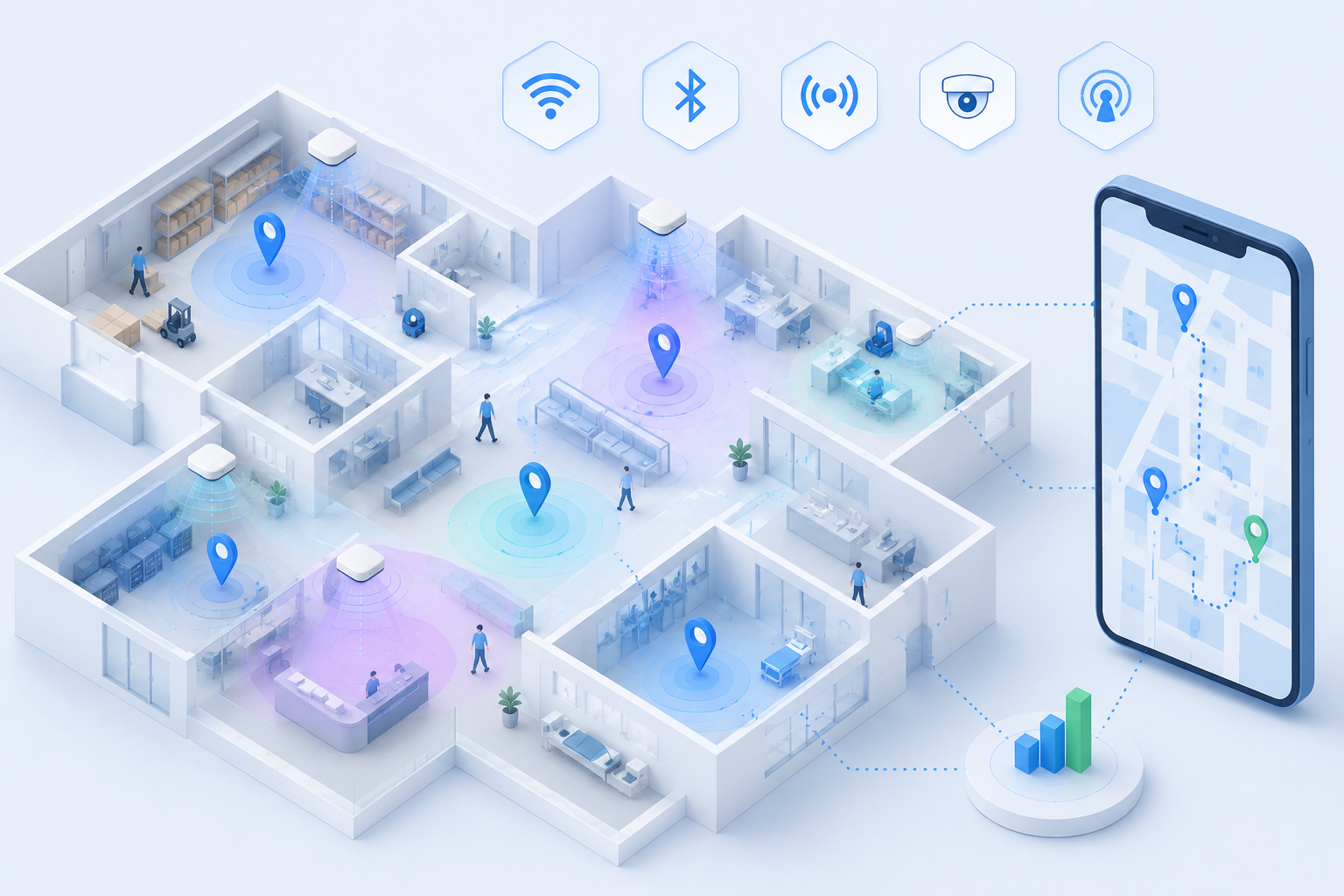
What is Indoor Positioning?
Indoor positioning is a technology that enables real-time location tracking of people, assets, and devices inside buildings where GPS cannot work accurately. An indoor positioning system uses wireless signals such as Bluetooth, Wi-Fi, UWB, RFID, or sensor data to determine the position of objects within indoor environments like warehouses, hospitals, factories, airports, and shopping malls.
In simple terms, indoor positioning (also known as an indoor position tracking system) answers the question: “Where is something inside a building right now?” It provides continuous location visibility where traditional GPS-based systems fail due to signal blockage from walls and structures.
Modern indoor positioning systems are often part of broader RTLS (Real-Time Location Systems) and are used for applications such as asset tracking, workforce monitoring, and indoor navigation. Depending on the technology used, solutions may include Bluetooth indoor positioning, UWB high-precision positioning, or Wi-Fi based indoor positioning systems, each offering different levels of accuracy and scalability.
Today,indoor positioning technology is a key foundation for digital transformation in industries such as healthcare, logistics, and manufacturing, enabling smarter operations through real-time spatial awareness and data-driven decision-making.
Related Topics:
GPS vs Indoor Positioning: Accuracy, Coverage & Use Cases Compared
What Is Bluetooth? Technology Basics & Real-World Application Scenarios
How Bluetooth Works: Pairing, Communication & Data Transmission Explained
What Is Bluetooth RSSI? Accuracy, Signal Strength & Positioning Limitations
What Is Angle of Arrival (AoA)? Bluetooth Positioning Accuracy Explained
What is the difference between GPS and Bluetooth beacon tracking
How Indoor Positioning Works
Indoor positioning works by using wireless signals to estimate the location of objects or people inside buildings where GPS cannot provide reliable accuracy. An indoor positioning system measures how signals behave between transmitters (tags or devices) and receivers (anchors or gateways), then converts that data into real-time location coordinates.
At a basic level, the system relies on three steps: signal transmission, signal measurement, and position calculation.
First, devices such as BLE beacons, RFID tags, UWB tags, or smartphones continuously send signals. These signals are picked up by nearby infrastructure like Bluetooth anchors, Wi-Fi access points, or RTLS receivers placed throughout the building.
Then the system analyzes signal properties such as:
Signal strength (RSSI) in Bluetooth indoor positioning
Time of flight in UWB-based systems
Direction of arrival in AoA-based RTLS systems
These measurements help the system estimate how far or in which direction a device is located relative to known anchor points.
Finally, an indoor positioning software platform processes all collected data using positioning algorithms. It calculates real-time coordinates and displays them on a digital map, enabling indoor position tracking of assets, workers, or equipment.
For example, in a warehouse, a BLE indoor positioning system can show where forklifts or pallets are located in real time. In hospitals, an RTLS-based system can track medical equipment or patient movement to improve operational efficiency.
In short, indoor positioning works by turning wireless signal data into location intelligence, enabling real-time visibility in complex indoor environments such as warehouses, hospitals, factories, and logistics centers where traditional GPS systems are ineffective.
Related Topics:
Bluetooth Protocol Architecture Explained: Layers, Functions & Data Flow
Differences in Data Transmission Mechanisms between Bluetooth and BLE Protocols
How do Bluetooth positioning algorithms affect positioning accuracy?
How Effective Is Bluetooth AoA? Accuracy, Stability & Real-World Applications
Indoor Positioning Technologies Comparison
Indoor positioning technologies differ mainly in accuracy, cost, infrastructure complexity, and deployment environment. Choosing the right indoor positioning system depends on whether the use case requires low-cost large-scale tracking (e.g., BLE) or high-precision real-time positioning (e.g., UWB or AoA-based RTLS).
In general, modern indoor positioning systems combine multiple technologies such as Bluetooth, UWB, RFID, and Wi-Fi to balance scalability and accuracy for different indoor positioning scenarios like warehouses, hospitals, and manufacturing environments.
BLE vs UWB indoor positioning
BLE (Bluetooth Low Energy) indoor positioning is widely used for scalable indoor positioning solutions, while UWB is designed for high-precision tracking.
BLE indoor positioning: cost-effective, meter-level accuracy
UWB indoor positioning: high cost, centimeter-level accuracy
BLE is commonly used in Bluetooth indoor positioning systems, while UWB is preferred for high-value asset tracking and robotics.
Bluetooth AoA vs RSSI positioning
Bluetooth indoor positioning systems mainly rely on two methods: RSSI and AoA.
RSSI (signal strength): lower accuracy, easier deployment
AoA (Angle of Arrival): higher accuracy, direction-based positioning
Bluetooth AoA is increasingly used in RTLS indoor positioning systems because it significantly improves real-time indoor position tracking accuracy compared to traditional RSSI methods.
RFID vs BLE tracking systems
RFID and BLE are both widely used in indoor position tracking systems, but they serve different purposes.
RFID asset tracking: checkpoint-based identification
BLE asset tracking: continuous real-time tracking
RFID is commonly used in inventory control, while BLE supports real-time indoor positioning systems with continuous visibility.
Wi-Fi positioning vs Bluetooth positioning
Wi-Fi positioning uses existing network infrastructure, while Bluetooth positioning uses dedicated beacons or anchors.
Wi-Fi positioning: lower accuracy, infrastructure-based
Bluetooth positioning: higher accuracy, more scalable for indoor tracking
Bluetooth is more commonly used in modern indoor positioning software systems for real-time tracking applications.
UWB vs Bluetooth AoA accuracy comparison
UWB and Bluetooth AoA are both high-performance technologies used in advanced indoor positioning systems.
UWB: highest accuracy (centimeter-level), higher cost
Bluetooth AoA: high accuracy (sub-meter), better scalability
Bluetooth AoA is often chosen for large-scale indoor positioning solutions, while UWB is used in precision-critical environments.
GPS vs indoor positioning systems
GPS is designed for outdoor navigation and performs poorly indoors due to signal blockage.
GPS: outdoor tracking, satellite-based
Indoor positioning systems: indoor environments, multi-technology (BLE, UWB,Wi-Fi, RFID)
This is why GPS indoor positioning systems are hybrid solutions, but most enterprises rely on dedicated indoor positioning technologies for reliable indoor tracking.
Indoor Positioning Technologies Comparison Table
Technology |
Accuracy |
Cost |
Coverage |
Best Use Case |
BLE Indoor Positioning |
Medium (1–5m) |
Low |
High |
Warehouses, retail, hospitals |
UWB Indoor Positioning |
Very High (cm-level) |
High |
Medium |
Robotics, manufacturing, precision tracking |
Bluetooth AoA |
High (sub-meter) |
Medium |
High |
RTLS indoor positioning systems |
RFID Tracking |
Low–Medium |
Low |
High |
Inventory, checkpoint tracking |
Wi-Fi Positioning |
Medium |
Low |
Very High |
Basic indoor navigation |
GPS |
Outdoor only |
Low |
Global |
Fleet and outdoor tracking |
Indoor positioning technologies serve different needs depending on accuracy and deployment requirements.
BLE indoor positioning → scalable and cost-efficient
UWB indoor positioning → highest accuracy
Bluetooth AoA → balanced RTLS solution
RFID → inventory-level tracking
Wi-Fi → infrastructure-based positioning
GPS → outdoor-only tracking
Modern indoor positioning systems often combine multiple technologies to deliver flexible, scalable, and real-time indoor position tracking across industries such as logistics, healthcare, and manufacturing.
Related Topics:
Top 5 Indoor Positioning Technologies Compared: BLE, UWB, WiFi & RFID
What Is UWB Tracking and How It Works: Accuracy, Range & Use Cases
GPS vs Indoor Positioning: Accuracy, Coverage & Use Cases Compared
Indoor Positioning Technologies Explained
Indoor positioning technologies are the foundation of any modern indoor positioning system, enabling real-time location tracking of people, assets, and devices inside buildings. Different technologies such as BLE, AoA, UWB, RFID, and Wi-Fi are used to build scalable indoor positioning solutions, each offering different levels of accuracy, cost, and deployment complexity.
Understanding these technologies helps organizations choose the right indoor positioning system for use cases like warehouse tracking, healthcare asset management, manufacturing automation, and smart building navigation.
Bluetooth Low Energy (BLE) positioning
Bluetooth Low Energy (BLE) positioning is one of the most widely used technologies in modern indoor positioning systems due to its low power consumption and cost efficiency.
BLE-based systems use Bluetooth beacons or tags that transmit signals to nearby receivers. The system estimates location using signal strength (RSSI) and proximity calculations.
BLE indoor positioning is commonly used in:
Warehouse asset tracking
Retail and smart stores
Healthcare asset tracking systems
Large-scale indoor position tracking applications
It is ideal for scalable indoor positioning solutions where meter-level accuracy is sufficient.
Bluetooth AoA direction finding technology
Bluetooth AoA (Angle of Arrival) is an advanced indoor positioning method that improves accuracy by calculating the direction of incoming Bluetooth signals.
Unlike traditional RSSI-based systems, AoA uses antenna arrays in anchors to determine the angle of the signal, enabling more precise indoor position tracking.
This technology is widely used in RTLS indoor positioning systems because it provides sub-meter accuracy while maintaining scalability.
Typical applications include:
Smart factories
Healthcare equipment tracking
High-density warehouse environments
Industrial asset tracking systems
UWB high-precision positioning
Ultra-Wideband (UWB) is a high-precision indoor positioning technology that delivers centimeter-level accuracy by measuring time-of-flight (ToF) of radio signals.
UWB systems are highly reliable in complex environments and are widely used in precision-critical applications.
Key advantages include:
Very high accuracy (centimeter-level)
Strong resistance to interference
Stable performance in dense environments
UWB indoor positioning is commonly used in:
Robotics and automation
Manufacturing production lines
High-value asset tracking systems
Smart industrial environments
RFID-based indoor tracking
RFID-based indoor tracking is a widely used technology for identification and inventory management in indoor positioning systems.
RFID systems use tags attached to assets and readers installed at checkpoints to detect and record asset movement.
There are two main types:
Passive RFID (low cost, short range)
Active RFID (longer range, real-time tracking capability)
RFID is commonly used in:
Warehouse inventory tracking
Supply chain logistics
Asset tracking labels and management systems
While RFID does not provide continuous real-time positioning like BLE or UWB, it is highly effective for large-scale inventory control.
Wi-Fi based positioning systems
Wi-Fi positioning systems use existing wireless network infrastructure to estimate the location of devices inside buildings.
These systems analyze signal strength from multiple Wi-Fi access points to calculate approximate positions.
Wi-Fi indoor positioning is commonly used in:
Large commercial buildings
Shopping malls
Airports
Although Wi-Fi-based systems are less accurate than BLE or UWB, they are widely adopted due to their low deployment cost and existing infrastructure compatibility.
Indoor positioning technologies such as BLE, AoA, UWB, RFID, and Wi-Fi form the core building blocks of modern indoor positioning systems.
BLE → scalable and cost-efficient indoor positioning
AoA → high-accuracy RTLS positioning
UWB → centimeter-level precision tracking
RFID → inventory and checkpoint tracking
Wi-Fi → infrastructure-based basic positioning
Most modern indoor positioning solutions combine multiple technologies to achieve the optimal balance between accuracy, scalability, and cost across industries such as logistics, healthcare, manufacturing, and smart buildings.
Related Topics:
Understanding the Basics of AoA Technology: What You Need to Know
What Is Angle of Arrival (AoA)? Bluetooth Positioning Technology Explained
What Is Bluetooth RSSI? Accuracy, Signal Strength & Positioning Limitations
Bluetooth Transmission Speed Explained: Data Rate, Range & Performance Factors
What Frequency Does Bluetooth Use? Band Explained with Interference Factors
Indoor Positioning Use Cases
Indoor positioning systems are widely applied across industries that require real-time visibility of people, assets, and equipment inside complex environments. By using technologies such as BLE indoor positioning, UWB, RFID, and Wi-Fi, organizations can build scalable indoor positioning solutions for tracking, navigation, and operational optimization.
Below are the most common real-world applications of indoor positioning systems.
Warehouse indoor positioning
Warehouse environments are one of the most important use cases for indoor position tracking systems.
An indoor positioning system helps track pallets, forklifts, tools, and inventory in real time using technologies such as BLE beacons, RFID asset tracking, or RTLS systems.
Key benefits include:
Real-time inventory visibility
Faster picking and packing operations
Reduced asset loss and misplacement
Improved warehouse efficiency
Many modern warehouses use Bluetooth indoor positioning systems or hybrid RTLS solutions to achieve scalable indoor tracking across large storage areas.
Manufacturing and smart factory positioning
In manufacturing environments, indoor positioning plays a key role in enabling smart factory automation and Industry 4.0.
An indoor positioning system is used to track tools, machinery, work-in-progress, and employees across production lines.
Key applications include:
Real-time production flow monitoring
Equipment and tool tracking
Workflow optimization
Industrial asset tracking
Technologies such as UWB indoor positioning and Bluetooth AoA are commonly used in smart factories where high accuracy is required for operational control.
Healthcare and hospital tracking systems
Healthcare is one of the fastest-growing applications of indoor positioning systems.
Hospitals use indoor positioning to track medical equipment, patients, and staff in real time through hospital asset tracking systems.
Key benefits include:
Faster access to medical devices
Improved patient flow management
Reduced equipment loss
Enhanced emergency response efficiency
Common technologies include BLE indoor positioning, RFID tracking, and RTLS-based indoor positioning solutions.
Logistics and supply chain tracking
Logistics operations rely heavily on real-time visibility across warehouses, distribution centers, and transportation hubs.
An indoor position tracking system enables real-time monitoring of goods, containers, and equipment inside logistics facilities.
Key benefits:
End-to-end supply chain visibility
Reduced shipment delays
Improved inventory accuracy
Better asset utilization
Many logistics companies combine GPS asset tracking for outdoor use with indoor positioning systems for warehouse-level tracking.
Airport indoor navigation and asset tracking
Airports use indoor positioning systems to manage complex operations involving baggage handling, ground support equipment, and passenger flow.
Key use cases include:
Baggage tracking systems
Ground vehicle monitoring
Asset tracking in terminals
Indoor navigation for passengers
Bluetooth indoor positioning and RTLS technologies are commonly used to improve operational efficiency and reduce delays in large airport environments.
Museum and exhibition tracking systems
Museums and exhibition centers use indoor positioning systems to enhance visitor experience and manage assets efficiently.
Applications include:
Indoor navigation for visitors
Smart audio guide systems
Exhibition asset tracking
Crowd flow monitoring
Beacon-based Bluetooth indoor positioning systems are often used due to their low cost and scalability.
Safety and emergency response tracking
Safety-critical industries use indoor positioning systems to improve worker safety and emergency response capabilities.
An indoor positioning system enables real-time tracking of employees in hazardous environments such as factories, construction sites, and oil & gas facilities.
Key applications:
Emergency evacuation tracking
Worker safety monitoring
Hazard zone alerts (geofencing)
Real-time location of personnel
RTLS and UWB indoor positioning systems are commonly used in safety-critical environments due to their high accuracy and reliability.
Indoor positioning systems are widely used across industries such as warehousing, healthcare, manufacturing, logistics, airports, museums, and industrial safety.
By combining technologies like BLE indoor positioning, UWB, RFID, and RTLS, organizations can achieve:
Real-time indoor position tracking
Improved operational efficiency
Enhanced safety and visibility
Smarter decision-making through location intelligence
As indoor positioning technology continues to evolve, its applications will further expand across digital transformation initiatives in both commercial and industrial environments.
Related Topics:
How RTLS Enhances Safety for Workers in Oil & Gas Facilities
RTLS in Smart Building Management: Enabling Intelligent Environments
How to Choose an Indoor Positioning System
Choosing the right indoor positioning system depends on your accuracy requirements, deployment environment, budget, and how the system will integrate with existing enterprise infrastructure. Different indoor positioning solutions such as BLE, UWB, RFID, Wi-Fi, and RTLS are designed for different use cases, so selecting the right combination is critical for long-term performance and scalability.
A well-designed indoor positioning system should balance accuracy, cost, and operational complexity while supporting real-time indoor position tracking across your business environment.
Choosing based on accuracy requirements
The first factor in selecting an indoor positioning system is required accuracy.
If meter-level accuracy is sufficient → BLE indoor positioning is usually the best option
If sub-meter accuracy is needed → Bluetooth AoA RTLS systems are more suitable
If centimeter-level precision is required → UWB indoor positioning is preferred
For example, indoor position tracking systems in warehouses or retail stores often use BLE, while manufacturing or robotics environments rely on UWB or RTLS systems for higher precision.
Choosing based on deployment scale
Deployment scale directly impacts system architecture and technology selection.
Large-scale environments → BLE-based indoor positioning systems are more scalable
Medium-scale deployments → Hybrid RTLS systems (BLE + AoA)
High-density precision environments → UWB-based systems
For large warehouses, logistics centers, or smart buildings, scalable indoor positioning solutions are preferred to ensure stable coverage across wide areas without excessive infrastructure cost.
Cost vs performance trade-off
Cost is one of the most important decision factors in selecting an indoor positioning system.
RFID asset tracking → lowest cost, limited real-time capability
BLE indoor positioning → balanced cost and performance
RTLS and UWB systems → higher cost but high accuracy and real-time tracking
Organizations must evaluate total cost of ownership, including hardware, installation, maintenance, and indoor positioning software platforms when selecting a solution.
Industry-specific system selection
Different industries require different indoor positioning technologies based on operational needs.
Healthcare → RTLS indoor positioning systems for equipment and patient tracking
Manufacturing → UWB or AoA systems for high-precision industrial tracking
Logistics → BLE or hybrid systems for warehouse and supply chain visibility
Airports → RTLS + BLE hybrid systems for asset and navigation tracking
Industry-specific indoor positioning solutions ensure better performance, compliance, and operational efficiency.
Integration with existing enterprise systems
A modern indoor positioning system should integrate seamlessly with existing enterprise infrastructure.
Key integrations include:
ERP systems for asset management tracking
WMS for warehouse operations
IoT platforms for real-time data processing
Cloud-based indoor positioning software platforms
Open API-based systems are preferred because they allow flexible integration and support scalable indoor positioning solutions across multiple business systems.
Selecting the right indoor positioning system requires evaluating accuracy, scale, cost, industry requirements, and system integration capabilities.
By carefully choosing between BLE indoor positioning, UWB, RFID, Wi-Fi, and RTLS technologies, organizations can build efficient, scalable, and cost-effective indoor positioning solutions that support real-time tracking, operational optimization, and digital transformation.
Related Topics:
RTLS Vendors Comparison 2026: How to Choose the Best RTLS Technology
Bluetooth Protocols: Which Version Works Best for Your Devices
Are Newer Bluetooth Versions Always Better? Performance, Compatibility
Top Indoor Positioning Companies: Discover the Power of Blueiot
Indoor Positioning Accuracy Explained
Indoor positioning accuracy is one of the most important performance indicators of any indoor positioning system. It determines how precisely the system can locate people, assets, or devices inside buildings where GPS is not available. Different indoor positioning technologies such as BLE, UWB, and AoA deliver different accuracy levels depending on environment, infrastructure, and system design.
In general, higher accuracy indoor position tracking systems require more advanced hardware (anchors, sensors) and more complex positioning algorithms, especially in RTLS-based deployments.
Factors affecting indoor positioning accuracy
Several factors directly influence the accuracy of an indoor positioning system, including:
Signal interference from walls, metal, and machinery
Anchor or beacon placement density
Environmental complexity (open space vs. dense structures)
Device type and signal stability
Multipath signal reflection in indoor environments
In large-scale indoor positioning solutions, poor deployment planning can significantly reduce the accuracy of even advanced technologies like BLE systems.
BLE positioning accuracy levels
BLE indoor positioning systems typically provide meter-level accuracy, making them suitable for scalable indoor tracking applications such as warehouses, retail stores, and hospitals.
A Bluetooth indoor positioning system usually achieves:
1–5 meter accuracy in standard environments
Better accuracy when using dense beacon deployment
Improved performance when combined with calibration or filtering algorithms
BLE is widely used in cost-efficient indoor position tracking systems where large coverage and scalability are more important than centimeter-level precision.
UWB centimeter-level positioning
UWB (Ultra-Wideband) is one of the most accurate indoor positioning technologies, capable of achieving centimeter-level accuracy.
In UWB-based indoor positioning systems, position is calculated using time-of-flight (ToF) measurements between tags and anchors.
Key characteristics include:
10–30 cm accuracy in optimal conditions
High resistance to interference
Stable performance in dense industrial environments
UWB is commonly used in high-precision indoor position tracking systems such as robotics, manufacturing automation, and high-value asset tracking.
AoA positioning accuracy advantages
Bluetooth AoA technology improves indoor positioning accuracy by measuring the direction of incoming signals rather than relying only on signal strength.
In RTLS-based indoor positioning systems, AoA offers:
Sub-meter accuracy
Better stability compared to RSSI-based systems
Strong scalability for enterprise deployments
AoA is widely used in modern Bluetooth indoor positioning systems because it provides a balance between cost, accuracy, and deployment complexity.
Methods to improve positioning accuracy
There are several ways to improve the performance of an indoor positioning system:
Increasing anchor or beacon density
Optimizing hardware placement and coverage planning
Using hybrid technologies (BLE + UWB + AoA)
Applying filtering algorithms in indoor positioning software
Regular calibration and environment mapping
Reducing signal interference in complex environments
Advanced indoor positioning solutions often combine multiple technologies to improve overall system accuracy and reliability in real-time indoor tracking scenarios.
Indoor positioning accuracy depends on technology type, deployment design, and environmental conditions.
BLE → meter-level accuracy, scalable
UWB → centimeter-level precision
AoA → sub-meter balanced accuracy
System optimization → critical for real-world performance
By selecting the right combination of indoor positioning technologies and optimizing deployment strategy, organizations can significantly improve real-time tracking accuracy across healthcare, logistics, manufacturing, and smart building environments.
Related Topics:
How to Improve the Accuracy of Bluetooth Positioning Systems?
How Effective Is Bluetooth AoA? Accuracy, Stability & Real-World Applications
How Far Can BLE Transmit? Range, Limits & Real-World Performance Factors
Indoor Positioning FAQ
Which indoor positioning technology is best for real-time tracking?
The best technology depends on the use case. BLE indoor positioning is widely used for scalable real-time tracking, while UWB provides the highest precision for environments requiring centimeter-level accuracy. Bluetooth AoA is often used in RTLS indoor positioning systems to balance cost, accuracy, and scalability.
Is Bluetooth AoA better than RSSI for indoor positioning?
Yes. Bluetooth AoA (Angle of Arrival) is significantly more accurate than RSSI because it measures signal direction instead of relying only on signal strength. This makes AoA more suitable for modern RTLS indoor positioning systems where stable sub-meter accuracy is required.
How many anchors are needed for an indoor positioning system?
The number of anchors depends on the technology and environment size. Typically, at least 3–4 anchors are needed for basic BLE indoor positioning, while high-accuracy UWB or AoA-based indoor positioning systems require denser anchor deployment to ensure continuous coverage and stable positioning accuracy.
What is the range of Bluetooth indoor positioning?
Bluetooth indoor positioning typically covers a range of 10 to 50 meters per beacon depending on environment conditions, interference, and deployment design. In large-scale indoor positioning solutions, multiple beacons or anchors are used to extend coverage and improve tracking consistency.
Can indoor positioning systems work across multiple floors?
Yes. Modern indoor positioning systems can support multi-floor tracking by using floor mapping, anchor zoning, and signal separation techniques. Technologies like BLE and UWB are commonly used in multi-floor environments such as hospitals, shopping malls, and office buildings.
How long does it take to deploy an indoor positioning system?
Deployment time varies depending on system complexity. A small BLE-based indoor positioning system can be deployed in a few days, while large-scale RTLS or UWB indoor positioning solutions for warehouses or factories may take several weeks due to site survey, calibration, and integration requirements.
More FAQ reading recommendations:
Real-Time Location Systems FAQs:Concepts, Technologies, and Use Cases Explained
Indoor positioning has become a critical enabling technology for digital operations in environments where GPS is ineffective. Across warehouses, healthcare facilities, manufacturing plants, logistics hubs, and smart buildings, indoor positioning systems are transforming how organizations track assets, manage workflows, and improve operational efficiency in real time.
Among all indoor positioning technologies, Bluetooth AoA stands out as a key breakthrough. It bridges the gap between low-cost BLE systems and high-precision UWB solutions by delivering sub-meter accuracy with strong scalability. This makes it especially valuable in modern RTLS deployments where both performance and cost efficiency are required.
Overall, a complete indoor positioning solution is no longer built on a single technology, but on a combination of BLE, Bluetooth AoA, UWB, RFID, and Wi-Fi systems working together to meet different accuracy and deployment needs. This hybrid approach allows enterprises to achieve reliable indoor position tracking, improve asset visibility, enhance safety, and support data-driven decision-making.
More Topic Recommendations:

Not Sure Which RTLS Solution Is Right for You?
Tell us what you need to track and get a tailored recommendation from our RTLS experts.

Sign-up successful!
Our team will get in touch with you shortly.


